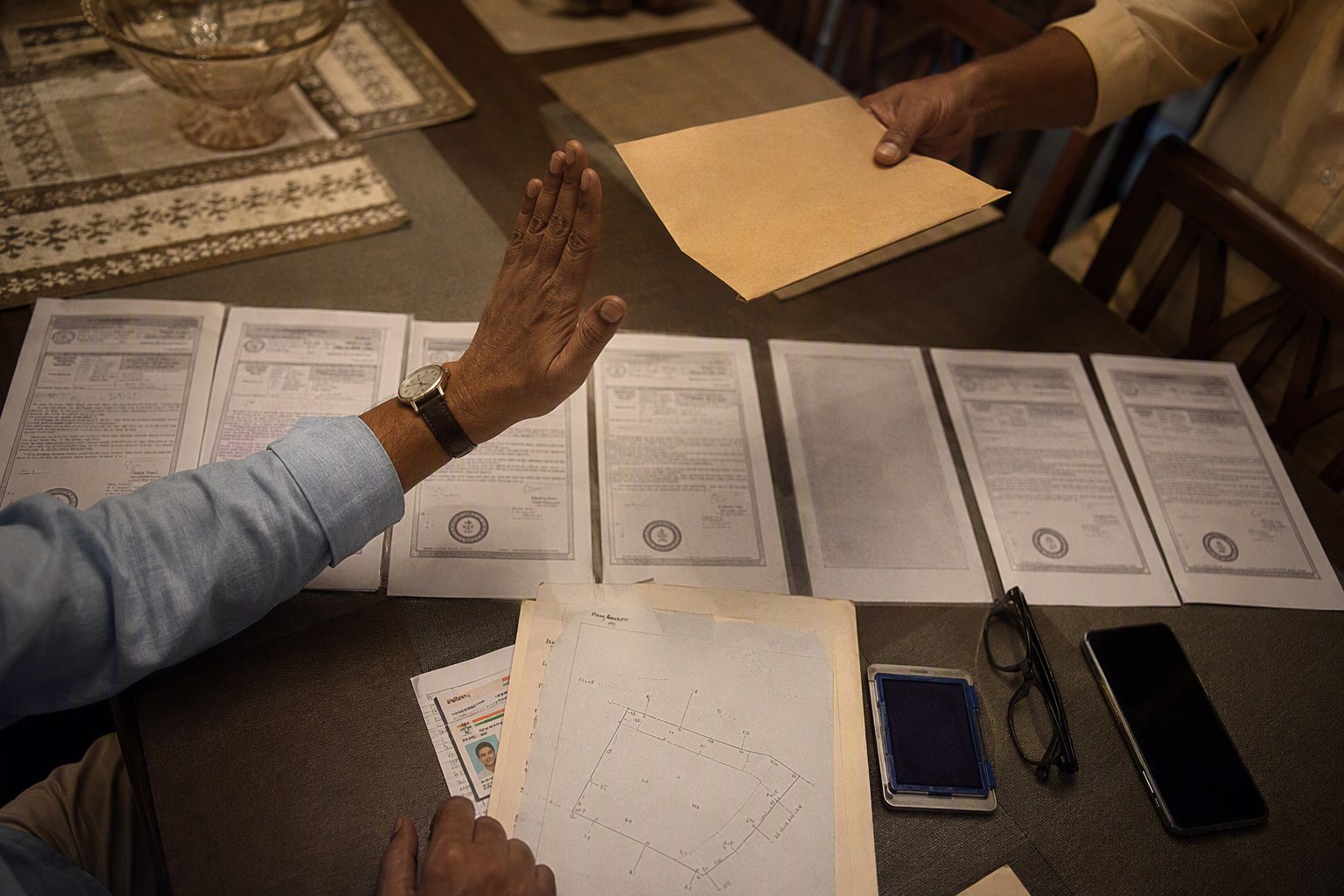



Telangana Case Study: One 22-A Entry Repriced a Plot Deal starts with a number every land buyer should respect: 3,076,153 prohibited properties are listed under Section 22-A as per latest IGRS data. In local language, people simply say, ee land 22-A lo unda? That one entry can stop a registration, disturb a bank loan, and force both buyer and seller to sit again at the table.
This case is from the Hyderabad growth belt, with names and survey details withheld for privacy. The plot was in a familiar western corridor setting, where buyers from Kukatpally, Miyapur, Gachibowli and Nallagandla often look at open plots in mandals like Shankarpally, Moinabad, Chevella, Kandukur and Maheshwaram. On paper, the deal looked normal. The layout access was clear. The seller had old link documents. The buyer had loan eligibility. The bank was ready to process.
Then one Section 22-A entry changed the mood.
Telangana 22-A Entry: why one database flag can change a plot deal
Section 22-A prohibited property entries are not small clerical remarks for buyers. They sit directly in the registration risk zone. If the property is shown as prohibited, the SRO may not register the sale deed unless the issue is removed, clarified, or legally resolved. That is why the number 3,076,153 matters. It tells us that this is not a rare Hyderabad gossip problem. It is a live due diligence issue across Telangana.
In our experience, a buyer normally checks three things first: title chain, physical possession, and approach road. Good buyers also check EC, pahani, Dharani records, village map, and local enquiries with the VRO-level ecosystem where possible. But many people still do the 22-A check late, after token advance. That is when negotiation becomes emotional.
For this case, the buyer had seen the land twice. The plot was near a fast-moving stretch outside the main city, within practical driving distance of financial district jobs. The seller had family documents and was confident. The broker said registration would be smooth. A bank representative had collected initial papers. Everybody behaved as if the deal was only a scheduling matter.
The buyer then ran a prohibited property check and asked a document writer near the relevant SRO to cross-check. A 22-A remark appeared against the survey number block. Not necessarily against the exact plot number in the way a layperson understands it, but against the parent land reference enough to create discomfort.
That distinction matters. In Telangana land transactions, especially plotted layouts carved from agricultural survey numbers, the risk can sit at parent survey number level. A small plot buyer may hold a sale deed for a house-site plot, but the official record may still throw an issue at the survey number layer. Banks do not like ambiguity. SRO staff will not take buyer comfort as proof. They go by record.
How the Telangana 22-A Entry was found before registration
The buyer did not discover the issue through any dramatic legal notice. It came through routine checking. That is exactly how most serious problems are caught.
- The buyer first checked the basic registration trail using an EC.
- Then the family asked for parent documents and layout papers.
- A survey number match was done because the plot number alone was not enough.
- The relevant SRO jurisdiction was identified.
- The 22-A list was checked against the survey details.
For a similar first-level screening, buyers can use the Section 22-A Prohibited Property Check. It should not replace legal opinion, but it gives an early warning. I also suggest checking the Encumbrance Certificate Search and confirming the registration office through Find Your SRO Office. If the buyer has only a plot number and not the underlying survey number, the Survey Number Finder can help structure the search better.
In this case, the buyer’s advocate asked a simple question: if the SRO refuses registration on the appointed day, who carries the loss? The seller said the issue was old and would not affect the plot. The broker said other registrations had happened in the area. The bank said their legal team would not proceed unless the entry was explained in writing.
That is where the deal moved from price discussion to risk allocation.
Telangana 22-A Entry and the bank’s comfort level
Banks do not underwrite property emotion. They underwrite documents. A buyer may say, road is there, compound wall is there, neighbours are there, layout is known. The bank will still ask: can we create a valid mortgage and enforce it later if needed?
Once the Section 22-A entry appeared, the bank’s legal team paused the file. They wanted clarity on whether the entry affected the entire survey number, a government claim, assigned land, endowment-related land, waqf concern, ceiling surplus, or another prohibited category. Without that clarity, the bank was not ready to give final approval.
This is where many buyers misunderstand loan sanction. A pre-approved loan or eligibility message is not the same as property approval. The borrower may be eligible, but the property can still fail. In open plots around Hyderabad outskirts, property approval is often the tougher part.
The bank did not declare the land bad. It simply said the risk was unresolved. That was enough to reprice the deal.
In land deals, uncertainty has a cost. If that cost is not priced before agreement, it appears later as delay, discount, or dispute.
How one 22-A entry forced a price reset
The seller’s first stand was predictable: the agreed price should remain because the physical plot was available and the family title chain existed. The buyer’s stand was also fair: if registration and loan are uncertain, the earlier price cannot stand like nothing happened.
No sensible buyer wants to pay full market expectation for a property that may need extra legal work, repeated SRO visits, revenue office follow-up, and bank reprocessing. Even if the issue is later resolved, the buyer is taking time risk. That time risk has value.
The final negotiation had three parts.
1. Token advance terms were rewritten
The buyer had paid only a small advance, so the damage was controllable. The revised understanding made the advance refundable if the 22-A issue was not cleared to the bank’s satisfaction. This was the first practical correction.
2. Timeline was linked to document clearance
Instead of a fixed registration date, both sides agreed that registration would happen only after written comfort from the advocate and bank legal team. This removed the pressure of rushing to the SRO with half-confidence.
3. Price was adjusted for risk
The seller accepted that a prohibited property remark reduces buyer confidence. The buyer accepted that if the issue is clarified and the bank approves, the plot still has value. The revised price reflected that middle ground. I am not quoting the amount because the transaction is private, but the principle is clear: a 22-A entry can reduce the buyer’s willingness to pay even before any court dispute exists.
This is not unfair to the seller. A clean marketable title commands better value. A title with unresolved remarks needs a discount, stronger indemnity, or both. Hyderabad buyers have become sharper on this after seeing enough delayed registrations in Shankarpally side, Moinabad belt, Shamshabad surroundings, and parts of Medchal-Malkajgiri where old agricultural records and modern plotting do not always speak the same language.
What the seller had to produce after the 22-A entry
After the issue surfaced, the seller had to collect more papers than expected. The usual sale deed bundle was not enough. The buyer’s advocate asked for supporting documents to explain the parent survey history.
- Link documents for earlier transfers.
- Latest pahani or revenue record extract where applicable.
- Dharani-related ownership reflection where applicable.
- Layout approval or regularisation papers, if any.
- Clarification on how the plotted land relates to the survey number shown in the 22-A entry.
- Any proceedings, deletion orders, or official correspondence connected to the prohibited entry.
- Tax receipts and possession-related material.
The buyer also checked guideline value through the Market Value / Guideline Value Search, not because guideline value solves title, but because stamp duty planning should not be left till the last day. For registration cost estimates, the Stamp Duty Calculator is useful. If construction potential is part of the buyer’s decision, tools like FSI/FAR Calculator, Road Width Check and Land Use Zone Finder also become relevant.
One thing I tell buyers repeatedly: do not confuse valuation with title. A plot may be in a good location and still have a weak document position. A plot may have a low ready reckoner value and still be clean. These are different checks.
Why 22-A problems feel worse in plotted land transactions
A flat buyer in a RERA project usually has a different due diligence path. The project, developer, approvals and unit details can be checked together. A plot buyer is more exposed to land history. The buyer must understand survey numbers, sub-divisions, village records, mandal-level revenue history, SRO registration trail and layout status.
That is why open plot buyers in areas like Kollur, Mokila, Adibatla, Tukkuguda, Kandukur, Maheshwaram, Shamirpet and Ghatkesar must slow down before paying advance. These markets are active, and good land exists. But activity does not automatically mean clean title.
In this case, the buyer was lucky because the 22-A entry came up before registration. If it had appeared after a larger advance, the seller-buyer relationship would have become tense. If the bank had rejected the property after the agreement period, the buyer may have struggled to recover money without legal pressure.
My opinion is blunt: any broker pushing a buyer to pay advance before survey number verification is creating avoidable risk. A serious seller should not object to basic checks. If the title is clean, verification helps the seller also.
Telangana 22-A Entry checklist before paying advance
Here is the practical checklist we use when reviewing open plot risk in Telangana. It is not a substitute for a property lawyer’s written opinion, but it will stop many careless decisions.
| Check | Why it matters | Buyer action |
|---|---|---|
| Survey number match | Plot numbers can mislead if parent survey details are unclear | Ask for layout plan and parent documents |
| 22-A prohibited property check | SRO may refuse registration if the property is prohibited | Check before token advance |
| EC review | Shows registered transactions and possible gaps | Review with advocate, not only broker |
| Dharani and pahani review | Revenue records may show ownership or classification issues | Compare names, extent and survey details |
| SRO jurisdiction | Wrong SRO assumptions waste time | Confirm the correct registration office |
| Bank legal opinion | Loan depends on property acceptability | Do not rely only on personal loan eligibility |
| Refund clause | Protects buyer if title clearance fails | Write it clearly in the agreement |
The Property Verification Tool is a good starting point for organising these checks. For buyers who are tracking a property over time, especially when a seller says correction is under process, the Property Change Tracker can help keep watch on changes.
What buyers can learn from this Telangana 22-A Entry case
The biggest lesson is not that every 22-A entry means the property is permanently unusable. Some entries may be clarified. Some may be wrongly mapped. Some may relate to a larger survey issue where the exact plot needs careful legal reading. But until the entry is explained, it is a live risk.
The second lesson is that price and title cannot be separated. Buyers often ask, what is the rate in this area? My answer is, first tell me whether the title is clean. A clean plot and a disputed plot in the same locality cannot be valued the same way. The market may quote one broad rate, but serious buyers discount risk privately.
The third lesson is that banks can become the strictest party in the room. A family buyer may be emotionally attached. A seller may be confident. A broker may be optimistic. But the bank’s legal department will ask for documents. If the property does not satisfy their checklist, the file pauses.
The fourth lesson is about timing. Do the 22-A check early. Do not wait for the sale agreement draft. Do not wait for stamp papers. Do not wait for the bank’s final login. A five-minute early check can save weeks of uncomfortable calls.
How the deal finally moved
The transaction did not collapse immediately. That is why this case is useful. Many real estate problems are not black and white. Here, the buyer, seller and bank reworked the deal.
The seller agreed to provide extra documents and pursue clarification. The buyer agreed to keep the offer open for a limited period, subject to legal comfort. The bank kept the file pending instead of rejecting it outright. The broker, after some initial resistance, accepted that the new price and timeline were linked to document clearance.
This is the mature way to handle such deals. Not shouting. Not blind trust. Not WhatsApp legal advice. Just records, written conditions and risk-based pricing.
For Telangana land buyers, the message is simple: a Section 22-A entry is not a small spelling mistake. It can change price, timeline, funding and peace of mind. With 3,076,153 prohibited properties in the official data, ignoring this check is not smart buying. It is gambling with registration.
If you are buying in Hyderabad outskirts, especially in plotted development corridors, make the 22-A check part of your first conversation. Ask for survey number. Ask for SRO. Ask for EC. Ask for revenue record. Then talk price. That order will save you money and stress.
Frequently Asked Questions
What is a Telangana 22-A entry in property records?
A Telangana 22-A entry means the property is shown under the prohibited properties category for registration purposes. If the entry applies, the SRO may refuse registration until the issue is clarified, corrected or legally resolved.
Can I buy a plot if the survey number appears in the 22-A list?
Do not proceed without a property lawyer’s written opinion and SRO-level clarity. Sometimes the issue may relate to the parent survey number or a classification mismatch, but the buyer should not assume it is harmless.
Will banks give loans on 22-A prohibited properties?
Usually banks become cautious if a 22-A entry appears. Even if the borrower is eligible, the property may not be accepted as mortgage security until the title and registration risk are cleared.
When should I check Section 22-A status?
Check it before paying token advance. At minimum, verify the survey number, EC, SRO jurisdiction, Dharani or revenue records, and any prohibited property entry before signing a sale agreement.
Does a 22-A entry reduce property value?
Yes, it can reduce buyer comfort and therefore affect pricing. Even if the issue is later clarified, the delay, legal work and bank approval risk can force a price reset or stronger refund conditions.