


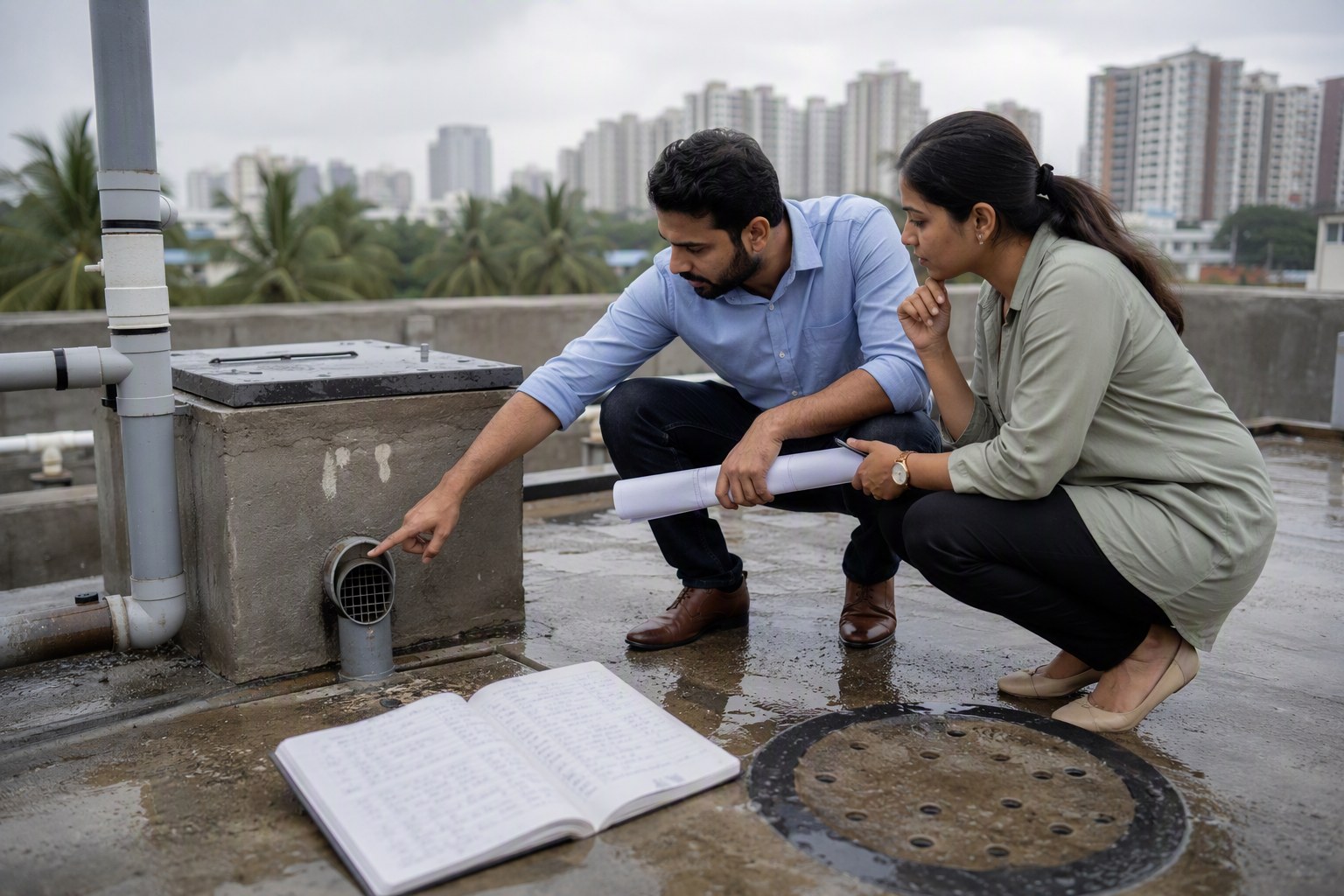
Rainwater Harvesting in Apartments: Proof Buyers Should Ask
Does Rainwater Harvesting in Apartments really add value to a flat, or is it just another brochure promise? Short answer: it adds value only when the system is built, connected, maintained, and documented. In Hyderabad, where buyers compare projects in Kondapur, Narsingi, Kokapet, Miyapur, Tellapur, Bachupally, Kompally, Uppal and LB Nagar, a rainwater harvesting claim should be treated like any other property claim. Ask for proof before you pay.
We’ve seen many apartment buyers get impressed by words like “green living” during site visits. But a recharge pit hidden behind the compound wall is not enough. A working system needs proper terrace water collection, clean inlet lines, silt traps, recharge pits or wells, maintenance access, and society-level upkeep. If the builder or seller cannot show documents and site evidence, treat the claim with caution.
My practical view: rainwater harvesting is a genuine value-add in Hyderabad apartments, but only when it reduces water stress, protects borewells, and is maintained after handover. A dead pit with broken pipes has no resale value.
Rainwater Harvesting in Apartments: Is It a Real Value-Add for Hyderabad Buyers?
Yes, but not automatically. In water-sensitive belts like Serilingampally mandal, Gandipet mandal, Rajendranagar mandal, Medchal side, Quthbullapur, and Hayathnagar, buyers are more alert about tanker dependency, borewell performance, and summer water planning. A properly maintained rainwater harvesting system can support the apartment’s long-term water management. It may not replace municipal supply or borewells, but it can reduce pressure on them.
For resale, the value is not only in the pit. The value is in confidence. A buyer wants to know that the owners’ association is not fighting water issues every summer. If the project has documented rainwater harvesting, regular cleaning records, and visible working infrastructure, it becomes a positive talking point during negotiation.
But don’t pay a premium just because the sales executive says “rainwater harvesting available”. Ask how it works. Ask where the water goes. Ask when it was last cleaned. Ask whether terrace water is actually connected to the recharge system or just discharged outside. In our experience, serious projects answer these questions without drama.
Rainwater Harvesting in Apartments: Documents Buyers Should Ask Before Purchase
Before buying a flat, especially in large gated communities around Financial District, Kokapet, Nanakramguda, Tellapur, Miyapur, Bachupally, Kompally or Pocharam, ask for documentary proof. This is not overthinking. You are checking whether the sustainability claim is part of the approved and maintained project, not just a marketing line.
1. Approved building plan showing rainwater harvesting provision
Ask for the sanctioned building plan and look for rainwater harvesting pits, recharge wells, stormwater drains, and open space treatment. The plan should match the physical site. If the plan shows pits near the driveway but the site has paved tiles everywhere, ask what changed and whether revised approvals exist.
For buyers checking plot extent, survey number, or land identity before apartment purchase, use the Survey Number Finder and cross-check with the project documents. This is useful when the project is spread across multiple survey numbers or when old land records mention different village names.
2. Completion certificate or occupancy certificate
The completion or occupancy documentation tells you whether the project was treated as complete by the approving authority. Rainwater harvesting is often part of building compliance, so don’t check it separately from the larger approval file. If a seller says the flat is ready but cannot share occupancy-related papers, pause and verify.
3. RERA registration and uploaded project details
For ongoing or recently completed projects, check the project on Telangana RERA. Use the RERA Project Lookup before believing handouts. RERA records may not answer every maintenance question, but they help you verify the basic project identity, promoter details, status, and declared information.
4. As-built plumbing and stormwater drawings
This is where many buyers stop asking, but this is exactly where the truth sits. Ask for as-built drawings showing terrace downpipes, stormwater lines, recharge pits, inspection chambers, and overflow routes. If the builder has handed over to the association, the society office should ideally have these drawings.
In older apartments, drawings may not be neatly available. Then ask for maintenance team confirmation and site inspection. A good plumber or facility manager can show the water path from terrace to silt trap to recharge pit.
5. Maintenance log or cleaning register
A rainwater harvesting pit needs cleaning. Leaves, dust, construction debris, plastic waste, and silt can block the system. Ask the association for a cleaning register, vendor bills, AMC papers, or internal maintenance notes. If the society has WhatsApp photos or dated inspection records, even that helps, though formal records are better.
6. Handover documents from builder to association
For large communities, the handover file should include services drawings, equipment details, warranties if any, and maintenance instructions. Rainwater harvesting should not be missing from this file. If it is missing, the association may struggle later to repair or trace the system.
Site Checks: What a Buyer Should Physically Inspect
Documents are one side. Site reality is the other. I prefer buyers to walk the property with the facility manager, not only with the sales team. Facility staff usually know whether the system is working, blocked, forgotten, or regularly cleaned.
Check the terrace water route
Stand near the terrace drain outlets and ask where the rainwater goes. In many apartments, terrace water is collected through downpipes. Those pipes should lead to a stormwater network and then to a silt trap or recharge structure. If water is simply pushed to the road or open setback, the harvesting claim is weak.
Check silt traps and filter chambers
Before water enters a recharge pit, it should pass through a silt trap or filter chamber. This prevents mud and waste from choking the pit. Ask the maintenance person to open the inspection cover if safe. If it is full of sludge and nobody remembers the last cleaning, the system may exist only on paper.
Check recharge pits or recharge wells
Recharge pits should be accessible for inspection and cleaning. Watch out for pits permanently sealed under tiles, pits used as dumping corners, or pits too close to sewage lines. Also check whether the covers are safe, child-proof, and not broken.
Check for sewage mixing risk
This is a serious red flag. Rainwater lines should not mix with sewage lines. In some poorly maintained buildings, broken chambers or bad slopes create contamination risk. If you see foul smell near the rainwater chamber, stagnant black water, or mosquito breeding, ask for immediate clarification.
Check basement seepage and overflow planning
In apartments with basements in Gachibowli, Kondapur, Manikonda, Nallagandla, and similar dense areas, poor stormwater design can create basement seepage. Rainwater harvesting should not mean water logging. There must be a proper overflow path for heavy rain.
Document Checklist for Buyers
| Proof to Ask | What It Confirms | Red Flag |
|---|---|---|
| Sanctioned plan | Rainwater harvesting was part of approved project design | Plan does not match site layout |
| Occupancy or completion papers | Project-level compliance was checked before occupation | Seller avoids sharing papers |
| RERA record | Project identity, promoter details, declared status | Project name or promoter details do not match |
| As-built stormwater drawings | Actual pipe route and recharge pit location | No one knows where the system is |
| Cleaning register or vendor bills | System is being maintained after handover | Last cleaning date not known |
| Site inspection with facility manager | Physical condition of pits, chambers, and drains | Blocked chambers, smell, stagnant water |
How Rainwater Harvesting Connects With Overall Property Due Diligence
Rainwater harvesting proof should be part of your larger flat verification, not a separate feel-good exercise. A property can have a good green feature but still have title, approval, mortgage, or prohibited property issues. Buyers in Telangana must check the full chain.
Start with project and land verification through the Property Verification Tool. Check whether the land is linked to any concern under government records. Telangana has 3,076,153 prohibited properties under Section 22-A as per the database context used by Verified.RealEstate. That number itself is a reminder: never rely only on a brochure, agent statement, or model flat visit.
Use the Section 22-A Prohibited Property Check when the project land survey numbers are available. For apartment purchases, buyers often forget land-level checks because they are buying only a flat. But every flat stands on land, and the land record matters.
Then check the transaction history using the Encumbrance Certificate Search. An EC helps you review registered transactions and possible charges over the property. If you already have an EC but cannot read the entries properly, the EC Analyzer can help you understand the document better.
For pricing, don’t depend only on the seller’s rate per sft. Check the ready reckoner or government market value using the Market Value / Guideline Value Search. In Hyderabad, quoted market prices in places like Kokapet, Narsingi, Tellapur, Kondapur, Miyapur, and Kompally can move differently from government guideline values. The gap itself is not illegal, but you should know both before negotiation.
What to Ask the Builder or Seller in Writing
Verbal answers are useful during a site visit, but written replies protect you better. Send a simple email or WhatsApp message and ask direct questions. Keep the tone polite but firm.
- Where are the rainwater harvesting pits or recharge wells located?
- Is terrace rainwater connected to the harvesting system?
- Can the builder or association share approved drawings showing the system?
- When was the system last cleaned?
- Who maintains it: builder, facility team, or owners’ association?
- Are there any complaints of water stagnation, smell, basement seepage, or mosquito issues?
- Was the system part of the original approval or added later?
- Are maintenance bills or cleaning photos available?
If the seller is a flat owner, ask for association confirmation. If the association refuses to comment, speak to residents. Security guards, housekeeping staff, and maintenance electricians often know whether pits get cleaned before monsoon.
How to Judge Whether the Claim Deserves a Price Premium
A good rainwater harvesting system can support resale confidence, but it does not automatically justify a higher price. I would treat it as a positive feature when three things are clear: the system is approved, the system is physically working, and the association maintains it.
In luxury and premium communities around Nanakramguda, Kokapet, Financial District, Narsingi, and Tellapur, buyers expect better infrastructure. In mid-segment apartments in Miyapur, Bachupally, Kompally, Uppal, Attapur, and LB Nagar, buyers may focus more on monthly maintenance, water availability, and practical running costs. In both segments, proof matters more than claims.
If two similar flats are available in the same micro-market, I would prefer the one with better water infrastructure and maintenance culture. But I would not ignore legal checks, UDS clarity, car parking documentation, EC, RERA status, and SRO records only because the project has a green feature.
Common Red Flags in Apartment Rainwater Harvesting
- Only one pit shown for a large project: Ask whether the design is adequate and approved. Don’t argue based on guesswork; ask for drawings.
- Pits hidden below permanent flooring: If maintenance access is poor, the system may fail quietly.
- No cleaning record: A blocked pit is not a working pit.
- Rainwater drains connected to road discharge: This weakens the harvesting claim.
- Foul smell near chambers: Possible sewage mixing or stagnant water issue.
- Builder says association has records, association says builder has records: Classic handover gap. Get clarity before purchase.
- Green certificate shown without site proof: Certificates help, but physical performance still matters.
Where Mandal, SRO and Land Records Fit In
Many Hyderabad buyers talk only in locality names: Gachibowli, Kondapur, Kokapet, Tellapur, Miyapur. Legal records may use village, mandal, survey number, SRO jurisdiction, and old revenue descriptions. For example, a project marketed as Narsingi may have land records tied to Gandipet mandal. A project promoted as Kompally side may fall under a different SRO than what a buyer assumes.
Use the Find Your SRO Office tool to understand registration jurisdiction. If land extent is mentioned in acres, guntas, square yards, or square metres and you want to compare documents, use the Area Unit Converter. For construction intensity and open space questions, the FSI/FAR Calculator and OSR Calculator can help you frame better questions, though final approval interpretation should come from the sanctioned plan and authority records.
Buyer’s Final View on Rainwater Harvesting in Apartments
Rainwater harvesting is not a decorative feature. It is part of water resilience. Hyderabad’s apartment buyers should treat it as infrastructure, just like lifts, fire systems, STP, transformer, parking, and drainage. If it works, it supports long-term living comfort. If it is ignored, it becomes another maintenance headache.
My advice is simple: don’t reject a flat only because the rainwater harvesting records are not perfect, especially in older buildings. But don’t pay extra for a claim that nobody can prove. Ask for the plan, inspect the pit, check maintenance records, verify project documents, and then decide. A serious seller will respect these questions. A weak seller will call you “too detailed”. In real estate, being detailed saves money.
Frequently Asked Questions
Is rainwater harvesting in apartments mandatory in Hyderabad?
Rainwater harvesting is commonly required as part of building and environmental compliance for many apartment approvals. Buyers should verify the sanctioned plan, occupancy or completion papers, and site condition instead of relying on a verbal claim.
What proof should I ask for before buying a flat with rainwater harvesting?
Ask for the sanctioned plan, as-built stormwater drawings, RERA details where applicable, completion or occupancy papers, handover records, cleaning register, vendor bills, and a physical inspection of recharge pits and silt traps.
Can rainwater harvesting increase apartment resale value?
It can support resale value when the system is working and maintained. Buyers value lower water stress and better society maintenance. But a blocked or undocumented pit will not justify a higher price.
How do I check if the project itself is legally safe?
Check RERA records, EC, SRO jurisdiction, survey number details, guideline value, and Section 22-A prohibited property status. Rainwater harvesting proof should be part of wider property verification.
Should I inspect rainwater harvesting during monsoon or summer?
Both are useful. Monsoon shows drainage flow, overflow, and waterlogging issues. Summer helps you understand borewell stress, tanker dependency, and whether the association takes water management seriously.