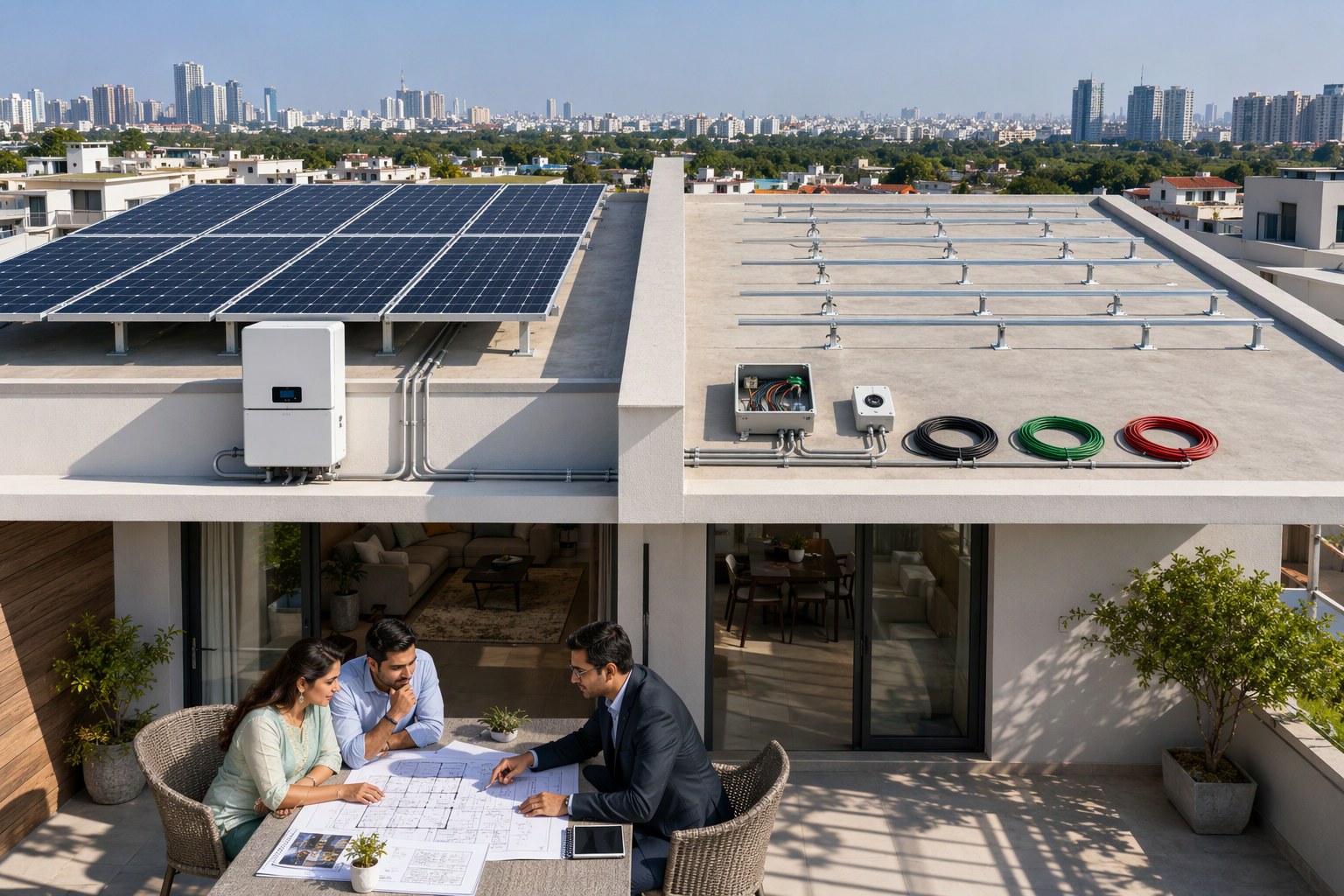
Solar Rooftop vs Solar-Ready Home is not just a green-living debate. For Hyderabad home buyers, it is a valuation question, a maintenance question, and very often, a documentation question. A working rooftop solar system can reduce electricity dependence and improve resale appeal when it is properly approved, safely installed, and clearly transferred to the buyer. A solar-ready home, on the other hand, only means the building has some provision for future solar installation. That provision may be useful, but it is not the same as a functioning asset.
We have seen this confusion often in villas at Mokila, independent houses in Kompally, gated communities near Tellapur, and premium apartments around Gachibowli and Narsingi. The brochure says solar-ready. The buyer assumes there is a solar plant. Later, during handover, the reality is only an empty conduit, an inverter space, or a promise that the terrace can take solar panels someday.
My practical view is simple: a working solar rooftop has value only when it comes with approvals, bills, maintenance clarity, and transferable rights. A solar-ready home has potential, not proven value.
Solar Rooftop vs Solar-Ready Home: The Straight Difference
A solar rooftop home already has panels, inverter, cabling, earthing, metering arrangement, and a working connection. In many cases, there will be a net metering or gross metering arrangement depending on the applicable DISCOM process and scheme at the time of installation. The buyer can physically inspect generation, electricity bills, inverter display, warranties, and service records.
A solar-ready home is different. It may have terrace space reserved, roof sleeves, conduits, structural loading provision, electrical shaft space, or a dedicated point near the meter room. These are useful features, especially in new villas and plotted developments around Shankarpally mandal, Gandipet mandal, and Ibrahimpatnam side layouts. But until panels are installed and commissioned, it is only infrastructure readiness.
| Feature | Solar Rooftop Home | Solar-Ready Home |
|---|---|---|
| Current power generation | Yes, if system is active | No |
| Buyer can verify output | Yes, through bills, inverter app, meter records | No output to verify |
| Value in resale | Stronger when documentation is clean | Moderate, depends on quality of provision |
| Maintenance responsibility | Immediate and recurring | Starts only after future installation |
| Due diligence required | High | Medium, but still needed |
| Risk | Faulty installation, expired warranty, approval gaps | Overstated marketing claim, weak wiring, terrace access issues |
Solar Rooftop vs Solar-Ready Home: Which One Adds Better Resale Value?
In our experience, a functioning solar rooftop adds better resale value than a solar-ready feature, but only when the system is legally and technically clean. Hyderabad buyers are not blindly paying a green premium. They ask practical questions: Who owns the panels? Is the terrace common area or private? Is the system maintained by the owner, builder, vendor, or apartment association? Are electricity savings visible in bills?
In a villa at Kollur or Mokila, the answer is usually more straightforward because the roof is typically under the individual owner’s control, subject to the sale deed, layout approvals, and community rules. In an apartment at Nanakramguda, Kondapur, or Miyapur, the terrace may be a common area. If the solar plant is installed for common lighting, lifts, pumps, or clubhouse loads, an individual flat buyer cannot assume personal ownership unless the documents say so.
A solar-ready home gives a buyer comfort that future installation may be easier. It can matter for independent houses where roof planning, conduit routing, and inverter placement are difficult after construction. Still, the resale premium is weaker because the buyer must spend later, apply later, maintain later, and manage approvals later.
Approvals Matter More Than the Marketing Claim
Many buyers spend time comparing panel brands but miss the approval trail. That is risky. A solar rooftop should have a clear paper trail from installation to commissioning. Ask for the vendor invoice, warranty documents, single line diagram if available, electrical safety-related records where applicable, DISCOM application or approval communication, net meter details where applicable, and latest electricity bills showing the effect of the system.
For a solar-ready home, ask the builder what exactly is ready. Is the conduit already laid from terrace to meter area? Is there a dedicated electrical route? Is the terrace structurally planned for panel load? Is there access for cleaning and service? Is the inverter location ventilated and safe? A vague line in the brochure is not enough.
Buyers in HMDA and GHMC limits should also connect this with the larger property file. Check sanctioned plan, completion or occupancy status where applicable, RERA registration for ongoing projects, and sale deed clauses. For projects, use RERA Project Lookup before you treat any green claim as a value addition.
Do Not Ignore Title Due Diligence Just Because the Home Is Green
A solar feature cannot cure a weak title. This is where many buyers make a costly emotional mistake. They like the idea of lower power bills, EV charging, and sustainable living, then they go soft on land records. Please do not do that.
Telangana has a large set of properties affected by prohibitions and restrictions. As per the Verified database context from government records, Section 22-A prohibited properties count stands at 3,076,153. That number is a reminder that title checks are not optional. Whether the house has premium solar panels or only solar-ready wiring, first check whether the property can be legally sold and registered.
Before paying a token advance, run a basic check through Section 22-A Prohibited Property Check. For land parcels and independent houses, cross-check survey number, village, mandal, and SRO mapping. You can use Survey Number Finder and Find Your SRO Office for this groundwork.
For resale homes, do not skip the EC. A rooftop solar system may have been financed separately, or the property itself may carry an old mortgage. Start with Encumbrance Certificate Search and, where needed, review the trail with EC Analyzer. If a bank loan exists, a CERSAI Charge Check is also sensible.
Location Makes the Solar Discussion More Practical
Solar value is not the same in every Hyderabad locality. In dense apartment belts like Ameerpet, Himayatnagar, Banjara Hills, and parts of Kukatpally, roof access and shadowing can be issues. Tall neighbouring buildings, mobile towers, water tanks, lift rooms, and uneven terrace rights affect performance. In villa-heavy and low-rise areas like Mokila, Shankarpally, Tellapur fringes, Kompally, Adibatla, and Shamshabad side developments, rooftop solar is often easier to plan because roofs are more accessible.
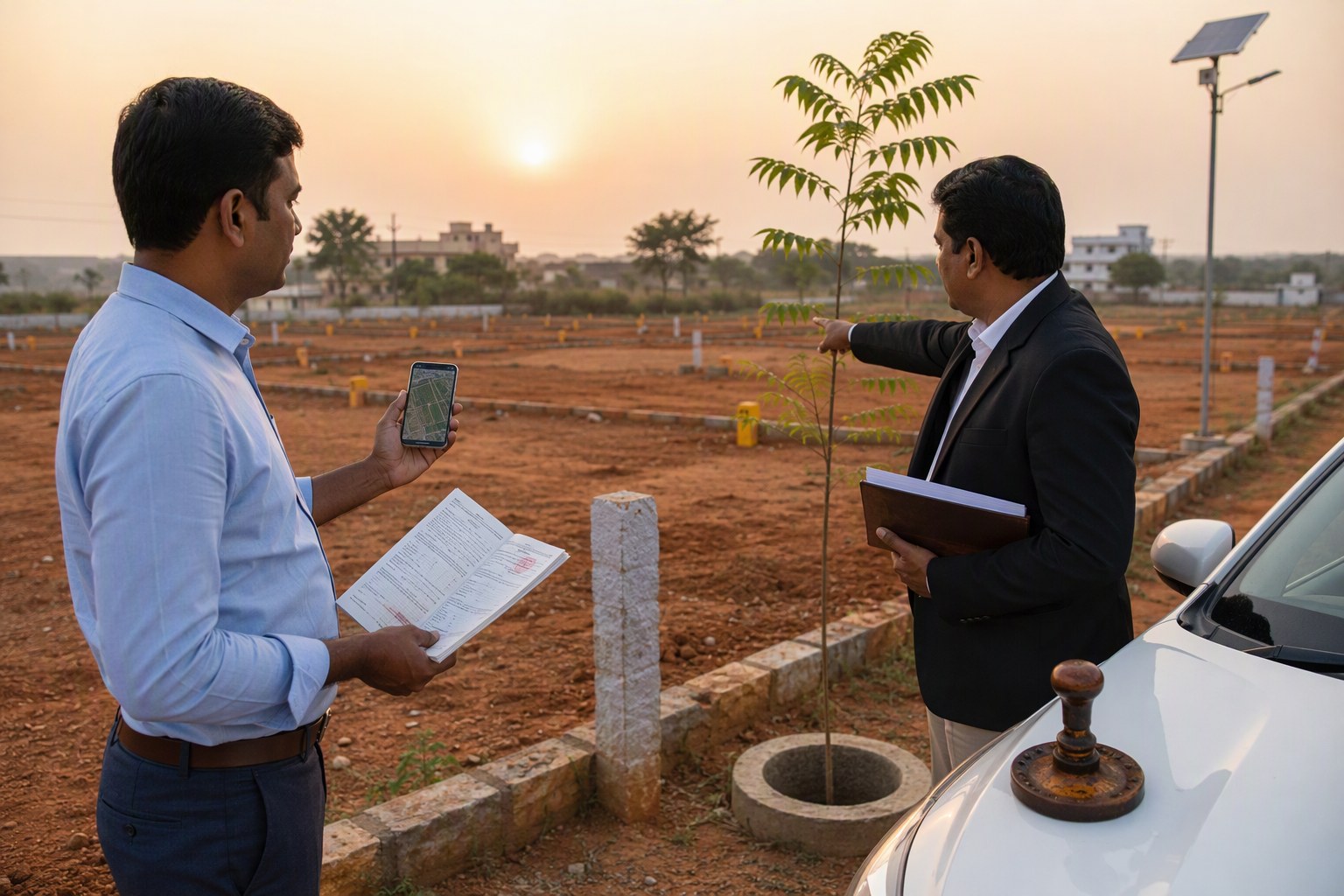
That does not mean every villa is automatically suitable. In plotted developments, check layout roads, open space rules, building permissions, and whether any association bye-laws restrict panel placement. In gram panchayat or municipality transition areas, buyers should be extra careful with permissions, road access, and land-use status. A solar plant on a house built on a doubtful plot is not value addition; it is decoration over a weak file.
Use Land Use Zone Finder to understand the broad zoning context. If you are evaluating a plot-plus-construction deal, also check building potential through FSI/FAR Calculator and road access through Road Width Check.
Solar Rooftop vs Solar-Ready Home: What Buyers Should Physically Inspect
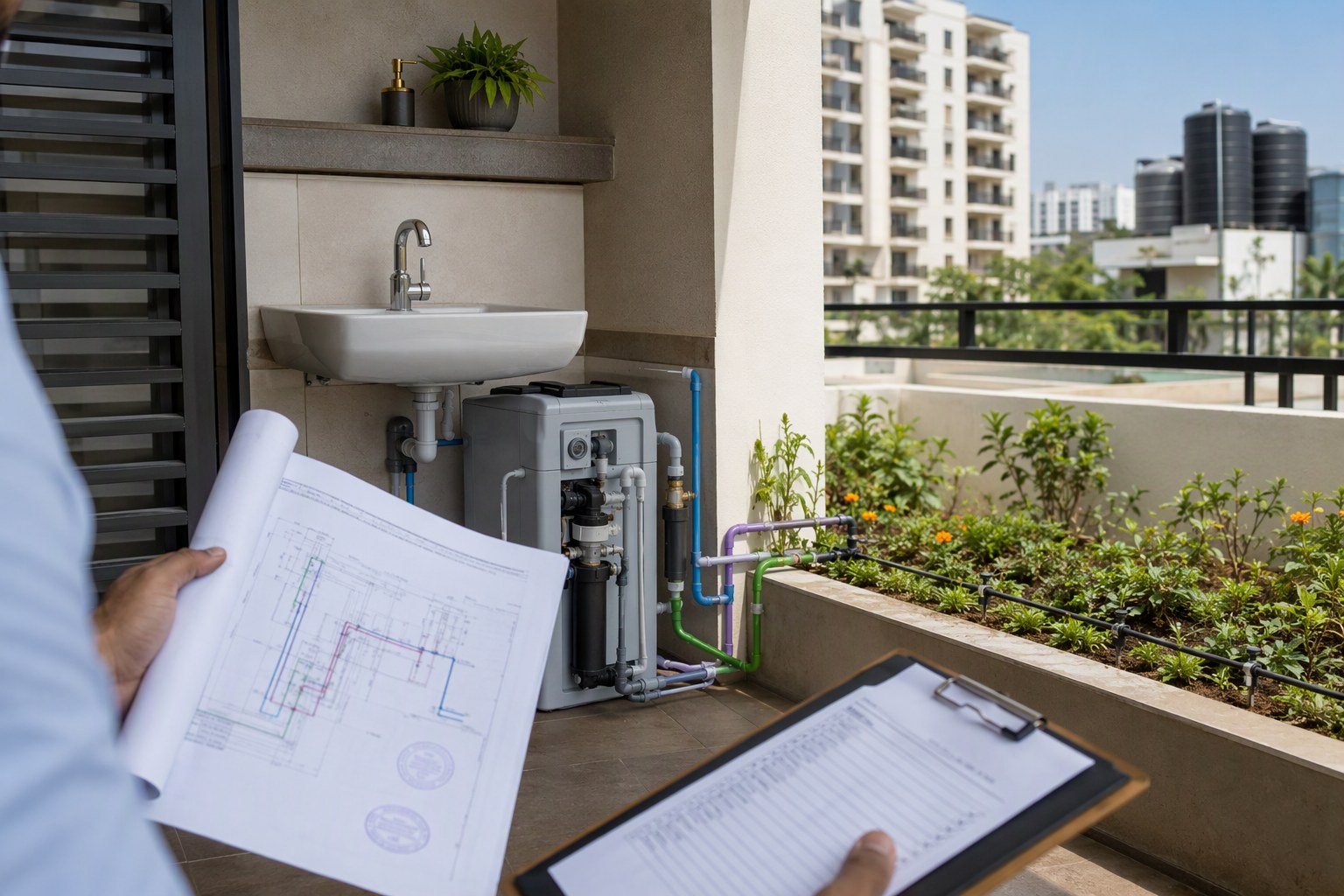
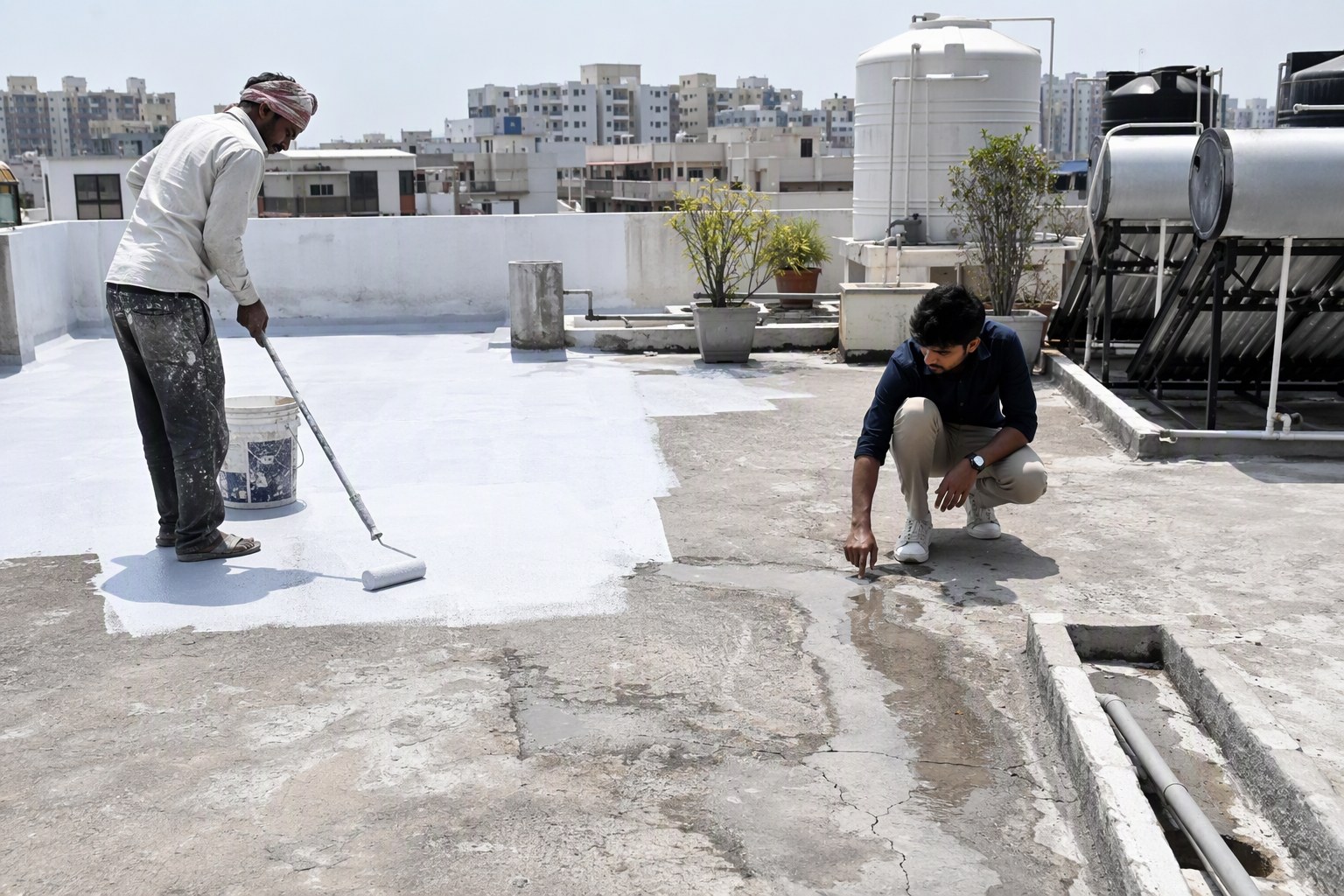
During site visits, do not stop at the model flat or sample villa. Ask to see the actual roof, meter room, inverter location, cabling path, and access route. A proper solar rooftop inspection should include panel condition, mounting structure, rusting, loose wiring, water seepage points, earthing, inverter ventilation, and whether cleaning is practically possible.
For a solar-ready home, inspect whether the readiness is real. Sometimes the builder has only left a pipe in the wall. Sometimes the meter room has no space. Sometimes the terrace is full of overhead tanks, dish antennas, ducts, and service equipment. If future installation requires breaking walls or disturbing waterproofing, the solar-ready claim is weak.
Quick inspection checklist for a working solar rooftop
- Ask for the installation invoice and warranty papers.
- Check whether the system is owned, leased, or under any third-party arrangement.
- Review recent electricity bills to see whether the system is actually connected.
- Inspect inverter display or app data during daylight hours.
- Check panel mounting, earthing, cable quality, and waterproofing around roof penetrations.
- Confirm who will handle warranty transfer after sale.
- Ask whether the apartment association or villa association has any restrictions.
Quick inspection checklist for a solar-ready home
- Ask the builder to show the exact conduits and termination points.
- Check whether the roof has clear, usable area.
- Confirm structural provision in writing, not orally.
- Ask whether the electrical panel can support future solar integration.
- Check whether inverter and battery space is ventilated and safe.
- Ask whether future installation may affect waterproofing warranty.
- Get the solar-ready specification included in the agreement or annexure.
Maintenance Responsibility Can Change the Real Value
A working solar rooftop is not a fit-and-forget feature. Panels need cleaning, inverters can fail, cables age, and rooftop waterproofing must be protected. In Hyderabad summers, dust accumulation is common, especially near ORR growth corridors, construction-heavy localities, and industrial-side belts. If maintenance is ignored, output drops and the buyer’s expected benefit becomes uncertain.
In an apartment project, the association’s role is critical. If the solar plant serves common area loads, the benefit may show as lower common electricity expenditure, not as a direct reduction in your individual flat bill. Ask how savings are accounted for in maintenance charges. If the builder has installed solar during the project stage, check when the association takes over and whether annual maintenance is budgeted.
In an independent house, the owner carries responsibility. That is fine if the documentation is clear. But if the previous owner installed panels through a financing or service contract, the buyer must know whether any obligations continue after sale.
Stamp Duty, Guideline Value and Green Premium
Buyers often ask whether a solar rooftop changes stamp duty. In normal practice, registration value is driven by the property value framework, agreement value, market value, building value, and the applicable registration process. Do not assume that a green feature automatically changes the ready reckoner or guideline value. Check the current value for the specific location, survey number, village, and SRO.
For a rough starting point, use Market Value / Guideline Value Search and then estimate duty impact through Stamp Duty Calculator. If the property includes land and building components, Composite Value Calculator and Building Value Calculator can help you think more clearly before negotiation.
My view is that sellers can ask for a premium for a good solar rooftop, but buyers should not pay blindly. Price it like any other asset attached to the property: age, condition, ownership, warranty, performance, and transferability. A new, documented, well-maintained system has better value. An old, poorly maintained system with no bills or papers is only a talking point.
Builder Claims: What Should Be Written in the Agreement?
If you are buying from a builder, insist that green features are written clearly in the agreement, specifications sheet, or handover annexure. Words matter. Solar rooftop, solar provision, solar-ready conduit, solar water heater, solar common lighting, and EV-ready point are not the same thing.
For under-construction projects at places like Tellapur, Nallagandla, Bachupally, Kollur, and Tukkuguda, brochures are often ahead of execution. That is why RERA filing, sanctioned plans, specifications, and sale agreement should be read together. Use Property Verification Tool for a broader file review approach before you commit.
If the builder says the home is solar-ready, ask for these clauses in writing:
- Exact solar-ready components provided.
- Location of conduits, inverter point, and electrical connection path.
- Whether terrace access is private, shared, or association-controlled.
- Whether future solar installation needs association approval.
- Whether waterproofing warranty remains valid after installation.
- Whether any load-related limitation applies.
Which One Should You Choose?
Choose a functioning solar rooftop if you want immediate utility and the paperwork is clean. It suits buyers who plan to occupy the home, monitor power use, and maintain the system properly. It is especially attractive for villas and independent houses where roof control is clear.
Choose a solar-ready home if you like the property but do not want to pay for a system immediately, or if you prefer installing your own brand and capacity later. It suits buyers who are not yet sure about usage, EV charging, battery backup, or long-term occupancy.
Avoid paying a major premium for a solar-ready claim unless the provision is technically meaningful and written into the documents. Avoid buying a working solar rooftop without seeing bills, ownership records, and maintenance status. Green value is real only when it is verifiable.
Final Buyer Takeaway on Solar Rooftop vs Solar-Ready Home
Solar Rooftop vs Solar-Ready Home comes down to proof versus promise. A working system with approvals, service records, clean ownership, and visible billing benefit can support resale value. A solar-ready home is useful, but its value is mostly future potential.
For Hyderabad and Telangana buyers, my advice is practical: check the roof, check the wiring, check the bills, check the agreement, and then check the title. A sustainable home is only as good as its legal file. Pahani, Dharani history where relevant, EC, SRO records, RERA status, Section 22-A status, and local permissions still sit at the centre of the purchase decision.
Frequently Asked Questions
Does a solar rooftop increase home resale value in Hyderabad?
Yes, it can improve resale appeal when the system is working, documented, maintained, and transferable. Buyers should verify bills, warranty papers, approval records, and ownership before paying a premium.
Is a solar-ready home the same as a solar rooftop home?
No. A solar-ready home usually has provision for future installation, such as conduits or roof space. A solar rooftop home already has an installed and functioning solar system.
What documents should I check before buying a home with solar panels?
Check the vendor invoice, warranty papers, DISCOM-related approval or application records where applicable, electricity bills, maintenance records, sale deed clauses, EC, RERA status for projects, and Section 22-A status.
Can apartment buyers claim ownership of rooftop solar panels?
Only if the documents clearly say so. In many apartments, the terrace and solar plant are common assets used for common area power. Flat buyers should read the sale agreement and association handover documents carefully.
Should I pay extra for a solar-ready villa?
Pay extra only if the provision is real and written into the agreement. Ask for details of conduits, inverter space, roof access, electrical capacity, waterproofing impact, and any association restrictions.