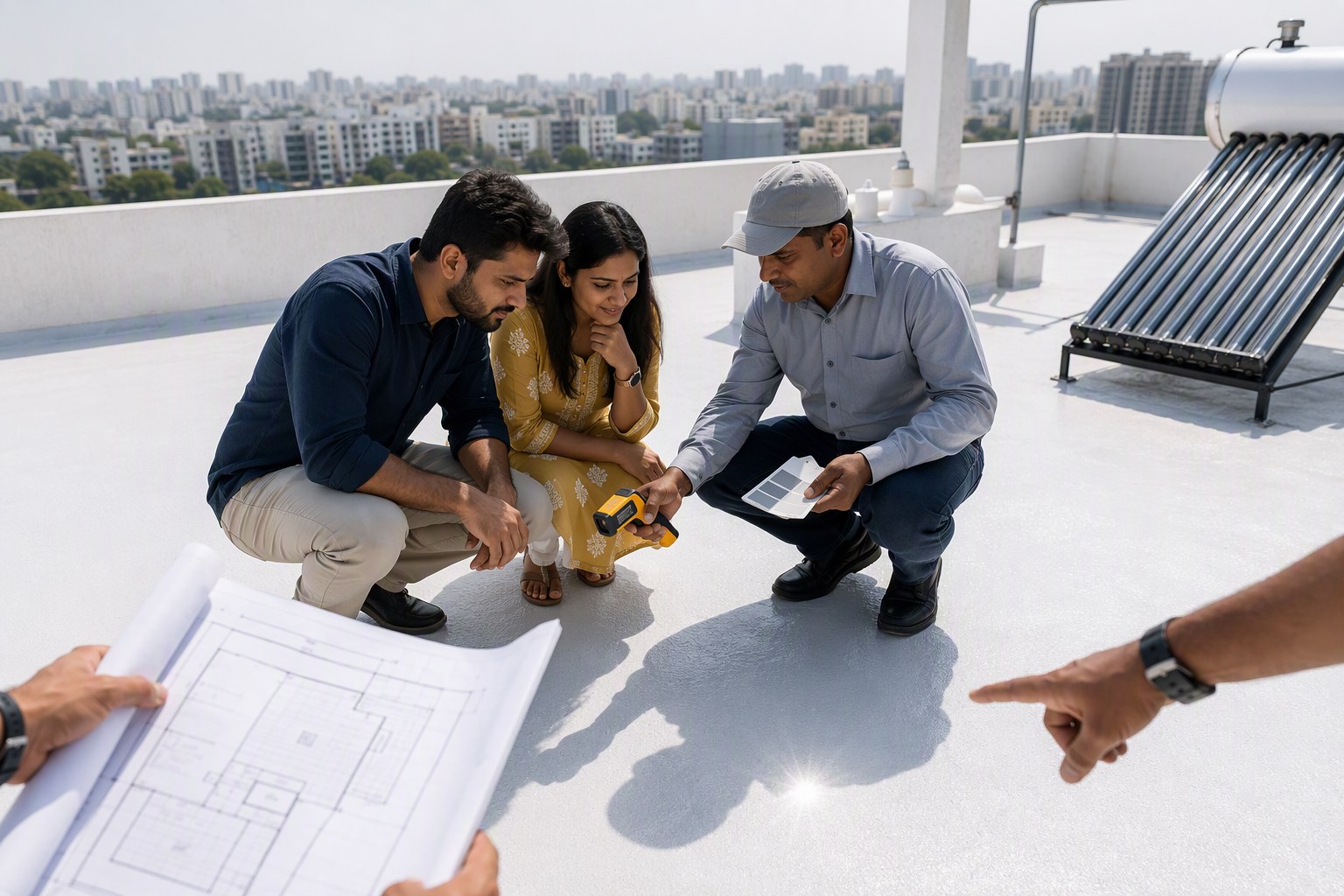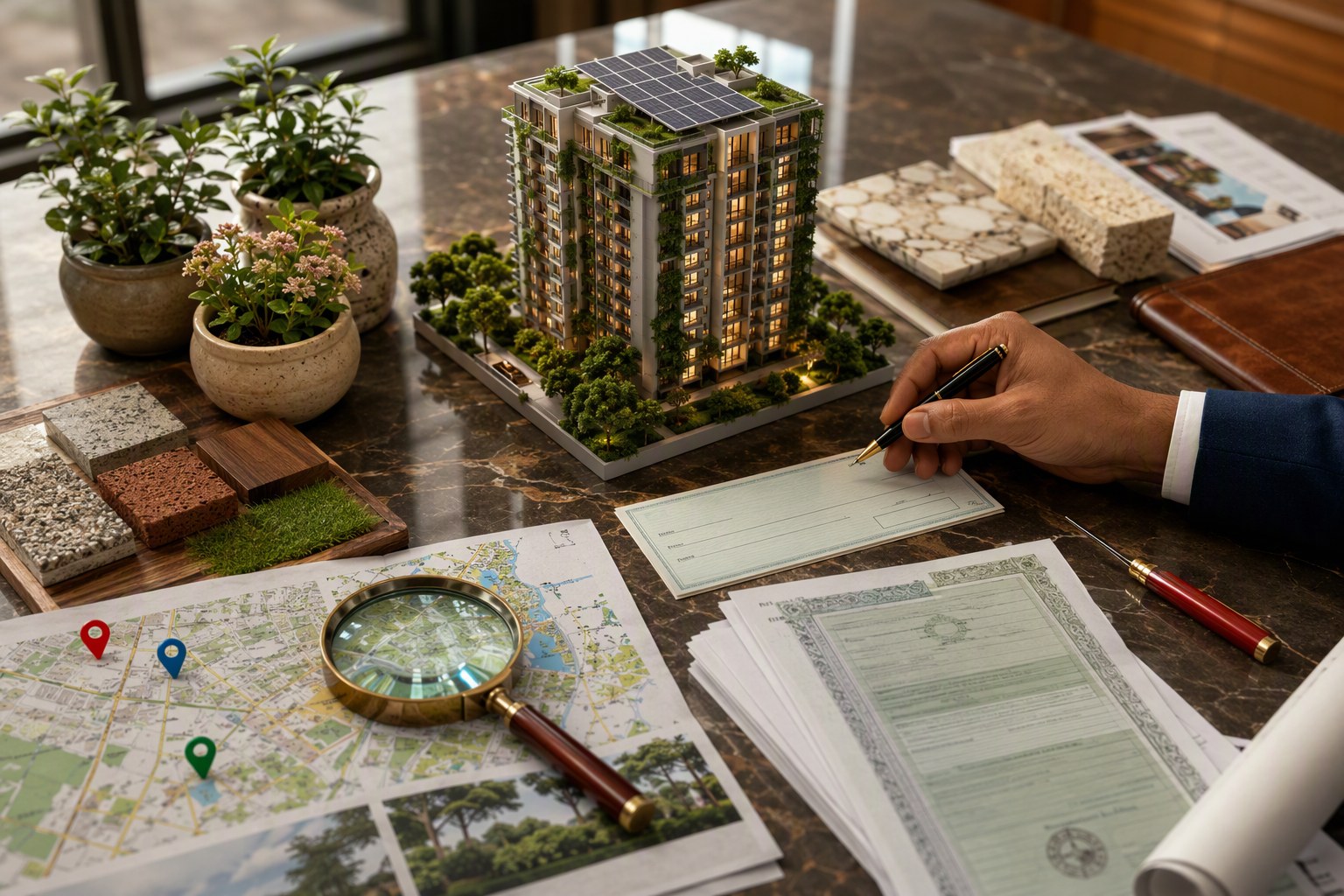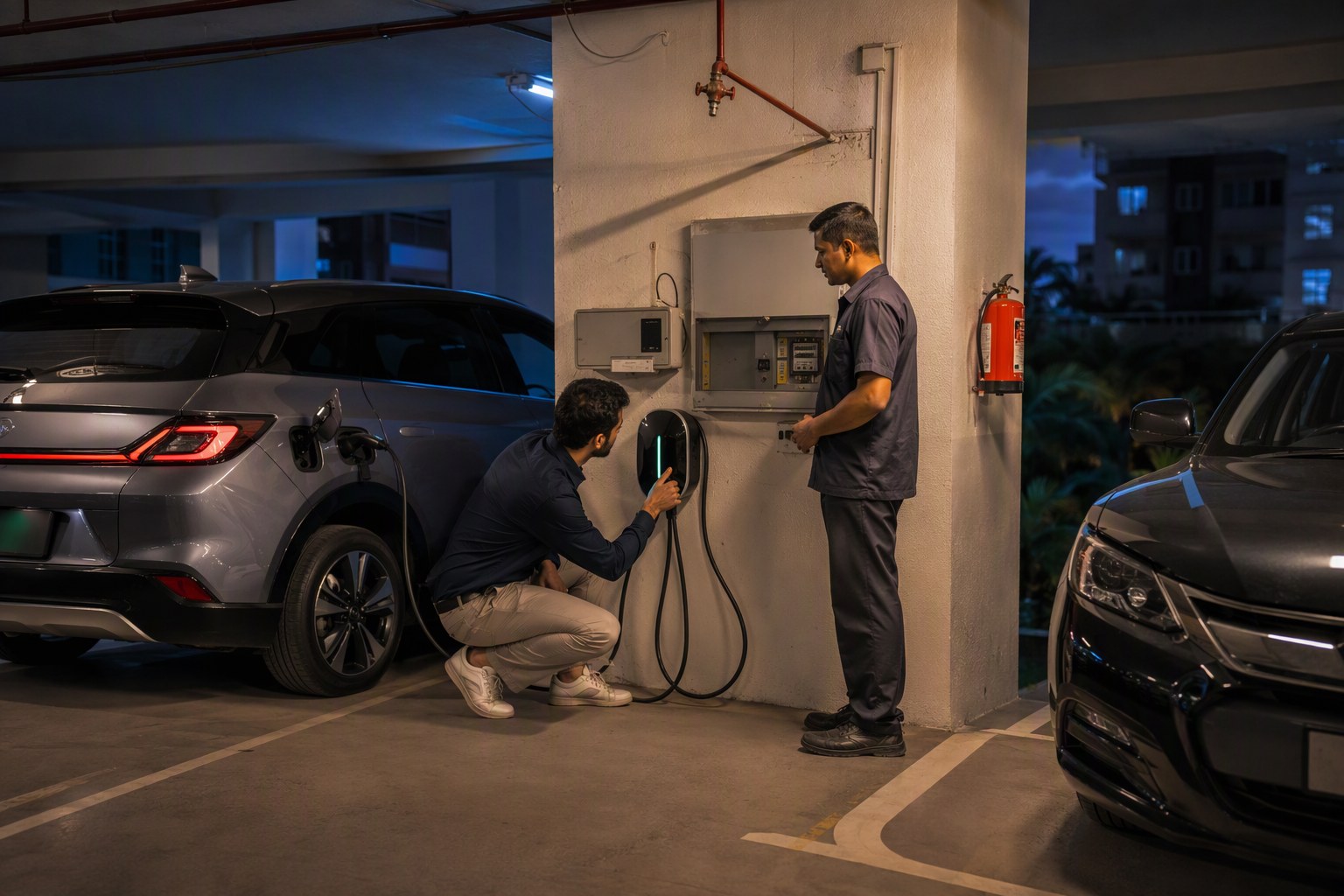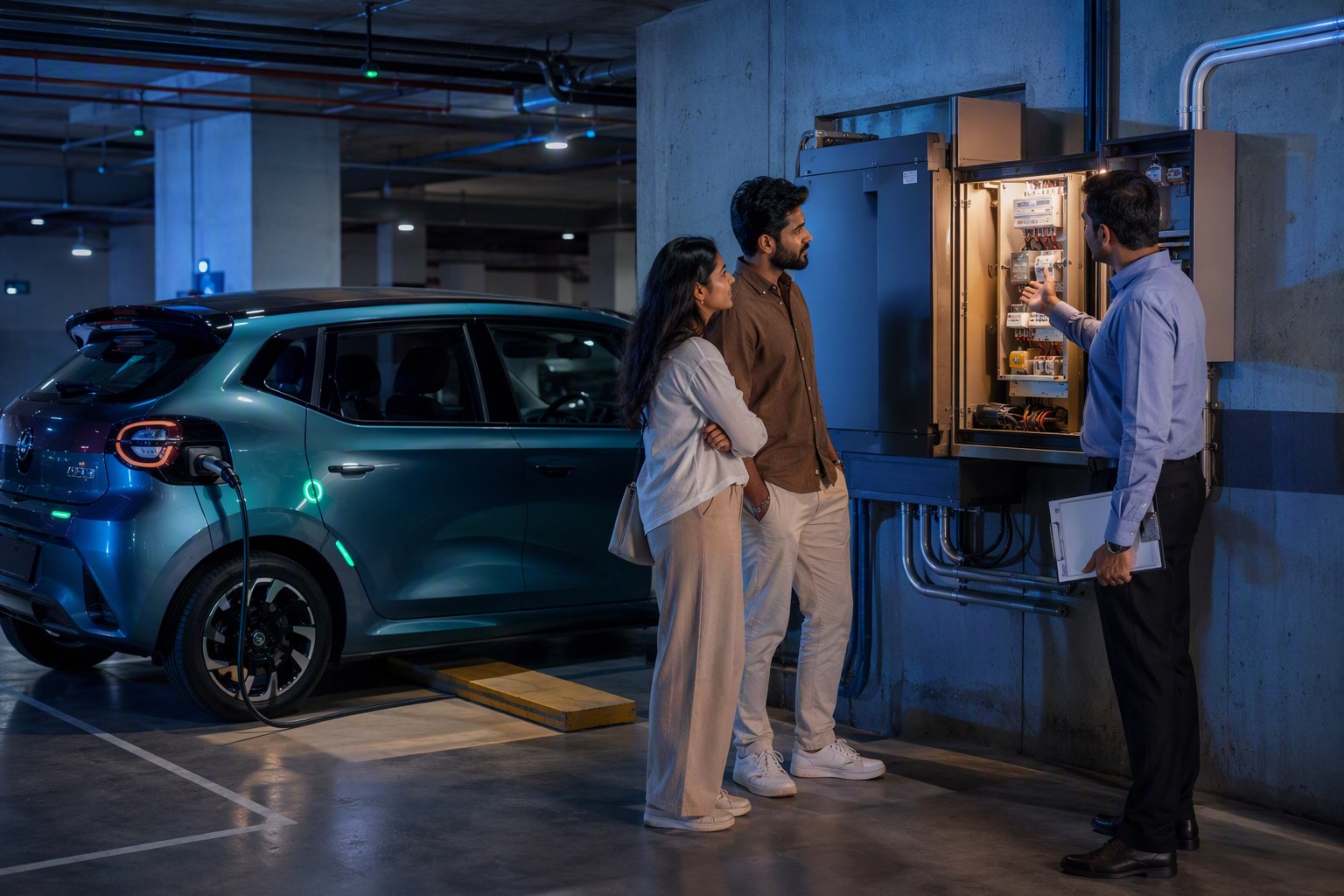
EV charging in your apartment is a real green upgrade only when the project has proper electrical load planning, safe cabling, clear association approval, transparent billing, and space for future charger demand. If the builder is merely showing one token charging point near the clubhouse, without sanctioned load details or a usage policy, treat it as a marketing add-on.
In Hyderabad’s western corridor — Kokapet in Gandipet mandal, Narsingi, Gachibowli in Serilingampally mandal, Tellapur in Ramachandrapuram mandal, Miyapur, Bachupally, Kompally and Manikonda — EV charging has become a common brochure line. We’ve seen buyers get excited by “EV-ready parking” during site visits. Fair enough. But the real question is simple: can you actually charge your vehicle safely, regularly, and fairly after possession?
My view: an EV point is valuable only if it works like a utility, not like a photo spot in the amenities list.
EV Charging in Your Apartment: When It Is Genuinely Useful
A proper apartment EV charging system is not just a socket near the parking bay. It is a planned electrical facility. The builder or society must think through sanctioned load, transformer capacity, cable routing, earthing, metering, fire safety, parking rights and billing.
For a buyer, the most useful EV setup is usually one of these:
- Dedicated charging provision for your allotted parking bay, with safe cabling from a metered source.
- Common charging bays, where residents book a slot and pay as per usage.
- EV-ready infrastructure, where conduits, distribution boards and load provision are already planned even if every flat does not install a charger on day one.
- Association-managed charging, where the Residents Welfare Association or apartment owners’ association controls access, maintenance and billing.
The best projects in areas like Financial District, Kokapet, Tellapur and Kondapur are beginning to understand this. Buyers are not asking for luxury only; they want practical running convenience. If you drive daily to Hitec City, Nanakramguda, Raidurg, Genome Valley, Shamshabad or Patancheru, home charging can reduce your dependence on public charging stations. That is the real lifestyle benefit.
But there is a catch. Your parking slot, your charger, and your electricity bill must be legally and technically aligned. Otherwise, the feature can create arguments in the cellar after the first few residents buy EVs.
EV Charging in Your Apartment: The Approval Questions Buyers Must Ask
Before you believe the sales executive, ask for documents. Not a WhatsApp message. Not a colourful brochure. Documents.
| Buyer question | Why it matters | What to ask for |
|---|---|---|
| Is the project sanctioned for the required electrical load? | Charging demand can strain the system if not planned. | Electrical load statement, transformer details, sanctioned connection papers. |
| Is EV charging shown in the electrical design? | Retrofitting in basements can become messy and unsafe. | Electrical single-line diagram and parking-level layout. |
| Who will pay for electricity? | Common meter billing can lead to disputes. | Billing policy, sub-metering plan or charger management system details. |
| Can every resident install a charger? | One or two points may not serve a large gated community. | Written EV policy from builder or draft association bye-law. |
| Is the parking slot clearly allotted? | Charging rights become difficult if parking is vague. | Allotment letter and sale agreement clauses. |
In our experience, serious developers answer these questions without irritation. If the salesperson says, “Sir, society will manage later,” slow down. That line usually means the builder has not planned the operational part.
For under-construction projects, cross-check the project registration and declared details through RERA Project Lookup. For land and title comfort, use the Property Verification Tool before getting carried away by green amenities. In Telangana, as per latest IGRS data, Section 22-A prohibited properties records cover 3,076,153 entries. That is a reminder that legal verification must come before amenity excitement.
When an EV Charging Point Is Only a Marketing Add-On
An EV charging point becomes a weak selling gimmick when it is installed without a proper plan. I am not against developers marketing green features. Good builders should promote sustainable living. But buyers must separate genuine infrastructure from display items.
Watch out for these red flags:
- Only one charger for a large project, with no future expansion plan.
- No clarity on load capacity or whether the transformer can support regular charging.
- Charging shown in the brochure but not in agreement.
- No billing mechanism, especially when power is drawn from a common area meter.
- Loose wiring or extension-style arrangements in basement parking.
- No written permission process for residents who want a personal charger.
- No fire safety coordination for charger locations and cable routes.
We’ve seen this issue in both premium and mid-segment projects. A project in Kokapet may have excellent clubhouse branding but still be vague on parking-level utilities. A smaller standalone apartment in Kukatpally or Uppal may actually be more practical if the owner group has already agreed on sub-metering and safe installation. Price segment alone does not decide quality here.
Load Capacity Is the Heart of Apartment EV Charging
If there is one technical question you must ask, ask this: has the electrical load been planned for EV charging?
Every apartment project has an electrical design based on expected consumption — flats, lifts, pumps, lighting, clubhouse, STP, security systems and common services. EV charging adds another layer of demand. If only a few residents use it, the system may manage. If many residents start charging at night, the project needs enough capacity and a controlled load management plan.
This is especially relevant in dense apartment belts like Miyapur, Nizampet, Bachupally, Kondapur, Gachibowli, Manikonda and Attapur. In these areas, parking floors are already tight. Retrofitting cable trays later can be painful. A buyer should ask whether the project has planned spare electrical capacity or only kept a symbolic provision.
Questions to ask the builder’s electrical team
- What is the sanctioned electrical load for the project?
- How many EV charging points are planned in phase one?
- Is there a provision to add more chargers later?
- Will chargers be slow chargers, fast chargers or a mix?
- Are chargers connected to individual meters, prepaid systems or common meters?
- Who maintains the charger after handover?
- Is there a written safety protocol for basement charging?
Do not worry if you do not understand every electrical term. Ask the questions anyway. A good builder will arrange a technical explanation. A weak builder will push you back to the sales desk.
Billing Clarity: The Most Common Future Dispute
Billing is where many apartment EV plans fail. If electricity is drawn from a common meter, all residents may end up indirectly paying for a few users unless there is a sub-meter or app-based payment system. That is not fair.
There are three practical billing models:
- Individual meter connection: Power is linked to the flat owner’s meter or a dedicated approved connection. This is clean but may need proper cabling and permissions.
- Sub-metered charging: The society tracks each user’s consumption and bills monthly. This needs discipline and transparent readings.
- Managed charger platform: Residents pay through a charging system or app managed by the association or vendor. This can work well if contracts are clear.
Before buying, ask whether the builder has committed to any of these. If the answer is “later, society will decide,” make sure you are comfortable with that uncertainty. In many Hyderabad apartments, association decisions take time. Parking, pets, maintenance, generator backup and visitor parking already create debates. EV charging can join that list very quickly.
Parking Rights and Charger Rights Are Not the Same
Many buyers assume that if they have one car parking slot, they can automatically install a charger. Not always. Apartment parking is governed by the sale agreement, sanctioned plan, association rules and practical safety concerns.
If your parking slot is in a basement, cable routing may pass through common areas. If your charger is fixed to a column or wall, it may affect common property. If multiple residents want the same facility, the association needs a uniform policy.
Check these documents carefully:
- Agreement of sale
- Construction agreement, if applicable
- Parking allotment letter
- Draft association bye-laws
- Maintenance handover documents
- Electrical and fire safety drawings, where shared
For resale flats, do not rely only on the seller’s word. Pull the title and charge history using Encumbrance Certificate Search and review the result with EC Analyzer. If you are buying in a locality where survey numbers and village names confuse you — common around Tellapur, Osman Nagar, Kollur, Mokila, Narsingi and Gandipet — use the Survey Number Finder.
EV Charging in Your Apartment and Property Value
Will EV charging increase resale value? My answer: it can improve buyer interest, but only when the setup is usable and documented. A random socket will not make a flat premium. A well-managed EV charging system can make the property more attractive to working professionals and families who already own or plan to buy electric vehicles.
In Hyderabad, location still dominates value. A flat near Gachibowli, Kokapet, Kondapur, Madhapur, Jubilee Hills, Begumpet, Sainikpuri or LB Nagar will be judged first on title, access road, approvals, maintenance quality, water situation, construction quality and connectivity. EV charging is a plus point after these basics are clear.
Buyers should first check the project’s legal and market position. Use Market Value / Guideline Value Search to understand government value references and Stamp Duty Calculator to estimate registration costs. If the property is older or has multiple past transactions, the CERSAI Charge Check can help check for recorded security interests.
How to Inspect an Apartment EV Charging Setup During Site Visit
During a site visit, do not just look at the model flat. Ask to see the parking level. This is where the truth of many amenities is visible.
At an under-construction project
- Ask where EV charging points will be located.
- Check whether the parking plan shows dedicated charging zones.
- Ask whether conduits are already planned for future chargers.
- Request the relevant agreement clause before paying a booking amount.
- Confirm whether the feature is part of the promised specifications.
At a ready-to-move project
- Inspect the charger location physically.
- Ask current residents whether the system is being used.
- Check who pays the bill.
- Ask whether the association has approved private chargers.
- Look for neat cabling, proper panels and safe routing.
In a ready project, resident feedback is gold. Security staff, facility managers and association committee members often know the real story. If they say the charger has not worked for months, take that seriously.
What Builders Should Put in Writing
A buyer-friendly builder should not hide behind vague green language. The sale team should be able to give a written note on the EV facility. Ideally, the agreement or annexure should mention the nature of provision.
Look for written clarity on:
- Number or type of charging points planned initially.
- Whether individual parking chargers are permitted.
- Whether future expansion is possible.
- Who owns and maintains common chargers.
- Billing method.
- Any installation charges payable by residents.
- Safety standards and operating rules.
If the builder refuses to put anything in writing, treat the amenity as uncertain. This does not mean you must reject the flat. It means you should not pay a premium only because the brochure says “EV charging available”.
Hyderabad Locality Lens: Where EV Charging Matters More
EV charging matters more in some buyer profiles and localities. If you are buying in office-heavy corridors like Financial District, Nanakramguda, Gachibowli, Kondapur, Madhapur and Kokapet, daily car usage is common. Home charging can be genuinely useful.
In growth corridors like Tellapur, Kollur, Mokila, Bachupally, Kompally, Bowrampet and Adibatla, buyers often depend on personal vehicles because public transport options may not be equally strong in every pocket. Here also, EV-ready infrastructure can be a sensible long-term feature.
In central areas like Somajiguda, Begumpet, Himayatnagar and Banjara Hills, redevelopment and limited parking can make retrofitting more difficult. For older apartments, association approval becomes even more important.
That said, do not ignore the basics. Check the SRO jurisdiction using Find Your SRO Office, verify land status using Section 22-A Prohibited Property Check, and track changes with Property Change Tracker if you are watching a property over time.
Buyer Verdict: Is EV Charging in Your Apartment a Real Green Upgrade?
Yes, EV charging in your apartment is a real green upgrade when five conditions are met: approved electrical capacity, safe installation, clear parking rights, transparent billing and written rules for current and future users.
No, it is not a meaningful upgrade when it is only one charger placed for brochure value, without load planning or association-level clarity. In that case, it may look modern during launch but become a maintenance headache after handover.
My practical advice: buy the flat for its title, location, construction quality, approvals and liveability. Treat EV charging as a strong bonus if it is properly documented. If the builder is charging a premium for a “green home” tag, ask sharper questions. Hyderabad buyers have become smarter, and developers must match that seriousness.
A genuine sustainable apartment is not defined by one amenity. It is defined by how well the building handles power, water, waste, ventilation, open space, mobility and maintenance over many years. EV charging is one part of that story. Make sure it is a working part.
Frequently Asked Questions
Is EV charging in your apartment enough reason to pay a premium?
Not by itself. Pay attention to title, RERA details, location, construction quality, maintenance and legal documents first. EV charging deserves a premium only when load capacity, billing and usage rights are clearly documented.
Can I install a private EV charger in my allotted parking slot?
You may need association approval because cabling and equipment can pass through common areas. Check your sale agreement, parking allotment letter and apartment bye-laws before installing anything.
What is the biggest risk with apartment EV charging?
The biggest risk is poor planning. If the building does not have adequate sanctioned load, safe cabling and a clear billing system, the charger can create disputes and safety concerns.
Should resale flat buyers check EV charging differently?
Yes. In resale apartments, speak to the association or facility manager, inspect the charger physically, check whether residents are actually using it, and verify title documents before purchase.
Which Hyderabad localities should pay closer attention to EV-ready parking?
Buyers in car-dependent and office-linked areas such as Kokapet, Narsingi, Gachibowli, Financial District, Tellapur, Kollur, Bachupally, Kompally and Adibatla should ask detailed EV charging questions during site visits.