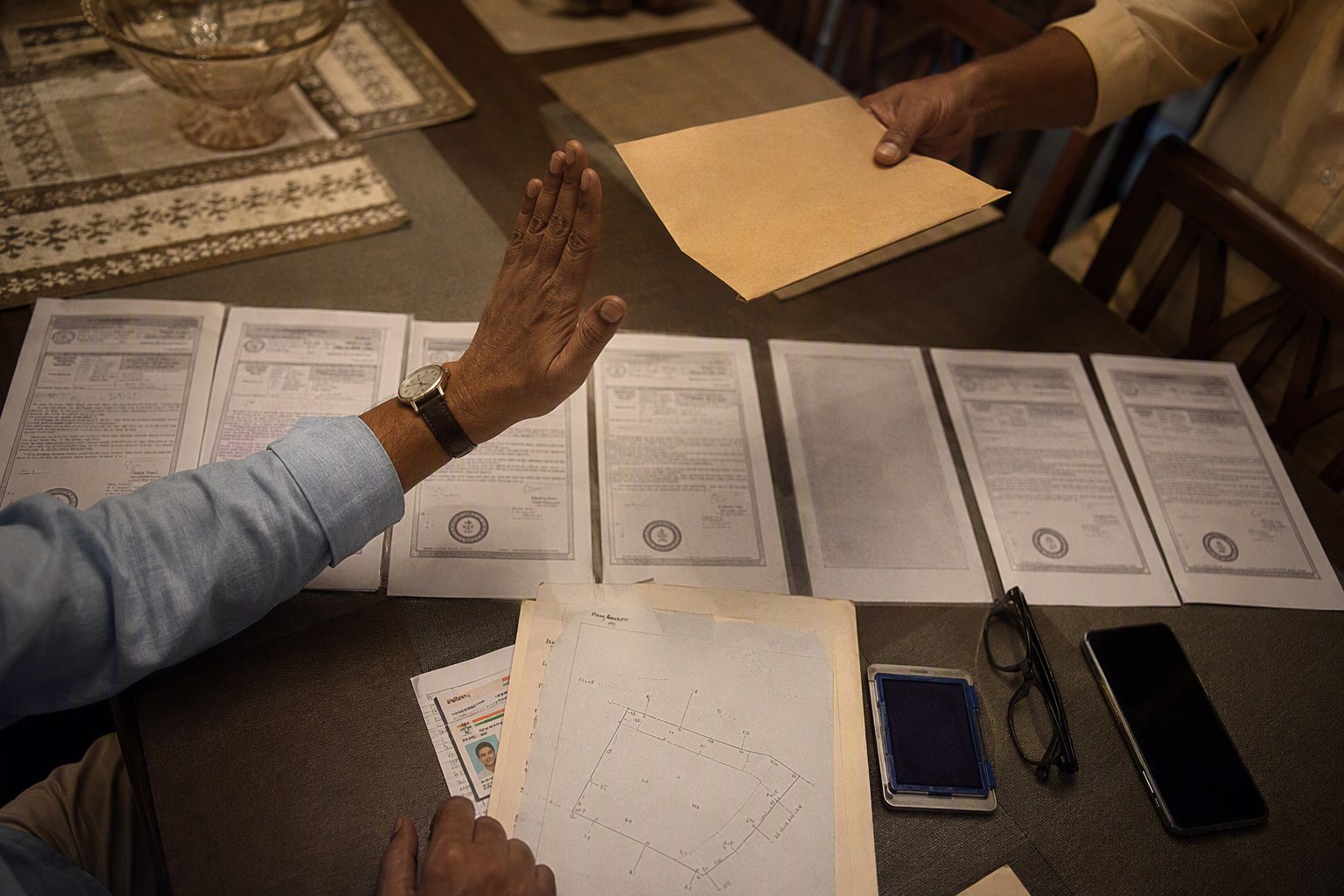



Case Study: Missing NALA Order Stalled a Hyderabad Villa Loan
A villa buyer from Hyderabad called us after his loan file went silent. Not rejected. Not approved. Just stuck. The site looked good, the internal roads were laid, compound wall was ready, and the sales team had a neat folder with layout drawings, payment schedule, draft sale agreement and glossy villa elevations. His family had already started discussing interiors.
Then the bank legal team asked one simple question: where is the NALA conversion order?
That question changed the mood of the deal. The buyer had heard the word NALA before, but only in passing. The sales executive had told him, ‘Sir, layout is approved only. Bank loans are going on.’ In Hyderabad real estate, that sentence is used too casually. A buyer may hear it at a site office in Mokila, Shankarpally, Tukkuguda, Kollur, Maheshwaram, Adibatla, Patancheru, Medchal or Ghatkesar. But for a lender, marketing confidence is not a land title document.
This case study is based on a real buyer-side document review, with names, survey numbers and exact location masked. The purpose is not to blame one developer. It is to show how a missing land-use conversion proof can delay or derail a villa loan even when everything on the ground looks convincing.
The buyer, the villa, and the first red flag
The buyer was a salaried IT professional, typical Hyderabad upper-middle-class profile. He wanted a gated villa because the apartment market felt crowded and he wanted a bit of open space for parents and children. The project was marketed as a small premium villa community on the city outskirts, with wide internal roads, clubhouse promise, underground drainage, water lines and streetlights.
The quoted price was not suspiciously low. That is why the buyer did not treat it as a risky deal. He thought risky properties are only the ones with kutcha roads, no boundary, no office, or some village dispute. This is a common mistake. A property can look organised and still have one missing approval that blocks bank funding.
He paid a booking amount after checking three things:
- The location on Google Maps and approach road.
- The draft layout shared by the sales team.
- One bank name mentioned by the developer as a possible lender.
He did not independently check the survey number, land-use status, prior transactions, or whether the land had been lawfully converted from agricultural to non-agricultural use. In Telangana, that conversion proof is usually discussed as NALA order or NALA proceedings.
What is a NALA order in plain language?
NALA refers to permission for using agricultural land for a non-agricultural purpose. In our market language, buyers often say ‘NALA conversion’ for land-use conversion. If agricultural land is being used for residential plotted development or villas, the lender wants to see that conversion proof in the land file.
Do not confuse NALA with layout approval. They are connected in practical due diligence, but they are not the same document. A layout plan may show roads and plots. A RERA registration may mention project details where applicable. A building permission may deal with construction approval. But NALA conversion deals with the base question: was this agricultural land legally permitted for non-agricultural use?
For villa communities around Hyderabad, this point matters because many projects start from agricultural parcels. The land may have old pattadar passbook history, succession entries, sale deeds and survey subdivisions. All that may be genuine. Still, if the land is being sold as residential villas, the bank will ask whether the use has been converted.
My opinion after seeing many buyer files: NALA is not a decorative document. It is a lender comfort document. If it is missing, the bank legal team will not get impressed by brochure design.
How the loan file got stuck
The buyer applied for a home loan through a private bank branch suggested by the site sales team. The relationship manager was positive at first. Salary was good. Credit score was clean. Existing obligations were manageable. Technically, the buyer was loan-worthy.
Then the file went to legal scrutiny. The legal officer asked for the title chain, link documents, latest encumbrance certificate, layout approval, land conversion proof, sanctioned plan or relevant project approval papers, and tax or revenue records. The buyer forwarded whatever the developer gave him.
The first reply from legal was short: NALA order not found in submitted set.
The developer’s office responded that the land was part of an approved layout and conversion was ‘already taken care of’. But the bank did not accept verbal assurance. They wanted the actual proceedings or official order, with survey numbers matching the project land.
This is where the buyer realised one painful truth: a loan approval is not based on site-office confidence. It is based on documents that can survive legal checking.
What the developer had, and what was missing
The document folder looked heavy. But heavy folders are not always complete folders. Here is what was available and what was missing at the point when the loan got stalled.
| Document | Status in buyer file | Why it mattered |
|---|---|---|
| Sale deeds in landowner chain | Available | Showed past ownership transfers, but did not prove land-use conversion. |
| Latest EC | Available for some period | Helped check registered transactions, but EC alone does not confirm NALA. |
| Draft villa sale agreement | Available | Useful for commercial terms, not enough for land legality. |
| Layout drawing | Available | Showed proposed development, roads and plots, but bank wanted supporting approvals. |
| NALA conversion order | Not available in file | Main reason the legal clearance was held back. |
| Survey number mapping | Partly available | Needed to connect the booked villa plot to the underlying land records. |
The buyer’s villa was one unit inside a bigger land parcel. The marketing material referred to project phases and villa numbers. The bank wanted survey numbers and conversion details, not just villa numbers. This mismatch between marketing language and revenue-record language creates many problems in Hyderabad outskirts.
The mistake: believing layout marketing is the same as land due diligence
The buyer had made a very understandable error. He saw roads, compound wall, site office and model villa. So he assumed the land file was clean. Many buyers think a project cannot reach that stage unless everything is perfect. That is not how our market works.
Sometimes civil works begin while some documents are still being arranged. Sometimes the developer has an approval for one portion but is selling another phase based on expectation. Sometimes the NALA order exists, but only for part of the land. Sometimes the order uses older survey numbers and the current sale documents use subdivisions, making bank matching difficult. Sometimes the document is simply not shared because the sales team does not understand what the legal team needs.
None of these situations should be casually ignored by a buyer. Even if the issue can be cured, it can cost time. If your agreement has strict payment timelines, that delay can put you under pressure.
Where the buyer should have checked earlier
Before paying the booking amount, the buyer could have done a basic document-screening round. It would not replace a property lawyer, but it would have reduced blind spots.
- Use Survey Number Finder to understand the survey number context instead of relying only on villa number or plot number.
- Run an Ec Search to review registered transaction flow and see whether the land chain looks consistent.
- Check the land-use indication through Landuse Zone Finder, especially for outskirts where agricultural-to-residential conversion questions are common.
- Use Verify My Land as a structured pre-check before taking the file to a bank.
- Check whether the land appears in restricted categories using Prohibited Property Check. Our database context tracks 3,076,153 prohibited property records, so skipping this check is not wise.
- If the project claims RERA applicability or registration, verify the details through Rera.
- Confirm the right registration office using Find Your Sro, because wrong SRO assumptions can confuse document search.
These checks do not give a magical green signal. They help you ask better questions before money leaves your account.
How the bank viewed the issue
The bank did not say the project was fake. That is a key distinction. A missing NALA order does not automatically mean fraud. But from a lender’s risk point of view, the file had an unresolved land-use question. Banks are cautious because they are funding a long-term asset. If the land-use basis is unclear, the mortgage value becomes uncomfortable for them.
In this case, the buyer’s personal eligibility was not the problem. The property file was the problem. This is why buyers should not celebrate only the loan eligibility letter. A home loan has two tracks: borrower appraisal and property appraisal. You may pass the first one and fail the second.
The bank asked for:
- NALA conversion proceedings or order for the relevant survey numbers.
- Proof that the booked villa plot falls within the converted extent.
- Clear matching between survey numbers in land records, layout documents and sale agreement schedule.
- Updated EC and link documents.
- Clarification on any phase-wise approval, if the project was sold in phases.
This is not unusual. A careful bank legal team will ask these questions. In fact, buyers should be happy when the legal team is strict before disbursement. It is painful in the moment, but it may save bigger trouble later.
The developer’s response
The developer first tried to handle it through reassurance. The buyer was told that other customers had taken loans and that the document would be provided soon. But when the buyer asked for a copy, the office shared an acknowledgement-like paper and some layout-related material, not the final conversion order that the bank wanted.
After repeated follow-up, the developer said the conversion was being processed for part of the land and that the buyer’s unit was in a phase where documentation would be regularised before registration. That sentence worried the buyer. He had been under the impression that all approvals were already in place.
At that stage, the buyer had three choices:
- Wait for the developer to provide the NALA order and risk losing time.
- Shift to another bank with a softer legal approach, which is risky if the underlying issue remains.
- Cancel or renegotiate the booking until documents are complete.
He chose to pause the loan and not sign the final agreement until the document issue was resolved. That was the correct move. A buyer should not rush into registration just because the site team says prices will increase next week.
Why switching banks is not a clean solution
Many buyers, when one bank raises a legal query, immediately ask the developer for another bank. Sometimes this works for minor formatting issues. But for land-use conversion, switching banks is not a cure. It only changes the examiner.
If Bank A asks for NALA and Bank B does not ask, that does not make the risk disappear. It only means Bank B’s legal process may be different, or the branch may have accepted a project-level comfort that you have not personally reviewed. As a buyer, your question should be: do I have the document in my file, and does it match my property schedule?
One more practical point: resale buyers later may ask the same question. Even if you somehow get a loan today, a future buyer’s bank may raise the issue when you sell. So the missing document can come back after years, at the worst possible time.
What a clean villa document pack should show
For a Hyderabad villa purchase, especially on converted land, I like to see a clean connection from land to villa. The file should not feel like a puzzle. A decent buyer-side pack should include these items, subject to project type and local jurisdiction:
- Parent title deeds and link documents for the land.
- Latest EC covering the relevant period.
- NALA conversion order or proceedings, where the land was agricultural and is now used for residential purpose.
- Survey number schedule and extent statement.
- Layout approval or relevant planning permission.
- Building permission or villa construction approval, as applicable.
- RERA details, where applicable.
- Draft agreement of sale with correct schedule.
- Tax receipts, mutation or revenue records, where relevant.
- Clear approach road and access proof.
The buyer should also compare market and registration values through tools like Guideline Value and calculate likely registration outgo using the Stamp Duty Calculator. These are not substitutes for title due diligence, but they help you budget correctly.
The schedule page is where many buyers sleep
In this case, the buyer had not read the property schedule carefully. Most buyers look at price, villa number and built-up area. The schedule is where the legal identity of the property sits. It should mention land extent, boundaries, survey numbers or plot references, undivided share where applicable, and construction details depending on the transaction structure.
If your sale agreement mentions only fancy villa naming and not the underlying land details clearly, ask questions. If the survey numbers in the agreement do not match the NALA order, ask for a written clarification. If the NALA order covers a larger land parcel, ask how your villa plot falls within that converted extent. These are not rude questions. You are buying an asset worth a serious chunk of your life savings.
What happened finally?
The buyer did not cancel immediately. He gave the developer time to produce the required conversion proof. The bank kept the legal clearance pending. After a few rounds, the developer arranged a more complete document set, but there were still matching issues between old survey references and the project schedule. The buyer then took the file to an independent lawyer, not just the bank panel.
The lawyer advised him to proceed only after the NALA order, layout approval and agreement schedule were aligned in writing. The buyer renegotiated the payment timeline and refused to pay the next instalment until the bank legal query was closed. That pressure worked better than emotional follow-ups.
The most useful lesson here is simple: the buyer did not lose money because he paused early. Had he signed blindly, the fight would have become harder. Before agreement, you still have negotiating power. After registration, every correction becomes slow, technical and stressful.
Buyer checklist before booking a Hyderabad villa
If you are looking at villas in Hyderabad’s growth corridors, keep this checklist handy before paying even a token amount:
- Ask for survey numbers, not just project brochure and villa number.
- Ask whether the land was agricultural at any point in the title chain.
- If yes, ask for NALA conversion proof for the relevant survey numbers.
- Match NALA extent with the project land extent.
- Check EC and link documents before signing the agreement.
- Do not rely only on ‘other banks are funding’ statements.
- Get a written document list from the developer.
- Use public and verification tools first, then take the file to a property lawyer.
- Keep payment milestones linked to document readiness.
- Do not allow urgency tactics to replace due diligence.
Hyderabad’s villa market has many genuine developers and well-planned communities. But the outskirts also have mixed land histories. Agricultural land, family partitions, old pahanis, revenue entries, approach road issues and conversion papers can all sit behind a beautiful entrance arch. A smart buyer checks both: the site and the file.
Final take for buyers
A missing NALA order is not a small clerical gap in a villa purchase. It can stop bank legal clearance, delay disbursement, disturb agreement timelines and create resale headaches. If a project is built on land that required conversion, ask for the conversion order before you get emotionally attached to the villa.
The best time to ask is before booking. The second-best time is before agreement. The worst time is after your bank refuses disbursement and the developer starts pushing you for payment. In Hyderabad real estate, good due diligence is not negativity. It is basic self-protection.
Frequently Asked Questions
Can a bank reject a villa loan only because NALA order is missing?
Yes, a bank can keep the file pending or decline legal clearance if land-use conversion proof is required and not provided. The borrower may be financially eligible, but the property must also pass legal scrutiny.
Is layout approval the same as NALA conversion?
No. Layout approval and NALA conversion serve different purposes. NALA deals with conversion of agricultural land for non-agricultural use, while layout approval deals with planned development aspects.
Should I trust a developer if they say other buyers already got loans?
Treat it as a lead, not proof. Ask for the exact documents used for those approvals and make sure your villa, phase and survey numbers are covered.
What should I check before paying a villa booking amount?
Check survey numbers, EC, title chain, NALA conversion where applicable, layout or building approvals, RERA status where relevant, and the draft agreement schedule. A lawyer review before booking is safer.
Can I proceed if NALA is under process?
Proceeding on an under-process document is risky. If you still want to continue, keep payment conditional, take written commitments, and do not register until the conversion proof and related approvals are clear.