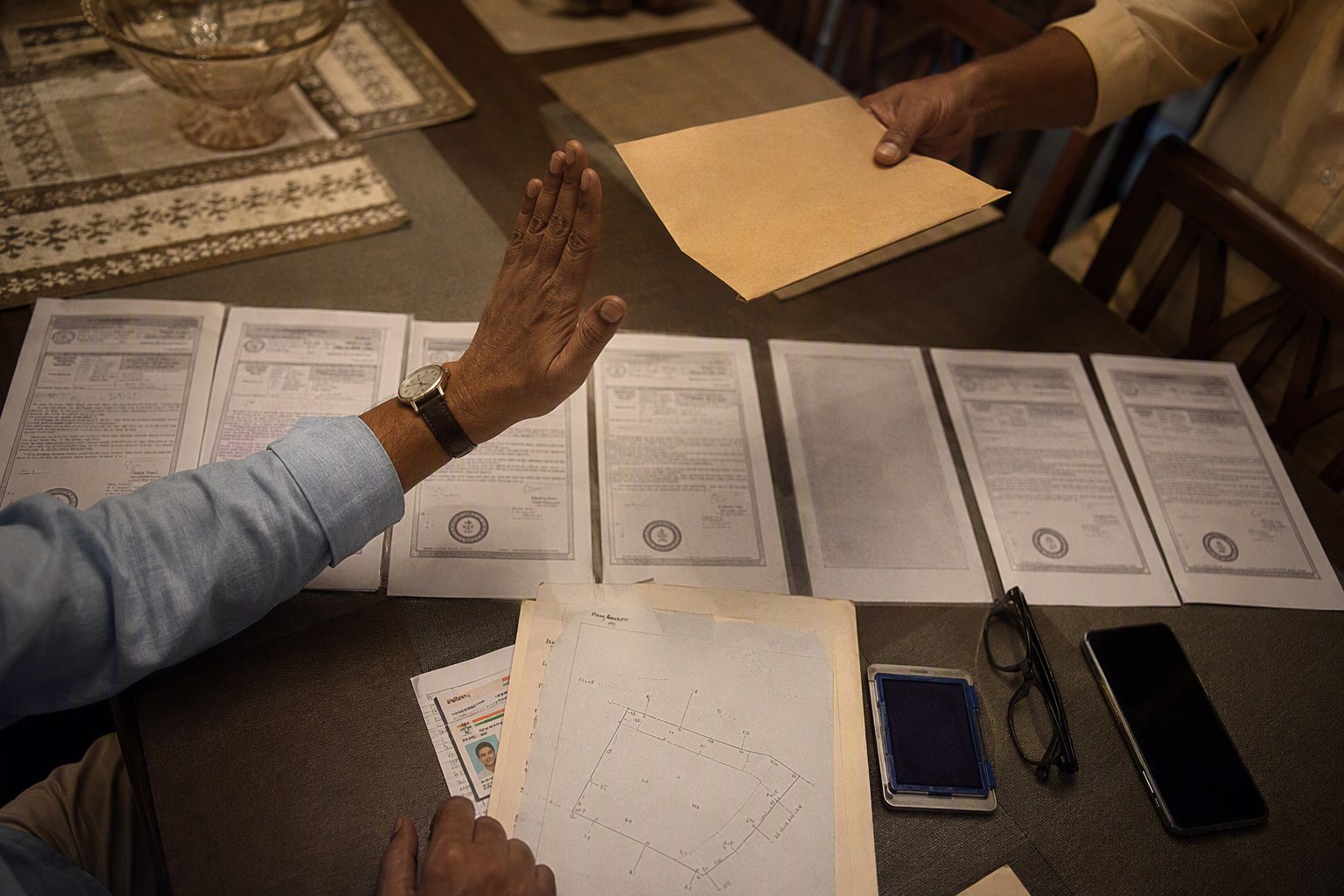



Hyderabad Plot Deal Paused After One Verification Check
Hyderabad Plot Deal Paused After One Verification Check: a city-based IT professional stopped a ₹1.03 crore open plot purchase near Bachupally last week after an early prohibited-property screening flagged the survey-number cluster for closer scrutiny. The buyer had already negotiated the rate, token amount and registration timeline. One online check changed the mood of the deal.
The plot under discussion measured 267 square yards and was being quoted at ₹38,500 per square yard, a familiar asking band in fast-moving pockets around Bachupally, Mallampet and Bowrampet in Medchal-Malkajgiri district. The buyer was not rejecting the land outright. He simply paused payment till the seller could produce cleaner records from the mandal office, SRO and Dharani trail.
In our experience, the smartest buyers in Hyderabad are not the ones who bargain the hardest. They are the ones who verify before emotions take over.
The case matters because Telangana already has 147,934 prohibited properties recorded under the Section 22-A backdrop. That number is large enough to make early screening a basic step, not a lawyer-only luxury at the end of the transaction.
Hyderabad Plot Deal Paused After One Verification Check: what happened
The buyer, a 36-year-old professional living in Gachibowli, had been searching for a west-side plot for about three months. His shortlist covered Bachupally mandal, Dundigal-Gandimaisamma mandal and a few resale plots near Nizampet. Like many end-users, he wanted a plot close enough to Miyapur, Kukatpally and Financial District, but not at premium Tellapur or Nallagandla pricing.
The seller introduced the asset as a clear-title resale plot in a layout with internal roads, electricity poles and houses already coming up nearby. The plot was said to be part of an old layout. The proposed payment schedule was simple: ₹5 lakh token, agreement of sale within seven days, registration within 30 days at the local SRO.
Before transferring the token, the buyer’s cousin ran the survey number through Verified.RealEstate’s Section 22-A Prohibited Property Check. That was the pause point. The result did not say the exact 267 sq yd plot was doomed. It indicated that the survey-number range needed a deeper look because related land records had a prohibition reference requiring confirmation.
That distinction is crucial. A flag is not a court judgment. But it is enough reason to stop the token payment, ask for documents and verify the parent land. Once money moves, negotiation power shifts to the seller.
Hyderabad Plot Deal Paused After One Verification Check, not after full legal due diligence
This was not a 40-page legal opinion. It was not a bank loan technical report. It was one early check done before the buyer lost control of the transaction. That is exactly why the case is useful for regular Hyderabad buyers.
The buyer had the usual documents on WhatsApp: layout copy, link document PDF, latest tax receipt, old EC screenshot and a hand-marked plot plan. What he did not have was a clean connection between the plot, the survey number, the parent extent, the conversion record and the SRO registration history.
We have seen this pattern in Mokila, Shankarpally, Adibatla, Tukkuguda, Kandukur, Ghatkesar, Shamirpet and Patancheru also. The brochure looks neat. The road exists. Neighbours are building. But the survey number story may still have gaps.
In this Bachupally-side case, the seller first said the issue was only an old data entry problem. That may be true in some cases. Telangana land data has legacy mismatches, old village maps, assigned land references, government land notations and court-related entries. But a buyer cannot accept oral comfort for a crore-rupee plot.
The numbers in this Hyderabad plot case
Here is the transaction snapshot, based on the anonymised details reviewed by our team.
| Item | Case detail |
|---|---|
| Location belt | Bachupally-Mallampet side, Medchal-Malkajgiri district |
| Mandal reference | Bachupally mandal |
| Plot size | 267 sq yd |
| Quoted rate | ₹38,500 per sq yd |
| Quoted total value | About ₹1.03 crore |
| Token discussed | ₹5 lakh |
| Proposed registration window | 30 days |
| Early red flag | Prohibition reference on survey-number screening |
| State backdrop | 147,934 prohibited properties in Telangana |
The rate itself was not unbelievable. In several micro-markets around Bachupally and Mallampet, resale plotted land can move sharply depending on road width, layout quality, drainage, access to ORR, distance from Miyapur Metro, and whether the plot sits inside a gram panchayat, HMDA-approved layout or older regularised layout. A ₹38,500 per sq yd ask is not shocking for a usable 267 sq yd plot in a developed pocket. That is why the buyer was ready to proceed.
The concern was not price. It was title risk.
Why one verification check changed the deal
The buyer’s first assumption was simple: if the seller has a registered sale deed and neighbours have built houses, the land should be safe. That assumption is risky in Telangana plotted land.
A registered document proves that a document was registered. It does not automatically prove marketable title, valid conversion, absence of government claim, absence of assigned land issue, or clean parent ownership. The SRO registers documents based on available inputs and restrictions. The buyer must still connect the dots.
The prohibited-property screening raised three practical questions:
- Is the survey number or part of it listed in any government, assigned, endowment, wakf, evacuee, ceiling surplus or court-related category?
- Was the layout carved out from a parent land parcel that had a restriction before plotting?
- Are the plot boundaries and parent survey extent matching village records, pahani entries and earlier sale deeds?
When these questions arise before token payment, the buyer has options. He can ask the seller for certified copies, updated Dharani extracts, mutation trail and clarification from the mandal revenue office. If the seller refuses, the buyer can walk away without chasing refund.
Checks the buyer ordered after the plot was flagged
Once the early flag appeared, the buyer did not panic. He moved the deal into verification mode. That is the right response.
1. Survey number mapping
First, the team checked whether the plot number in the layout matched the claimed survey number and village. Buyers often focus on the plot number because that is what appears on the layout plan. Revenue records work on survey numbers and extents. You can use the Survey Number Finder to start this mapping before asking for certified documents.
2. SRO jurisdiction check
Next, the buyer verified the correct Sub-Registrar Office. In Hyderabad’s growth corridors, buyers sometimes confuse municipal limits, mandal limits and SRO limits. A Bachupally-side property may not follow the same office assumption as a Nizampet or Kukatpally apartment. The Find Your SRO Office tool helps avoid that basic mistake.
3. Encumbrance search
The buyer then checked the EC trail through the Encumbrance Certificate Search. EC is useful to see registered transactions, mortgages and document flow. But EC alone is not enough. It will not always reveal revenue prohibitions, family disputes not registered as encumbrances, physical possession fights or wrong survey mapping.
4. Guideline value and stamp duty planning
The quoted market price was ₹38,500 per sq yd. The buyer also checked the government market value through the Market Value / Guideline Value Search. This matters because registration charges are based on the higher of declared consideration and market value. After that, he used the Stamp Duty Calculator to estimate cash outflow for registration. In Telangana, sale deed costs commonly include stamp duty, transfer duty and registration fee. For a crore-rupee plot, even a small rate assumption changes the cheque size.
5. Wider title review
Finally, the buyer submitted the details through the Property Verification Tool for a wider look at title, survey consistency, revenue references and registration history. This is where a buyer moves from quick screening to decision-grade review.
Why Telangana’s 147,934 prohibited-property number should influence Hyderabad buyers
The figure of 147,934 prohibited properties is not a small clerical list. It is a reminder that Telangana’s property market has layers. Some are old revenue layers from combined Andhra Pradesh days. Some relate to assigned lands. Some involve government lands, endowment lands, wakf entries, court orders or disputed public-interest categories.
I do not advise buyers to treat every flag as fraud. That would be unfair to genuine sellers also. Many old entries need updating. Some parcels get wrongly clubbed at survey-number level even though a sub-division or approved layout may have a clearer position. Still, the burden is on the seller to clarify.
For Hyderabad plot buyers, the danger is speed. A broker says three other buyers are waiting. A seller says token today or price changes tomorrow. A relative says land always appreciates near ORR. In such moments, buyers skip the least expensive checks and reserve all verification for after agreement.
That order is wrong. Do the cheap checks first. Spend on legal review after the basic data looks acceptable.
Local market context: why plots around Bachupally attract this pressure
Bachupally, Mallampet, Bowrampet and Dundigal have become attractive because they sit between established employment and emerging residential demand. Miyapur Metro, JNTU, Nizampet, Pragathi Nagar and Kukatpally provide city-side connectivity. ORR access through Dundigal and the wider north-west corridor gives long-term appeal.
Buyers who cannot stretch to Tellapur, Osman Nagar or prime Nallagandla often look here for 200-300 sq yd plots. Compared with inner Hyderabad apartments, land feels more controllable. You can build a duplex later, keep it for children, or sell during the next infrastructure cycle.
That emotional comfort is exactly why documentation must be strict. Plotted land has more moving parts than a ready apartment. You must look at layout approval, road width, land-use zoning, OSR, conversion, parent title and access road rights. If you plan construction, tools like the Road Width Check, Land Use Zone Finder and FSI/FAR Calculator become relevant after title comfort is reached.
What the seller was asked to produce
After the flag, the buyer sent a clear document request instead of arguing on the phone. This is a good practice. Written requests reduce confusion and test seller confidence.
- Certified copy of current sale deed and previous link documents.
- Latest EC for at least 30 years, where available.
- Layout approval or regularisation record, with plot number and survey number mapping.
- Revenue records, including pahani or relevant Dharani extracts for parent land history.
- Mutation trail showing how ownership moved from parent pattadar to current seller.
- Clarification on the prohibited-property reference for the survey-number cluster.
- Tax receipts, possession proof and physical boundary confirmation.
The seller agreed to provide link documents but pushed back on revenue clarification, saying registration had happened earlier without issue. That response did not satisfy the buyer. Previous registration may reduce doubt, but it does not remove it.
What happened to the ₹5 lakh token
The token was not paid. That is the biggest win in this case.
Many buyers transfer ₹2 lakh, ₹5 lakh or ₹10 lakh after a site visit, assuming the amount is refundable if documents fail. Reality is messier. Refund terms may be oral. Brokers may deduct expenses. Sellers may delay. Families end up spending weeks on calls for their own money.
Here, the buyer told the seller that token would be released only after the prohibited-property clarification and title review. The seller asked for two days. Then four days. As of the latest update shared with us, the deal remains paused.
That is not a failure. In Hyderabad land buying, a paused deal is often a protected deal.
Red flags that buyers should not ignore in Hyderabad plot deals
From this case, I would put these warning signs on a buyer’s checklist:
- The seller insists on token before sharing link documents.
- The broker gives only plot number, not survey number and village.
- The layout plan has no approval reference or unclear boundaries.
- The EC is shown as a screenshot, not checked independently.
- The parent land extent in documents does not match the layout extent.
- The seller says Dharani is not needed for plotted land, without explaining the parent trail.
- The survey number has a prohibited-property or court-related reference.
- The access road exists physically but is not clear in documents.
One red flag may be explainable. Three red flags together should slow the buyer immediately.
How to handle a flagged survey number without overreacting
If your Hyderabad plot search throws up a prohibited-property reference, do not jump straight to cancellation. Follow a calm sequence.
First, confirm you entered the correct district, mandal, village and survey number. Telangana has many similar village names and old-new jurisdiction changes. Second, check whether the flag applies to the whole survey number or a portion. Third, ask for sub-division details, layout approval and the parent title chain. Fourth, compare EC records with revenue records. Fifth, take a property lawyer’s opinion before agreement or registration.
We’ve seen genuine plots survive this process. We’ve also seen buyers saved from messy land where the seller had confidence but not proof.
What this case says about Hyderabad plot buying in 2026
The Hyderabad plot market is becoming more data-driven, but not fully clean. Buyers now have better online tools, Dharani access, SRO data points, EC searches and market-value references. Still, local ground verification remains essential. A plot is not only a point on Google Maps. It is a legal slice of a revenue survey number.
My view is simple: do not treat verification as a post-negotiation formality. Treat it as part of price discovery. If a plot has clean title, proper layout, good road width and correct land use, it deserves a stronger price. If documents are weak, the discount should be heavy or the deal should be avoided.
For this Bachupally-side buyer, one check prevented a rushed ₹5 lakh token and a possible ₹1.03 crore exposure. That is the real lesson. Hyderabad land can create wealth, but only when the paperwork is as attractive as the location.
Buyer checklist before paying token for a Hyderabad plot
- Get survey number, village, mandal and district before site visit enthusiasm takes over.
- Run a prohibited-property check at the beginning, not after agreement.
- Check EC independently and compare it with link documents.
- Verify SRO jurisdiction and guideline value.
- Ask for layout approval, conversion and revenue trail.
- Check road width, land-use zone and buildability if you plan construction.
- Put token conditions in writing, including refund terms if title fails.
- Do not rely only on neighbour construction as proof of clean title.
Hyderabad buyers are becoming sharper. Sellers with clean documents should welcome this. Sellers who avoid basic checks are telling you something without saying it directly.
Frequently Asked Questions
Does a prohibited-property flag mean the Hyderabad plot is illegal?
Not always. A flag means the survey number or related land record needs deeper verification. It may be a partial restriction, old entry, data mismatch or genuine title risk. Do not pay token until the seller gives documentary clarification.
Should I check Section 22-A before or after paying token?
Check it before paying token. Once money is transferred, getting a refund can become difficult even if the documents later show problems. Early screening keeps control with the buyer.
Is EC enough for buying a plot in Bachupally or other Hyderabad suburbs?
No. EC shows registered transactions and some encumbrances, but it does not fully prove revenue title, land-use compliance, layout approval or absence of government-related restrictions. Use EC along with survey, Dharani, SRO and legal checks.
What documents should I ask from a plot seller in Telangana?
Ask for current sale deed, link documents, EC, layout approval, survey mapping, revenue records, mutation trail, tax receipts, conversion or regularisation papers and any clarification related to prohibited-property entries.
Can I buy a plotted land parcel if neighbouring houses are already built?
Neighbouring construction is a positive ground signal, but it is not legal proof. Your plot must have its own clean title, correct survey mapping, access, layout status and registration eligibility.