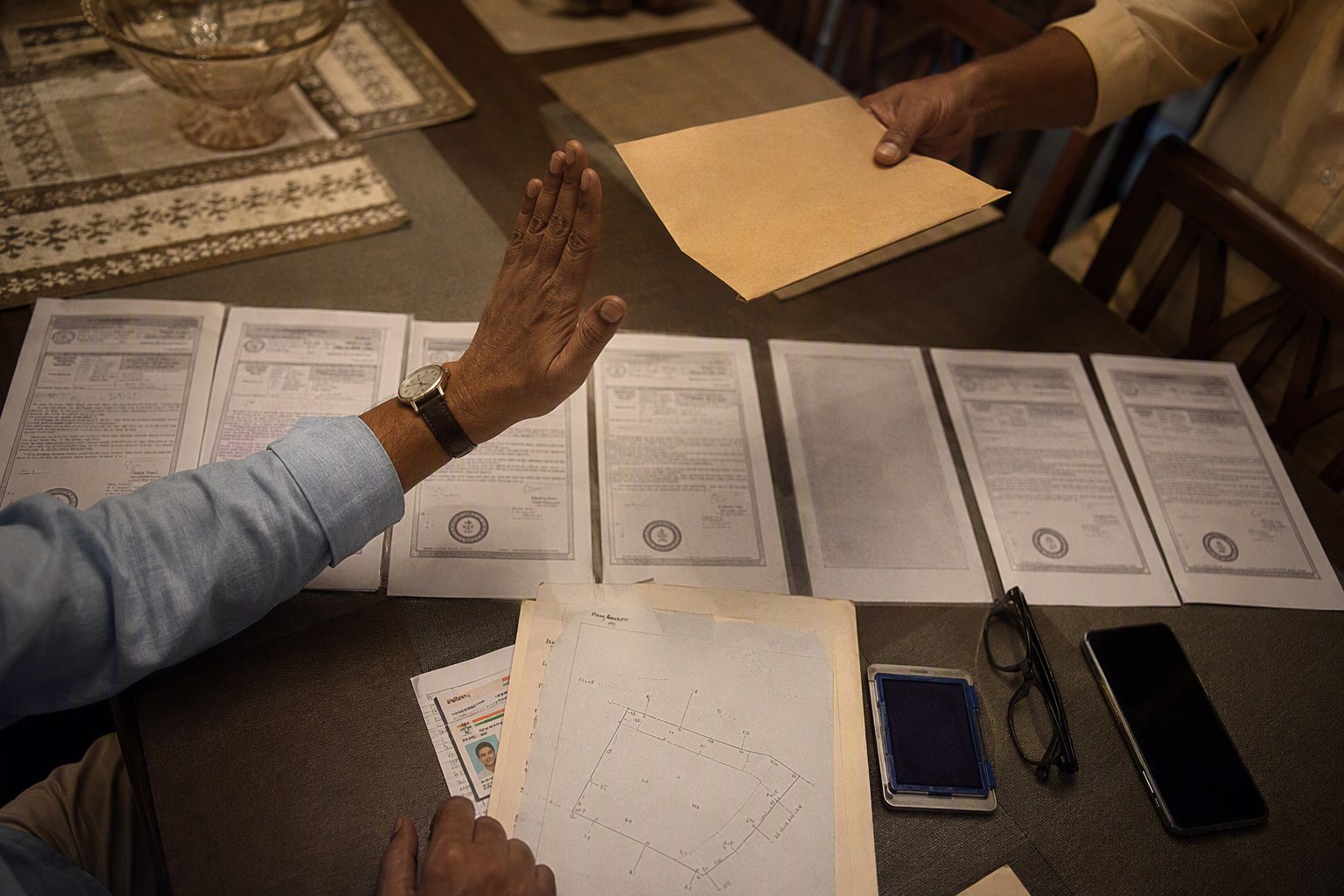



Hyderabad Case Study: Flat on a Partly Blocked Plot — why 22-A still matters
Hyderabad Case Study: Flat on a Partly Blocked Plot starts with one hard number: Telangana has 1,47,934 prohibited property records under Section 22-A. That is not a small clerical pile sitting in some back office. It touches real transactions in Hyderabad, Rangareddy, Medchal-Malkajgiri and Sangareddy every week. Some are obvious land parcels. Some are old survey numbers hidden under polished apartment towers. In our experience, the dangerous cases are not always open plots. They are resale flats where the building looks occupied, the maintenance is running, the bank loan was once sanctioned, but the underlying land survey number carries a partial 22-A flag.
This case study is about one such flat in West Hyderabad. The buyer liked the location, the price was sensible, and the seller had a clean-looking sale deed. The twist came later: the flat was built on a plot that had multiple sub-divisions, and one portion of the parent survey number was blocked in prohibited property records. Not the full apartment. Not the full land. A partial flag. That is exactly where many buyers get confused.
Our simple view: a resale flat is not clean just because the apartment door number exists, the EC shows past sale deeds, and the society has a WhatsApp group. The land beneath the building still has to be checked at survey number level.
Hyderabad Case Study: Flat on a Partly Blocked Plot — the data signal
Section 22-A of the Registration Act allows certain properties to be kept out of registration. In Telangana, these records can include government lands, assigned lands, endowment lands, waqf-related entries, court-disputed lands, ceiling surplus lands and other categories. The buyer generally sees only the final effect: the SRO may refuse registration or ask for clarification when a document is presented.
The figure of 1,47,934 prohibited property records should make Hyderabad buyers slow down, especially in areas where village lands became apartment corridors over the last 20 years. Think of Gachibowli, Kondapur, Narsingi, Manikonda, Puppalaguda, Miyapur, Hafeezpet, Tellapur, Kollur, Bachupally, Kompally and parts of Uppal. These are not bad markets. In fact, many are among the strongest residential pockets in Telangana. But rapid urban conversion means older pahani entries, survey number splits, layout approvals, mutation trails and SRO records do not always speak in one clean voice.
Before paying token advance, a buyer should run three basic checks: survey number, prohibited property status, and EC. On Verified.RealEstate, start with the Survey Number Finder, then check the Section 22-A Prohibited Property Check, and compare document history through the Encumbrance Certificate Search. These are not replacement for a lawyer, but they stop you from walking blind into a deal.
The flat: a good Hyderabad resale deal on paper
The property in our case was a 2 BHK resale flat near the Kondapur-Miyapur side, in a pocket where office commuters from HITEC City, Gachibowli and Financial District actively search. The apartment was around 1,150 sft. The building was eight years old. The quoted price was roughly in the same band as many mid-market resale flats in that stretch: not a distress sale, not an inflated NRI quote either.
For context, many resale discussions in Kondapur, Hafeezpet and Miyapur run anywhere from about Rs 6,500 to Rs 10,500 per sft depending on exact road access, builder name, UDS, age, parking, metro approach and society maintenance. Newer gated communities in Kondapur and Gachibowli can ask much higher. Miyapur and Bachupally may give better ticket sizes, while Narsingi and Kokapet pricing behaves differently because of Financial District demand. The buyer here was not chasing a miracle rate. That made the deal feel believable.
The seller had these documents ready:
- Registered sale deed in the seller’s name
- Previous link document from the builder
- Municipal tax payment receipts
- Electricity bill and society NOC
- Old EC showing the builder sale deed and current owner transaction
- Approved building plan copy, though not very neatly scanned
At this stage, many buyers relax. The flat exists, the seller has a registered deed, and the EC does not show a mortgage. The buyer even used our Stamp Duty Calculator to estimate transaction cost. In Telangana, the usual registration outgo for sale transactions is commonly calculated around stamp duty, transfer duty and registration fee, adding up to about 6% in many standard cases. For a Rs 75 lakh flat, that can be around Rs 4.5 lakh before other costs. So the buyer wanted to lock the deal quickly.
Hyderabad Case Study: Flat on a Partly Blocked Plot — where the doubt started
The first red flag was not dramatic. It was a mismatch in survey number presentation. The sale deed mentioned the apartment land as part of a larger survey number, with a sub-division reference in the schedule. The building plan used a slightly different format. The EC indexed the property with the flat number and builder name, but the land schedule was not easy to map. The pahani extract shown by the seller was old and not updated to the current urban status.
We asked for the parent land link documents. The seller was cooperative but said, quite honestly, that he had never checked them. He bought from the builder when the project was new, took a bank loan, and assumed the bank legal team had verified everything. This is a common Hyderabad belief. Bank approval helps, but it is not a lifetime guarantee. Banks check for loan security at that time. They may not catch every land classification issue, and they may not re-check fresh 22-A entries after the loan is closed.
Using the survey details, the buyer checked the entry through the Section 22-A Prohibited Property Check. The result did not say the flat number was blocked. It showed that a related survey number had a prohibited entry for a portion. That is where the word partly became the whole story.
What does a partial 22-A flag mean for an apartment buyer?
A partial 22-A flag means the entire parent survey number may not be prohibited. Only a certain extent may be marked, or only a particular sub-division may be affected. For agricultural land, this may be easier to understand: out of 5 acres, perhaps 1 acre has a dispute or government classification. For apartments, it becomes harder because the buyer is dealing with undivided share of land, not a fenced plot.
Suppose a builder acquired land in Survey No. 120, 121 and 122 of a village. Later, one portion of Survey No. 121 is flagged under 22-A. If the project’s approved land parcel includes a cleanly demarcated portion outside the prohibited extent, the buyer may be safe after proper verification. If the project land overlaps the prohibited extent, then resale registration can become risky. If the records are unclear, the SRO may insist on clarification from revenue authorities.
In this case, the flat was not automatically bad. That is the nuance. A partial flag is not the same as saying the whole apartment complex is illegal. But it is also not something to ignore with the line, builder sold so many flats, what can happen now? We have seen SRO objections come up at the resale stage even when earlier documents were registered.
The locality angle: Hyderabad growth hides old village records
Many Hyderabad homebuyers forget that today’s apartment clusters were yesterday’s village survey numbers. Kondapur falls in Serilingampally side of Rangareddy district administration history, while Miyapur is part of the old Ranga Reddy-Hyderabad urban expansion story and now connected closely to Medchal and GHMC systems. Puppalaguda and Manikonda are linked to Gandipet/Rajendranagar side records. Narsingi, Kokapet and Tellapur have their own rapid growth patterns across Rangareddy and Sangareddy districts.
When land changes from agricultural use to residential use, the paper trail should ideally show:
- Clear ownership flow through link documents
- Mutation or revenue record continuity where applicable
- Conversion or layout permissions if required
- HMDA or GHMC approval status, depending on location and time
- RERA registration for applicable projects
- No adverse 22-A entry affecting the project land
For newer projects, buyers should also check the RERA Project Lookup. For older resale flats, RERA may not help if the project predates registration requirements, so land and EC checks become even more critical.
The verification table we prepared for the buyer
We made a simple issue table before the buyer paid any further advance. This is the kind of working sheet I like because it separates fear from fact.
| Item checked | What appeared clean | What needed deeper checking |
|---|---|---|
| Sale deed | Seller name, flat number, parking and UDS mentioned | Land schedule referred to parent survey number with sub-division |
| EC | Current owner purchase reflected, no visible mortgage | EC is transaction history, not proof that land classification is clean |
| Building plan | Plan copy existed and matched broad building layout | Need to match approved plot boundary with survey map |
| 22-A check | No flat-wise prohibition shown | Parent survey number had partial prohibited entry |
| Market value | Price looked reasonable for the micro-market | Guideline value and market rate do not cure title defects |
The buyer also checked the location’s official value using our Market Value / Guideline Value Search. This helped for budgeting and under-valuation risk. But I told him clearly: ready reckoner value is not a title certificate. A property can have a guideline value and still have a 22-A issue.
How the SRO angle changed the decision
The buyer then identified the correct registration office using the Find Your SRO Office. This matters because Hyderabad buyers often assume any nearby SRO can register any flat. Jurisdiction is based on the property location. A Kondapur-side property may not fall where a buyer casually expects, especially near borders of mandals and municipal limits.
The document writer informally said registration should go through because many flats in the building were already registered. I do not dismiss document writers; experienced ones know SRO behaviour very well. But oral comfort is not enough when there is a partial prohibited entry. The buyer’s lawyer asked for written clarification or at least revenue-side mapping of the affected extent. That is the correct approach.
The seller felt this was over-cautious. His point was also understandable: he had bought legally, paid stamp duty, lived there for years, and paid property tax. But resale due diligence is not an insult to the seller. It is a check on records. Good sellers should welcome it because it protects their own transaction from last-minute failure.
What we found in the land trail
The parent land had been split across multiple transactions before the apartment project came up. One older link document described a larger extent. Later documents carved out smaller pieces. The builder’s acquisition deed referred to boundaries, but the survey sketch available with the seller was not enough to prove that the project land stayed completely outside the prohibited portion.
The prohibited record was linked to a portion that appeared to be on one side of the parent survey number. The apartment compound, based on physical location, seemed outside that side. But physical assumptions do not close a title file. We needed a reliable mapping between the approved layout/building plan and the revenue sketch.
At this point, the buyer had three options:
- Proceed based on past registrations and take the risk
- Ask seller to obtain clarification from revenue/SRO side before sale
- Walk away if clarification was delayed or refused
My opinion was clear: do not proceed with only verbal assurances. Hyderabad resale inventory is large enough. A buyer should not gamble lakhs of rupees because the flat has good ventilation and a nice east-facing balcony.
The money risk: why partial flags can become expensive
Let us look at the numbers. Assume a resale price of Rs 75 lakh. Token advance may be Rs 1 lakh to Rs 5 lakh. Agreement advance can be 10%, so Rs 7.5 lakh. Registration cost may be around Rs 4.5 lakh in common Telangana sale scenarios. Interior repairs, shifting and brokerage can add another Rs 2 lakh to Rs 6 lakh. If a 22-A issue blocks registration after the agreement, the buyer may spend months recovering advance or renegotiating.
If the buyer is selling another property to fund this purchase, capital gains planning also gets disturbed. In such cases, check tax impact early using the Capital Gains Tax Calculator. A title delay can affect exemption timelines under income tax planning, especially where the buyer is trying to reinvest sale proceeds.
There is also a loan angle. Some banks may sanction initially based on flat documents and later hold disbursement if legal re-check raises the survey number issue. A few private lenders may move faster, but that does not mean the title is safer. Fast loan processing is not land verification.
How buyers should verify a resale flat on such land
Here is the practical checklist we use for Hyderabad resale flats where the land schedule has old village survey references:
1. Read the schedule, not only the first page
The first page of a sale deed shows parties and document number. The schedule tells you the land identity. Check survey number, sub-division, extent, boundaries, UDS and parking. If the schedule is vague, ask questions before paying advance.
2. Match flat documents with land documents
Builder sale deed, development agreement, GPA, landowner share documents, link deeds and approved plan should broadly match. If the building stands on multiple survey numbers, list each one.
3. Run 22-A check at survey number level
Do not search only by apartment name. Use survey number and village/mandal details. The Section 22-A Prohibited Property Check is a good starting point.
4. Pull a fresh EC
Do not depend on an EC downloaded two years ago. Use the Encumbrance Certificate Search and check recent activity. EC will not solve 22-A, but it shows mortgages, sales, releases and possible litigation references in registered documents.
5. Check market value and SRO jurisdiction
Use the Market Value / Guideline Value Search and Find Your SRO Office. This helps you plan stamp duty and avoid jurisdiction confusion.
6. Get a written legal opinion
For partial flags, a lawyer should compare the prohibited extent with the project land. If needed, ask for a survey sketch, revenue clarification, or SRO guidance. Do not rely only on society gossip.
Hyderabad Case Study: Flat on a Partly Blocked Plot — final outcome
The buyer did not cancel immediately. He gave the seller a fair chance to produce clarification. The seller approached the builder’s office, which produced some old approval papers but not a clear revenue mapping. The society secretary said many flats were registered earlier, which was useful background but not proof. After two weeks, the seller could not provide a satisfactory document showing that the apartment land was fully outside the prohibited portion.
The buyer withdrew before signing the sale agreement. He lost only a small inspection expense and legal fee, not a large advance. One month later, he shortlisted another flat in the same broad corridor, this time with cleaner land schedules and no related 22-A concern. The price was slightly higher by about Rs 3 lakh, but the transaction moved without anxiety.
Some readers may feel he was too cautious. I disagree. When a database contains 1,47,934 prohibited property records, caution is not negativity. It is market discipline. Hyderabad’s property market rewards fast decisions, yes, but only after the basic land checks are done.
What sellers can learn from this case
This is not only a buyer lesson. Sellers of resale flats should prepare a clean title pack before listing the property. If your apartment is on land with old survey numbers, keep link documents, approved plan, latest EC, tax receipts, loan closure letter, and any land clarification available. If a partial 22-A flag exists in the parent survey number but your project land is unaffected, prove it with documents. That can protect your sale price.
Hyderabad buyers are becoming sharper. They compare Kondapur with Nallagandla, Miyapur with Bachupally, Kokapet with Narsingi, and Kompally with Suchitra not only on price per sft but also on title comfort. A seller who answers land questions clearly will close faster.
Verified.RealEstate view
A flat is a share in land plus a right to occupy built-up space. Hyderabad apartment buyers often focus on carpet area, amenities, floor rise, clubhouse, road width and rental yield. All of that matters. But the land schedule is the foundation of the deal.
Partial 22-A flags are tricky because they sit between clean and blocked. They need mapping, not panic. They need documents, not assumptions. If you are buying a resale flat in Hyderabad, especially in fast-grown corridors of Rangareddy, Medchal-Malkajgiri and Sangareddy, check the survey number before you negotiate the sofa and modular kitchen value.
Use the tools, speak to the correct SRO, take a lawyer’s written view, and keep your advance conditional on title clearance. That one clause can save you from a long fight.
Frequently Asked Questions
Can a resale flat be affected by Section 22-A if the flat was registered earlier?
Yes. Earlier registration does not always guarantee that a later resale will pass without objection. If the underlying survey number has a partial or fresh prohibited entry, the SRO may ask for clarification.
Does a partial 22-A flag mean the entire apartment project is illegal?
No. It may affect only a portion of the parent survey number. The key question is whether the project land overlaps with the prohibited extent. That needs document and survey-level verification.
Is an Encumbrance Certificate enough for buying a Hyderabad resale flat?
No. EC shows registered transactions and some encumbrances, but it does not by itself prove land classification or remove 22-A risk. Use EC along with survey number, pahani, link document and prohibited property checks.
Should I pay advance before checking 22-A status?
Preferably no. If you must pay a small token, write that it is refundable if title, SRO, loan or 22-A verification fails. Avoid large agreement advances before land checks.
Which tools should I use before buying a resale flat in Hyderabad?
Start with survey number search, 22-A prohibited property check, EC search, guideline value search and SRO finder. For newer projects, also check RERA details.