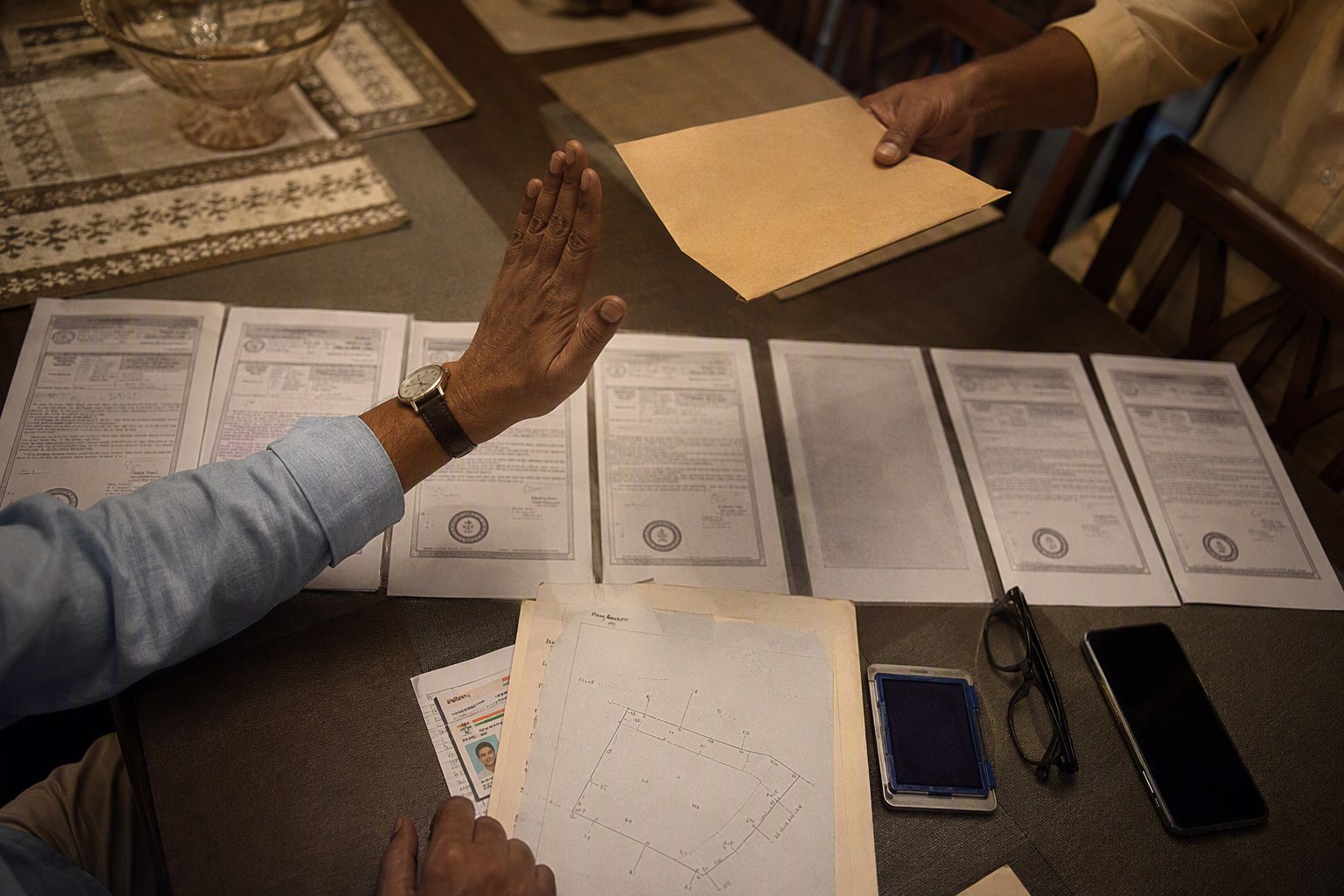



Telangana Case Study: NALA Gap That Paused a Plot Sale
Telangana Case Study: NALA Gap That Paused a Plot Sale starts with a number every plot buyer should take seriously: Telangana has 147,934 Section 22-A prohibited property records. Most buyers stop after checking whether their survey number is blocked under 22-A. In our experience, that is only the first gate. A plot can be free from the prohibited list and still get paused at the bank, SRO, or legal scrutiny stage if NALA conversion, pahani entries, layout papers, and land-use zoning do not speak the same language.
This case came from the Tukkuguda-Raviryal side of Maheshwaram mandal, Ranga Reddy district, one of the most active plot markets around ORR Exit 14, Srisailam Highway, Aerospace Park, and the airport employment belt. The buyer had a clean-looking file. No 22-A hit. No mortgage in the Encumbrance Certificate. Seller had pattadar passbook copies and an old NALA order. Still, the sale was paused for nearly a month because the NALA order covered one extent and one survey subdivision, while the plot being sold was traced to another subdivision after Dharani updates.
Our view is simple: 22-A tells you whether registration may be blocked by a prohibited classification. It does not certify that the land is safely converted, correctly zoned, or ready for residential plotting.
Telangana Case Study: NALA Gap That Paused a Plot Sale — the data lead
The figure of 147,934 prohibited property records under Section 22-A shows why Telangana buyers have become alert about banned survey numbers. In Hyderabad surroundings, we see buyers regularly checking 22-A before paying advance, especially in Shankarpally, Chevella, Maheshwaram, Kandukur, Medchal, Ghatkesar, and Yacharam mandals.
That awareness is good. But the market has created a false comfort also. Many buyers hear the words not in 22-A and assume the plot is safe. That is not how land due diligence works in Telangana.
Section 22-A mainly deals with properties barred from registration, such as certain government lands, assigned lands, endowment lands, waqf lands, protected lands, and other notified categories. If a survey number is listed, the SRO may refuse registration. You can run a quick preliminary check through our Section 22-A Prohibited Property Check. But once it is clear, the next checks matter just as much: NALA conversion, master plan land use, survey subdivision, EC, pahani, mutation trail, and layout permission.
For this case, the buyer first ran the 22-A check and got no adverse result. That was correct. The plot was not a prohibited property. The problem was different: the NALA conversion and land-use papers were not aligned with the plot boundaries and survey subdivision shown in the sale file.
Telangana Case Study: NALA Gap That Paused a Plot Sale in Maheshwaram mandal
The property was a 267 square yard open plot near Tukkuguda-Raviryal belt. The seller quoted ₹48,000 per square yard, putting the deal value at ₹1,28,16,000. This was not an abnormal number for that micro-market. In the first quarter of 2026, our field conversations show plotted resales around Tukkuguda, Raviryal, and parts of Maheshwaram commonly being discussed in the ₹38,000 to ₹55,000 per square yard band, depending on road width, layout approval, distance from ORR, and clarity of title.
Compare that with other active Hyderabad plot corridors:
| Locality / belt | Mandal / area | Observed resale plot quote range | Main buyer concern |
|---|---|---|---|
| Mokila, Velimela, Kollur side | Shankarpally / Ramachandrapuram belt | ₹45,000 - ₹75,000 per sq yd | HMDA layout status, approach road, venture approvals |
| Tukkuguda, Raviryal, Maheshwaram | Maheshwaram mandal | ₹38,000 - ₹55,000 per sq yd | NALA, land-use zoning, airport / ORR influence |
| Adibatla, Kongarakalan | Ibrahimpatnam mandal | ₹22,000 - ₹40,000 per sq yd | Industrial zone overlap, access roads, EC trail |
| Ghatkesar, Pocharam, Narapally | Ghatkesar mandal | ₹18,000 - ₹35,000 per sq yd | Layout permission, nala / lake buffers, title chain |
| Kokapet, Narsingi, Gandipet belt | Gandipet / Rajendranagar side | ₹1,20,000 - ₹1,80,000 per sq yd | High value title risk, UDS clarity, SRO market value |
These are market observation bands, not government values. For registration planning, buyers must separately check the ready reckoner or market value through the Market Value / Guideline Value Search. Telangana registration charges are usually calculated on the higher of document value and government market value, so under-quoting in an agreement will not help if the SRO value is higher.
What looked clean at first glance
The buyer was a Kondapur-based IT professional buying the plot for future house construction. The seller was a local landowner family that had already sold a few plots in the same pocket. The initial file had these papers:
- Sale deed of the larger agricultural land in favour of the seller family.
- Dharani pattadar passbook extract.
- Recent pahani showing the seller name.
- Old NALA conversion order.
- Handed-over layout sketch used for marketing the plots.
- Latest EC for 19 years.
- Draft sale agreement for 267 sq yd at ₹48,000 per sq yd.
The buyer did three good things before paying the full advance. He checked the survey number through the Survey Number Finder, pulled an EC using the Encumbrance Certificate Search, and checked whether the land appeared in the 22-A prohibited property list. Nothing alarming came out at that stage.
The EC did not show any mortgage. The seller name matched the broad land ownership chain. The plot was not under Section 22-A. A less careful buyer may have gone ahead and fixed the registration date at the SRO.
But the buyer had applied for a plot loan. The bank legal team asked one plain question: Does the NALA order cover this exact plot area and does the permitted use match the land-use certificate?
Where the NALA gap appeared
The NALA order was the weak link. Telangana NALA conversion is required when agricultural land is put to non-agricultural use. For plots, this usually means the agricultural land must be converted before being used as residential layout land, subject to planning permissions and local authority rules.
In this file, the NALA order referred to an older survey description. The order covered Ac.1-20 guntas in one survey subdivision. After Dharani updates and internal family partition entries, the plot being sold was shown under a slightly changed subdivision. The layout sketch given to buyers used the newer subdivision. The NALA order did not carry a clear sketch proving that the buyer's 267 sq yd plot fell inside the converted extent.
That may sound like a clerical issue. In land transactions, such clerical gaps can become expensive. If the SRO asks for clarification on the nature of land, or if the bank refuses loan disbursement, the buyer's advance, registration date, and negotiated price all get disturbed.
The second issue was land use. The seller's file described the plot as residential. The old NALA proceedings mentioned non-agricultural conversion but did not clearly support the residential plotted layout now being sold. The master plan extract for that belt had to be checked separately. We asked the buyer to verify it through the Land Use Zone Finder and then cross-check with a certified land-use certificate where required.
This is where many Tukkuguda, Maheshwaram, Kandukur, and Adibatla files get stuck. The land may not be prohibited. The seller may genuinely own it. But if the conversion, zoning, layout permission, and survey map are not in the same line, the file becomes a negotiation risk.
The cost impact: stamp duty was not the only number
At the agreed price of ₹1,28,16,000, the buyer was planning for normal Telangana registration outgo. At the common effective rate of 7.5% for stamp duty, transfer duty, and registration fee, the approximate registration cost would be:
| Plot extent | 267 sq yd |
|---|---|
| Agreed rate | ₹48,000 per sq yd |
| Agreement value | ₹1,28,16,000 |
| Approx. registration charges at 7.5% | ₹9,61,200 |
| Total cash planning before legal costs | ₹1,37,77,200 |
You can run your own number using the Stamp Duty Calculator. In this case, the larger cost was not the stamp duty. It was uncertainty. The buyer had already blocked funds, arranged a loan, negotiated with the seller, and planned registration leave from office. A 25 to 30 day pause created pressure on both sides.
The seller first argued that since there was no 22-A entry, the buyer was over-checking. That is a common reaction in Hyderabad's plot market. Sellers often say SRO registration ayipotundi sir, meaning the document may pass at registration. But the buyer's concern was not only registration. It was future construction, resale, bank funding, and municipal approval.
How the file was corrected
The deal did not collapse. It was paused and repaired. That is why this case is useful for genuine buyers and genuine sellers.
The seller collected a certified copy of the NALA proceedings and related sketch from the revenue side. A licensed surveyor overlaid the old survey extent with the present Dharani subdivision and the layout sketch. The buyer also insisted on a land-use check, because a residential plot must be supported by the planning context, not just a sales brochure.
The correction process had four practical steps:
- Survey mapping: The plotted area was mapped against the old survey number, new subdivision, and ground boundaries.
- NALA extent confirmation: The seller produced proof that the plot fell within the converted extent. Where the old description was weak, the seller applied for a clarification.
- Land-use verification: The buyer checked whether the site fell in a land-use zone that allowed residential plotting, subject to layout rules.
- Agreement addendum: The sale agreement deadline was extended by 30 days and the seller accepted responsibility for producing corrected papers before registration.
After this, the bank legal team cleared the file with conditions. The buyer negotiated a small price reduction of ₹3 lakh because the delay was caused by seller-side documentation. Registration was completed later at the correct SRO. If you are unsure about jurisdiction, use Find Your SRO Office before fixing registration logistics.
Why 22-A clearance alone is not enough in Telangana plots
We have seen similar patterns in Mokila, Shankarpally, Kandukur, Ghatkesar, Bibinagar side, and even older gram panchayat layouts around Medchal. The file passes one test and fails another.
Here is the plain difference:
| Check | What it tells you | What it does not tell you |
|---|---|---|
| Section 22-A check | Whether the property is listed as prohibited for registration | Whether the land is converted, layout-approved, or suitable for residential use |
| EC search | Registered sale, mortgage, release, gift, partition entries | Unregistered agreements, ground disputes, wrong survey mapping |
| Dharani / pahani | Present revenue ownership and land classification entries | Planning permission and building eligibility |
| NALA order | Conversion from agricultural to non-agricultural use for a stated extent | Automatic layout approval or master plan compliance |
| Land-use certificate | Whether the planning zone supports the intended use | Title ownership or encumbrance position |
For buyers, the safest approach is to treat due diligence as a stack. One clean document does not cure another weak document. A clean EC cannot fix a missing NALA. A NALA order cannot fix a 22-A prohibition. A layout sketch cannot replace master plan land use. A sale deed cannot prove that the plotted boundary is inside the converted extent unless the survey trail supports it.
What buyers should check before paying advance
Before paying token or advance for any plot in Telangana, especially around Hyderabad growth corridors, check these items in this order:
- Survey number and village: Confirm the correct survey number, subdivision, village, and mandal. Many mistakes happen because two villages have similar names or the same seller owns land in neighbouring survey numbers.
- 22-A status: Check if the survey number is listed as prohibited. Telangana's 147,934 prohibited records are not a small risk pool.
- EC: Pull a minimum 13 to 30 year EC depending on title history. For high value plots, do not rely only on the seller's PDF.
- Pahani and Dharani entries: See whether the land is still shown as agricultural. If yes, ask for NALA and planning papers.
- NALA conversion: Check extent, survey number, boundaries, order date, and purpose. The order must cover the plot you are buying, not just some land in the same family holding.
- Land-use zone: Check whether residential use is allowed. This matters near industrial belts, conservation areas, water bodies, road widening stretches, and airport influence zones.
- Layout approval: HMDA, DTCP, municipality, or gram panchayat layout status must be understood properly. Old GP layouts need special caution.
- Road width and building potential: If your plan is to build, use tools like the Road Width Check and FSI/FAR Calculator before assuming construction value.
If you want a single starting point, upload the details through our Property Verification Tool. For plots where papers are still being corrected, the Property Change Tracker can help you monitor changes and revisit the file before registration.
Seller lesson from this Telangana NALA case
This case is not only a buyer warning. Sellers also lose money when their file is half-ready. A genuine seller in Maheshwaram, Shankarpally, or Kandukur can get a better price if the NALA order, land-use certificate, layout approval, EC, and pahani are arranged before marketing.
In this case, the seller lost ₹3 lakh in negotiation because the buyer's bank paused the deal. The seller also had to run around for certified copies after the agreement was signed. Had the file been prepared earlier, the same plot may have closed faster at the original price.
Hyderabad buyers are becoming sharper. NRIs, IT employees, doctors, and business families are no longer satisfied with one pattadar passbook and one layout sketch. They ask for SRO market value, EC, NALA, zoning, and RERA where applicable. For apartment projects and plotted developments that require project registration, buyers should also check the RERA Project Lookup.
Our opinion: the next big dispute area is not only title, it is use
Old-style due diligence focused on ownership: who sold to whom, whether the seller had right to sell, whether there is a mortgage. That is still necessary. But around Hyderabad, the next big dispute area is land use. Can this land be used as a residential plot? Is it converted? Is it inside a layout? Is it in a zone that supports the buyer's plan? Is there a buffer, road widening mark, or master plan restriction?
The Telangana plot market is moving fast in places like Tukkuguda, Kollur, Mokila, Adibatla, Ghatkesar, and Shankarpally. Rates are high enough that a small document gap can lock lakhs of rupees. A 267 sq yd plot at ₹48,000 per sq yd is not a casual purchase. With registration charges, legal fee, brokerage, and later construction planning, the family is committing well above ₹1.35 crore.
So the lesson from this case is direct: do not stop at not in 22-A. Ask the second question. Has this exact plot, in this exact survey subdivision, for this exact use, been properly converted and supported by land-use papers?
If the answer is unclear, pause before the bank or SRO pauses it for you.
Frequently Asked Questions
Is a plot safe if it is not listed under Section 22-A in Telangana?
No. A clean 22-A result only means the property is not appearing as prohibited for registration under that check. You still need to verify title chain, EC, Dharani entries, NALA conversion, land-use zoning, layout approval, and survey boundaries.
What is the NALA issue in a plot sale?
NALA refers to conversion of agricultural land for non-agricultural use. A plot sale can get paused if the NALA order does not cover the exact survey number, subdivision, extent, or intended use of the plot being sold.
Can the SRO register a plot even if NALA papers are weak?
Sometimes registration may still be attempted, but that does not make the purchase safe. Weak NALA or land-use papers can affect bank loan, future resale, building permission, and buyer confidence.
How much are registration charges for a plot in Telangana?
A common effective rate is about 7.5% including stamp duty, transfer duty, and registration fee, calculated on the applicable value. Buyers should check the latest SRO market value and use a stamp duty calculator before registration.
Which documents should I check before buying a plot near Hyderabad?
Check sale deed chain, EC, Dharani pahani, pattadar details, Section 22-A status, NALA conversion, land-use zone, layout approval, road width, and SRO jurisdiction. For high value plots, get a legal and survey review before paying a large advance.