

Case Study: A Temple Land Tag That Stopped a Plot Buyer
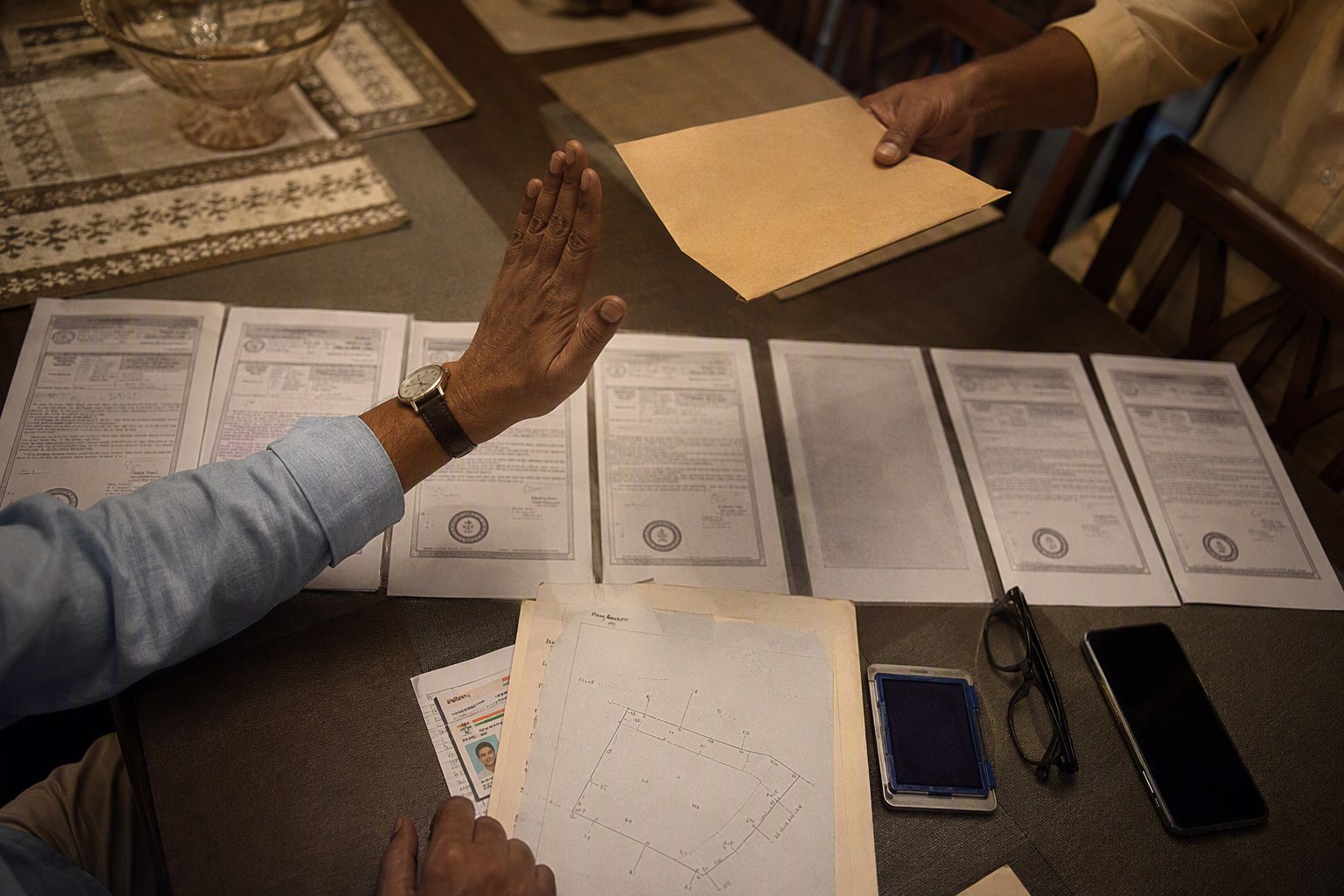
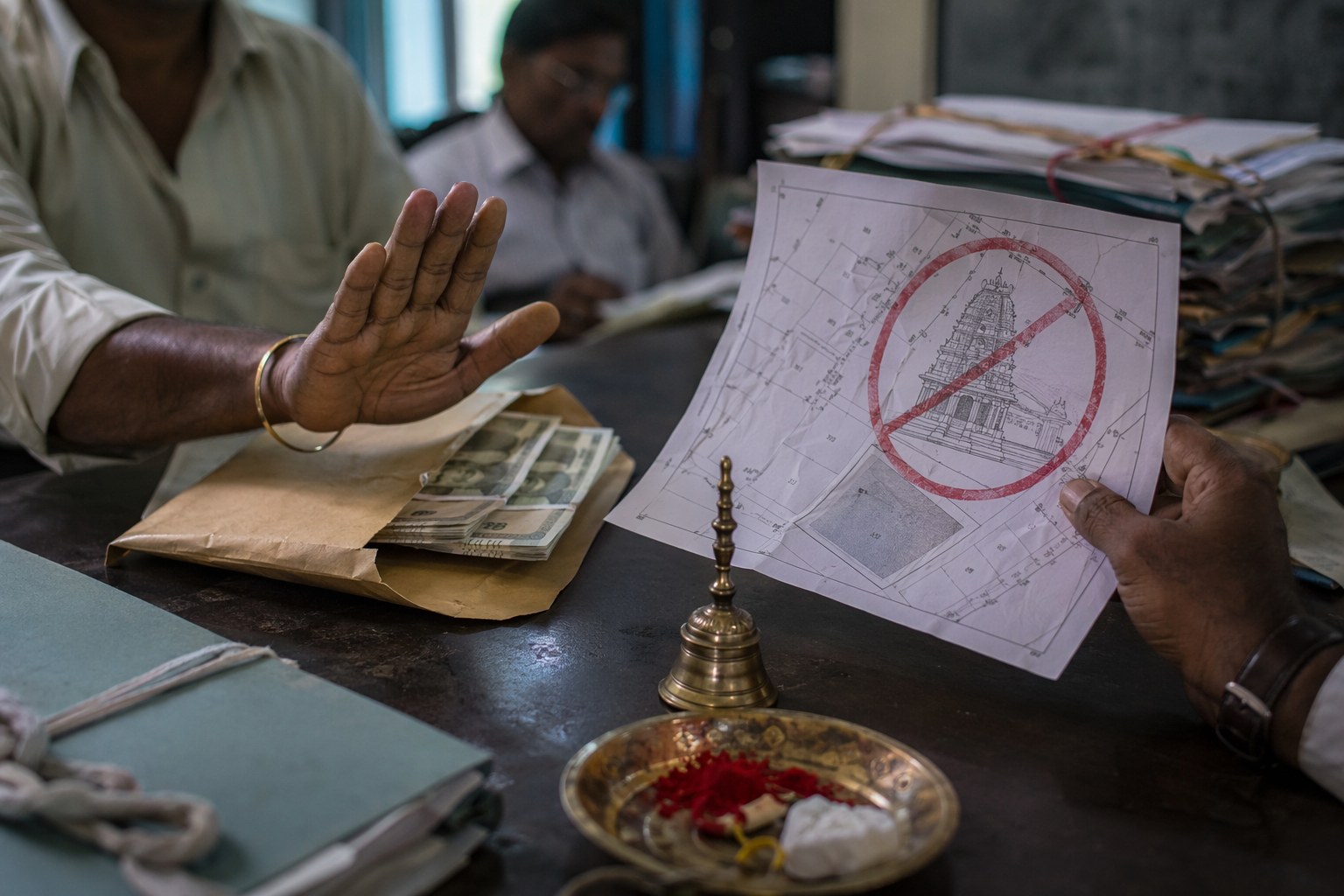
Would you pay a token for a plot if a temple land tag appeared during verification? One Hyderabad buyer almost did. The plot looked clean on the surface: good approach road, active development nearby, seller ready with photocopies, and a broker pushing for same-day token. But one line in the prohibited property check changed the mood. The land had an indication connected to temple property records. The buyer paused. In our experience, that pause saved him from a very expensive argument later.
This case is from the Hyderabad growth corridor where buyers often move fast because plots get marketed aggressively. We are not naming the buyer, seller, village, or survey number because the file is private. But the pattern is very familiar across areas like Rampally, Pocharam, Ghatkesar mandal, Mokila in Shankarpally mandal, Kollur, Tellapur, Adibatla and Ibrahimpatnam side. A plot may be shown as residential in conversation, but the survey number may still carry an old restriction, endowment reference, or mismatch in government records.
Temple Land Tag: the question that changed the deal
The buyer’s first question to us was simple: “Can I pay a small token and verify later?” My answer was no. Not because every temple land indication is automatically fatal, but because token payment changes the pressure. Once money goes out, the discussion shifts from verification to recovery.
The plot was being sold as a resale open plot in a developing layout near the eastern Hyderabad side. The seller showed a sale deed chain, tax receipts and a layout sketch. The broker said the registration would happen at the jurisdictional SRO without issue. The buyer was told that several nearby plots had already been sold. This is a common line in the market. It may even be true. But nearby registrations do not clean your survey number.
We first checked the basic identity of the land: village name, mandal, district, old and new survey references, extent, plot number, and the SRO jurisdiction. Then we ran the survey number through a prohibited property check. That is where the warning appeared. The entry was not a casual spelling mismatch. It had a temple land indication connected with the survey reference.
Our advice was direct: do not pay token, do not sign an advance receipt, and do not accept “sir, this is old record” as an explanation unless the seller produces government-backed clarification.
Temple Land Tag checks before token payment
A temple land tag usually means the buyer must slow down and verify with documents, not emotions. In Telangana, many buyers hear “22-A” only when the SRO refuses registration. By then, the advance amount, broker commission and family plans are already involved. This case did not reach that stage because the buyer checked before payment.
We used the Section 22-A Prohibited Property Check to see whether the survey reference appeared in the prohibited records. We then matched it with the village and mandal details through the Survey Number Finder. For SRO jurisdiction, the buyer checked Find Your SRO Office. These three checks are basic, but they often expose the exact issue that glossy brochures hide.
After that, we asked for the Encumbrance Certificate. An EC may show past transactions, but it does not always prove that future registration is safe. Still, it helps identify how the land moved from one person to another. The buyer used the Encumbrance Certificate Search and later planned to review the result with the EC Analyzer. We also suggested checking government market value through the Market Value / Guideline Value Search, not to decide legal title, but to understand the ready reckoner context before entering negotiation.
Why a temple land indication is not a small clerical issue
In Hyderabad and surrounding districts, buyers sometimes treat land tags as “system mistakes”. Some are mistakes. Some are old entries that need correction. Some relate only to part of a survey number. But some are serious restrictions connected with endowment, temple, waqf, government, assigned, ceiling, or other protected categories. A buyer cannot decide this by looking at the plot boundary stones.
Temple lands are especially sensitive because they may be recorded under endowment or religious institution ownership. Even if a private party has physical possession, saleability is a separate question. Possession, fencing and a past document do not automatically create clean title. A registered deed can also be challenged if the root itself is defective. That is why we told the buyer to wait for documentary clarification before paying even a nominal token.
As per latest IGRS data available in our database, Telangana’s prohibited properties dataset has 3,076,153 records under Section 22-A context. That number itself tells a practical story. This is not a rare corner issue. The database is large, and survey-level caution is required, especially in fast-moving corridors where agricultural land became layouts over time.
What we asked the seller to produce
We did not reject the plot on day one. A good verification process gives the seller a chance to clarify. But the clarification must come through proper records, not broker confidence. We asked for the following:
- Full link documents from the earliest available title deed, not only the latest sale deed.
- Latest pahani or revenue record reference showing the pattadar and land classification.
- Dharani details matching the same village, mandal and survey number.
- Any proceedings showing deletion, correction, or clarification if the land was wrongly tagged.
- Endowment department clarification or legally valid NOC, if the tag related to temple land.
- Layout approval documents, if the plot was part of a layout.
- NALA conversion or land use conversion papers, wherever applicable.
- EC for the relevant period, checked against document numbers and executant names.
The seller initially said the temple reference was old and did not apply to the plot. That answer may sound reasonable, but it is incomplete. If the survey number was subdivided, the seller must show how the plot’s portion is outside the restricted extent. If the record was corrected, the seller must show the correction order. If the entry is wrong, the seller must get it corrected before asking the buyer for money.
Where Hyderabad plot buyers usually get trapped
We have seen this mistake in several local markets. In Ghatkesar mandal, buyers are attracted by access to Warangal highway and ORR-side movement. In Shankarpally mandal, Mokila and nearby villages get strong attention because of villa and plotted development activity. Kollur and Tellapur attract IT corridor buyers who want land before apartment prices move further. Adibatla and Ibrahimpatnam get enquiries from buyers tracking aerospace, pharma and outer growth stories.
The risk is not the locality. The risk is buying only the story. A good locality can still have a bad survey number. A clean-looking layout can still sit partly on disputed land. A registered deed in the past can still face a registration block today. In Telangana, the SRO system and prohibited property records can stop a transaction even after buyer and seller agree on price.
Another trap is token pressure. The broker says, “Only small amount, sir, otherwise plot will go.” But a token receipt rarely contains enough protection. If the receipt says the amount is non-refundable, the buyer is in a weak position. If the seller delays documents, the buyer keeps chasing. If the land fails verification, refund becomes a negotiation.
The verification sequence that worked in this case
Here is the sequence we followed. This is not a theory. It is the order that helped the buyer avoid a bad hurry.
| Step | What was checked | Why it mattered |
|---|---|---|
| Identity check | Village, mandal, survey number, plot number, extent | One spelling or survey mismatch can lead to the wrong result. |
| Prohibited property check | Section 22-A and related restricted land indication | The temple land tag appeared here before token payment. |
| EC review | Past registered documents and ownership movement | It showed transaction history, but not final safety by itself. |
| Revenue record review | Pahani, Dharani, land classification | It helped compare seller claim with government record. |
| SRO confirmation | Registration jurisdiction and likely registration risk | The buyer needed clarity before fixing sale deed date. |
| Seller clarification | NOC, correction order, endowment clarification if available | Only official papers could answer the temple land concern. |
For apartment buyers, I would also check project registration through the RERA Project Lookup. For plot buyers, RERA may not always be the main check, depending on the nature of the layout, but layout approval and land title checks remain non-negotiable. If construction potential is part of the decision, buyers can later use the FSI/FAR Calculator and Road Width Check. Legal safety comes first; development maths comes later.
What happened after the buyer paused
Once the buyer refused token, the tone changed. The broker pushed for a small booking amount. The seller said documents would be arranged after advance. We insisted on the opposite: documents first, advance later. That single stand gave the buyer control.
Within a few days, the seller could not produce a clear correction order or department clarification. There was no convincing document showing that the plotted portion was free from the temple land indication. The buyer walked away. He lost time, not money. In Hyderabad real estate, that is a good result.
Some readers may ask whether the plot could still become safe later. Yes, possible. If the tag is wrong, if the restricted extent is different, or if there is a valid government clarification, the seller can clean the record. But the buyer should not fund that clean-up through token money. Let the owner resolve the record first. Then the buyer can reassess.
How to handle a temple land tag if you still like the property
If you genuinely like the location and do not want to drop the deal immediately, take a structured approach. First, freeze all payments. Second, put every query in writing. Third, ask the seller for government-backed proof. Fourth, get an independent legal opinion from an advocate who understands Telangana land records, not only sale deed drafting.
Do not rely only on EC. Do not rely only on Dharani screenshots. Do not rely only on the seller’s statement that “registration happened for neighbouring plot”. Ask for the exact survey number correlation. In older villages, survey numbers may have subdivisions, part extents, old pahanis, and later layout plotting. This is where many mistakes happen.
Use the Property Verification Tool to organise checks before you meet the seller again. If you are tracking a property over time, the Property Change Tracker can help you keep watch on changes. For document drafting after verification clears, the Legal Document Generator may help prepare cleaner transaction paperwork, but drafting should come only after land status is clear.
Temple Land Tag lesson for Telangana buyers
The biggest lesson from this case is simple: a temple land tag is not something to “adjust” after payment. It must be answered before payment. Telangana’s land market has become faster, but government records still decide registration risk. A buyer may love the location, but the SRO will look at the record.
In our experience, serious sellers cooperate with verification. They may be busy, but they understand why documents are needed. Risky sellers rush token, avoid written answers, and keep saying that the issue is common. Common does not mean safe.
If you are buying in Hyderabad outskirts, especially in villages that moved from agriculture to plotting, treat survey number verification as the first step. Not the last. Check the prohibited property status, EC, pahani, Dharani, SRO jurisdiction, layout approval and land use. Then talk about token. That order saves money, stress and family fights.
The buyer in this case did not get the plot. But he kept his capital safe. For me, that is a successful transaction outcome. Sometimes the best property decision is the sale deed you do not sign.
Frequently Asked Questions
Can I pay token if a temple land tag appears but the seller says it is old?
Avoid token until the seller gives official clarification, correction order, or valid department proof. Oral assurance is not enough for a restricted land indication.
Does an Encumbrance Certificate prove that temple land is safe to buy?
No. EC shows registered transaction history. It may not remove a prohibited property issue. You still need to check Section 22-A status, revenue records, and relevant department records.
What should I ask from the seller if a survey number has a temple land indication?
Ask for link documents, latest pahani, Dharani details, layout approval, NALA papers where applicable, and any official clarification or correction order related to the temple land tag.
Can only part of a survey number be prohibited?
Yes, in some cases the issue may relate to a part extent. The seller must prove the exact plot portion is outside the restricted extent through proper government records.
Which checks should I do before buying an open plot in Telangana?
Check survey number identity, prohibited property status, EC, pahani or Dharani record, SRO jurisdiction, layout approval, land use, road access and seller title chain before paying advance.