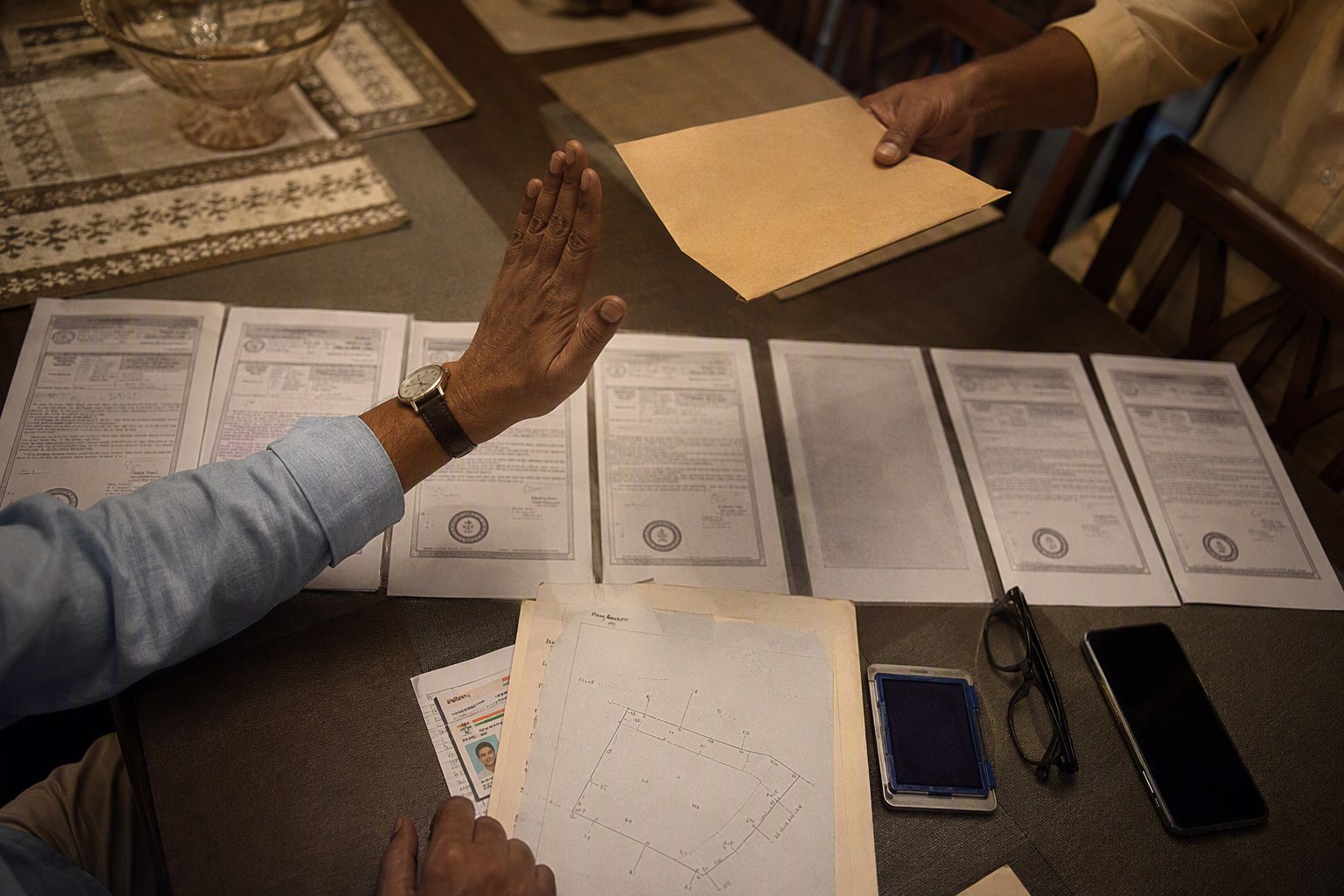



Case Study: Clean EC, But a 22-A Entry Stopped Registration
Can a clean Encumbrance Certificate still fail at registration because of a 22-A entry? Yes. We have seen this happen in Telangana, especially around Hyderabad growth corridors where old survey numbers, government land claims, assigned land records, court-related entries and departmental objections can sit outside the usual buyer checklist. A clean EC tells you whether registered transactions or charges are visible for a period. It does not automatically certify that the property is free from Section 22-A registration restrictions.
This case study explains how one buyer cleared the EC stage, arranged funds, reached the SRO, and still could not register because the survey number had a 22-A prohibited property entry. The point is simple: before token advance, check EC, pahani, Dharani status, SRO mapping, market value, and 22-A status together.
As per latest IGRS data available in our database, Telangana has 3,076,153 prohibited property records under Section 22-A. That single number is enough reason to treat 22-A checking as a first-step verification, not a last-minute formality.
Clean EC, But a 22-A Entry Stopped Registration: What Happened?
The buyer was looking at a plotted property on the western side of Hyderabad, in the kind of belt where demand from IT employees, investors and small developers is very strong. Think of the regular buyer search zone: Miyapur, Hafeezpet, Tellapur, Nallagandla, Kokapet, Narsingi, Shankarpally, Mokila, Moinabad and the villages around these corridors. The exact property details are masked here, but the pattern is very familiar.
The seller had a sale deed. The EC did not show any recent mortgage or registered dispute for the search period taken. The link documents looked readable. The buyer’s family felt comfortable because the seller was local and the plot had physical access from an existing road. A token was paid. Draft sale deed work started. Then the SRO-level check showed the problem: the survey number was reflecting in the prohibited property list under Section 22-A.
At that point, the Sub-Registrar could not simply ignore the entry and proceed. The EC was clean, but registration risk remained alive because the restriction was not about a private mortgage or sale transaction. It was a statutory registration bar linked to the land record category.
Why a Clean EC Does Not Clear a 22-A Entry
Many buyers treat the Encumbrance Certificate as the final truth. In our experience, that is one of the most costly misunderstandings in Telangana property buying.
An EC mainly reflects registered transactions affecting a property, such as sale deeds, gift deeds, mortgage deeds, release deeds and similar registered instruments for the chosen period. It is useful, no doubt. You should always check it using the Encumbrance Certificate Search and then read it carefully, not just download it and keep it in a folder.
But Section 22-A is different. A 22-A entry can stop registration because the government has identified certain properties as not registerable, often due to land classification, government interest, assignment conditions, endowment or wakf claims, court or departmental restrictions, or other categories recognised by the registration machinery. The EC may not show this as an encumbrance because the restriction is not necessarily a registered private transaction.
That is why a property can look clean on EC and still fail at the SRO counter.
22-A Entry Stopped Registration: The Hyderabad Buyer’s Mistake
The mistake was not that the buyer checked the EC. The mistake was stopping there.
In Hyderabad and nearby districts, land has moved through many administrative layers: old pahanis, town survey changes, gram panchayat layouts, HMDA influence, municipal mergers, Dharani records, SRO boundaries and revenue village histories. A plot marketed as being in a popular locality may legally sit in a different revenue village and mandal. For example, a buyer may say “Kokapet side”, but the legal documents may refer to a specific village under Gandipet mandal. Someone may say “Tellapur”, while records may require checking in the concerned revenue village under Ramachandrapuram or nearby administrative jurisdiction. These details matter.
In this case, the buyer checked the seller name and EC history, but did not verify the survey number against the prohibited property list before paying the token. The draft deed reached the document writer. The SRO office was identified. Only then did the prohibited entry become visible as a registration blocker.
By then, the buyer had emotional commitment, family pressure and negotiation fatigue. That is exactly when bad decisions are made.
Clean EC, But a 22-A Entry Stopped Registration: What the SRO Looks At
At the SRO, registration is not only about whether both parties are present with Aadhaar, PAN and witnesses. The registering office checks whether the property is eligible for registration under the applicable registration system and government restrictions. If the property is flagged under Section 22-A, the Sub-Registrar generally cannot register the sale deed unless the entry is cleared or the applicable authority permits correction/removal as per procedure.
The SRO is not your title lawyer. The SRO’s job is not to certify perfect title. But when the government system shows a prohibited property entry, the office is bound by that restriction. Buyers often argue, “But EC is clear.” That argument usually does not solve the issue because EC and 22-A are two different checks.
Before fixing a registration date, buyers should use the Find Your SRO Office tool to identify the correct SRO and then run the survey number through the Section 22-A Prohibited Property Check. If the land is agricultural or converted from agricultural origin, also match the village and survey number carefully with revenue records.
Where the Confusion Usually Starts: Locality Name vs Revenue Record
Hyderabad property marketing runs on locality names. Legal verification runs on revenue identity.
A brochure may say Narsingi. The sale deed may refer to a specific survey number in a revenue village under Gandipet mandal. A listing may say near Financial District, but the land record may be tied to a different village boundary. A plot advertised as Mokila may fall under a precise village and survey number that must be checked independently. This is common across Shankarpally, Moinabad, Maheshwaram, Kandukur, Patancheru, Ameenpur and Hayathnagar belts as well.
That is why we always ask for these details before giving even a practical opinion:
- Current sale deed copy
- Link documents
- Survey number and sub-division number
- Revenue village name
- Mandal and district
- Layout approval details, if it is a plotted layout
- Mutation or Dharani record status, where applicable
- EC for a reasonable period
- 22-A prohibited property status
- Market value or ready reckoner value from the registration department
If the seller gives only a Google Maps pin and a photocopy of an old deed, do not treat that as enough. Use the Survey Number Finder to cross-check the land identity before moving to price negotiation.
The Scale of the 22-A Risk in Telangana
The number is not small. Our database shows 3,076,153 prohibited property records under Section 22-A. This does not mean every attractive property is risky. It means buyers cannot assume that a clean EC automatically removes statutory restrictions.
We see the risk more often where land history is complicated: old assigned lands, government land boundaries, village common lands, endowment-linked lands, wakf-related entries, ceiling land issues, court-affected survey numbers, and cases where only part of a larger survey number is problematic. Sometimes one sub-division is clean and another is not. Sometimes the seller may also be unaware because the family has held the property for years and never attempted a fresh sale deed after the entry appeared.
In fast-moving markets like Kokapet, Narsingi, Tellapur, Kollur, Mokila, Tukkuguda and Maheshwaram, the pressure to close quickly is high. Brokers may say, “Sir, many buyers are ready.” That may be true. Still, the SRO system will not register merely because demand is high.
What Buyers Should Check Before Paying Token Advance
Here is the practical order I prefer. It saves money and arguments.
| Check | Why it matters | Tool to use |
|---|---|---|
| Survey number and village | Confirms the exact land identity, not just the locality name | Survey Number Finder |
| EC | Shows registered transactions and visible encumbrances for the selected period | Encumbrance Certificate Search |
| 22-A status | Flags whether registration may be barred under prohibited property rules | Section 22-A Prohibited Property Check |
| SRO jurisdiction | Helps you approach the correct registration office and avoid wrong-office assumptions | Find Your SRO Office |
| Guideline value | Gives the registration market value basis used for stamp duty calculation | Market Value / Guideline Value Search |
| Stamp duty estimate | Helps plan registration cost before sale deed drafting | Stamp Duty Calculator |
I am not quoting a per-square-yard rate here because this case database does not carry locality-wise ready reckoner amounts. For a live transaction, pull the current guideline value for the exact village, locality and property type. In Telangana, ready reckoner value can change by road, usage and location category, so casual market talk is not enough.
How Sellers Should Handle a 22-A Entry
If you are a seller and your property appears under Section 22-A, do not try to push the buyer into registration by saying, “EC is clear, no problem.” That may only damage trust. First find out why the entry exists.
Ask these questions:
- Is the entire survey number listed or only a part?
- Is the entry linked to government land, assigned land, endowment, wakf, court order or another category?
- Do your link documents cover the same survey number and extent?
- Is there any mismatch between pahani, Dharani record and registered deed?
- Was any correction order passed but not updated in registration records?
- Which authority is competent to clarify or remove the entry?
Some entries may be corrected if they are wrong. Some may require revenue department action. Some may not be removable for a normal private sale. The answer depends on the land category and the record trail. A document writer cannot magically solve this by changing wording in the sale deed.
What the Buyer Did After Registration Was Stopped
In this case, the buyer paused the transaction instead of forcing it. That was the right call.
The seller was asked to produce supporting revenue records and written clarity on the 22-A issue. The buyer also reviewed whether the token agreement had a refund clause in case of title or registration defect. Luckily, the buyer had not paid a very large advance. Many buyers are not so lucky. We have seen cases where families pay a major amount after seeing EC and only later discover that registration cannot proceed.
The lesson is not “avoid all properties with complex history.” Hyderabad real estate often has layers. The lesson is to price the risk, document the condition, and do verification before money moves.
EC, Dharani, Pahani and 22-A: How They Work Together
For Telangana land, each record answers a different question.
- EC: What registered transactions are visible for the selected period?
- Sale deed: What title was conveyed in the registered document?
- Link documents: How did the seller or earlier owners get the property?
- Pahani or revenue record: What does the revenue history show for agricultural land?
- Dharani: What is the current digital revenue record status where applicable?
- 22-A check: Is registration prohibited or restricted for this property identity?
- SRO market value: What value does the registration department apply for stamp duty purposes?
None of these alone is enough for every property. A flat in a RERA-registered project in Gachibowli has a different verification path from an open plot in Shankarpally mandal. For apartments and villas, use the RERA Project Lookup as well. For open land, survey number, village, mandal and 22-A checks become more central.
Our Practical View for Hyderabad Buyers
We’ve seen buyers spend more time comparing interiors than reading the land identity in the deed. That is risky. In Hyderabad’s expanding edges, the attractive price is sometimes attractive for a reason. Not always, but often enough to justify caution.
If a seller refuses to share survey number before token, I would treat that as a warning sign. If the broker says 22-A checking is needed only after agreement, I disagree. If someone says EC is the only document required, I would slow down immediately.
A good property can withstand verification. A good seller will not be afraid of a 22-A check, EC review, SRO confirmation and guideline value search. Clean paperwork helps both sides close faster.
Clean EC, But a 22-A Entry Stopped Registration: Final Takeaway
A clean EC is valuable, but it is not a registration guarantee. Section 22-A is a separate gate. If that gate is closed, the sale deed may not pass through the SRO even when the EC looks fine.
Before you pay advance for land or a plot in Telangana, especially around Hyderabad growth corridors, check the property in this order: survey number, revenue village, EC, 22-A status, SRO jurisdiction, guideline value and layout or project approvals. Use the Property Verification Tool if you want one place to organise the basic checks.
The buyer in this case avoided a bigger loss because the issue surfaced before full payment. Many people discover it too late. Don’t let a clean EC give you false comfort when a 22-A entry can still stop registration.
Frequently Asked Questions
Can a property have a clean EC but still be under 22-A?
Yes. EC and Section 22-A checks serve different purposes. EC shows registered transactions for a selected period, while 22-A can restrict registration based on government or statutory records.
Should I check 22-A before or after paying token advance?
Check it before paying token advance. At minimum, take the survey number, village, mandal and SRO details, then verify whether the property appears in the prohibited property list.
Does the SRO remove a 22-A entry during registration?
No, the SRO generally cannot ignore or remove a prohibited property entry at the registration counter. The seller must get proper clarification or correction from the competent authority as per the nature of the entry.
Is every 22-A entry a permanent problem?
Not always. Some entries may be wrong or outdated and can be corrected through the proper process. Others may reflect genuine restrictions. The reason for the entry must be verified before deciding.
Which tools should I use before buying land in Telangana?
Start with survey number identification, EC search, Section 22-A prohibited property check, SRO lookup and guideline value search. For flats or villas, also check RERA project details where applicable.