

Case Study: A Boundary Mismatch Repriced a Plot Deal
Case Study: A Boundary Mismatch Repriced a Plot Deal is a simple reminder for Hyderabad plot buyers: do not pay token money only because the layout looks neat and the seller speaks confidently. In this case, a buyer paused before paying advance because the registered deed, Encumbrance Certificate details and on-ground boundaries were not telling the same story. That pause changed the deal value.
The buyer was looking at a residential plot on the western side of Hyderabad, in the Mokila-Shankarpally belt. The location was attractive, the approach road was decent, and the seller had a registered document. On paper, it sounded like a regular resale plot. But during verification, the deed boundaries, EC trail and physical stones at the site did not line up cleanly.
Our view is blunt: when land records and ground reality disagree, the plot is not ready for token payment. It may still be buyable, but only after the risk is priced properly and the paperwork is corrected or explained.
Boundary Mismatch Repriced a Plot Deal: What Happened First
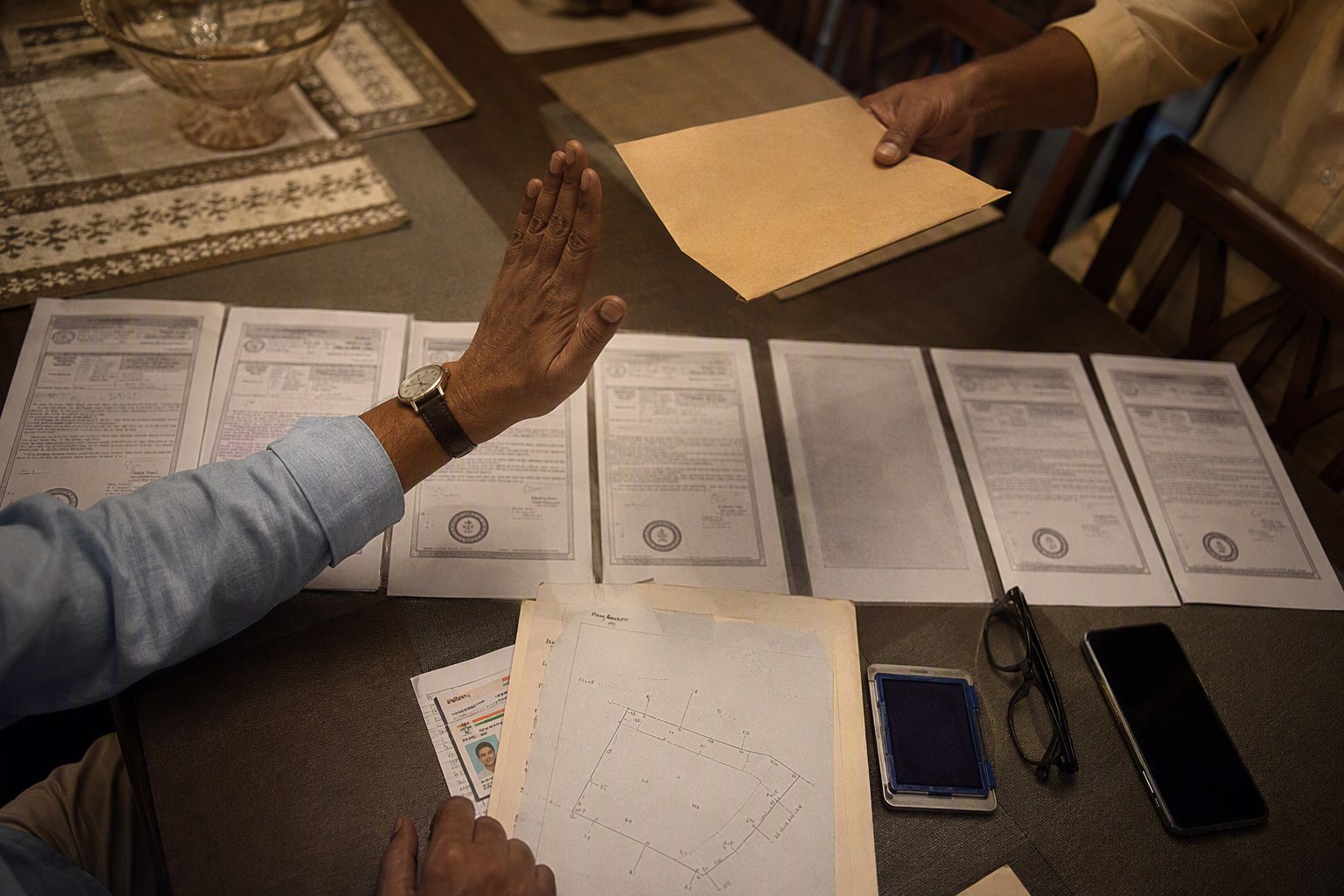
The seller shared a copy of the registered sale deed and said the plot was part of an old layout. The buyer wanted to pay a token and block the deal before another party came in. This is a common pressure point in Hyderabad's active plot corridors like Mokila, Shankarpally, Kollur, Tellapur, Adibatla, Tukkuguda and Maheshwaram.
Instead of rushing, the buyer asked for three basic checks:
- Registered deed and link documents
- Encumbrance Certificate trail from the SRO records
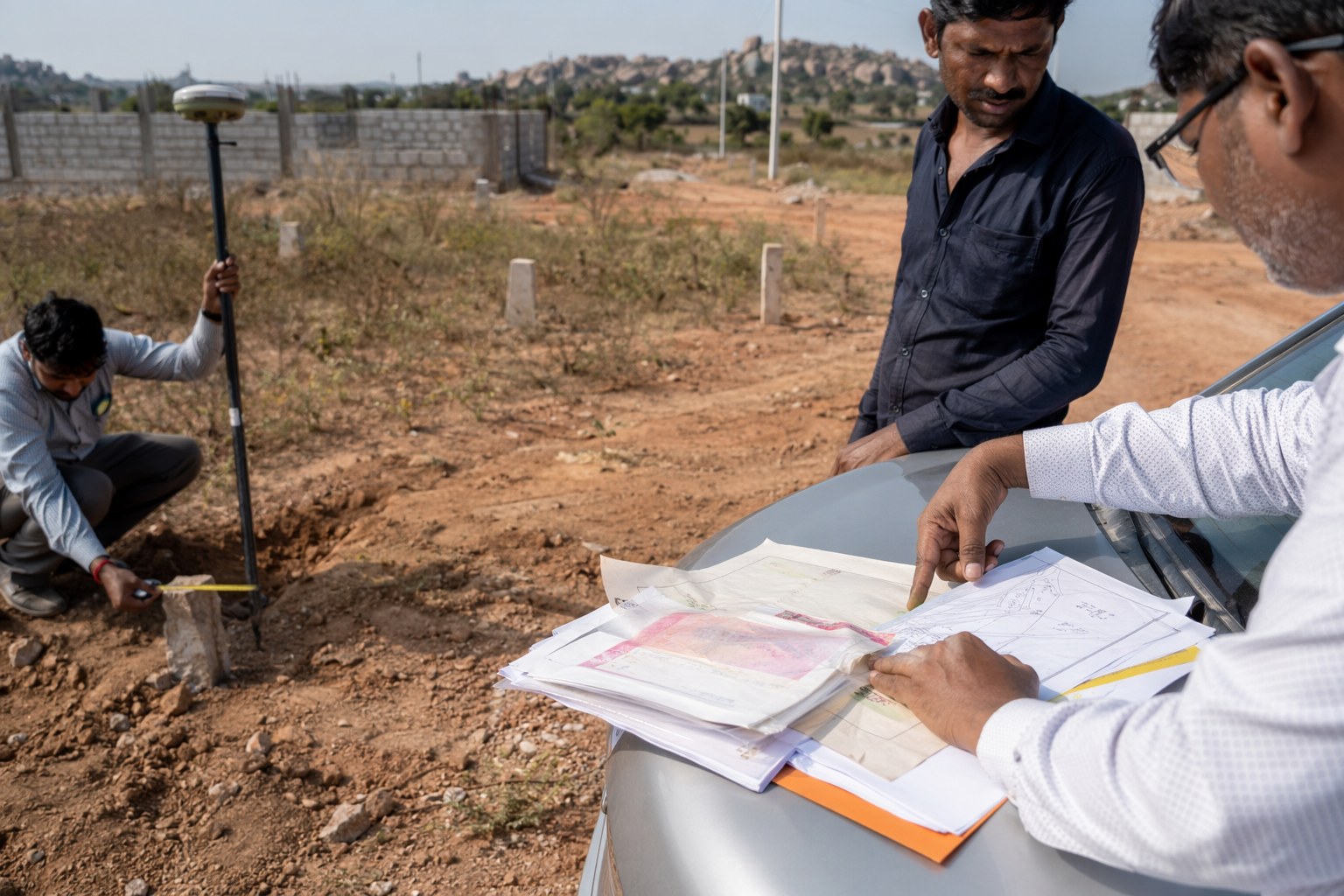
- Site visit with boundary confirmation
The first red flag came from the deed description. The boundaries mentioned one neighbour on the eastern side, but the on-ground possession showed a different boundary line. The northern side was also not matching neatly with the access path shown by the seller. Then the EC showed the transaction trail, but it did not by itself prove that the exact physical plot being shown was the same plot described in the deed.
Many buyers misunderstand this point. An EC tells you about registered transactions and charges reflected in registration records. It does not walk the land for you. It does not confirm that the stone on the site is in the correct place. That is why a document check and a physical boundary check must go together.
In our experience, plot disputes rarely start with dramatic fraud. They often start with small mismatches: one wrong neighbour name, a shifted stone, an old pathway, or a layout sketch that nobody has reconciled with current possession.
Boundary Mismatch Repriced a Plot Deal Before Token Payment
The key decision in this case was timing. The buyer did not pay token first and verify later. He verified first, then negotiated. That one change kept him in control.
Once the mismatch was found, the buyer asked the seller to explain three things in writing:
- Why the deed boundary did not match the present on-ground boundary
- Whether the plot was carved from a larger survey number and whether the subdivision was properly traceable
- Whether any neighbour had a claim, pathway access issue, or old possession understanding
The seller initially treated it as a minor issue. That reaction is also common. Sellers often say, “Sir, all plots here are like this only,” or “You can adjust after registration.” A serious buyer should not accept that casually. Adjustment after registration can become a long fight with neighbours, layout owners, gram panchayat records, SRO records, and sometimes court papers.
After the buyer insisted on a written clarification and fresh measurement, the seller became open to renegotiation. The final conversation shifted from emotional urgency to risk pricing. The plot was not rejected immediately, but the buyer no longer treated it as a clean-title, clean-boundary parcel. The mismatch reduced the buyer's willingness to pay the original asking level.
Why EC Alone Did Not Save the Deal
The Encumbrance Certificate is useful, but it is not a magic certificate. For Hyderabad and Telangana plot purchases, EC verification should be one layer in the due diligence stack, not the full stack.
Use the Encumbrance Certificate Search to identify registered transactions, sale deeds, mortgages and other entries reflected in SRO records. Then read the EC against the sale deed. Check whether the parties, document numbers, dates, village, survey number and property description are consistent. If you are not comfortable reading the trail, the EC Analyzer can help you identify gaps that need human review.
But EC does not confirm physical boundaries. It does not certify that the seller is showing the exact land described in the document. It does not check whether the neighbour's compound wall has eaten into the plot or whether the plot has shifted inside an informal layout. That has to be verified on the ground.
This is where buyers in areas like Shankarpally mandal, Moinabad mandal, Maheshwaram mandal, Hayathnagar mandal and Abdullapurmet mandal must be extra careful. Much of the demand is for open plots, old gram panchayat layouts, HMDA layouts, resale plots and converted agricultural land. The paper trail can be messy if past owners did not maintain clean sketches and link documents.
The Deed Boundary Problem: Small Line, Big Value
In a sale deed, the boundary schedule is not a decorative paragraph. It is one of the most practical parts of the document. It tells you what is on each side of the property. If that schedule does not match the site, the buyer must slow down.
In this case, the buyer noticed that the boundary names and the site conditions were not naturally matching. A neighbour mentioned in the old document was no longer identifiable at the site. The access side shown by the seller also needed confirmation. The layout sketch was not enough because old plotted developments often change shape on the ground over time.
We have seen this in several Hyderabad outskirts. A plot may be marketed as being near a main road, but the actual access may depend on an internal road whose status is unclear. Or the deed may mention a plot number, while the site team shows another plot because stones were shifted. Sometimes the issue is innocent. Sometimes it is not. Either way, the buyer pays for the risk if he ignores it.
The practical approach is to compare:
- Sale deed schedule
- Link document schedule
- EC property description
- Layout plan or sketch
- On-ground stones and neighbour occupation
- Survey number and village record references
For survey-related checks, start with the Survey Number Finder. For a wider land-risk scan, use the Property Verification Tool before you commit money.
Section 22-A Check Was Also Part of the Review
Boundary mismatch was the main issue in this case, but it was not the only check. Telangana has a large prohibited property database under Section 22-A. As per the Verified database context, there are 3,076,153 prohibited property entries. That number alone should make any plot buyer cautious, especially in land-heavy transactions around Hyderabad's growth corridors.
A Section 22-A issue can affect registration. It may relate to government land, assigned land, endowment land, waqf-related entries, court matters or other restricted categories depending on the record. A buyer should not assume that a registered document in the past automatically clears every future risk.
Before paying token, run a Section 22-A Prohibited Property Check. If the property sits anywhere near a sensitive survey number, old government land pocket, tank area, assigned land cluster or disputed village boundary, take a legal opinion before moving ahead.
How the Buyer Renegotiated Without Making It Personal
The smartest part of this case was the buyer's tone. He did not accuse the seller. He did not create drama at the site. He simply converted the mismatch into a commercial point.
The buyer said the plot might still be acceptable, but only if the seller either corrected the boundary record, produced supporting documents, or reduced the price to reflect the uncertainty. This is the right way to talk in a plot negotiation. You are not insulting the seller. You are pricing risk.
The seller was asked for:
- Clear link documents
- Old layout copy or approved plan, if available
- Clarification on boundary changes
- Neighbour confirmation, where practical
- Fresh site measurement
- SRO-level document consistency check
Once these questions were put on the table, the seller's earlier confidence softened. That is usually when the real negotiation begins. A clean property has clean answers. A risky property needs either correction or discount. If the seller gives neither, the buyer should walk away.
Ready Reckoner Value Is Not the Same as Safe Value
Many buyers ask, “If the government market value is available, why worry so much?” Because ready reckoner or guideline value is a valuation input, not a title guarantee.
You can check the official market value range using the Market Value / Guideline Value Search. You can estimate duty implications through the Stamp Duty Calculator. These are useful for budgeting. But they do not say that the boundary stones are correct, the seller's possession is clean, or the plotted layout has no hidden problem.
In this case, the buyer did not argue only on market value. He argued on uncertainty. That is more powerful. A plot with a clean deed trail, matching boundaries and clear access deserves a different price conversation from a plot where the buyer must spend time and legal effort after purchase.
What Hyderabad Plot Buyers Should Check Before Token
Token payment is emotionally dangerous. Once buyers pay, they feel committed. Sellers also start using the token as pressure. That is why the verification sequence matters.
For open plots in Hyderabad and surrounding mandals, follow this order:
- Check the seller's title documents: Sale deed, link documents, gift deed, partition deed or development documents, depending on the case.
- Pull the EC: Confirm whether the registered trail matches the seller's story.
- Verify survey number and village: Do not rely only on marketing names like “near Kollur” or “close to Tukkuguda”. The revenue village and mandal matter.
- Inspect the site: Stand on the plot. Check approach, stones, neighbours, road width and occupation.
- Match deed boundaries: Read all four sides and compare with the physical site.
- Check Section 22-A: Never skip this for land.
- Find the correct SRO: Use Find Your SRO Office if you are unsure where the document is registered.
- Track changes: For longer negotiations, use Property Change Tracker to stay alert to fresh changes.
If the plot is inside a developed layout, also check road width, land use and open space treatment. Tools like Road Width Check, Land Use Zone Finder and OSR Calculator are useful starting points. For apartments or villa projects, run a RERA Project Lookup as well.
Why This Case Matters for Mokila, Shankarpally and Other Growth Corridors
The western corridor has strong buyer interest because of access to Financial District, Gachibowli, Kokapet, Narsingi and Tellapur. Mokila and Shankarpally have become familiar names for families who want land instead of a flat. That demand also creates pressure to move fast.
But land is not like buying a ready apartment in a well-documented society. Plot identity depends on survey numbers, village maps, layout sketches, boundary stones, old owners and actual possession. If one layer is weak, the buyer must ask why.
The same lesson applies to southern and eastern Hyderabad too. In Maheshwaram, Tukkuguda, Adibatla, Bongloor, Hayathnagar and Ghatkesar-side transactions, buyers often hear big future-growth stories. Growth may be real, but your plot must still be legally and physically identifiable. Appreciation talk cannot cure a boundary defect.
The Final Outcome: Repricing Was the Sensible Middle Path
The buyer did not blindly cancel the deal. He also did not blindly proceed. He used the mismatch to reopen the commercial terms. That is the mature response.
When a boundary mismatch appears before token payment, buyers generally have three options:
- Ask the seller to resolve and document the issue before advance
- Renegotiate the price to reflect the risk and future work
- Exit the deal if the seller cannot explain the mismatch
In this case, repricing was possible because the buyer had not yet paid token. After token, the same conversation would have been harder. After registration, it would have been costlier. After construction, it could have become a neighbour dispute.
Our opinion is clear: a plot buyer's best bargaining power is before token payment. Use it. Ask boring questions. Read the deed schedule. Match the EC. Walk the boundary. Check the survey number. If anything feels off, slow the deal down.
Buyer Takeaways From This Boundary Mismatch Case
- A registered deed is necessary, but it is not enough by itself.
- EC confirms recorded transactions; it does not confirm the physical plot shown at site.
- Boundary schedule in the deed must match on-ground possession.
- Section 22-A check is compulsory for land purchases in Telangana.
- Ready reckoner value helps with valuation, not title safety.
- Token should be paid only after basic document and site checks.
- If the seller avoids written clarification, treat it as a serious warning.
This case is not rare. It is exactly the kind of issue that appears in resale plots across Hyderabad's expanding edges. The difference here was not luck. The buyer simply verified before paying. That one discipline converted a risky rush into a better negotiation.
Frequently Asked Questions
Can a registered sale deed still have a boundary mismatch?
Yes. A deed may be registered, but the physical site shown by the seller can still differ from the deed schedule due to shifted stones, old layout changes, neighbour occupation or wrong identification of the plot.
Is an Encumbrance Certificate enough before buying a plot in Telangana?
No. EC is useful for checking registered transactions and charges, but it does not verify physical boundaries, possession, access road status or survey-level land risks.
Should I pay token before checking Section 22-A status?
Avoid it. For Telangana land, Section 22-A prohibited property check should be done before token payment, especially for open plots, agricultural conversions and resale layout plots.
What should I do if deed boundaries and site boundaries do not match?
Ask for written clarification, link documents, layout sketch and fresh measurement. If the seller cannot explain the mismatch, renegotiate for risk or walk away.
Does guideline value prove that a plot is safe to buy?
No. Guideline value or ready reckoner value helps estimate registration value and stamp duty. It does not guarantee title, boundary accuracy or clean possession.