

Telangana Case Study: Old Canal Marking Paused a Plot
Telangana Case Study: Old Canal Marking Paused a Plot is the kind of file we see often in Hyderabad land buying. A buyer likes the location, the price feels workable, the seller pushes for token, and then one small revenue marking changes the mood. In this case, an old canal line shown in village records made the buyer stop before paying a ₹5 lakh token. That pause saved him from entering a deal where the title looked clean on the surface, but the land use history needed deeper checking.
The plot was in the western Hyderabad growth belt, near the Mokila-Shankarpally side. The buyer, a software professional living in Kondapur, wanted a 300 square yard open plot for future self-construction. The seller quoted around ₹38,000 per square yard, which is not unusual for good approach-road plots in this stretch depending on layout status, road width, and exact village. The discussion had already reached payment terms. Then the buyer’s cousin asked one plain question: “Did you check the old village map, not just the link documents?”
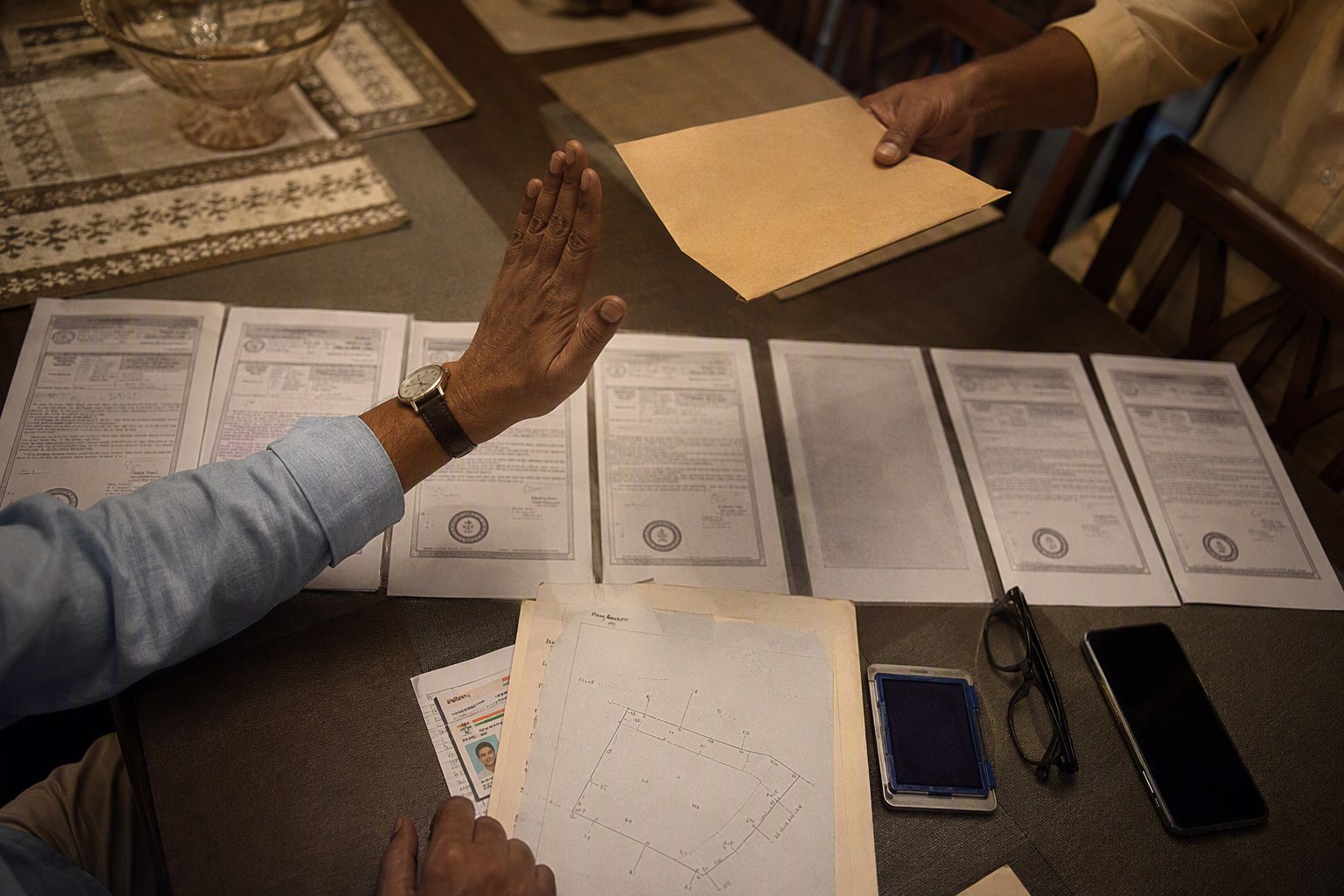
That question changed the file. The Encumbrance Certificate did not show any mortgage or sale dispute. The sale deed chain looked regular. But the village map carried an old kaluva/canal marking touching the survey number. That was enough reason to pause.
Telangana Case Study: Old Canal Marking Paused a Plot Before Token Payment
Let me set out the story properly. The buyer had shortlisted three plots: one near Tellapur, one in Kollur, and one in a village under Shankarpally mandal. Tellapur and Kollur were costlier for his budget, especially for clear layout plots with decent internal roads. The Shankarpally-side plot looked attractive because the road access was good and the seller was ready for a quick registration. In our experience, “quick registration” is useful only when the papers are also quick to verify.
The seller shared the registered sale deed, link documents, latest tax receipts, and basic layout sketch. The buyer checked the price against local market talk and then calculated registration costs. In Telangana, a regular sale deed generally carries 4% stamp duty, 1.5% transfer duty, and 0.5% registration fee, making it around 6% of the market value or sale consideration, whichever is higher. For a ₹1.14 crore plot, even registration outgo can be around ₹6.84 lakh. Before spending that kind of money, token payment should never be treated casually.
The first-level online checks looked fine. The buyer used an EC search to see whether any registered mortgage or past sale transaction was visible. For a quick starting point, buyers can use the Encumbrance Certificate Search and then compare it with the certified EC from the registration department. He also checked the likely SRO jurisdiction because villages in the western belt can fall under different registration offices depending on exact location. The Find Your SRO Office tool helps here, especially when the seller casually says “any SRO is okay”. It is not so simple.
What raised the doubt was not the EC. It was the map layer. The survey number appeared in old village records with a narrow water channel marking. Local people called it an old canal, but the revenue sketch showed it more like a kaluva line connecting low-lying agricultural fields. The layout promoter said it was not active for many years. That may be true on ground. But land buyers should remember one thing: a physical non-existing canal and a revenue-record canal are two different problems.
Why Telangana Case Study: Old Canal Marking Paused a Plot Matters In Hyderabad Land Deals
Hyderabad buyers are used to checking EC, link documents and pattadar passbook. Good. But for open plots, that is still not enough. Old canals, nalas, cart tracks, burial ground notings, assigned land history, ceiling land doubts, waqf entries, endowment references, and government land remarks can sit quietly in older records. They may not shout from the sale deed. They may appear only when you compare the survey number with the village map, pahani, Dharani details, prohibited property list, master plan layer, and ground inspection.
Telangana has 147934 prohibited property records under Section 22-A. That number is not small. Section 22-A entries can stop registration or create serious title risk. Some entries are straightforward government lands. Some relate to assigned lands, endowments, wakf, evacuee property, surplus land, or other notified categories. Some records are old and may need correction, but until the correction happens, the buyer carries the headache.
That is why we advise buyers to do three checks before token: EC, map, and 22-A. Not after agreement. Not one day before registration. Before token. Once token is paid, emotions enter the transaction. The buyer starts thinking, “I already paid, let me adjust.” That is exactly when bad decisions happen.
For this case, the buyer first checked whether the survey number had any prohibited property angle using a Section 22-A screen. A public-facing starting point is the Section 22-A Prohibited Property Check. Then he used the Survey Number Finder to confirm he was not mixing up adjacent survey numbers. This happens more than people admit. One plot can be marketed with a nearby survey number because the better-known survey has clean documents, while the actual ground parcel falls slightly into another number.
The Plot Looked Good On Ground, But Records Told A Different Story
On the ground, the plot did not look risky. There was no running canal. No standing water. No visible nala. The approach road was laid, boundary stones were present, and a few houses were coming up nearby. From a normal buyer’s eyes, it looked like a developing residential pocket. This is why local real estate can trap even educated buyers. Ground reality is only one half of verification.
The old map marking was narrow, but it clipped the larger survey area. The plotted layout had carved small plots from that larger parcel. The seller’s plot was not exactly on the visible old line according to the promoter’s sketch, but there was no proper government-approved overlay to prove it. The buyer asked for the layout approval file. The seller sent a photocopy, but the sanctioned plan number was not easy to verify. The road width shown in the marketing brochure also differed from what was measured at site.
At this stage, we asked the buyer to stop price negotiation and move into document verification mode. This is a common mistake: people keep bargaining while the title is still uncertain. A ₹2,000 per square yard discount means nothing if the land later faces a registration block or municipal refusal for building permission.
The buyer checked the guideline value using the Market Value / Guideline Value Search. This helped him understand the government market value for registration, but ready reckoner value does not certify clean title. It only helps calculate minimum registration value. He also checked likely stamp duty through the Stamp Duty Calculator so he knew the transaction cost. Still, title clearance needed revenue and planning checks.
What We Checked In The Old Canal Marking Case
The file was then broken into five parts. This is how we usually handle such land cases in Hyderabad outskirts, whether it is Shankarpally, Moinabad, Chevella, Maheshwaram, Kandukur, Abdullapurmet, Ghatkesar, or Medchal side.
| Check | What was reviewed | Why it mattered |
|---|---|---|
| EC and link documents | Registered sale deeds, EC period, seller chain | To identify mortgages, past sales, court attachments visible in registration records |
| Revenue records | Pahani history, Dharani details, village map, survey number extent | To see whether the land had canal, government, assigned, or classification issues |
| 22-A status | Prohibited property list reference | To avoid registration block under Section 22-A |
| Planning status | Layout approval, road width, land use zone | To confirm whether residential plotting and future construction were legally supportable |
| Ground inspection | Road, boundaries, neighbouring development, water flow path | To match records with physical site conditions |
The EC came clean for the period checked. That was a positive sign, but not final. The pahani history showed agricultural usage in earlier years, and the village map carried the old canal marking. There was no immediate 22-A hit for the exact survey number as checked, but adjacent land had remarks that needed attention. This is where buyers should be careful. If neighbouring survey numbers are affected by government land, canal, nala, or endowment entries, your own plot may still face practical problems during road access, mutation, layout regularisation, or building permission.
The planning check raised another doubt. The plot was being sold as part of a small internal layout, but the approval papers were not fully traceable. If it were a plotted development under HMDA or DTCP limits, the approval number should be verifiable. For apartment buyers, we would also check the project on the RERA Project Lookup. For open plots, RERA may apply depending on project size and development structure, but buyers should not assume every plotted venture is outside scrutiny.
We also checked land use. A residential-looking site can still fall under a different master plan zone, conservation belt, water body buffer, or road widening proposal. The Land Use Zone Finder is a good starting point. If you plan to build later, also check road width through the Road Width Check, because building permission depends heavily on approach width, plot size, setbacks, and local authority norms.
How The Buyer Handled The Seller Pressure
The seller became restless when the buyer asked for older revenue papers. This is normal. Many sellers think an EC and latest sale deed should be enough. Some genuinely do not know the old land history. Some know but hope the buyer will not ask. In this case, the seller said, “Sir, already two parties are ready. If you want, pay token today.” That line is popular from Kokapet to Kandukur.
The buyer did the right thing. He did not argue. He replied that he would pay token only after a written clarification on the old canal marking and layout approval status. He asked for copies of the complete approval file, old pahanis, mutation details, and a survey sketch showing the plot position against the old canal line. He also wanted a clause in the agreement that token would be refundable if any 22-A, canal, nala, layout, or access issue appeared during legal due diligence.
That one clause changed the seller’s tone. The seller was ready for normal token receipt, but not for a due-diligence refund clause. That itself was a signal. A clean seller may still dislike paperwork, but a confident seller usually cooperates when the buyer’s questions are reasonable.
Finally, the buyer dropped the plot. Not because the land was definitely illegal. We must be fair here. An old canal marking does not automatically mean every plot in that survey number is impossible to buy. Sometimes canals have been realigned, closed, converted, or wrongly carried in old sketches. Sometimes the affected strip is away from the plotted area. But unless the seller proves it with proper records, the buyer should not carry the burden.
What Hyderabad Buyers Should Learn From This Case
The biggest lesson is simple: do not pay token based only on location liking. Western Hyderabad has strong demand in Tellapur, Kollur, Mokila, Velimela, Narsingi, Kokapet, Gandipet, and Shankarpally. Southern belts like Tukkuguda, Maheshwaram, Kandukur, and Shamshabad are also active. Eastern side areas like Ghatkesar, Pocharam, Bibinagar, and Yadadri stretch attract budget buyers. In all these places, one survey number can be clean while the next one carries a record issue.
Open plot buying is not like buying a finished flat in Madhapur or Kondapur where the apartment association, occupancy certificate, RERA, and bank loan due diligence may already create some filters. Even there, checks are needed. But land is more sensitive. A canal marking, nala buffer, assigned land history, or 22-A listing can disturb the entire investment plan.
We have seen buyers spend weeks negotiating a ₹1 crore plot and then check documents in the last two days. That is backward. The order should be: identify survey number, check ownership, check EC, check 22-A, check map, check land use, check approval, inspect ground, then negotiate seriously. Price comes after risk.
If you are still at shortlisting stage, use the Property Verification Tool to organise the basic risk points. If you are comparing the built-up possibility on a plot, the FSI/FAR Calculator can help you understand potential construction scale, though final permission depends on the local authority. If you are buying and tracking the same property for future changes, the Property Change Tracker is useful for keeping an eye on updates.
Token Payment Checklist For Telangana Plot Buyers
Before paying even ₹50,000 as token, ask for these documents and screenshots. If the seller refuses basic verification, do not feel shy to walk away. Hyderabad has enough land supply; clean title is rarer than attractive brochures.
- Exact village, mandal, survey number, sub-division number, and plot number.
- Current registered sale deed and at least 30 years of link documents where possible.
- Latest EC from the correct SRO for the required period.
- Dharani record, pattadar details, pahani history, and mutation flow.
- Village map or cadastral map showing roads, canals, nalas, and boundaries.
- Section 22-A prohibited property status for the survey number and nearby numbers.
- Layout approval copy with verifiable approval number and authority name.
- Master plan land use, road width, and any proposed road widening impact.
- Physical site photos, boundary confirmation, and access road ownership clarity.
- Refund clause in token receipt if legal, revenue, planning, or registration defects are found.
In this case, the buyer’s best decision was not some dramatic legal move. It was patience. He paused before token. That is the entire story. In Telangana land deals, that pause can save years of running around mandal office, SRO, survey department, and courts.
Our View On Old Canal Markings In Telangana Records
Old canal or kaluva markings should be treated as a serious yellow flag, not an automatic red flag. The correct response is verification, not panic. Ask whether the canal is active, abandoned, realigned, or wrongly mapped. Check whether any buffer rule applies. See if the plotted area overlaps the marked strip. Confirm whether the layout approval authority considered it. If the seller cannot answer these points with documents, the buyer should not fund the seller’s uncertainty.
Section 22-A risk must also be checked early because Telangana’s 147934 prohibited property records show how large the issue is. Many buyers assume registration department will stop the transaction if something is wrong. That is a dangerous comfort. Some problems appear before registration, some during mutation, some during building permission, and some only when you sell later. A careful buyer checks before paying token because that is when he still has full bargaining power.
For Verified.RealEstate readers, my practical opinion is this: in Hyderabad outskirts, never buy a plot only by seeing roads and compound walls. Buy it after matching the ground with the record. EC tells you registered transaction history. Pahani and Dharani tell you revenue story. Village map tells you physical-history clues. 22-A tells you whether the government has placed a registration block. All four should speak the same language. If they do not, slow down.
Frequently Asked Questions
Does an old canal marking mean the plot cannot be bought?
Not always. It means the buyer must verify the village map, survey sketch, layout approval, land use, and any buffer impact. If the seller cannot prove that the plot is outside the affected area, avoid token payment.
Why is Section 22-A check needed before token payment in Telangana?
Section 22-A covers prohibited properties where registration may be blocked or disputed. Telangana has 147934 such records, so checking the survey number early is safer than discovering the issue after agreement.
Is a clean Encumbrance Certificate enough for buying a Hyderabad plot?
No. EC mainly shows registered transactions like sale deeds and mortgages. It may not reveal canal markings, assigned land history, master plan restrictions, or all revenue classification issues.
What should a token receipt mention for a Telangana land deal?
It should mention survey number, plot number, sale price, token amount, time for due diligence, and refund terms if EC, 22-A, revenue, layout, access, or land use defects are found.
Which records should be matched for open plot verification?
Match the sale deed, EC, Dharani details, pahani history, village map, layout approval, land use zone, road width, and ground boundaries before making a financial commitment.