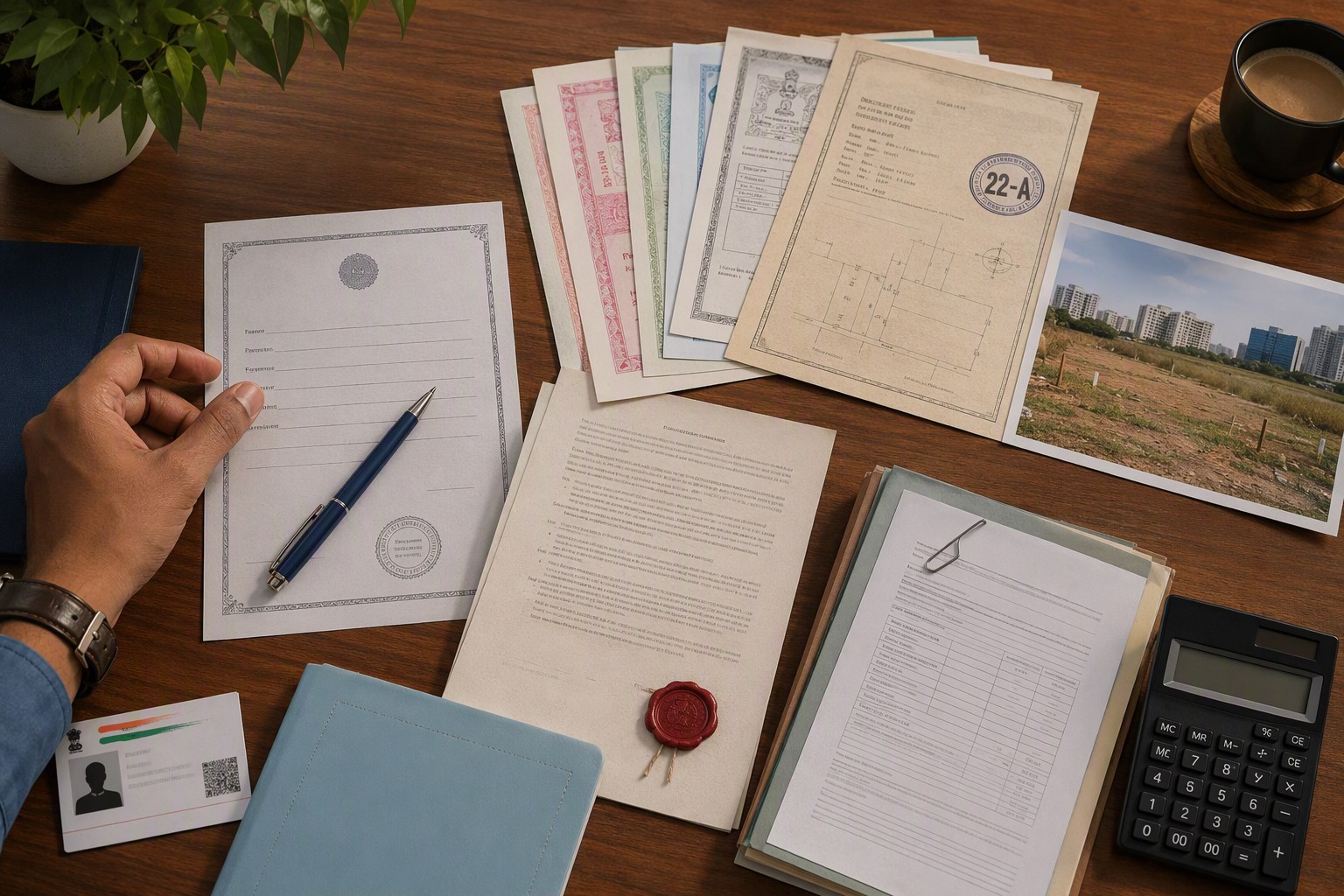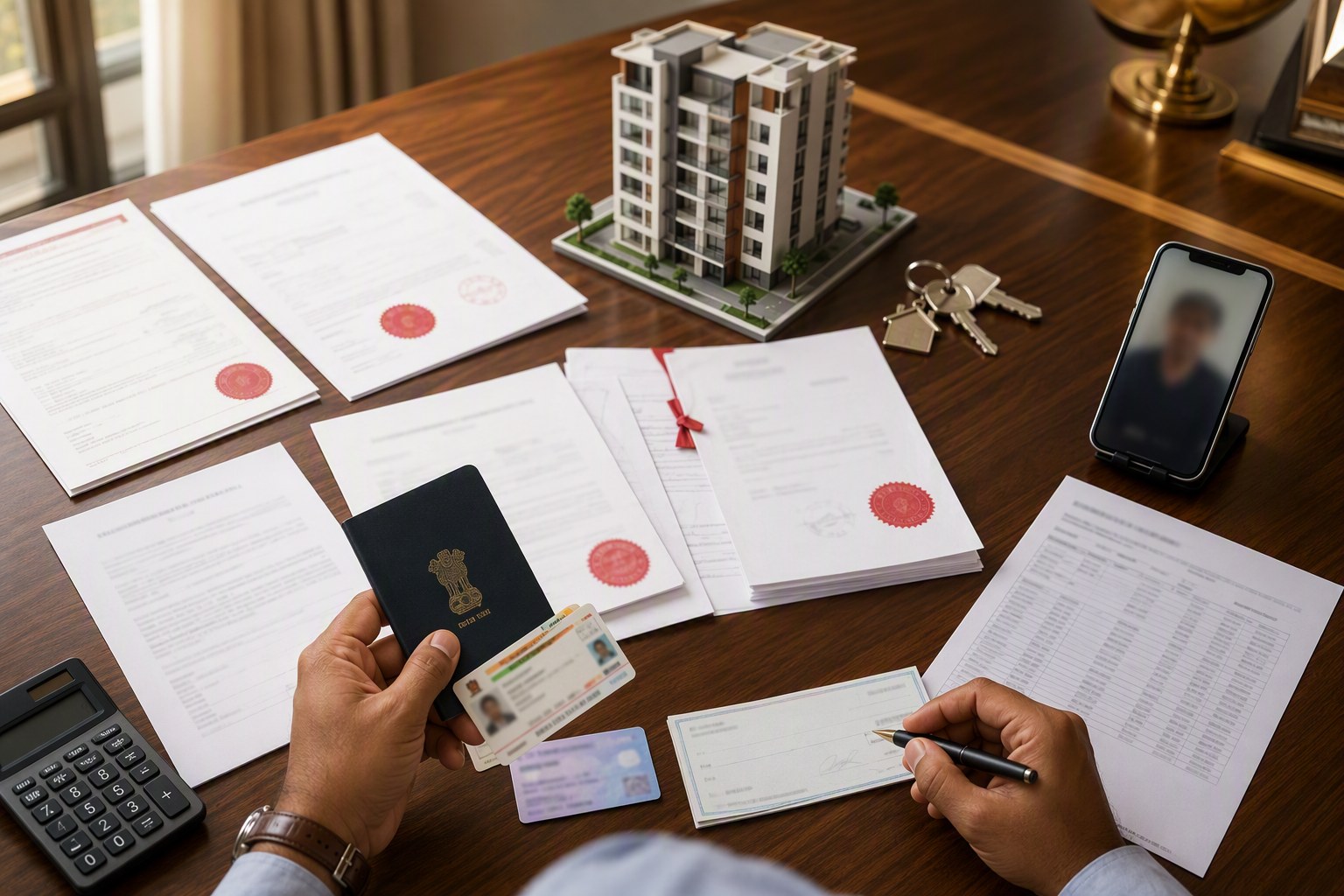
Can you buy property from an NRI seller without risk? Yes, you can. But do not treat it like a normal resident-to-resident sale. Before paying advance, verify the seller’s authority to sell, identity proof, tax compliance, Encumbrance Certificate, payment trail, Section 22-A status, and registration readiness at the correct SRO. In Hyderabad and surrounding districts, we’ve seen many clean NRI transactions in Gachibowli, Kondapur, Narsingi, Tellapur, Miyapur, Kompally and Shamshabad. The safe ones all have one common feature: paperwork is checked before emotions take over.
Our view is simple: buying from an NRI is not risky by itself. Buying from an unavailable, poorly documented or tax-non-compliant seller is risky.
NRI-owned flats, villas and open plots are common in Hyderabad. Many owners moved to the US, UK, Gulf, Australia or Singapore years ago, and now want to sell because prices have improved or family needs have changed. For buyers, these can be good opportunities. But the due diligence must be sharper because the seller may not be physically present, signatures may come through a Power of Attorney, and tax deduction rules are different from a normal local sale.
Can You Buy Property From an NRI Seller Without Risk? The Short Answer
Yes, if you complete six checks before signing the agreement of sale:
- Authority to sell: Is the NRI personally coming to India, or is a Power of Attorney holder signing?
- Identity: Do the passport, PAN, OCI or visa details match the title documents?
- Title and EC: Does the Encumbrance Certificate show a clean chain of ownership?
- Tax compliance: Has the buyer planned TDS under the correct NRI tax provisions?
- Payment trail: Is every rupee moving through identifiable bank channels?
- Registration readiness: Are all parties, witnesses, documents and SRO requirements ready?
For Telangana buyers, start with the basics: check the property through Property Verification Tool, review the Encumbrance Certificate Search, and confirm whether the asset falls under any restriction using Section 22-A Prohibited Property Check. Telangana government records show 3,076,153 prohibited properties under Section 22-A, so this is not a box-ticking exercise. If a property is blocked, disputed or prohibited, the SRO can refuse registration.
Can You Buy Property From an NRI Seller Without Risk in Hyderabad Localities?
You can, but locality-specific checks matter. A flat in Kondapur under Serilingampally mandal is a different due diligence exercise from an open plot near Shankarpally or Moinabad. A villa in Narsingi or Kokapet may need layout approvals and UDS clarity. A plotted land parcel near Adibatla, Shamshabad or Maheshwaram may need survey number verification, land use check, link documents, pahani records and mutation review.
In our experience, NRI sale issues generally come from three areas: weak Power of Attorney, unclear family ownership, and last-minute tax confusion. Buyers often focus only on price because the property looks attractive. That is a mistake. The first question should be: “Can this exact seller legally sign and receive the sale consideration?”
Use Market Value / Guideline Value Search before finalising the agreement. The market price may be different from the ready reckoner or guideline value used for stamp duty. The SRO will look at the government value for registration, not your WhatsApp negotiation. Also use Stamp Duty Calculator to estimate registration costs before you lock the deal.
First Check: Is the NRI Seller Personally Signing or Using a Power of Attorney?
This is the most sensitive part of an NRI property sale. If the seller is coming to Telangana and signing the sale deed in person at the SRO, your risk reduces, though it does not disappear. You still need title, EC, tax and payment checks.
If a Power of Attorney holder is signing, slow down. A POA is not a magic document. It must clearly authorise sale, registration, receipt of money, execution of agreement, delivery of possession and related acts. Many old POAs only allow management or representation, not sale. Some are executed abroad and not properly adjudicated in India. Some are cancelled privately but still shown to buyers.
What to verify in an NRI Power of Attorney
- Full name of the NRI owner exactly as per title deed, passport and PAN.
- Property details: flat number, survey number, extent, boundaries, village, mandal and district.
- Clear sale authority, not just general management authority.
- Authority to receive sale consideration, if money is being routed through the POA holder.
- Embassy, consulate, notary or applicable attestation based on where it was executed.
- Adjudication or stamping in India as required before use.
- Confirmation that the POA is still valid and not revoked.
For open plots, cross-check survey details using Survey Number Finder. For flats, match the unit number, undivided share, parking, block name and project details with the sale deed and builder documents. If it is a RERA project or recent apartment project, check the promoter details through RERA Project Lookup.
Identity Proof: Do Not Accept Only a Video Call
Video calls are useful, but they are not legal due diligence. Ask for passport, PAN, current overseas address proof, Indian address proof if available, and OCI details if relevant. The name must match across the old sale deed, tax documents, bank account and present draft sale deed.
Small name variations can create big registration headaches. For example, “Ramesh Kumar Reddy”, “Ramesh K Reddy” and “Ramesh Kumar R” may refer to the same person, but the SRO and buyer’s bank will ask for supporting proof. If the seller changed name after marriage or changed passport details, get the proper affidavit and supporting documents before agreement stage.
If the property is ancestral or inherited, ask harder questions. Did the NRI get the property through a registered sale deed, gift deed, will, succession, partition or release deed? Are other family members involved? In Hyderabad families, we often see flats registered in one person’s name but paid for by parents or siblings. Payment history may not create ownership by itself, but family objections can delay possession and registration.
Encumbrance Certificate and Link Documents Are Non-Negotiable
The EC tells you whether registered transactions, mortgages, releases and other entries appear against the property for the selected period. It is not the whole truth, but it is the starting point. Use Encumbrance Certificate Search and then examine the actual link documents.
For a Hyderabad flat, you should normally review:
- Current sale deed in favour of the NRI seller.
- Previous link deed or builder sale deed.
- Construction agreement or sale agreement, if applicable.
- Mother deed and development agreement for the project, where relevant.
- Occupancy certificate or completion-related papers, if available.
- Latest property tax details and society maintenance status.
- Loan closure letter and release deed if the property was mortgaged.
For land, the list becomes broader:
- Registered link documents for the full chain.
- Pahani, ROR or Dharani-related records, where applicable.
- Mutation status.
- Survey number and sub-division details.
- Layout approval, if it is a plotted layout.
- Land use and road access.
- Section 22-A prohibited property status.
Use EC Analyzer if you want to read the EC entries more carefully. Also check charges through CERSAI Charge Check, especially when the seller had a home loan or the buyer is taking bank finance.
Section 22-A Check: The Risk Many Buyers Ignore
Section 22-A prohibited property status is one of the most practical checks in Telangana. If the property is in a prohibited list, assigned land category, government land category, endowment-related category or another restricted classification, registration can get blocked. Telangana records show 3,076,153 prohibited properties under Section 22-A, so buyers should not assume that a clean-looking sale deed is enough.
This matters more in peri-urban mandals like Gandipet, Shankarpally, Moinabad, Shamshabad, Maheshwaram, Medchal, Ghatkesar and Yadagirigutta-side growth corridors. Many parcels changed hands over years, but old land classifications may still affect saleability. Before paying a token advance, check through Section 22-A Prohibited Property Check.
Tax Compliance When Buying From an NRI Seller
This is where many buyers get caught. When the seller is an NRI, the buyer has tax deduction responsibilities under applicable law. Do not copy the process used for a resident seller. Speak to a CA before signing the agreement, especially if the seller is asking for full payment without deduction or wants money credited into multiple family accounts.
The seller may provide a lower deduction certificate or tax computation support. The buyer should not casually accept verbal assurances like “I will handle tax later.” If tax deduction is missed or wrongly handled, the buyer may face trouble. The sale deed, agreement, payment receipts and bank transfers should all reflect a clean and consistent trail.
The seller can estimate tax using Capital Gains Tax Calculator, but the buyer should still take professional tax advice. This is not the place for guesswork. In NRI deals, tax planning must happen before the agreement of sale, not one day before registration.
Payment Trail: Keep It Clean, Boring and Bankable
A clean payment trail protects both buyer and seller. Pay only to the legal seller or to a properly authorised account mentioned in the agreement. If the POA holder is receiving money, the POA must clearly permit it. If the seller wants payment split between relatives, consultants or overseas accounts, pause and get written legal and tax advice.
Good payment practice includes:
- Token advance through bank transfer, not loose cash.
- Agreement of sale mentioning seller’s NRI status.
- Clear payment schedule linked to document verification and registration.
- TDS handling as advised by CA.
- Receipts for every payment.
- Final consideration matching the sale deed and bank entries.
Banks also become strict when the seller is abroad. If you are taking a home loan for a flat in Miyapur, Bachupally, Nallagandla, Tellapur or Kompally, the bank legal team may ask for POA validation, life certificate-style identity confirmation, loan closure proof and original title chain. Do not treat bank legal approval as full title verification, but use it as one more safety layer.
Registration Readiness at the Correct SRO
Every property is mapped to a jurisdictional Sub-Registrar Office. A Kondapur flat may not fall under the same registration office as a Narsingi villa or a Shamshabad plot. Use Find Your SRO Office before planning the registration date.
Before registration, confirm:
- Original title documents are available.
- Seller or POA holder can attend with valid ID.
- Witnesses are ready.
- Draft sale deed is vetted by buyer’s lawyer.
- Stamp duty and registration charges are calculated.
- TDS and tax documents are in order.
- Possession handover terms are written.
- Society, builder or association dues are settled.
For apartments, ask for a no-dues letter from the association where possible. For villas, check corpus, maintenance, clubhouse charges and any pending developer commitments. For open plots, physical possession and boundary confirmation are critical. Go to the site. Speak to neighbours. Check access road. Confirm that the land shown on paper is the land being shown on ground.
Hyderabad Buyer Checklist for NRI Seller Transactions
| Check | Why it matters | Useful tool |
|---|---|---|
| EC and link documents | Shows registered transaction history, mortgages and releases | Encumbrance Certificate Search |
| Section 22-A status | Registration may be blocked if property is prohibited | Section 22-A Prohibited Property Check |
| Guideline value | Helps estimate government value for registration | Market Value / Guideline Value Search |
| SRO mapping | Confirms the correct registration office | Find Your SRO Office |
| Survey number | Useful for land in mandals like Shankarpally, Moinabad and Shamshabad | Survey Number Finder |
| Stamp duty estimate | Prevents last-minute funding surprises | Stamp Duty Calculator |
Red Flags in NRI Seller Property Deals
Some warning signs are easy to spot if you are not rushing:
- Seller refuses to share passport or PAN copy.
- POA holder pushes for immediate cash advance.
- Original documents are “in the bank” but no loan closure proof is shown.
- EC shows a mortgage but release deed is missing.
- Property is in one family member’s name but another person negotiates everything.
- Seller says TDS is not required because he has an Indian PAN.
- Survey number on paper does not match the land shown on site.
- Agreement value, sale deed value and bank transfer trail do not match.
- Registration is being pushed to a different SRO without clear reason.
We have seen buyers lose months because they trusted a relative of the NRI seller without checking the POA. We have also seen clean transactions finish smoothly because the buyer asked for the right documents early. The difference is not luck. It is discipline.
What Should the Agreement of Sale Say?
The agreement should clearly record that the seller is an NRI, how the seller is represented, how tax deduction will be handled, and what happens if registration fails due to title, tax or document issues. Do not use a vague one-page format for a high-value Hyderabad property.
Key clauses should cover:
- Seller identity and NRI status.
- POA details, if applicable.
- Property schedule with correct boundaries and identifiers.
- List of original documents to be handed over.
- Payment schedule and bank account details.
- Tax deduction and certificate responsibilities.
- Loan closure and release deed obligations.
- Possession date and condition of property.
- Default and refund clauses.
- Registration date, SRO and expenses.
You can prepare a first draft through Legal Document Generator, but for an NRI seller transaction, get a property lawyer to review it. Drafting is where many future disputes are either avoided or created.
Flat, Villa or Land: Risk Changes by Property Type
Apartment in areas like Gachibowli, Kondapur, Nallagandla or Miyapur
Check sale deed, UDS, parking, association dues, property tax, EC, loan closure and project approvals. If the seller bought directly from a builder, confirm whether all builder dues are cleared.
Villa in Kokapet, Narsingi, Tellapur or Kompally
Check land share, permissions, clubhouse and corpus dues, internal road rights, gated community documents, and any pending developer handover issues. Villa documents can be thicker than flat documents, so do not rely only on the latest sale deed.
Open plot in Shankarpally, Moinabad, Shamshabad or Maheshwaram
Do a deeper land check. Verify survey number, land use, layout approval, approach road, physical possession, Dharani status where relevant, pahani history and Section 22-A status. Use Land Use Zone Finder and Road Width Check for planning-related clarity.
Final View: Can You Buy Property From an NRI Seller Without Risk?
You can buy from an NRI seller safely, but only when the documentation supports the transaction. The seller being abroad is not the problem. Poor authority documents, unclear tax deduction, missing EC entries, unverified survey numbers and casual payment routing are the real problems.
My practical advice: do not pay a major advance until you verify title, POA, identity, EC, tax plan, Section 22-A status and SRO readiness. Hyderabad real estate rewards patient buyers. A good property will survive proper due diligence. A bad one will pressure you to skip it.
Frequently Asked Questions
Can I buy a flat in Hyderabad from an NRI seller through Power of Attorney?
Yes, but the POA must clearly authorise sale, registration and receipt of money. It should be properly attested, stamped or adjudicated as required, and still valid on the date of registration.
Is TDS different when the seller is an NRI?
Yes. NRI seller transactions have different tax deduction requirements compared with resident seller transactions. Speak to a CA before agreement stage and record the tax process in writing.
Should I check Section 22-A before buying from an NRI?
Absolutely. Telangana records show 3,076,153 prohibited properties under Section 22-A. If the property is restricted, the SRO may refuse registration even if the seller has old documents.
What documents should I ask from an NRI seller before paying advance?
Ask for passport, PAN, title deed, link documents, EC, POA if applicable, tax plan, loan closure proof if mortgaged, property tax or maintenance status, and bank account details for payment.
Can an NRI seller receive sale money in any account?
No. Keep the payment trail clean. Pay only to the legal seller or to an authorised account mentioned in the agreement and supported by proper tax and POA documentation.