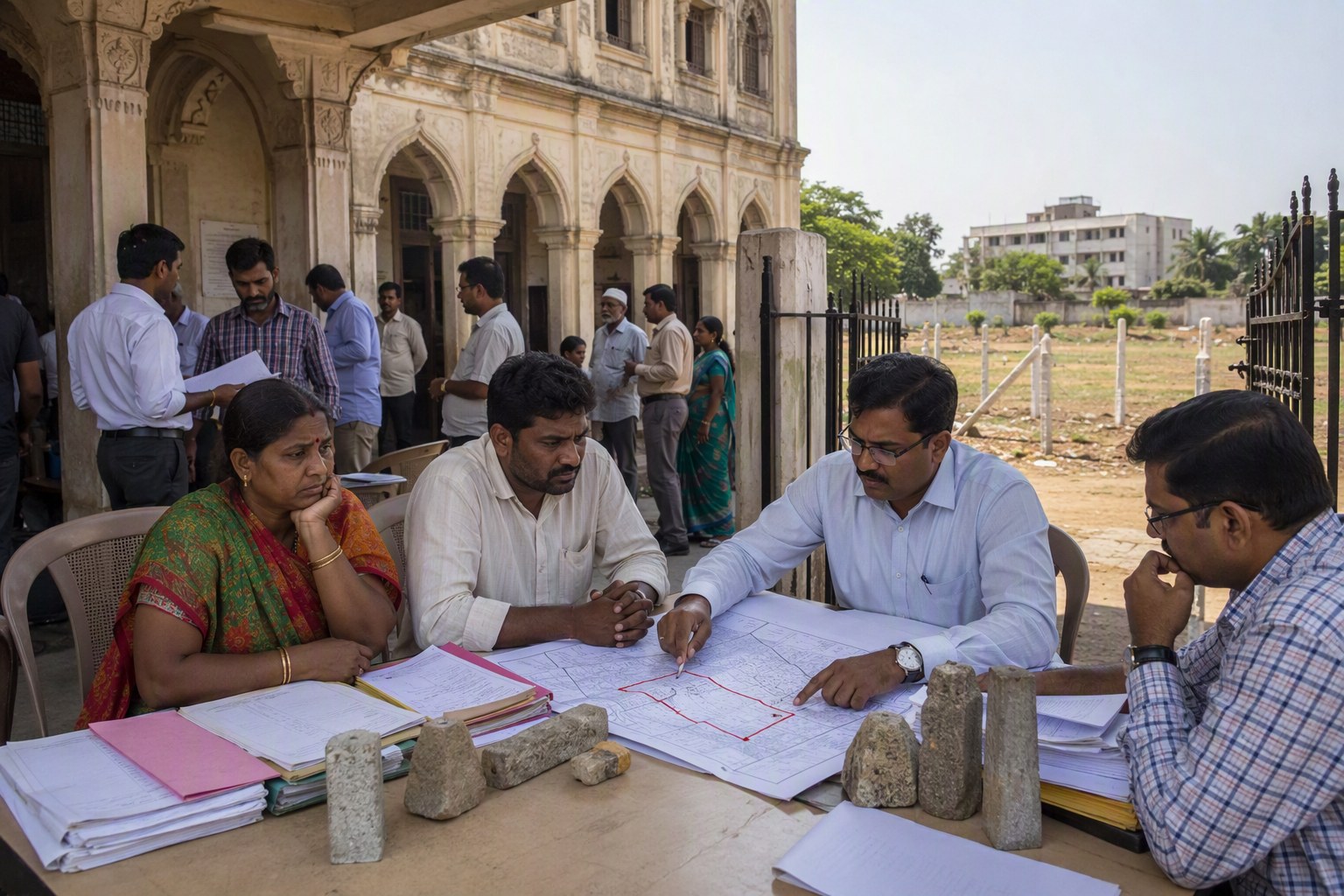



Telangana May Standardise SRO Refusal Notes for Buyers could become a practical relief for property purchasers who reach the sub-registrar office, pay attention to every document, and still face a blocked registration without a clear written reason. The issue is not small. As per latest IGRS data available with Verified.RealEstate, Telangana has 30,3,076,153 prohibited properties in the Section 22-A prohibited properties database. A uniform refusal note system can help buyers understand whether the problem is survey-number based, court-related, assigned land-linked, government land-linked, or due to some other entry in official records.
For a buyer in Hyderabad, this is not a technical office matter. It directly affects booking amounts, sale agreements, bank loans, stamp duty planning, and family timelines. We’ve seen buyers in Serilingampally, Rajendranagar, Gandipet, Moinabad, Shamshabad, Ghatkesar, Medchal and Hayathnagar mandals get confused when the SRO refuses registration but the wording does not clearly explain the legal block.
A standard refusal note will not remove a prohibition by itself. But it can tell the buyer exactly what went wrong, where to verify it, and what remedy route may be available.
Telangana May Standardise SRO Refusal Notes for Buyers: what is being discussed
The proposal being discussed in property and registration circles is simple: when a sub-registrar refuses to register a document, the refusal note should follow a common format across Telangana. Today, the experience can vary from SRO to SRO. A buyer at an SRO handling Kokapet or Narsingi transactions may receive one style of explanation, while a buyer dealing with land in Shamirpet, Ghatkesar or Maheshwaram may receive a different style of wording.
For ordinary citizens, that difference matters. A refusal note with vague language like “prohibited property” does not answer basic questions. Is the entire survey number blocked? Is only a part of the land covered? Is the land listed under Section 22-A? Is the issue connected to assigned land, endowment land, wakf land, government land, court attachment, or another department’s communication?
In our experience, buyers often hear three different explanations from three different places: the seller, the document writer, and the SRO staff. A standardised note can reduce this noise. It can also make the next step easier for advocates, banks, real estate consultants and revenue officers who examine the file later.
Why Telangana May Standardise SRO Refusal Notes for Buyers now
The scale of the prohibited property database is the main reason this reform matters. Telangana has 30,76,153 prohibited properties recorded under Section 22-A data, as per latest IGRS data. That number covers a wide spread of property types and locations, from urban plots around Hyderabad’s growth corridors to rural survey lands in different districts.
Hyderabad’s outer growth areas are especially sensitive because many land deals still move through survey numbers, old pahanis, mutation records, Dharani entries, layout approvals and conversion documents. A flat buyer in a RERA project may think only about the apartment number. But the land under that project may have its own chain of title, survey history and SRO-level checks.
Before signing or paying a major advance, buyers should use basic verification tools such as Section 22-A Prohibited Property Check, Encumbrance Certificate Search, and Find Your SRO Office. These do not replace legal due diligence, but they help buyers ask sharper questions before the registration day.
What a uniform refusal note should ideally contain
A good refusal note should not read like a one-line rejection. It should be a useful government communication. If Telangana moves ahead with standardisation, buyers will benefit if the note includes the exact land reference, the reason for refusal, the record source, and the appeal or rectification route.
| Refusal note field | Why buyers need it |
|---|---|
| Survey number, sub-division and village | To confirm whether the blocked entry matches the property being purchased. |
| Mandal and SRO jurisdiction | To avoid confusion when village names overlap or when SRO boundaries are not clear. |
| Section 22-A category or reason | To understand whether the issue is government land, assigned land, court-related, endowment-related or another prohibition. |
| Reference to official database entry | To allow the buyer, seller and advocate to trace the exact record. |
| Next authority to approach | To know whether the matter should go to revenue authorities, court, department office or the registration department. |
This is where standard wording can make a big difference. If every refusal note gives the same basic fields, a buyer in Tellapur and a buyer in Adibatla will at least know how to read the rejection. The legal outcome may differ, but the communication becomes clearer.
Impact on Hyderabad buyers, sellers and banks
For buyers, the biggest benefit is clarity before money gets locked. Many sale agreements have deadlines for registration. If the SRO blocks the document and the note is unclear, both parties start blaming each other. The seller may say the land is clean. The buyer’s bank may ask for a clean EC or further clarification. The advocate may need more revenue records. The family, meanwhile, has already planned shifting, interiors or loan disbursement.
For sellers, a clear refusal note can also be useful. Genuine sellers with old title issues can see the exact objection and try to resolve it. In areas such as Bachupally, Kollur, Mokila, Shankarpally, Thukkuguda and Kompally, old agricultural land has moved through multiple phases: pahanis, conversion, layouts, permissions, mortgages and resale agreements. One unclear prohibition entry can disturb the entire transaction.
Banks will also prefer specific refusal reasons. A housing loan team is not looking for oral explanations. It needs written proof. If the refusal note says exactly what the defect is, the bank can decide whether to pause the file, reject the loan, or ask for a legal clarification.
Buyers should also cross-check value and duty planning before execution. Use Market Value / Guideline Value Search and Stamp Duty Calculator before going to registration. If the property is part of a project, check its status through RERA Project Lookup. For land parcels, Survey Number Finder and Property Verification Tool are sensible starting points.
Section 22-A is not just a clerical entry
Some buyers treat a prohibited property result as a minor data error. That is risky. Section 22-A entries can block registration because the government or another authority has flagged the property. The entry may be right, partly right, outdated, or disputed. But until it is clarified through the proper channel, an SRO cannot simply ignore it because the parties are ready to sign.
In Telangana, land records can sit across multiple systems and departments. Dharani may show one status. Old pahani copies may show another historical trail. The EC may show past registrations. The layout approval may be from a local body or planning authority. The SRO will still look at the registration bar applicable to that property.
This is why a standard refusal note should ideally mention the source of the block. If the entry is from the prohibited properties list, say so. If it is based on a court order, mention the reference available in the record. If it is because the survey number is under a government land communication, the note should not leave the buyer guessing.
What buyers should do before registration day
My view is straightforward: do not discover a 22-A problem at the SRO counter. By then, emotions are high and money is already committed. Run checks early, especially for open plots, agricultural lands, gram panchayat layouts, old HMDA/HUDA layouts, and properties in fast-moving mandals around ORR.
- Check whether the survey number appears in the prohibited property list.
- Take an EC for the relevant period and ask your advocate to read it, not just collect it.
- Confirm the SRO jurisdiction for the village and property type.
- Verify the guideline value and stamp duty before document preparation.
- For flats, verify RERA registration and land title documents behind the project.
- For plots, compare the layout plan, survey number, village, mandal and seller’s title documents.
If a refusal still happens, ask for the written refusal note and preserve it. Do not depend only on oral comments. A written note is what your advocate, banker or revenue consultant can act upon.
What this means for the registration department
For the department, a uniform format can reduce repeated visits and arguments at SRO offices. It can also bring better accountability. If each refusal note carries structured fields, senior officers can review patterns: which mandals see more refusals, which survey numbers cause repeated trouble, and which categories need data correction or public clarification.
That does not mean every buyer will get instant relief. Some prohibitions are serious and legally valid. Some require court orders. Some need revenue department correction. But a clear note can separate genuine legal blocks from data confusion.
In Hyderabad’s property market, clarity itself has value. A buyer may still walk away from the deal, but at least the decision will be based on a written reason rather than corridor talk outside the SRO.
The bottom line for Telangana property buyers
Telangana May Standardise SRO Refusal Notes for Buyers is a small-sounding reform with real market impact. With 30,76,153 prohibited properties in the database, refusal communication cannot remain vague or inconsistent. A uniform note can help buyers, sellers, banks and advocates identify the exact registration block and the next step.
Until such a system is fully visible in daily SRO practice, buyers should treat due diligence as a pre-registration activity, not a last-minute formality. Check the survey number, EC, SRO, guideline value, RERA status and Section 22-A risk before signing the final sale document.
Frequently Asked Questions
What is an SRO refusal note in Telangana?
An SRO refusal note is a written communication from the sub-registrar explaining why a property document was not accepted for registration. It may relate to Section 22-A prohibition, court orders, title concerns, jurisdiction issues or other official objections.
Why does standardisation of refusal notes matter for buyers?
Standardisation can make refusal reasons clearer across SRO offices. Buyers can then understand the exact survey number, village, mandal, legal reason and next authority to approach, instead of depending on oral explanations.
How many prohibited properties are recorded in Telangana?
As per latest IGRS data available with Verified.RealEstate, Telangana has 30,3,076,153 prohibited properties recorded in the Section 22-A prohibited properties database.
Can a prohibited property still be sold?
If a property is under a registration prohibition, the SRO may refuse registration until the issue is legally resolved or clarified by the competent authority. Buyers should not rely on oral assurances from sellers.
What should I check before going to the SRO?
Check the Section 22-A status, encumbrance certificate, SRO jurisdiction, guideline value, stamp duty and RERA status where applicable. For land, also verify survey number, pahani, Dharani entries and layout approvals through a qualified professional.