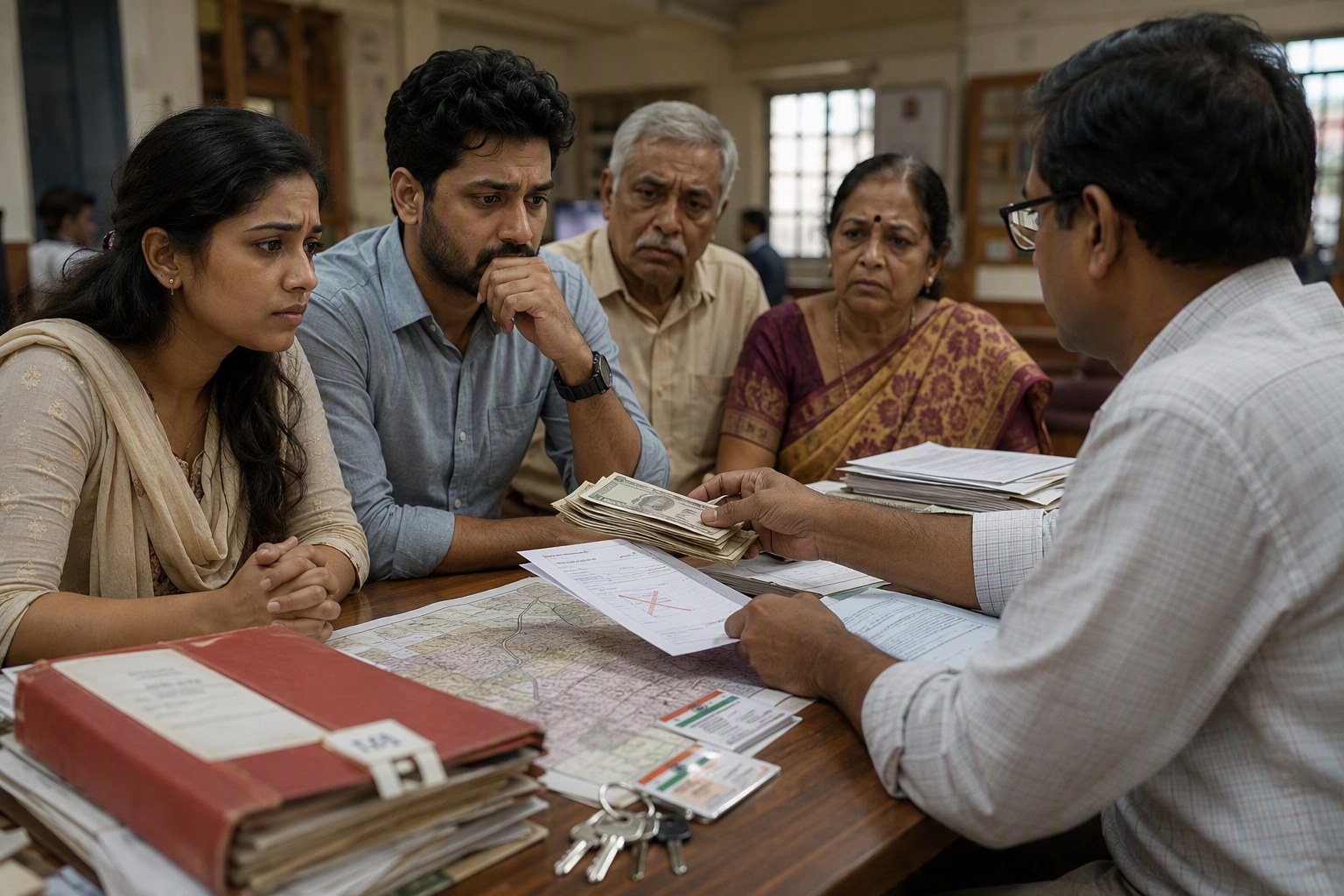
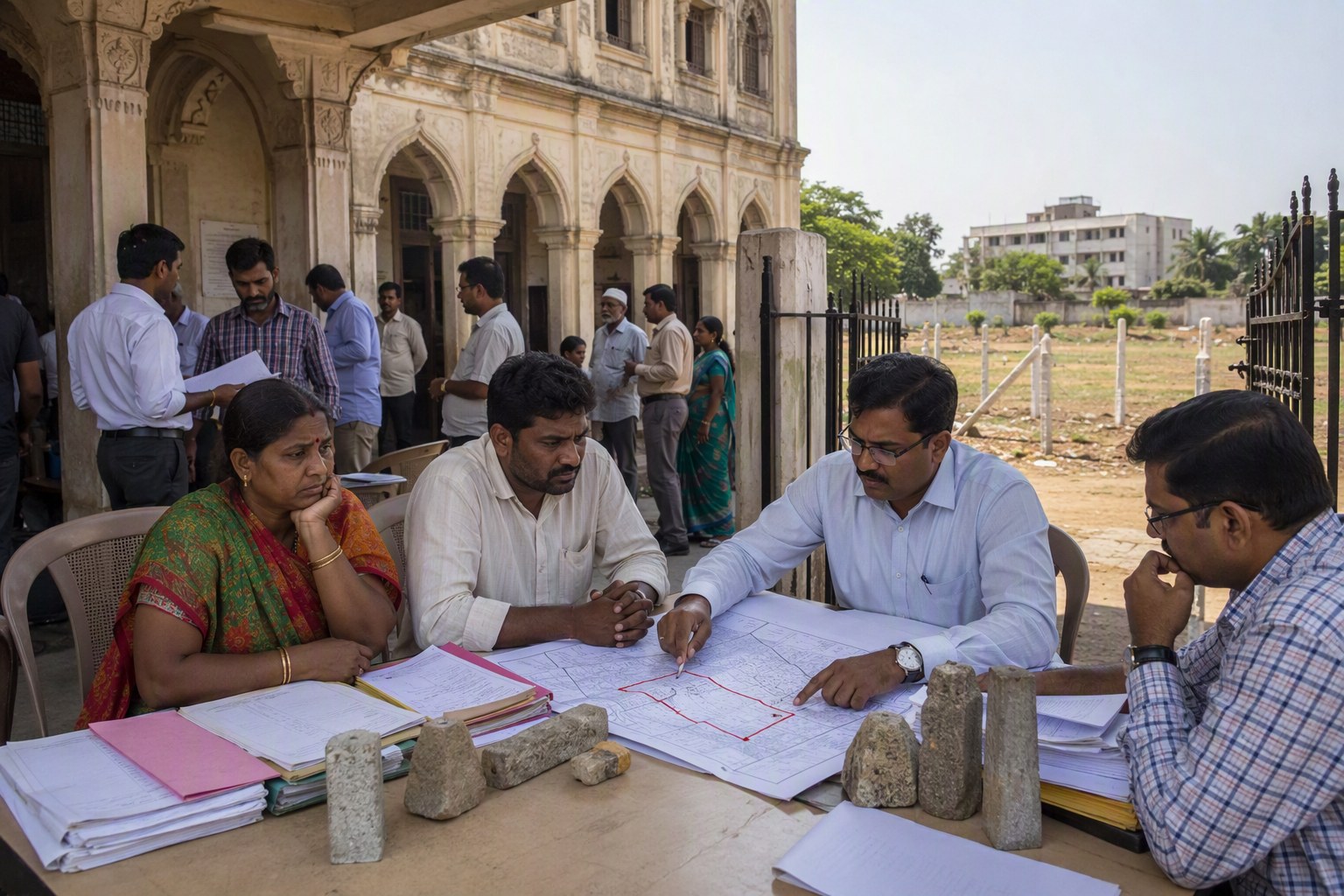
Telangana Registrations are moving into a stricter checking phase, and buyers should treat this as a warning before paying token money. The biggest red flag is the official prohibited properties list under Section 22-A: Telangana has 147,934 prohibited properties. If a land parcel, flat-linked undivided share, or plotted layout falls into this category, the Sub-Registrar Office can refuse registration even after the buyer has paid an advance.
For Hyderabad buyers, this is not a small technical issue. We have seen deals in Kokapet, Narsingi, Tellapur, Bachupally, Shankarpally, Moinabad and Maheshwaram move fast because the seller says another party is ready. That pressure is exactly where mistakes happen. A buyer pays ₹2 lakh, ₹5 lakh or ₹10 lakh as token, then discovers the survey number has a prohibition entry, old litigation, mismatch in pahani, or a missing link document.
Our view is simple: EC, Section 22-A, Dharani and SRO checks must happen before token payment, not after drafting the sale agreement.
Telangana Registrations: why stricter scrutiny matters now
At the registration stage, the SRO is not only checking stamp duty and identity proof. Officers can examine whether the property is registrable, whether the survey number is blocked, whether the seller has marketable title, and whether the document matches government records. In practical terms, buyers should expect less tolerance for vague property descriptions, missing survey boundaries, incorrect door numbers, and mismatched names between sale deed, pattadar passbook, EC and Dharani.
The number that should worry buyers is 147,934. That is the count of prohibited properties under Section 22-A. These can include government lands, assigned lands, endowment lands, wakf properties, ceiling surplus lands, certain dispute-linked parcels, and other lands notified by the State. A clean-looking plot on ground can still carry a registration block in records.
This matters more in Hyderabad’s growth corridors because transactions often involve converted agricultural land, plotted ventures, old gram panchayat layouts, inheritance partitions, and resale agreements. In Gandipet mandal, Rajendranagar mandal, Shankarpally mandal, Moinabad mandal, Abdullapurmet mandal and Maheshwaram mandal, buyers must track both the village survey number and the current municipal or layout identity. One missing link can stop a sale deed at the counter.
Telangana Registrations checks buyers should finish before token money
Most buyers first ask about price, loan eligibility and vastu. Fair enough. But under stricter Telangana Registrations scrutiny, the first due diligence layer should be legal and record-based. Start with the Encumbrance Certificate Search to see registered transactions, mortgages, releases, agreements and court-related entries where available. EC is not a full title certificate, but it tells you whether the seller’s story matches registered history.
Next, run a Section 22-A Prohibited Property Check. This is the step many buyers skip. They assume a property is safe because a neighbour registered recently or because a bank gave loan approval to another flat in the same area. That assumption is risky. Survey-number-level issues can differ even within the same village or layout.
Then identify the correct jurisdiction using Find Your SRO Office. Hyderabad buyers often mix up locality names and SRO limits. A flat may be marketed as Financial District but fall under a different registration office depending on the exact village and mandal. For land, use the Survey Number Finder and cross-check the survey number against Dharani, pahani/adangal entries, layout approval and link documents.
Before finalising the price, check the official market value through Market Value / Guideline Value Search. Registration cost is calculated on the higher of sale consideration or government market value. For most sale deeds in Telangana, buyers should roughly budget around 6% towards stamp duty, transfer duty and registration fee, subject to property type and latest notified rules. You can estimate it using the Stamp Duty Calculator.
What an SRO may question during registration
- Section 22-A status: whether the property is on the prohibited list.
- Seller title: whether link documents support ownership from previous holders.
- Survey number accuracy: whether boundaries, extent and village details match records.
- EC history: whether past mortgages, releases or sales are properly reflected.
- Dharani and pahani records: especially for agricultural land and converted land.
- Layout or building approval: HMDA, GHMC, DTCP or municipality approval, as applicable.
- RERA status: for ongoing apartment and villa projects, check through RERA Project Lookup.
How the 147,934 prohibited properties figure hits Hyderabad buyers
The Section 22-A list is not some distant government file. It affects day-to-day buying decisions. Suppose a buyer is considering a 300 sq yd plot near Shankarpally. The seller shares a layout copy and says the land is clear. The buyer pays token because prices are moving. Later, the SRO record shows the parent survey number has a prohibited entry or part of the land is under dispute. Even if the seller is genuine, the buyer’s money is now stuck in negotiation.
In another common case, a resale flat in Narsingi or Manikonda may look safe because the apartment has residents, electricity meters and bank loans. Still, the buyer must verify the undivided share land, link documents, builder’s registered development agreement and EC. Apartment buyers sometimes focus only on the flat number and forget the land underneath. Registration scrutiny can expose that gap.
For villas and plotted developments around Mokila, Kollur, Tukkuguda, Adibatla and Ibrahimpatnam, we suggest checking the parent survey number, layout approval, land conversion, road access and zone. If the buyer plans future construction, tools like Land Use Zone Finder, Road Width Check and FSI/FAR Calculator can prevent costly surprises.
| Buyer check | Why it matters | When to do it |
|---|---|---|
| EC search | Shows registered transaction and loan history | Before token |
| Section 22-A check | Confirms whether registration can be refused | Before token |
| Guideline value check | Helps estimate stamp duty and under-valuation risk | Before price finalisation |
| SRO identification | Avoids wrong jurisdiction and document confusion | Before document drafting |
| RERA lookup | Checks project registration for ongoing projects | Before booking amount |
Telangana Registrations: what buyers should ask sellers
A serious seller should be able to share documents before asking for non-refundable token money. Ask for the latest EC, link documents for at least 30 years where possible, pattadar passbook or title deed for land, mutation details, latest pahani, tax receipts, layout approval, building permission, occupancy certificate if applicable, and the seller’s ID proof. For apartments, ask for sale deed, mother deed, development agreement, GPA if any, sanctioned plan, OC, association NOC and loan closure letter if the property is mortgaged.
In our experience, the biggest warning sign is irritation. If the seller or broker says, why so many checks, many buyers are waiting, treat it carefully. Genuine urgency is possible, but legal clarity should not be sacrificed. Registration refusal is more painful than losing a so-called hot deal.
Buyers should also record token terms clearly. If you still decide to pay token before full legal opinion, mention that refund is mandatory if EC, Section 22-A, Dharani, SRO, bank legal or title verification shows an adverse finding. Put the survey number, flat number, extent, village, mandal and SRO in the receipt. A vague receipt saying advance for plot near Kollur is of little help later.
Our practical checklist before paying even ₹1
- Match seller name across sale deed, EC, Aadhaar/PAN and tax records.
- Check whether the survey number or sub-division appears in the Section 22-A list.
- Verify EC for the correct village, survey number, flat number and document numbers.
- Confirm SRO jurisdiction instead of relying on locality branding.
- Compare agreed value with government guideline value.
- For ongoing projects, verify RERA registration and project details.
- Take a written refund clause for adverse legal findings.
What this means for the market
Stricter scrutiny may slow down some registrations, especially in land-heavy transactions. But it is good for genuine buyers. Hyderabad’s property market has become expensive, and a failed registration can damage a family’s savings. A buyer purchasing in Tellapur, Kondapur, Uppal, Kompally or Shamshabad is not only buying square feet. They are buying clean title, registrability and future resale confidence.
My opinion is that brokers and sellers will also have to adapt. The old style of first token, then documents will not work for careful buyers anymore. Clean-paper properties will command better trust. Properties with missing link documents, unclear inheritance, old GPA chains or survey disputes will face tougher questions at both buyer and SRO level.
The safest buying order is simple: identify property, collect documents, run EC and Section 22-A checks, verify guideline value and SRO, take legal opinion, then pay token with refund terms. That one change can save buyers from months of stress.
Frequently Asked Questions
Can a property be refused registration in Telangana even after token payment?
Yes. If the property is under Section 22-A prohibition, has title issues, wrong survey details or other record mismatches, the SRO can refuse registration. Token payment does not make the property registrable.
What is the first check before buying land in Hyderabad outskirts?
Start with EC and Section 22-A checks for the exact survey number, village and mandal. Then verify Dharani, pahani, layout approval, land conversion and SRO jurisdiction.
Does an Encumbrance Certificate prove clear title?
No. EC shows registered transactions and encumbrances for the searched period. It must be read along with link documents, revenue records, Section 22-A status and legal opinion.
Should apartment buyers also check Section 22-A?
Yes. Apartment buyers should verify the land on which the project stands, including the parent survey number, development agreement, link documents and RERA details where applicable.
How much should buyers budget for registration charges in Telangana?
For many sale deeds, buyers should roughly plan around 6% towards stamp duty, transfer duty and registration fee, subject to property type and current government rules. Always calculate on the higher of sale value or guideline value.