


Telangana May Add Reason Codes For Stalled Property Deeds
Telangana may add reason codes for stalled property deeds, a move that can make Sub-Registrar Office decisions easier to understand for buyers, sellers, document writers and lawyers. The biggest impact will be felt in registrations stopped due to Section 22-A checks, where Telangana currently has 1,47,934 prohibited properties recorded. For families buying in Hyderabad’s fast-moving corridors like Serilingampally, Gandipet, Rajendranagar, Medchal, Shankarpally and Hayathnagar, a clear digital reason code can reduce confusion at the SRO counter.
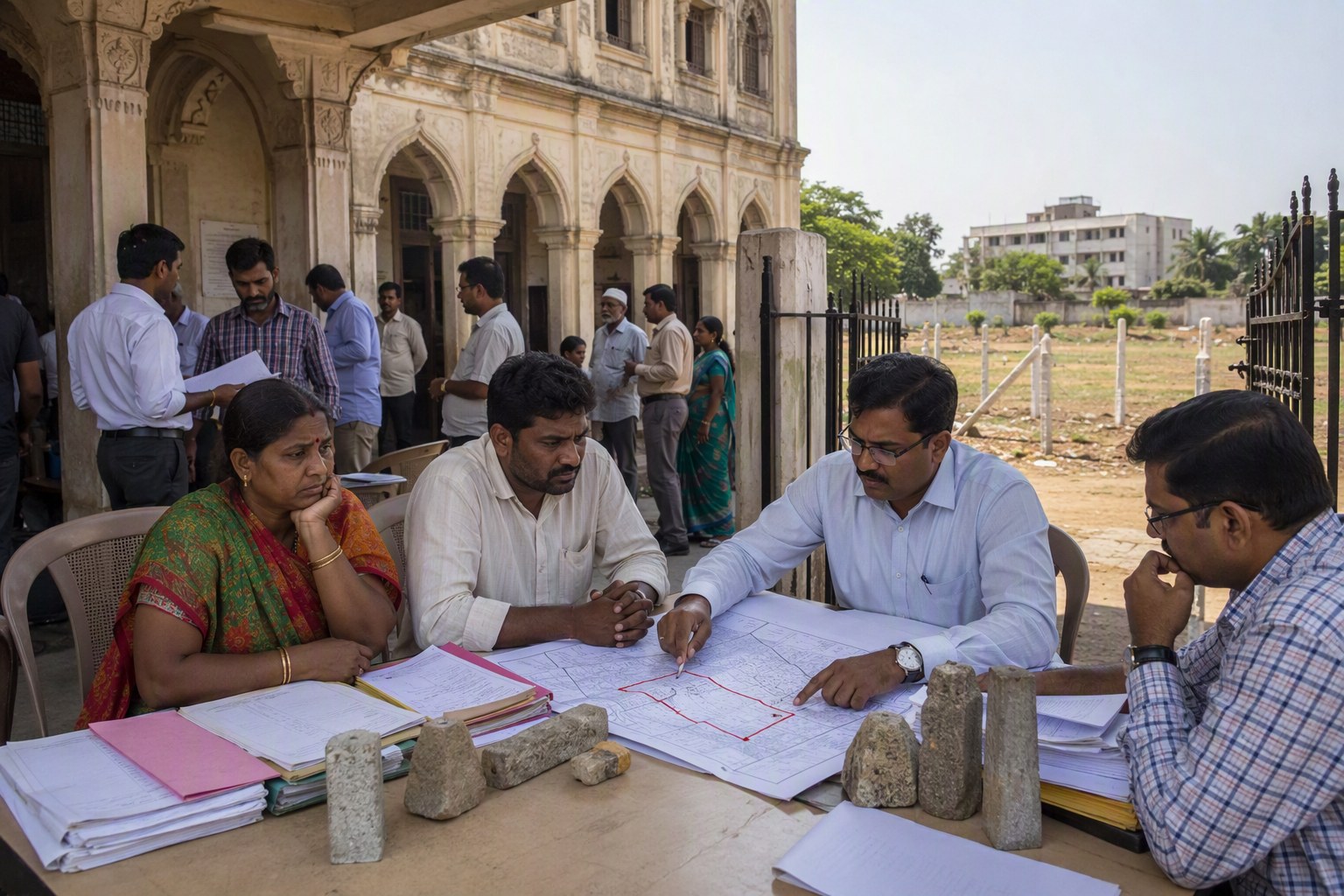
At present, when a sale deed is stalled or refused, the buyer often hears a short line: “22-A issue”, “survey number blocked”, “court case”, “government land”, or “technical objection”. That is not enough. A house buyer who has already paid token advance, arranged bank loan, calculated stamp duty and fixed registration date needs to know the exact reason. Is the entire survey number prohibited? Is only a part affected? Is it a data mismatch between Dharani, pahani and registration records? Or is it a missing NOC?
In our experience, most registration disputes do not start because buyers ignored the law. They start because the reason for refusal is not explained in a standard, documentable way.
Telangana May Add Reason Codes For Stalled Property Deeds: What It Means
The proposed idea is simple: when a property document is stopped, the registration system can show a standard digital reason code. Instead of every SRO using different wording, a code-based format can tell the party why the deed is pending, refused or sent for further verification.
For example, a deed may be stopped because the survey number appears in the Section 22-A prohibited properties list. Another file may be held because the property description in the sale deed does not match the pahani, old link document or municipal door number. In some layouts near Mokila, Tellapur, Narsingi and Kollur, buyers have seen cases where the layout name is popular in the market but the underlying survey number needs deeper checking.
If Telangana standardises these reasons, the buyer can take a printout or digital copy and show it to the seller, advocate, bank, revenue officer or layout developer. This can save time, especially where multiple parties are involved.
Why Telangana May Add Reason Codes For Stalled Property Deeds Around 22-A Checks
Section 22-A is the heart of many registration blocks in Telangana. It covers properties that cannot be registered due to legal or government restrictions. These may include government lands, assigned lands, endowment lands, wakf lands, ceiling surplus lands, certain court-disputed lands and properties specifically notified by authorities.
The number is not small. Telangana has 1,47,934 prohibited properties under Section 22-A. That means a routine property transaction can fail if the survey number, plot extent or property record is linked to a prohibited entry.
Hyderabad’s surrounding mandals are especially sensitive because agricultural land, old gram panchayat layouts, HMDA layouts, ORR growth corridors and gated communities often sit close to older revenue records. We have seen buyers get attracted by a good price in places like Shankarpally mandal, Moinabad mandal, Maheshwaram mandal and Ghatkesar mandal, only to later discover that survey-level verification was not done properly.
Before paying a major advance, buyers should check the property through the Section 22-A Prohibited Property Check, confirm survey details with the Survey Number Finder, and run an Encumbrance Certificate Search. These three checks catch many early warning signs.
How A Reason Code Can Change SRO-Level Communication
Today, SRO staff deal with heavy public pressure. Buyers want same-day registration. Sellers want payment release. Agents push for quick clearance. Banks ask for proof. Lawyers ask for written refusal. In that rush, the exact reason sometimes gets lost.
A standard reason-code system can bring discipline. It can separate genuine legal prohibition from fixable documentation errors. That difference matters a lot.
| Possible reason category | What it may mean for the buyer | Likely next step |
|---|---|---|
| 22-A prohibited property match | Survey number or property entry is blocked for registration | Verify with revenue records, Dharani and official prohibited list |
| Ownership mismatch | Seller name does not match the link document, EC or revenue record | Check link documents, mutation, pahani and legal heir papers |
| Extent mismatch | Area in deed differs from earlier document or survey record | Correct deed schedule or obtain proper survey confirmation |
| Pending court or authority objection | Property may be under dispute or official hold | Collect court order, NOC or clearance, as applicable |
| Market value or fee issue | Stamp duty calculation may not match guideline value | Recheck SRO value and pay deficit duty if applicable |
This is where digital clarity helps. Telangana sale deed registration usually involves 4% stamp duty, 1.5% transfer duty and 0.5% registration fee, adding up to around 6% for a standard sale transaction. If the issue is only undervaluation or wrong fee calculation, a buyer can resolve it through payment correction. But if the issue is Section 22-A, the matter is legal and revenue-linked, not just a fee problem.
Buyers can estimate registration cost using the Stamp Duty Calculator and compare declared value with official rates through the Market Value / Guideline Value Search. For apartments and villas, the Composite Value Calculator is also useful before document preparation.
What Buyers In Hyderabad Should Do Before Booking A Registration Slot
In Hyderabad, property risk changes from locality to locality. A flat in a RERA-registered tower in Kokapet is a different due diligence exercise from an open plot in Chevella mandal. A resale apartment in Kondapur requires a clean EC, link documents and society records. A farmhouse land parcel in Moinabad needs revenue verification, access road checking and land-use review.
My practical advice is this: do not wait for the SRO to become your first verification point. By the time your deed reaches the SRO, money has usually moved. Token amount, agreement amount, loan processing fee, legal fee and registration planning may already be done.
- Check whether the survey number is hit by Section 22-A before paying a large advance.
- Search the EC for at least 30 years for land and older houses, where possible.
- Match the seller’s name across sale deed, pattadar passbook, Dharani, pahani, property tax and link documents.
- Check the correct SRO using the Find Your SRO Office tool.
- For flats, verify the project on the RERA Project Lookup before trusting brochure claims.
- Use the Property Verification Tool when the property is land, plot or a non-standard resale asset.
In areas like Bachupally, Kompally, Nizampet, Ameenpur and Patancheru, apartment buyers usually focus on price per sft and amenities. That is natural. But land title, permissions and registration readiness are just as critical. In plotted developments near Ibrahimpatnam, Yacharam, Kandukur and Adibatla, survey number accuracy becomes even more serious.
Why Lawyers And Banks Will Welcome Standard Refusal Codes
Property lawyers spend a lot of time interpreting vague SRO objections. If the objection comes with a standard code and short description, legal opinion can be faster and more accountable. Banks will also benefit because loan files often get stuck when registration uncertainty appears late in the transaction.
A bank may approve a loan based on legal scrutiny, valuation and borrower eligibility. But if the SRO refuses the deed due to a prohibited property flag, disbursement becomes difficult. A clear code can help the bank decide whether the issue is curable or whether the property should be rejected.
This can also reduce unnecessary running around between the SRO, revenue office, tahsildar office, municipal office and document writer. For ordinary buyers, that matters. Not everyone knows how to read Dharani entries, old pahani copies or village maps.
Will Reason Codes Remove Registration Disputes?
No, they will not remove disputes by themselves. Telangana’s property record system still has old gaps: legacy revenue entries, spelling differences in names, unclear boundaries, partial prohibitions, layout regularisation questions and court matters. A digital reason code cannot solve all of that.
But it can create a clean starting point. If the SRO says “registration refused due to prohibited property match under Section 22-A”, the buyer knows the problem. If the reason says “seller name mismatch”, the seller knows what to correct. If the reason says “market value deficit”, the party can calculate and pay.
That is a big improvement over vague oral explanations. In a market where one registration delay can affect home loan validity, moving dates and seller payment timelines, clarity is not a small thing.
Verified.RealEstate View
Telangana’s registration system has already become more digital than what many buyers realise. Still, the last-mile communication at SRO level needs improvement. Reason codes for stalled property deeds can make the system fairer, especially for first-time buyers who do not have a regular advocate or property consultant.
Our view is that the codes should be visible on the registration receipt or refusal memo, with a short plain-language explanation in English and Telugu. The system should also mention whether the issue is curable, requires revenue clearance, needs court order review or is a hard prohibition. That one extra line can save lakhs of rupees and many months of stress.
For now, buyers should not treat SRO registration as a formality. Check Section 22-A, EC, market value, RERA status, survey number and SRO jurisdiction before signing. Hyderabad property is valuable, but clean title is what protects that value.
Frequently Asked Questions
What are reason codes for stalled property deeds in Telangana?
Reason codes are standard digital labels that can explain why a property registration is pending, refused or held for verification. They may cover issues like Section 22-A prohibition, ownership mismatch, extent mismatch, court dispute or stamp duty shortfall.
How many prohibited properties are listed under Section 22-A in Telangana?
Telangana has 1,47,934 prohibited properties recorded under Section 22-A. Buyers should check this before paying a major advance, especially for land and plots.
Can a 22-A issue be corrected at the SRO?
Not always. If the property is genuinely prohibited, the SRO cannot register it. If the issue is a data mismatch or wrong entry, the owner may need revenue department clarification, correction or official clearance.
Which checks should I do before property registration in Hyderabad?
Check the Section 22-A status, EC, guideline value, survey number, seller ownership, RERA status for projects and correct SRO jurisdiction. These checks reduce the risk of last-minute refusal.
What is the usual registration cost for a sale deed in Telangana?
For a standard sale transaction, Telangana generally has 4% stamp duty, 1.5% transfer duty and 0.5% registration fee, making it around 6% in total. Exact charges can vary by transaction type.