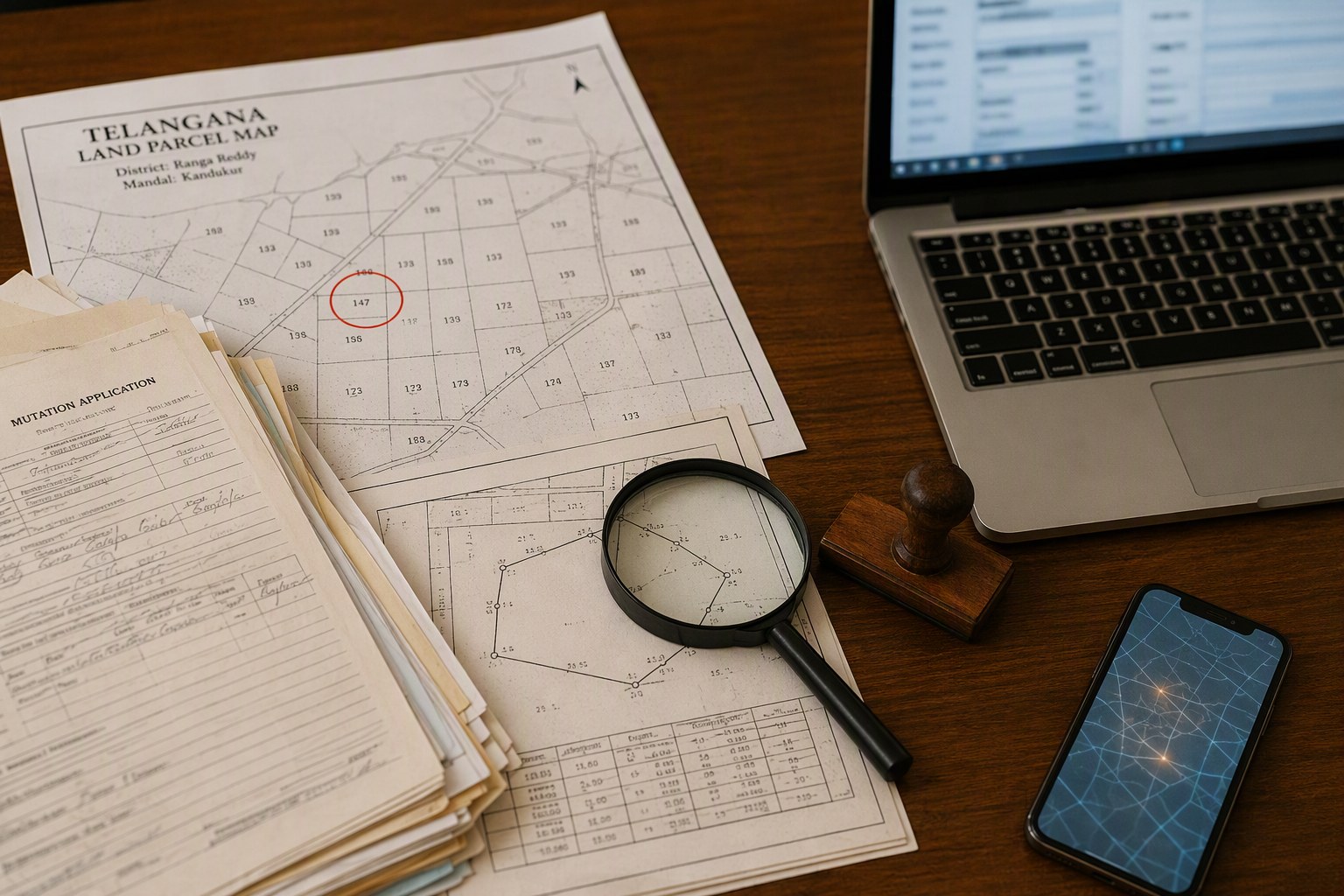
Telangana May Link Property Tax Records With 22-A Land Lists, and if the proposal moves from discussion to execution, it can change how buyers do first-level due diligence before paying token advance. The idea is simple but useful: when a property tax record exists in a municipality or gram panchayat, the system may cross-check it against the Section 22-A prohibited properties database before the buyer reaches the SRO counter for registration.
As per latest IGRS data available in our database, Telangana has 3,076,153 prohibited property entries under Section 22-A. That is not a small administrative list sitting quietly in one department. It covers different categories of land where registration may be restricted, including government land, assigned land, endowment land, wakf-linked land and other notified properties.
Telangana May Link Property Tax Records With 22-A Land Lists: What This Means
At present, many buyers start with what the seller shows: property tax receipt, electricity bill, old sale deed, building permission copy, pahani, mutation entry, or a Dharani extract. In urban pockets like Kukatpally, Nizampet, Bachupally, Ameenpur, Narsingi, Manikonda, Tellapur and Gachibowli, a tax receipt often gives buyers a false sense of comfort.
We’ve seen this repeatedly in Hyderabad and surrounding mandals. A municipal tax assessment can prove that a structure or holding is recorded for tax collection. It does not automatically prove clean title. It does not override a 22-A restriction. It also does not guarantee that the survey number behind the house site is free from government claims or old prohibitory entries.
If tax data is linked with 22-A lists, the buyer may get an early red flag at the property-tax stage itself. That is the real value. Instead of discovering a restriction only when the document is presented for registration, the buyer can pause much earlier.
Our view is clear: a tax receipt should be treated as a supporting document, not as a title certificate. Linking it with 22-A data can make it a useful warning signal, especially in fast-moving resale markets around Hyderabad.
Why Telangana May Link Property Tax Records With 22-A Land Lists Now
The pressure point is not only registration. It is the gap between local-body records and land records. Municipalities and gram panchayats collect property tax based on assessment records. Revenue and registration departments deal with survey numbers, ownership trails, prohibited lists and SRO-level registration checks. When these systems do not talk to each other, buyers fall into the gap.
Take a typical layout plot near Patancheru or Ameenpur. The buyer may see a tax receipt from the local body, an old link document, a layout sketch and a boundary wall on site. But if the underlying survey number has a 22-A entry, registration can become difficult or impossible. In another case, an old gram panchayat house number in a village absorbed into an urban area may exist, but the revenue classification may still need careful checking.
This proposed linkage can act like a first alarm. It may not decide ownership. It may not replace legal scrutiny. But it can tell the buyer: “Do not proceed blindly. Check the survey number, SRO jurisdiction, EC and prohibited property status.”
How 22-A Prohibited Properties Affect Buyers In Hyderabad And Telangana
Section 22-A restrictions matter because SROs are expected to refuse registration of properties that fall under prohibited categories. For buyers, the pain usually appears late. By then, they may have paid advance, signed an agreement of sale, arranged bank processing, or planned a home loan schedule.
In places like Shankarpally mandal, Gandipet mandal, Moinabad, Maheshwaram, Shamshabad, Hayathnagar and Medchal, land histories can be layered. One part of a survey number may be sold as plots, another part may have old assignments, and another portion may carry a government or institutional claim. On paper, the seller may present one clean-looking document. The village map and 22-A list may tell a different story.
For apartment buyers also, this matters. A flat in a high-rise at Narsingi, Kollur, Tellapur or Puppalaguda may appear to be a simple unit purchase. But the project land must still be checked. RERA registration is useful, but buyers should also verify the underlying land records, EC and any prohibited-property alerts.
Where Property Tax Linking Can Help Before SRO Registration
The best part of this proposal is timing. Today, many buyers reach the SRO after most negotiation is over. If tax records and 22-A lists are connected, the warning can come at the start of the transaction journey.
| Buyer Stage | Current Risk | How 22-A Linkage May Help |
|---|---|---|
| Checking property tax receipt | Buyer assumes tax record means clear title | System may flag if linked land falls in 22-A list |
| Paying token advance | Advance may be paid before land check | Buyer can hold payment until survey number is verified |
| Agreement of sale | Clauses may not cover prohibited-property risk | Parties can add specific title and 22-A conditions |
| SRO registration | Restriction may appear late | Earlier alert reduces last-minute shock |
In our experience, early warning is half the battle in Telangana property deals. Once the buyer has paid a large advance, practical pressure starts. The seller may say the issue is temporary. The broker may ask for patience. The bank may ask for more documents. A clean alert before payment keeps the buyer in control.
Telangana May Link Property Tax Records With 22-A Land Lists, But Buyers Still Need Checks
Even if this linkage comes into force, buyers should not treat it as the final word. Government databases can have spelling variations, old village names, merged municipal limits and survey-number mismatches. A property may be assessed under a door number, while the 22-A entry may sit under a survey number. Mapping these two correctly is the key challenge.
Before paying advance, buyers should use multiple checks. Start with the survey number. Confirm the village, mandal and SRO jurisdiction. Run an EC search. Check prohibited-property status. Compare the ready reckoner or market value with the sale consideration for stamp duty planning. For apartments, verify RERA details and land documents.
Useful starting points are Section 22-A Prohibited Property Check, Survey Number Finder, Encumbrance Certificate Search and Find Your SRO Office. If you are estimating registration outgo, use the Stamp Duty Calculator and compare values through Market Value / Guideline Value Search.
What Sellers And Builders Should Expect
Sellers may face more questions if their tax record gets linked to a 22-A alert. This is actually healthy for the market. Genuine owners can clear documentation doubts early. Sellers with weak papers will find it harder to push buyers into rushed agreements.
Builders and layout developers around growth corridors such as Kollur, Mokila, Adibatla, Tukkuguda, Kompally and Bowrampet should keep village-wise and survey-wise land files ready. Buyers are becoming sharper. A glossy brochure is not enough. They ask for land conversion, link documents, EC, RERA, layout approval, mortgage release details and SRO clarity.
For plotted developments, the risk is sharper because many sales are survey-number driven. A small error in survey number, village name or mandal can send the buyer to the wrong record. That is why document matching matters more than verbal assurance.
My Reading Of The Policy Direction
This move, if implemented well, can reduce avoidable disputes. Telangana already has large digital land and registration datasets. The next practical step is interlinking them in a buyer-friendly way. A person checking a property tax record should not need to understand every internal department boundary. The system should warn them when the land behind that tax record has a registration restriction.
But the state must be careful with false positives and old entries. A wrongly mapped alert can trouble genuine owners. There should be a clear correction route, preferably with time-bound verification at the mandal, municipal and registration levels. Without that, people may run between offices with files, challans and old proceedings.
For buyers, my advice is simple. Do not buy only because the tax is paid. Do not buy only because the seller has an old registered deed. Do not buy only because a bank gave verbal comfort. Match the property tax record with the survey number, revenue record, EC, 22-A status and SRO jurisdiction. If anything does not match, slow down.
Buyer Checklist Before Paying Advance
- Ask for the exact survey number, village and mandal, not only the door number or flat number.
- Check whether the land appears in the Section 22-A prohibited property list.
- Verify the EC for the correct SRO period and property description.
- Compare municipal or panchayat tax records with the sale deed schedule.
- For flats, check RERA details using RERA Project Lookup.
- Track future changes through Property Change Tracker if you are seriously negotiating.
- Take legal opinion before signing an agreement of sale, especially for open plots and old gram panchayat properties.
The policy direction is welcome, but the buyer’s discipline remains the main protection. In Telangana real estate, clean documentation is not one document. It is a chain. Property tax, pahani, Dharani entry, EC, SRO record, layout approval, RERA and 22-A status must speak the same language.
Frequently Asked Questions
Will a property tax receipt prove clear title in Telangana?
No. A property tax receipt shows assessment or tax payment with a local body. It does not prove ownership, marketable title or freedom from Section 22-A restrictions.
What is Section 22-A in Telangana property registration?
Section 22-A relates to properties where registration is prohibited or restricted. As per latest IGRS data in our database, Telangana has 3,076,153 prohibited property entries under this category.
How can buyers check if land is in the 22-A list?
Buyers should verify the survey number, village and mandal, then check prohibited-property status, EC and SRO details. Start with the Section 22-A check and confirm with official records before payment.
Will linking tax records with 22-A lists stop bad property deals?
It can reduce risk by giving an early warning, but it will not replace legal due diligence. Buyers must still verify title documents, EC, revenue records, approvals and SRO jurisdiction.