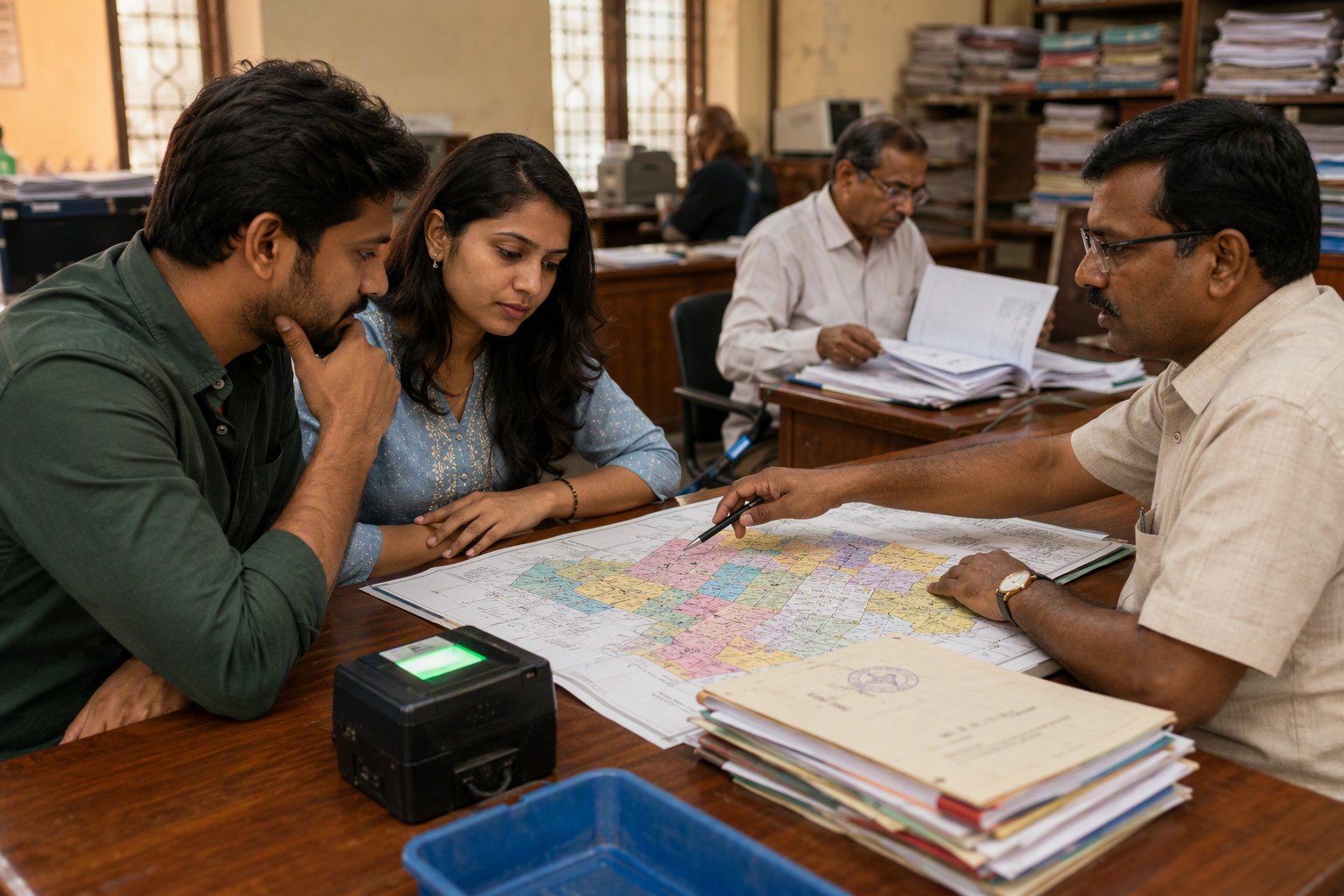
Telangana May Mandate 22-A Checks for Mutation Requests, and if this shift comes through, buyers will need to think beyond registration day. At present, most people treat Section 22-A verification as a pre-registration issue checked at the SRO before sale deed execution. The possible change would push that scrutiny into the mutation stage also, meaning the buyer’s name may not move smoothly into revenue or local body records if the land later flags as prohibited.
For Hyderabad and peri-urban buyers, this is not a small procedural tweak. Mutation is where ownership starts reflecting in pahani, Dharani, municipal assessment, or other local records depending on the property type. In our experience, many buyers celebrate after registration and postpone mutation. That habit may become risky if 22-A verification becomes part of the mutation application workflow.
Telangana May Mandate 22-A Checks for Mutation Requests: What may change
Section 22-A is the legal route through which certain properties are marked as prohibited for registration. These can include government lands, assigned lands, endowment lands, wakf-related entries, ceiling surplus lands, court-affected properties, and other notified categories depending on the record. Telangana already has a large prohibited property database. As per Verified.RealEstate database records, there are 3,076,153 prohibited property records under Section 22-A.
The proposed shift is about timing and coverage. Today, buyers usually focus on whether the SRO accepts the sale deed. If the sale deed gets registered, many assume the title journey is complete. But mutation is a separate administrative act. It updates the buyer’s name in revenue or civic records. If 22-A checking is built into mutation applications, the buyer may face a second round of scrutiny after spending money, paying stamp duty, and completing registration.
My view is simple: Telangana property buyers should stop treating mutation as a clerical step. It is becoming a title-health checkpoint, especially in mandals where old survey records, government land claims, and layout conversions overlap.
Telangana May Mandate 22-A Checks for Mutation Requests: Why buyers should care after registration
The key impact is on post-registration certainty. A sale deed may be registered, but mutation may still get delayed or questioned if the survey number, sub-division, village record, or land classification attracts a 22-A entry. This matters most in fast-moving markets around Hyderabad where land has passed through multiple hands.
We’ve seen this concern come up in areas like Gandipet, Kokapet, Narsingi, Manikonda, Tellapur, Kollur, Mokila, Shankarpally, Maheshwaram, Tukkuguda, Adibatla, Hayathnagar, Abdullapurmet, Shamirpet, Medchal, and Moinabad. In many such locations, the buyer is not just buying a plot or land parcel. They are buying a chain of survey numbers, pahanis, conversion orders, layout permissions, mortgage releases, and old link documents.
If mutation begins to require 22-A verification, buyers should check the land status before sale agreement, before sale deed, and again before mutation filing. This is especially true for agricultural land purchases through Dharani, HMDA layout plots carved from older survey numbers, gram panchayat layouts, and properties where the land was converted from agriculture to non-agriculture.
How the 22-A check may affect different property types
| Property type | Possible mutation impact | Buyer caution |
|---|---|---|
| Agricultural land | Dharani mutation may be held up if survey number or extent has a prohibited flag | Check pahani, passbook history, 22-A status, and seller pattadar details |
| Open plot in layout | Mutation or local body assessment may face questions if parent survey number has issues | Verify layout approval, parent land documents, and SRO records |
| Apartment | Flat transfer may not directly involve land mutation, but land title issues can affect project confidence | Check RERA, link documents, EC, and land ownership of the project |
| Villa project | Land share and layout approvals may need closer scrutiny | Review land conversion, approval plan, EC, and 22-A status of survey numbers |
| Inherited property | Name change may be questioned if land category is disputed or notified | Check succession papers, pahani entries, and prohibited status before filing |
What is Section 22-A in Telangana property checks?
Section 22-A is commonly understood by buyers as the “prohibited property” filter. In simple terms, if a property is listed under this category, the registration system may refuse or restrict registration depending on the notified reason. The issue is that many buyers check only the final plot number or door number. In land transactions, the real risk often sits at the survey number level.
For example, a buyer in Maheshwaram mandal may be shown a plot in a layout. The seller may talk only about plot number and road width. But the underlying survey number, village name, and land classification decide much of the legal comfort. The same applies in Gandipet mandal, where old agricultural records and premium development activity sit side by side. A clean-looking sale deed is not enough if the parent land has a pending red flag.
Before paying token advance, buyers should use the Section 22-A Prohibited Property Check, verify survey details through the Survey Number Finder, and examine registered document history with the Encumbrance Certificate Search. For larger deals, I would also track changes over time using the Property Change Tracker.
Mutation is not the same as registration
This distinction causes many disputes. Registration proves that a document was executed and recorded by the SRO. Mutation updates the government record to show who is in possession or ownership for revenue or civic purposes. Both are relevant, but they are not the same thing.
For agricultural land, mutation is closely tied to Dharani, pattadar passbook entries, pahani records, and revenue classification. For urban properties, mutation may involve municipal records, property tax assessment, and local body transfer. For HMDA or DTCP layouts, buyers must also see whether the parent layout and survey numbers match the approvals.
If 22-A checks are added to mutation requests, the mutation desk may not simply ask, “Is there a registered deed?” It may also ask, “Is this survey number free from prohibited property restrictions?” That is a more serious test.
Practical checklist before buying in Hyderabad and nearby mandals
- Check the SRO: Use Find Your SRO Office to confirm the correct registration jurisdiction for the village or locality.
- Verify market value: Before registration planning, check the ready reckoner using Market Value / Guideline Value Search.
- Estimate stamp duty: Use the Stamp Duty Calculator before budgeting the transaction.
- Run 22-A check: Search by district, mandal, village, and survey number wherever possible.
- Check EC: Read the encumbrance certificate for mortgages, prior sales, court attachments, and unusual gaps.
- For apartments: Confirm project registration through RERA Project Lookup and compare land details with the brochure and agreement.
- For layouts: Match plot number with layout approval, parent survey number, road width, open space, and land use.
Where disputes may increase
The immediate pressure may be felt in transactions where registration happened, but mutation is pending. Buyers who purchased land on old agreements, GPA arrangements, unapproved layouts, or incomplete link documents may face more questions. Sellers may say, “Registration is done, what is the problem?” But the buyer will still need mutation for future resale, loan processing, inheritance planning, and government record alignment.
In Hyderabad’s western corridor, land values and development speed have pushed buyers to close deals quickly. In the southern belt around Maheshwaram, Tukkuguda, and Adibatla, plotted ventures have attracted many first-time land buyers. In northern mandals like Shamirpet and Medchal, agricultural-to-residential transitions are common. These are exactly the places where survey-number-level checking matters.
My opinion: if Telangana brings 22-A verification into mutation, it will irritate some buyers in the short term, but it can reduce future title shocks. The pain will be in pending cases, old paperwork, and properties where sellers gave verbal assurances instead of clean records.
What buyers should do now
Do not wait for a formal dispute to begin checking. If you have registered a property but not applied for mutation, file it without delay after verifying the survey number and document chain. If your mutation is pending, keep copies of the sale deed, link documents, EC, tax receipts, layout approval, conversion proceedings, pattadar passbook, and pahani extracts ready.
If you are about to buy, add a clause in the sale agreement that the seller must cooperate for mutation and must disclose any 22-A, court, government land, endowment, wakf, or assigned land issue. This is not just lawyer language. It is practical protection.
For high-value land in mandals like Gandipet, Serilingampally, Rajendranagar, Moinabad, Shankarpally, Maheshwaram, and Hayathnagar, I would not proceed without a written legal opinion based on current government records. A clean EC alone is not enough. EC shows registered transactions; it does not automatically clear land classification risk.
Bottom line for Telangana buyers
If Telangana mandates 22-A checks for mutation requests, the buyer’s due diligence window will extend beyond the SRO counter. Registration will remain vital, but mutation will become a second test of title comfort. That means buyers must verify survey numbers, prohibited property status, EC, Dharani entries, RERA details where relevant, and local body records before money changes hands.
In our experience, the safest buyer is not the one who negotiates the lowest price. It is the one who knows exactly what land record they are buying into.
Frequently Asked Questions
Will 22-A checks apply after registration also?
If Telangana adds 22-A verification to mutation applications, buyers may face scrutiny even after sale deed registration. The exact process will depend on the final government workflow.
Does registration guarantee mutation in Telangana?
No. Registration records the sale deed at the SRO. Mutation updates revenue or civic records. A registered deed can still face mutation questions if land classification or prohibited property issues arise.
How can I check if my land is under Section 22-A?
Check using district, mandal, village, and survey number details. Buyers can start with the Section 22-A Prohibited Property Check and also review EC, pahani, Dharani entries, and link documents.
Which Hyderabad areas need extra care for survey number checks?
Extra care is sensible in fast-growing belts such as Gandipet, Kokapet, Narsingi, Tellapur, Kollur, Mokila, Maheshwaram, Tukkuguda, Adibatla, Shamirpet, Medchal, and Moinabad.
Is an Encumbrance Certificate enough before buying land?
No. EC is useful for registered transaction history, but buyers should also check 22-A status, land classification, pahani, layout approval, conversion records, RERA where relevant, and seller title documents.