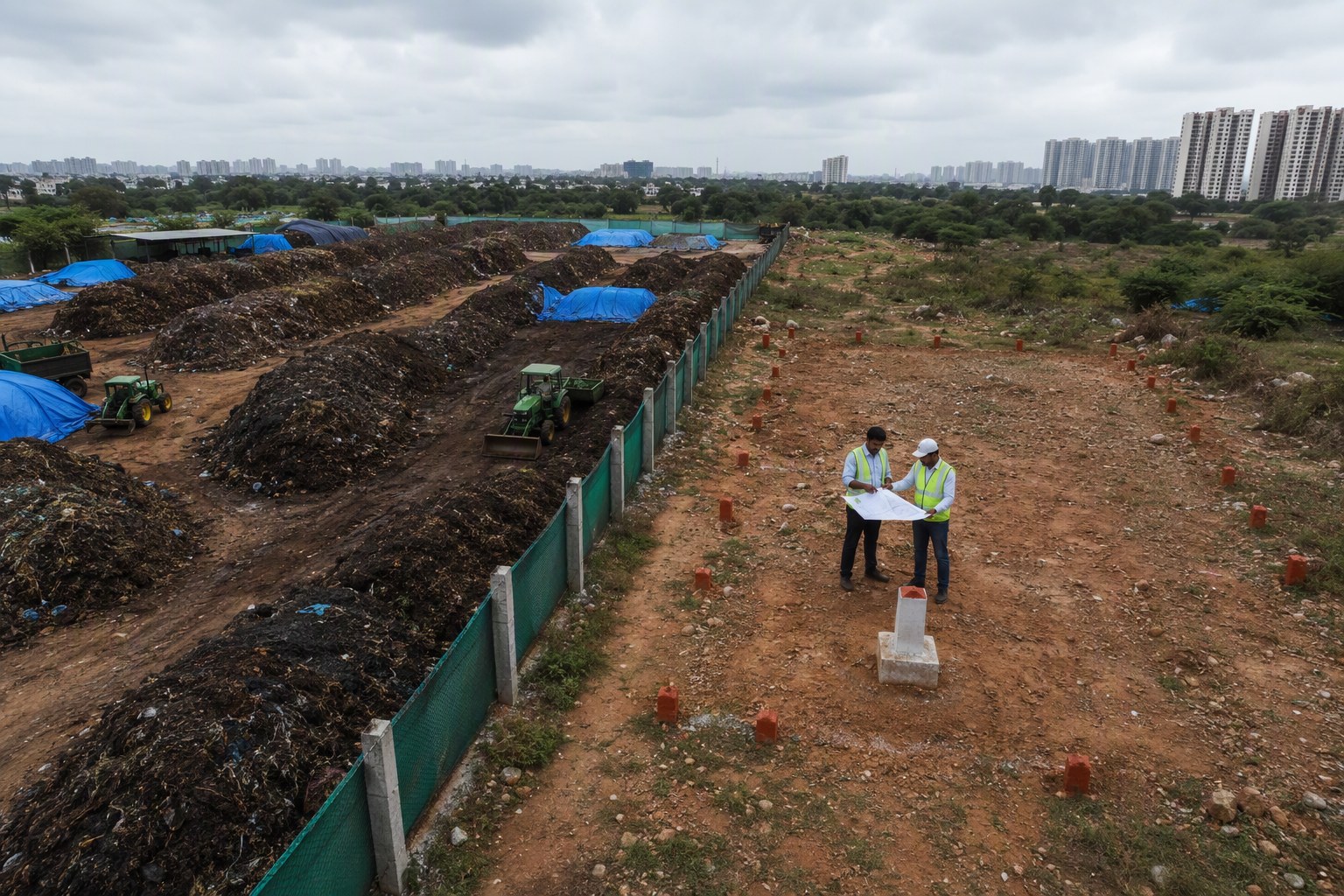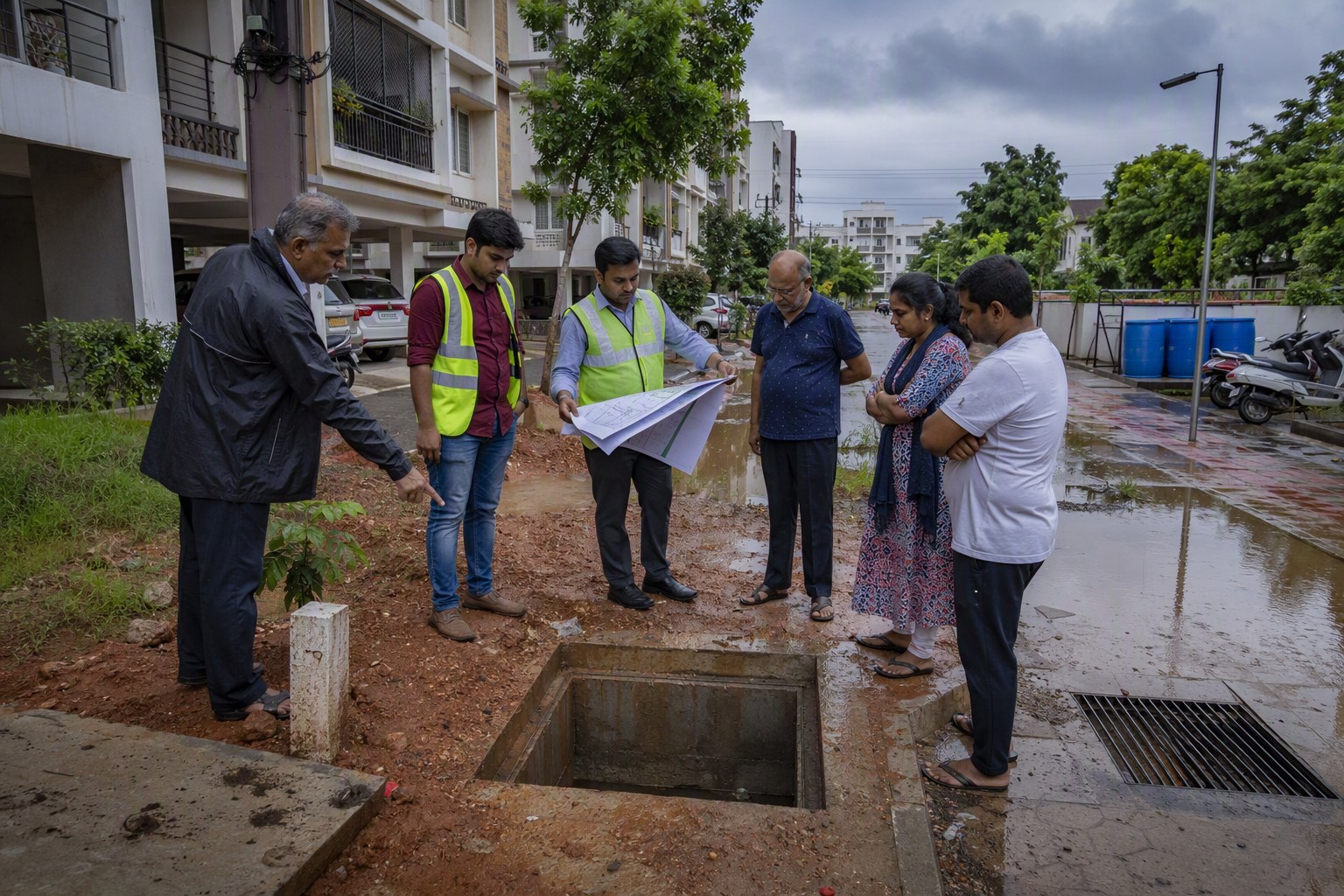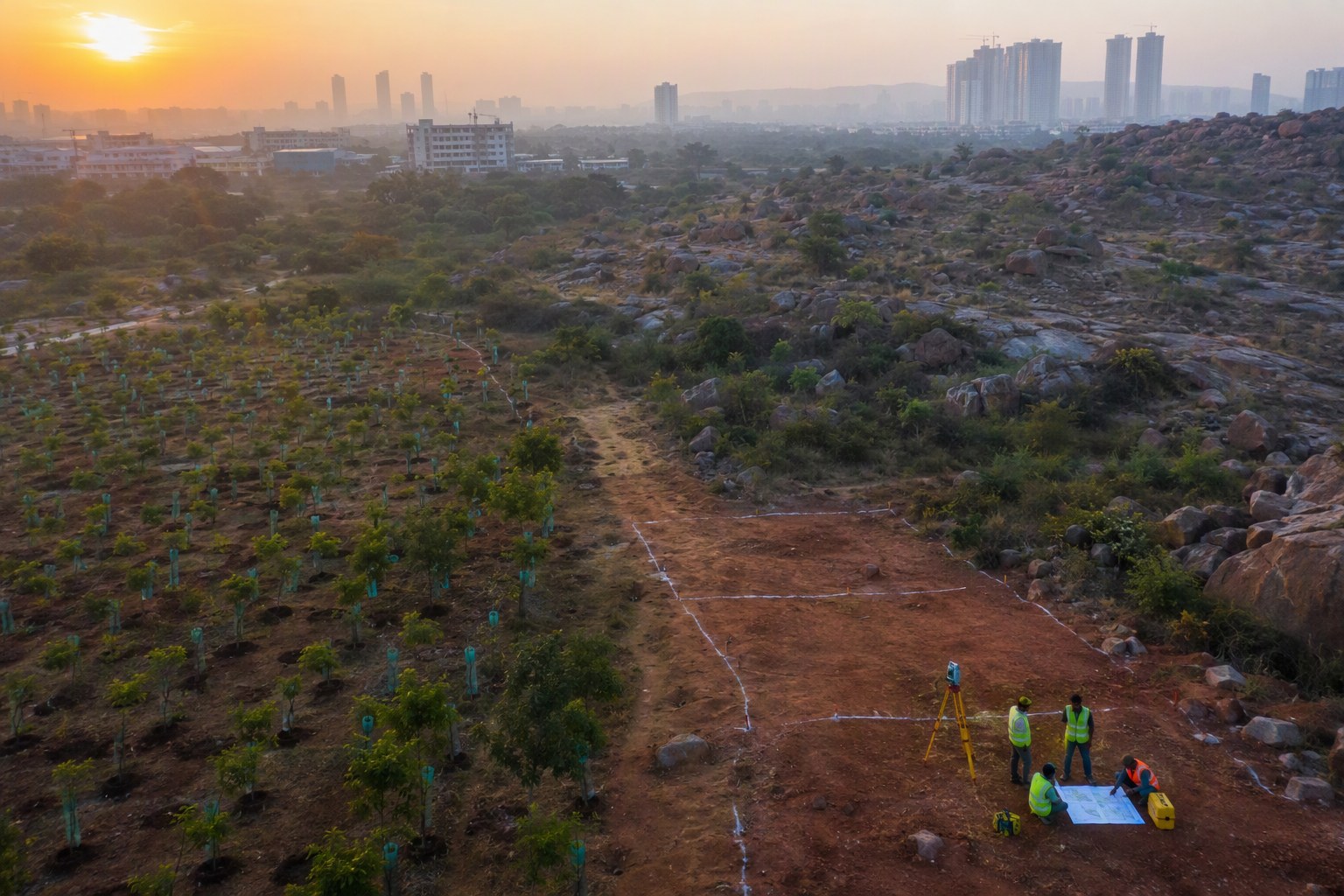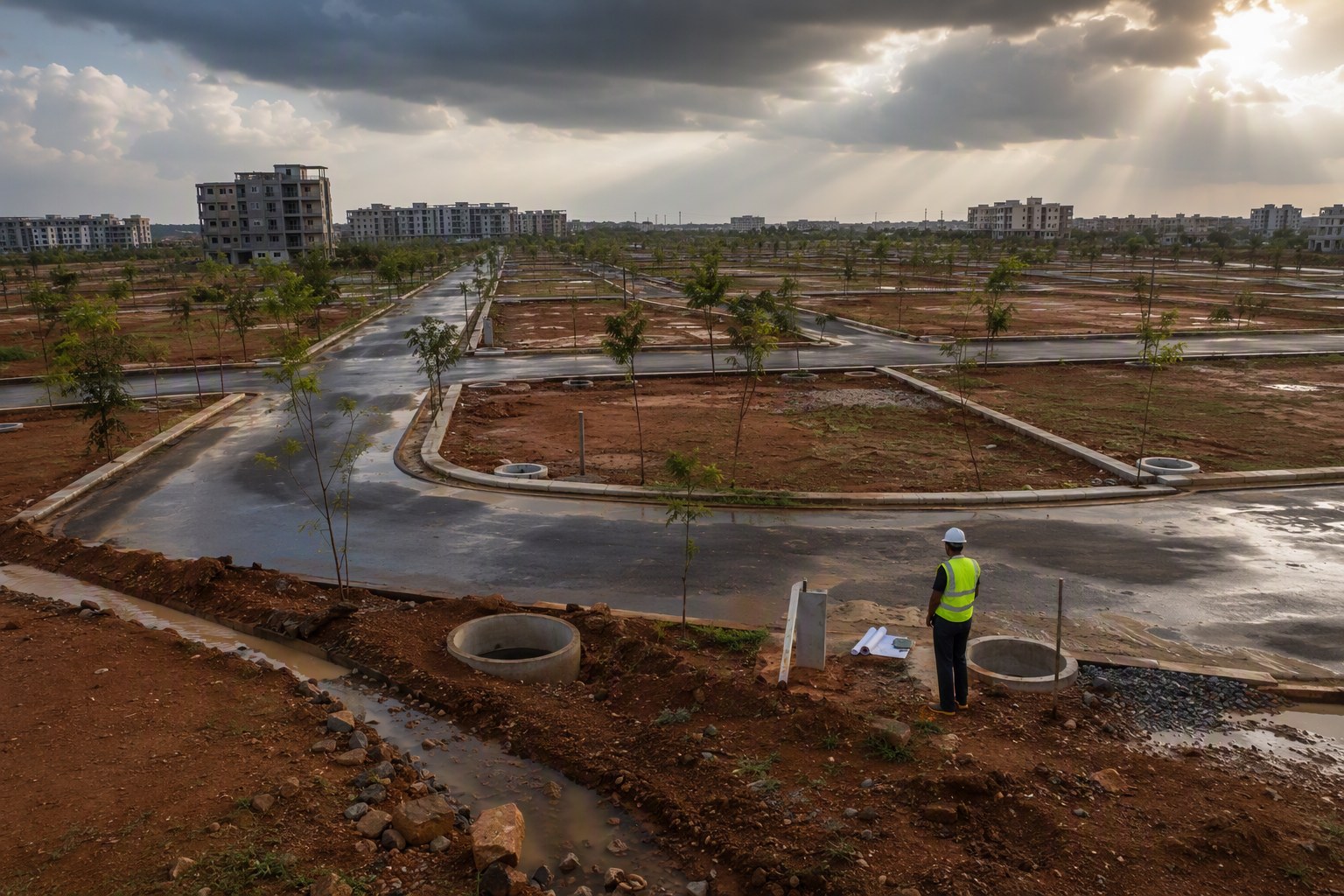
Telangana Rainwater Harvesting Audits may soon become a serious due-diligence point for plotted layouts, gated communities and apartment projects, not just a green feature shown in brochures. For buyers in Hyderabad growth corridors like Kollur, Tellapur, Mokila, Adibatla, Shadnagar, Maheshwaram and Medchal, this shift matters because water planning is now linked to long-term habitability, resale confidence and approval discipline.
The immediate discussion in real estate circles is simple: if inspections become tighter, developers will have to show that rainwater harvesting pits, recharge wells, storm-water drains and open space planning are working on the ground, not only marked on layout drawings. In our experience, this is where many buyers miss the point. They check road width, HMDA or DTCP approval, RERA, EC and price. Very few ask whether the project can handle monsoon runoff or recharge groundwater properly.
For Telangana layouts, rainwater harvesting is moving from a brochure promise to a practical verification item. Buyers should treat it like they treat title, access road and sanctioned layout.
Telangana Rainwater Harvesting Audits: What may change for buyers
If rainwater harvesting audits become more active, buyers may start asking sharper questions before booking a plot or flat. In areas under pressure from rapid development, especially around Outer Ring Road exits and proposed growth pockets, water is no longer a side topic. It affects borewell dependency, basement flooding risk, internal road quality and maintenance costs after handover.
A buyer looking at a layout in Mokila village of Shankarpally mandal, for example, should not stop at the layout copy. The buyer should ask where runoff goes during heavy rain, whether recharge pits are placed at correct low points, and whether storm-water drains connect to a legal outfall. In Maheshwaram mandal, where large layouts and warehouse-linked development are common, the same question becomes even more relevant because natural drainage lines can be disturbed by filling and levelling.
This is not only an environmental discussion. It is a property value discussion. A layout with poor drainage may look neat in summer, but monsoon reveals the real planning quality. We have seen buyers become alert only after internal roads stagnate or open plots remain waterlogged for days. By then, association-level repairs become expensive and blame moves between developer, local body and plot owners.
Telangana Rainwater Harvesting Audits and developer due diligence
For developers, stronger rainwater harvesting audits could mean better documentation at every stage. Layout applications already include technical drawings and conditions. The next practical layer is proof that the on-site works match approved plans. That means pits must not be symbolic. Recharge structures, drains, gradients and open space reservations should be measurable and visible.
In HMDA-style growth areas like Tellapur, Narsingi, Kokapet, Kollur and Gandipet surroundings, buyers are already paying attention to project approvals and RERA disclosures. The same seriousness should extend to water systems. A developer who can show proper recharge planning, maintenance access and drainage connectivity will have an advantage over someone selling only location hype.
For plotted developments, the issue is even sharper. After plots are sold, maintenance control often shifts. If rainwater systems are badly built or hidden under debris, the layout may face recurring trouble. In apartment projects, the association will eventually inherit the system. So a buyer should ask for drawings, inspection notes if available, and site photographs before agreement stage.
Why this matters in Hyderabad’s expanding mandals
Hyderabad’s real estate growth is no longer limited to core municipal limits. Buyers are moving towards Shankarpally, Chevella, Moinabad, Maheshwaram, Kandukur, Medchal, Shamirpet, Ghatkesar and Yadagirigutta-side corridors. Many of these areas still have agricultural land history, pahanis, survey-number-based identification and local drainage patterns that cannot be ignored.
When farmland becomes a layout, the land is usually levelled, internal roads are formed and plots are demarcated. If the natural slope is not respected, rainwater can shift from one owner’s plot to another. If a nala or seasonal drain is encroached or narrowed, the risk is not just technical; it can become a legal and approval problem also.
That is why buyers should combine environmental checks with title and land-record checks. Telangana has a large volume of restricted property records. As per latest IGRS data available in our database, 3,076,153 properties are listed under prohibited properties, commonly referred to in Section 22-A context. This number itself reminds us that land due diligence in Telangana cannot be casual. Rainwater harvesting audit checks should sit alongside title, SRO, land-use and survey-number verification.
Practical checklist for Telangana Rainwater Harvesting Audits before booking
Here is the buyer-side checklist I would personally use before paying a token advance in a new layout or apartment project:
- Ask for the approved layout or building plan: Check whether rainwater harvesting pits, storm-water drains and open spaces are shown clearly.
- Visit during or after rain if possible: A dry-site visit hides drainage defects. A post-rain visit shows low points, stagnation and road slope issues.
- Check land-use compatibility: Use the Land Use Zone Finder to understand the planning zone before assuming residential use is clean.
- Verify survey number and village: Match the project location with the correct village and mandal using the Survey Number Finder.
- Check prohibited property risk: Before discussing amenities, run a basic check through the Section 22-A Prohibited Property Check.
- Review RERA details: For eligible projects, use the RERA Project Lookup and compare promised amenities with uploaded project information.
- Confirm access and road width: Drainage, road formation and emergency access are linked. Use the Road Width Check where relevant.
- Check guideline value before pricing discussion: The Market Value / Guideline Value Search helps buyers compare registration value context with the quoted market price.
What buyers should ask the developer on site
Many sales teams will say, “Sir, rainwater harvesting is there.” That answer is not enough. Ask them to show the exact location. Ask who will maintain it. Ask whether the recharge pits are connected to rooftop water, open-area runoff, or both. Ask whether silt traps are provided. Ask whether the system is already completed or planned for a later phase.
For a gated community, ask whether the clubhouse, cellar, internal roads and landscape areas are included in the storm-water plan. In low-lying pockets near lakes or nalas, ask whether any flood-buffer or drainage restriction applies. In gram panchayat-side layouts, ask for the approval authority and confirm whether the layout falls under HMDA, DTCP or other local planning control.
A clean answer should sound specific. “There are recharge pits at these marked locations, water from this drain flows here, maintenance access is from this point” is better than “all permissions are there”. In land transactions, vague answers are usually where future disputes begin.
How rainwater audits may influence layout design
If inspections become routine and strict, layout design may change in visible ways. Developers may leave better open space planning, avoid careless filling of natural drains, maintain proper road camber, and document recharge structures with more discipline. This can slightly change how saleable area is planned, especially where land slope or drainage channels need protection.
For buyers, that is not a negative. A layout that respects site conditions is usually more liveable. Nobody wants a plot that becomes a water collection point every monsoon. Nobody wants an apartment cellar where pumps run constantly because surface runoff was poorly planned.
There is also a resale angle. Future buyers may ask for proof of proper drainage and water recharge, especially in premium corridors. Just as EC, RERA, occupancy certificate and mutation documents are checked today, environmental compliance records may become part of a serious resale file. The Encumbrance Certificate Search and Property Verification Tool are already part of many buyer checklists; rainwater audit documents may sit next to them in the same folder.
Developer reputation will matter more than brochure promises
Telangana buyers are becoming sharper. They are comparing pahanis, Dharani entries, SRO jurisdiction, RERA filings and ready reckoner values. The next layer is physical performance of the project. A developer who has delivered proper drainage in earlier ventures will carry credibility. A developer whose layouts regularly face stagnation complaints will face tougher questions.
In my view, this is a healthy shift. For years, green features were used as marketing language. Rainwater harvesting, solar lighting, avenue plantation and waste management were presented as amenities. Now buyers are learning to ask whether these features actually work. That is good for the market.
For new layouts in Telangana, especially on the Hyderabad fringe, rainwater harvesting audits may become a practical checkpoint before booking, bank loan processing, association takeover and resale. The smart buyer will not wait for a dispute. They will ask early, verify documents and inspect the land physically.
Frequently Asked Questions
Frequently Asked Questions
What are Telangana Rainwater Harvesting Audits in real estate?
They refer to inspections or verification of rainwater harvesting systems such as recharge pits, storm-water drains and related site works in layouts or building projects. For buyers, the key point is whether the system exists and works as per approved planning.
Should I check rainwater harvesting before buying a plot in Hyderabad outskirts?
Yes. In growth areas like Shankarpally, Maheshwaram, Medchal, Ghatkesar and Shamirpet, drainage and recharge planning can affect road condition, waterlogging, maintenance cost and resale confidence.
Which documents should I ask from a developer?
Ask for the approved layout or building plan, drainage drawings, rainwater harvesting location details, RERA information where applicable, EC, land-use confirmation and survey-number records.
Can rainwater harvesting problems affect resale value?
They can. A plot or apartment in a waterlogging-prone project may face buyer hesitation later. Serious buyers increasingly check physical site performance along with title, approval and registration documents.
Is rainwater harvesting enough to prove a project is legally safe?
No. It is only one due-diligence point. Buyers must also verify title, Section 22-A risk, land use, EC, RERA status, SRO jurisdiction and approval authority before committing money.