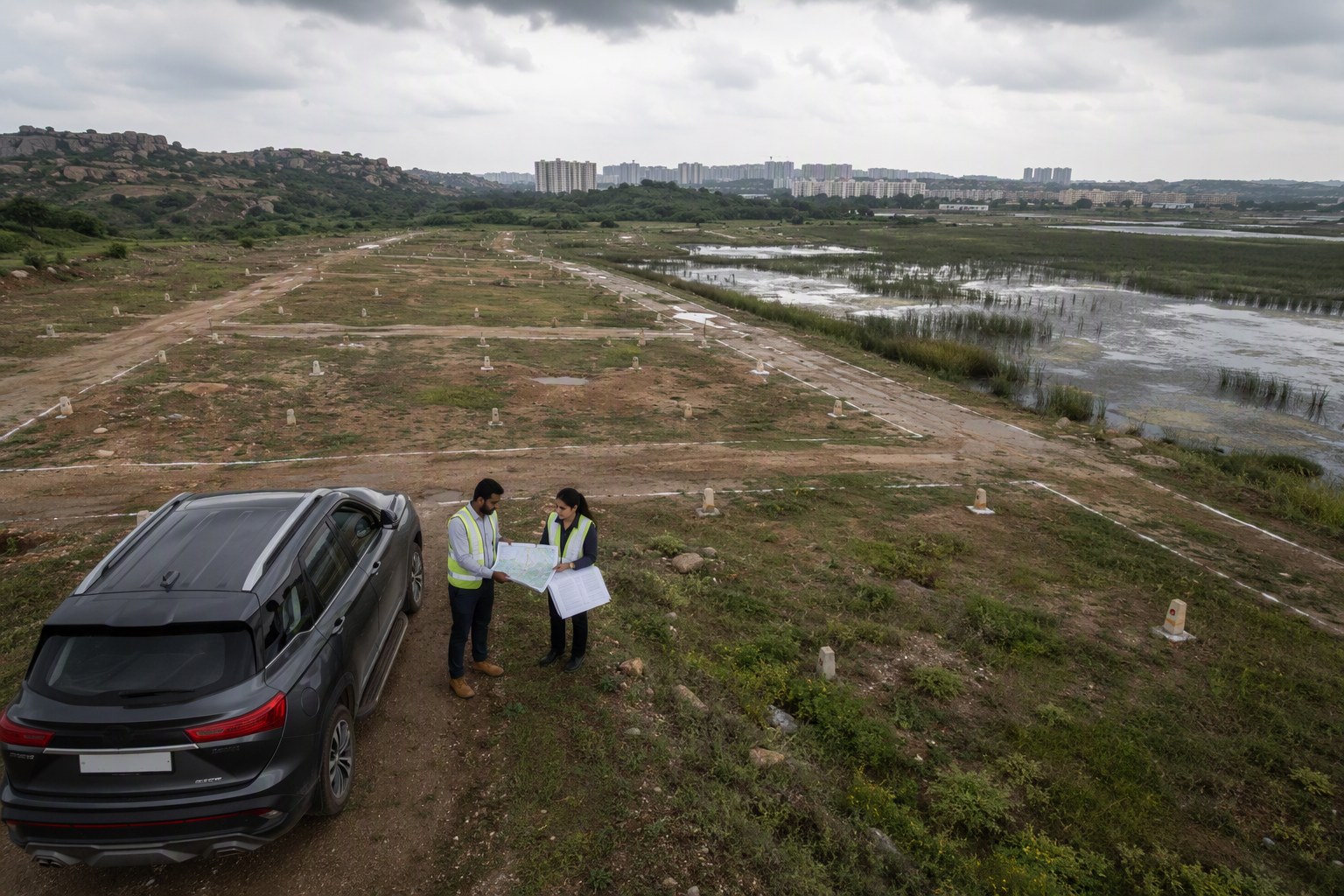
EV Charging Hubs May Face Land Status Checks in Telangana as green mobility infrastructure developers, fleet operators and fuel-station partners start looking beyond plug points and power load into a more basic question: is the land itself clean for registration, leasing and long-term use? The issue is not small. As per latest IGRS data, Telangana records show 3,076,153 Section 22-A prohibited properties. In everyday terms, that is about 30.76 lakh properties where registration may be restricted or flagged due to government, assigned, endowment, waqf, ceiling, court or other prohibited status entries.
For EV charging networks planning hubs near Hyderabad’s growth corridors, this means land due diligence cannot be treated as a last-stage legal formality. A charging hub may look ideal on the road map, close to ORR exits or warehouse clusters, but if the survey number sits in a prohibited list or has unclear pahani history, the project can get stuck before civil works begin.
EV Charging Hubs May Face Land Status Checks in Telangana: Why this is becoming a real project risk
EV charging hubs need visible, accessible and legally usable land. Developers usually search for plots near logistics belts, office districts, highways, apartment clusters and fuel stations. Around Hyderabad, we have seen interest around Gachibowli and Nanakramguda in Serilingampally mandal, Kokapet and Narsingi in Gandipet mandal, Shamshabad mandal along airport-side roads, Patancheru mandal on the industrial side, Medchal mandal towards the northern warehouse belt, and Hayathnagar towards the Vijayawada highway side.
These are sensible locations from a mobility angle. But from a property angle, some land parcels in Telangana can carry older revenue complications. A private party may show a sale deed, tax receipt or electricity connection, but that alone does not prove the land is free for fresh registration, mortgage, commercial lease or development. Section 22-A entries can stop transactions at the SRO stage.
For EV companies, the risk is sharper because charging hubs often involve long leases, transformer approvals, civil foundations, parking layout, signage, commercial power connections and sometimes retail tie-ups. If the land title fails midway, the loss is not only the advance amount. Design work, vendor mobilisation, charger procurement timelines and grid coordination can also go off track.
In our experience, the best EV site is not just the one with road frontage and power feasibility. It is the one where the survey number, ownership trail, SRO records and land-use position all speak the same language.
30.76 lakh Section 22-A prohibited properties raise the bar for EV charging hub due diligence
The number that should make developers cautious is 3,076,153 prohibited properties in Telangana records. Section 22-A is not a minor clerical column. It is a legal filter used by registration authorities to restrict certain properties from being registered. The exact reason can vary from land to land, so a blanket assumption is dangerous.
Some entries may relate to government lands. Some may involve assigned lands, endowment properties, waqf-linked properties, lands under litigation, or other restricted categories as reflected in government records. The practical effect is simple: even if a commercial deal is signed, the registration process may not move if the property is listed as prohibited.
For a normal buyer, this is already serious. For an EV charging hub developer, it can affect the entire project model. A hub needs continuity. Customers, fleet operators and delivery vehicles cannot be shifted every few months. If a developer signs a lease without checking the prohibited property status, the site may later become unsuitable for bank funding, expansion, transfer of lease rights or even basic compliance documentation.
Before paying a token advance, teams should run a Section 22-A Prohibited Property Check. It should be followed by a Encumbrance Certificate Search and, where the chain is complex, an EC Analyzer review. These checks will not replace a lawyer, but they can save a developer from chasing a parcel that should have been rejected on day one.
EV Charging Hubs May Face Land Status Checks in Telangana before leases, power approvals and site works
The old style of real estate due diligence was sale deed first, lawyer later. That approach does not work well for infrastructure rollouts. EV charging operators should check land status before lease signing, before applying for high-load power connection, and certainly before installing chargers or laying concrete platforms.
A proper first-level check should cover the following:
- Survey number and village match: Confirm the exact survey number, sub-division and village. A mistake between neighbouring survey numbers can create serious confusion, especially near village boundary areas.
- Dharani and pahani position: Check whether the land extent, pattadar name, nature of land and transaction history look consistent.
- Section 22-A status: Check whether the property appears in prohibited property records.
- SRO jurisdiction: Verify the right sub-registrar office through Find Your SRO Office and review registration history.
- Encumbrance trail: Look for mortgages, prior sales, court attachments or unexplained gaps in the EC.
- Land-use and access: Check whether the proposed charging use is compatible with the local planning context, road width and entry-exit requirements.
Developers can start with Survey Number Finder, then run the land through Property Verification Tool. For commercial layouts or larger hub formats, Land Use Zone Finder and Road Width Check become equally relevant. A charger on paper is easy. A charger on a disputed or restricted parcel is a headache.
Hyderabad corridors where EV hub land scrutiny may become stricter
The likely hotspots are not hard to identify. Office-heavy areas such as Gachibowli, Financial District, Nanakramguda and HITEC City need charging for employee vehicles, cabs and corporate fleets. Residential growth belts like Narsingi, Kokapet, Tellapur and Kollur have apartment demand. Logistics and industrial movement is strong around Patancheru, Medchal, Kompally, Shamshabad and Hayathnagar.
Each of these micro-markets has a different land story. Serilingampally mandal has many developed parcels, but title chains can still be layered due to old layouts, society lands and historic transactions. Gandipet mandal has premium land interest, but developers must be careful with survey details and land-use checks. Shamshabad mandal has airport-side demand, but agricultural-to-commercial transition and access rights need careful reading. Patancheru and Medchal sides may offer larger parcels, yet industrial, revenue and mortgage records must be studied properly.
We should not assume every land parcel in these locations is risky. That would be unfair. But the 30.76 lakh prohibited-property figure tells us that Telangana has a large body of restricted entries sitting in official records. Any developer who ignores that database is taking an avoidable risk.
What EV developers should ask landlords before paying an advance
Landlords and aggregators may present a location as “perfect for charging”. The developer’s response should be polite but firm. Ask for the survey number, village name, mandal, pattadar passbook details where applicable, link documents, latest EC, tax receipts and land-use proof. If it is a converted or commercially used parcel, ask for the relevant approvals or records supporting that use.
For lease-based hubs, the lease deed should clearly record the purpose, power infrastructure rights, access rights, parking control, signage rights, termination conditions and responsibility if title or prohibition issues arise. If the property is later found to be under Section 22-A restriction, the developer should not be left fighting alone after investing in equipment.
One practical approach is to create a “land green signal” checklist before technical teams visit the site. This can include prohibited property status, EC review, SRO confirmation, owner identity match, land-use screen and road access check. After that, technical teams can study transformer location, charger layout, fire access, drainage and customer circulation.
If the transaction involves purchase instead of lease, use Market Value / Guideline Value Search and Stamp Duty Calculator to understand registration cost inputs based on government values. Do not rely only on oral market talk, especially in high-demand corridors where asking prices move faster than paperwork.
Why this matters for Telangana’s green mobility story
Telangana needs more EV charging points, especially as private EV adoption, fleet electrification and last-mile delivery charging requirements grow. But green infrastructure cannot be built on weak land records. A delayed hub affects commuters, cab fleets, delivery workers, mall operators and office parks. It also affects investors who expect stable, long-life infrastructure assets.
There is a larger lesson here. Clean energy and green mobility projects still depend on old-fashioned land discipline: survey number accuracy, SRO verification, pahani reading, EC history, ready reckoner awareness and local mandal-level understanding. Technology can make vehicles smarter, but it cannot cure a bad title.
My view is simple. EV charging companies that build a land due-diligence desk early will scale faster than those treating land as a broker-managed task. Telangana’s property records contain both opportunity and caution. The opportunity is visible on the highways and urban corridors. The caution sits in the 3,076,153 prohibited-property entries that every serious developer must respect.
Frequently Asked Questions
Can an EV charging hub be built on land listed under Section 22-A?
If a property is listed under Section 22-A, registration or certain transactions may be restricted. Developers should not sign a lease or purchase agreement without legal review and official clarification from the relevant records and SRO.
Why should EV developers check prohibited property status in Telangana?
Telangana records show 3,076,153 Section 22-A prohibited properties. For EV hubs, a land-status issue can delay leases, power approvals, funding, expansion and site operations.
Which Hyderabad areas need extra land due diligence for EV charging hubs?
High-demand corridors such as Gachibowli, Nanakramguda, Kokapet, Narsingi, Shamshabad, Patancheru, Medchal and Hayathnagar need careful survey number, SRO, EC, land-use and access checks before investment.
What documents should be checked before leasing land for an EV charging station?
Developers should check survey number details, village and mandal, pahani or Dharani records, link documents, EC, Section 22-A status, land-use position, SRO jurisdiction and access rights.
Which Verified.RealEstate tools help with EV hub land checks?
Useful tools include the Section 22-A Prohibited Property Check, Encumbrance Certificate Search, Survey Number Finder, Property Verification Tool, Land Use Zone Finder and Find Your SRO Office.