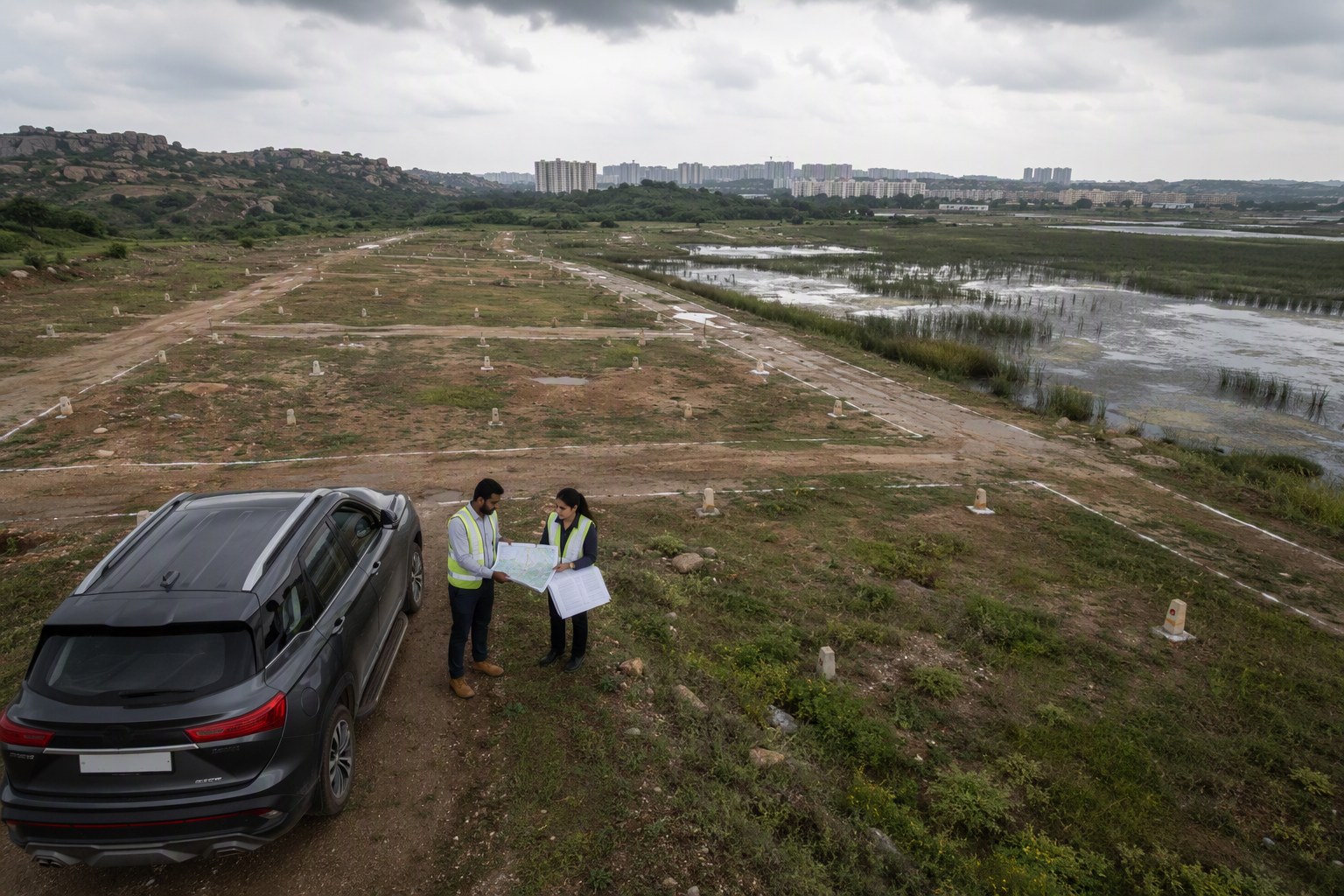
Wetland Buffer Checks are likely to become a stronger pre-booking filter for Telangana plotted layouts, especially around Hyderabad’s fast-moving western, northern and southern growth corridors. For buyers, this is not only an environmental issue. It is a title-risk issue, a resale issue and, in some cases, a registration issue.
In our experience, many layout buyers check price, LP number, road width and loan availability first. Lake buffer, FTL, shikam land, nala alignment and wetland impact come much later. That order may now change. If a plotted layout is close to a cheruvu, kunta, vagu or storm-water channel, buyers should verify the survey number before paying the booking amount.
For plotted land, the next level of due diligence is not just “Is the layout approved?” It is also “Is any part of this survey number touching a lake buffer, FTL line or drainage path?”
Wetland Buffer Checks May Become A Pre-Booking Standard
Across Telangana, especially in HMDA and DTCP growth areas, wetland and lake buffer verification is moving from a technical planning question to a buyer-side checklist. The trigger is simple: once money is paid, correcting a wrong plot choice becomes painful. If a layout road, open space, amenity block or plotted area falls near a water body buffer, future construction, resale and approvals may face objections.
This matters in localities where plotted layouts are aggressively marketed: Mokila, Shankarpally, Kollur, Tellapur, Narsingi, Gandipet, Moinabad, Shamirpet, Medchal, Ghatkesar, Adibatla, Maheshwaram, Patancheru and Ameenpur. Many of these areas have tanks, nalas, irrigation channels and low-lying lands mixed with private patta lands. A neat brochure does not always show that ground reality.
Buyers should begin with the survey number. Use the Survey Number Finder to identify the land parcel, then cross-check land use through the Land Use Zone Finder. For location context, the Geo Insights tool can help you look at the surrounding area before you visit the site.
Why Wetland Buffer Checks Matter For Telangana Layout Plans
Telangana’s land market has one special challenge: the same village may have clean private land, assigned land, government land, shikam land, water bodies and old pathways sitting close to each other. This is common in peri-urban villages. A buyer looking at a 200-square-yard plot may not know what sits across the proposed 30-feet road.
Wetland buffer checks matter because environmental restrictions can affect three things:
- Buildability: A plot may be registered, but building permission can still be questioned if it falls within a restricted lake or drainage buffer.
- Loan and resale: Banks and second buyers are becoming stricter on FTL, buffer and government land doubts.
- Future layout modifications: If authorities seek corrections, the most affected buyers are those who booked without checking survey-level risk.
We have seen buyers ask for HMDA or DTCP approval copy but ignore the village map, pahani, Dharani status and physical contour of the land. That is risky. A layout near a tank in Gandipet mandal deserves a different level of scrutiny from a layout on dry interior land. Same with low-lying pockets in Ameenpur, Patancheru mandal, Shamirpet mandal or Ghatkesar mandal.
Wetland Buffer Checks And Section 22-A: Different Issues, Same Lesson
Lake buffer risk is not the same as a Section 22-A prohibition. Still, the buyer lesson is similar: check before booking. As per the Verified database context, Telangana has 3,076,153 prohibited property records under Section 22-A. That number shows why land buyers cannot depend only on sales talk or a layout poster.
Before paying token advance, check whether the land has any prohibition flag through the Section 22-A Prohibited Property Check. Then review transaction history with the Encumbrance Certificate Search or the EC Analyzer. If the project claims RERA applicability, verify it through the RERA Project Lookup.
One more practical step: identify the correct registration office through Find Your SRO Office. In Telangana, village names and mandal boundaries can confuse outstation buyers. The SRO jurisdiction, Dharani village name and marketing name of the layout may not sound the same.
What Buyers Should Ask Before Booking A Plot Near A Lake
If the project is near a cheruvu, kunta, vagu, nala, canal or low-lying catchment, ask sharper questions. Do not stop at “LP number unda?” Ask for survey-wise clarity.
| Buyer Check | What To Ask The Seller | Why It Matters |
|---|---|---|
| Survey number | Which survey numbers are covered in the layout? | Buffer risk is checked at land-parcel level, not brochure level. |
| FTL and buffer | Is any part of the land near FTL, shikam, nala or tank bed? | Construction and resale may be affected. |
| Village records | Can you share pahani, Dharani extract and village map reference? | Revenue records may reveal land nature and classification. |
| Layout approval | Is the LP approval survey-wise and final? | Marketing layout and sanctioned layout must match. |
| Open space and roads | Are OSR, roads and amenities outside restricted buffer areas? | Future handover and maintenance can face disputes. |
For layout planning checks, buyers can also use the OSR Calculator and Road Width Check. These will not replace official approvals, but they help a buyer ask better questions during site visits.
Mandals Where Lake Proximity Needs Extra Care
Hyderabad’s expansion has pushed plotted development into villages that were earlier agricultural or semi-rural. In Shankarpally mandal, villages around Mokila and Kondakal have seen strong buyer interest. In Gandipet and Moinabad mandals, land close to water bodies, farm clusters and village tanks needs careful boundary checking. In Maheshwaram and Shamshabad mandals, buyers should check nalas and storm-water movement, not only airport connectivity.
North Hyderabad has its own caution areas. Shamirpet, Medchal, Keesara and Ghatkesar have many tanks and water-flow channels. In the west and north-west, Ameenpur and Patancheru are sensitive because lake ecology, industrial surroundings and residential expansion are close to each other. A plot may look dry in summer, but the land character may look different during heavy rain.
Rates are often discussed casually in WhatsApp groups as “per square yard” quotes. Buyers should not treat those as ready reckoner value. For government market value and guideline reference, use the Market Value / Guideline Value Search. For registration cost planning, use the Stamp Duty Calculator. A low quoted price near a water body should not be celebrated without checking why it is low.
How Developers May Respond To Stronger Wetland Buffer Checks
Good developers will treat this as a chance to build trust. They can publish survey-wise layout boundaries, share FTL distance clarifications where relevant, mark open spaces properly and avoid vague claims like “100% clear title” without documents. In my view, the best plotted projects will start showing environmental due diligence along with title due diligence.
Developers who depend on urgency selling may struggle. “Only few plots left” is not a substitute for pahani, EC, LP copy, RERA status where applicable, SRO clarity and land-use confirmation. Telangana buyers are becoming more document-aware, especially NRIs and salaried families buying their first plot around Hyderabad.
For buyers, the safest habit is simple: never book on the first site visit. Take the survey number, check records, revisit the land after understanding the map and speak to a local revenue/document professional if the site is near a water body. A lake view is attractive. A lake buffer problem is not.
Verified.RealEstate View
Wetland Buffer Checks should sit beside EC, Section 22-A, RERA and guideline value checks in every serious plotted-layout purchase. Telangana’s land market rewards quick decision-making, but it punishes careless booking. When a project is near a cheruvu, kunta, vagu or nala, the buyer must slow down.
Our opinion is clear: environmental compliance is now part of buyer due diligence. Not a separate subject. Not only for lawyers. Not only for town planners. If you are buying land in or around Hyderabad, lake buffer verification belongs in your pre-booking file.
Frequently Asked Questions
What are Wetland Buffer Checks in Telangana plotted layouts?
They are checks to see whether a plotted layout or its survey numbers fall near a lake, tank, FTL area, shikam land, nala, vagu or other restricted water-body buffer. These checks help buyers understand buildability and resale risk before booking.
Is HMDA or DTCP approval enough for a plot near a lake?
Approval is necessary, but buyers should still verify survey numbers, land use, EC, Section 22-A status and physical proximity to FTL or buffer zones. The sanctioned layout copy must match what is being sold on ground.
Which Hyderabad areas need extra lake buffer checking?
Buyers should be careful in lake-rich and low-lying growth areas such as Gandipet, Moinabad, Mokila, Shankarpally, Ameenpur, Patancheru, Shamirpet, Medchal, Ghatkesar, Adibatla and Maheshwaram.
Can a registered plot still face wetland or buffer objections?
Yes. Registration and buildability are not the same. A plot may have a sale deed, but building permission, resale or bank loan checks can raise questions if the land is affected by FTL, buffer, nala or water-body restrictions.
Which documents should I ask before paying a booking amount?
Ask for survey numbers, LP approval copy, pahani, Dharani details, EC, link documents, land-use clarity, SRO details and any available clarification on FTL, buffer or nala impact if the site is close to a water body.