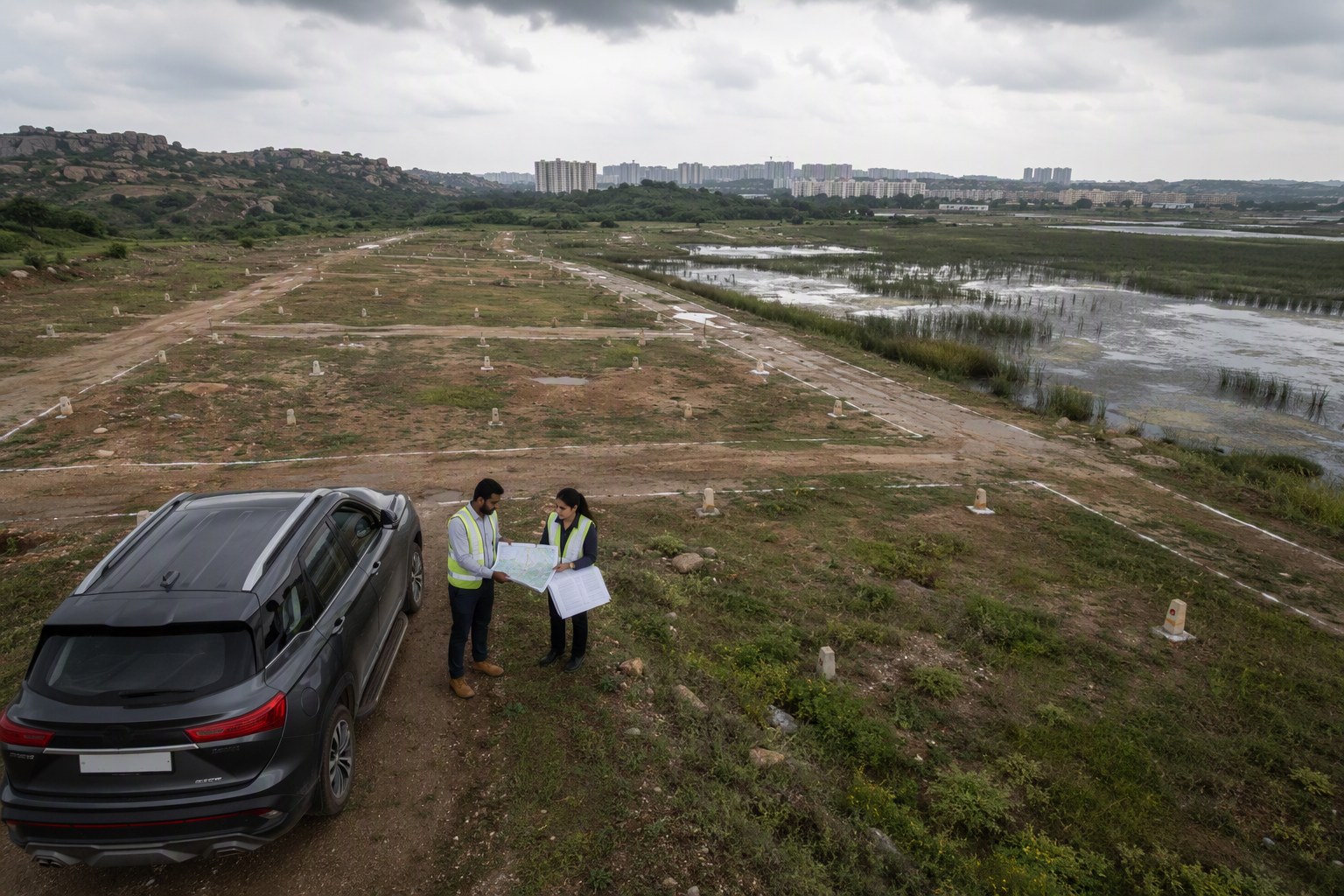
Telangana Solar Park Sites May Face a New Layer of Title Screening
Telangana Solar Park Sites are likely to come under sharper land-title and eco-sensitive scrutiny as renewable energy developers aggregate large rural parcels across the state. The immediate reason is simple: Telangana has a very large prohibited-property base. As per latest IGRS data available with Verified.RealEstate, 3,076,153 properties are listed under Section 22-A prohibited properties.
That number does not mean every solar park site is disputed. It means every serious land aggregation exercise now has to start with one tough question: is the survey number clean for registration, conversion, long lease, mortgage and project financing?
For solar parks, this is not a small paperwork issue. These projects usually need multiple adjoining survey numbers, often across village boundaries. One wrong entry in a pahani, one 22-A hit, one tank-buffer objection, or one mismatch between Dharani and SRO records can slow down the entire block. In our experience, renewable energy land due diligence is now closer to industrial land due diligence than ordinary agricultural purchase verification.
Our view: Telangana’s solar push will not be held back by land availability alone. It will be tested by how quickly developers, land aggregators and officials can separate clean patta lands from prohibited, assigned, ecological and litigated parcels.
Why Telangana Solar Park Sites Need 22-A Checks First
Section 22-A entries are the first red flag because they directly affect registration. If a property falls under the prohibited list, the SRO may refuse registration or ask for higher-level clarification. For a farmer selling two acres, this is a transaction problem. For a solar park aggregator tying up hundreds of connected bits, it becomes a project-risk problem.
The 3,076,153 prohibited properties figure is large enough to change how land teams work. Earlier, many agents would collect pahanis, take a village-level opinion and then move to agreement. That is no longer safe. The first screening should include the Section 22-A Prohibited Property Check, followed by survey-number mapping through the Survey Number Finder and village-level registration office confirmation using Find Your SRO Office.
This matters in Hyderabad-facing rural belts such as Kandukur, Maheshwaram, Yacharam, Ibrahimpatnam, Shabad, Chevella, Moinabad, Shamirpet, Medchal and Toopran. These mandals and nearby growth corridors already see interest from logistics, pharma, warehousing, plotted layouts and institutional buyers. Renewable energy land teams entering the same areas cannot assume that agricultural title history is simple just because the land looks open on ground.
Telangana Solar Park Sites and Eco-Sensitive Land: The New Risk Zone
The second screening layer is environmental. Solar land is often described as non-polluting, but the land footprint is still big. If aggregation touches tanks, nalas, forest-edge lands, grazing lands, endowment lands, assigned lands, waqf entries or hill-slope areas, the issue can become bigger than registration.
In Telangana, many villages have old water bodies locally known by tank names, kunta names or cheruvu boundaries. Field bunds may not tell the full story. A parcel may appear dry in summer, but revenue records, village maps or irrigation references may show a water-linked classification. That is where solar developers need to check land use, village maps and ground reality together.
Before signing memorandums with landowners, teams should use tools like Land Use Zone Finder and Geo Insights. These are not substitutes for government approvals, but they help identify early risk. For a project lender or EPC company, early flags are cheaper than a stalled registration after money has already gone into aggregation.
What Must Be Checked Before Aggregating Solar Land
| Check | Why it matters for solar park sites | Practical document or tool |
|---|---|---|
| Section 22-A status | Can block registration at the SRO level | Section 22-A Prohibited Property Check |
| Survey number identity | Prevents wrong-parcel agreements and boundary confusion | Survey Number Finder |
| Encumbrances | Shows registered mortgages, sales, gifts and other past transactions | Encumbrance Certificate Search |
| Market value and ready reckoner | Helps estimate registration cost and compare SRO value with deal terms | Market Value / Guideline Value Search |
| Land use and ecological sensitivity | Flags planning, water-body and non-agricultural-use concerns | Land Use Zone Finder |
Where the Pressure Is Highest Around Hyderabad
Solar park land may not sit inside core Hyderabad, but Hyderabad’s market still influences it. When land in Rangareddy, Medchal-Malkajgiri, Sangareddy, Yadadri-Bhuvanagiri and Vikarabad side corridors attracts competing buyers, title risk becomes more expensive. A clean parcel near an access road is chased by multiple users. A doubtful parcel is passed between brokers until someone takes a risky call.
We’ve seen this pattern earlier in plotted development. In places like Adibatla, Tukkuguda, Shankarpally, Mokila, Ghatkesar and Shamirpet, buyers slowly learnt that survey number verification is not optional. The renewable energy sector is now reaching a similar stage. A solar park site is not just land plus sunlight. It needs a bankable title chain, road access, conversion path, SRO acceptance and no hidden ecological objection.
That is why solar aggregators should not rely only on farmer declarations or broker assurances. They must compare pahani entries, Dharani extracts, old sale deeds, ECs, mutation history and physical possession. If the land has passed through family partitions, unregistered arrangements, court compromise deeds or GPA transactions, the legal team should slow down.
What Developers Should Do Before Paying Advances
The safest approach is to divide the exercise into three stages: screening, documentation and registration readiness. Screening removes obvious 22-A and land-use risks. Documentation checks ownership and past transactions. Registration readiness confirms that the deal can actually pass through the correct SRO without surprises.
- Start with the prohibited list: Check each survey number, not just the village name.
- Match pahani with sale deed history: Names, extents and survey subdivisions must agree.
- Pull the EC early: Use the EC Analyzer after getting the encumbrance certificate to read transaction patterns better.
- Check the SRO: Some villages fall under SRO boundaries that buyers do not expect. Use SRO Village Directory.
- Test the ready reckoner value: The Market Value / Guideline Value Search helps compare official value before budgeting stamp duty through the Stamp Duty Calculator.
- Inspect ecological markers: Tanks, nalas, forest boundary references and grazing-use history need field and record checks.
For landowners, this can be an opportunity. If their land is clean, properly mutated and not hit by 22-A, it will stand out. But if there are old succession gaps, missing pattadar passbook updates or boundary overlaps, fixing them before negotiation is better than arguing later at the SRO counter.
The Bigger Policy Message
Telangana wants investment, renewable power and rural income. But solar land aggregation cannot be treated like ordinary bulk buying. The state’s prohibited-property base is too large to ignore, and ecological land checks are becoming more sensitive across districts.
There is also a practical governance issue. A developer may clear title with one department, only to face a different objection from another record set. Better coordination between Dharani, IGRS, revenue offices, local bodies and planning authorities will help serious investors. It will also protect farmers from failed deals where advances are paid, disputes arise, and the project disappears.
For now, the message for Telangana Solar Park Sites is clear. Do the boring checks first. Verify the survey number, check 22-A, read the EC, confirm SRO jurisdiction, compare land use, and only then move to pricing. Clean land may look costlier at the start, but doubtful land is usually far more expensive by the time lawyers, banks and approvals enter the room.
Frequently Asked Questions
Why are Telangana Solar Park Sites facing stricter title checks?
Because large land aggregation can get affected by Section 22-A prohibited entries, old title gaps, ecological restrictions and SRO-level registration objections. Telangana has 3,076,153 prohibited properties as per latest IGRS data, so survey-wise screening is now essential.
Does a 22-A entry mean the land can never be used for solar?
Not always. It depends on why the property is listed and whether the entry can be clarified or corrected by the competent authority. But until it is cleared, registration and financing can become difficult.
Which documents should a solar developer check first?
Start with pahani, Dharani extract, old sale deeds, EC, survey sketch, mutation records, 22-A status, SRO jurisdiction and land-use details. Field inspection for tanks, nalas and access roads is also needed.
Are Hyderabad outskirts relevant for solar park land?
Yes. Mandals around Rangareddy, Medchal-Malkajgiri, Sangareddy, Yadadri-Bhuvanagiri and Vikarabad see competing demand from layouts, logistics and industries. That makes clean title and clear land use more valuable.
Can online tools replace legal due diligence?
No. Online tools help with early screening, but final decisions should be based on certified records, SRO checks, revenue verification, legal opinion and site inspection.