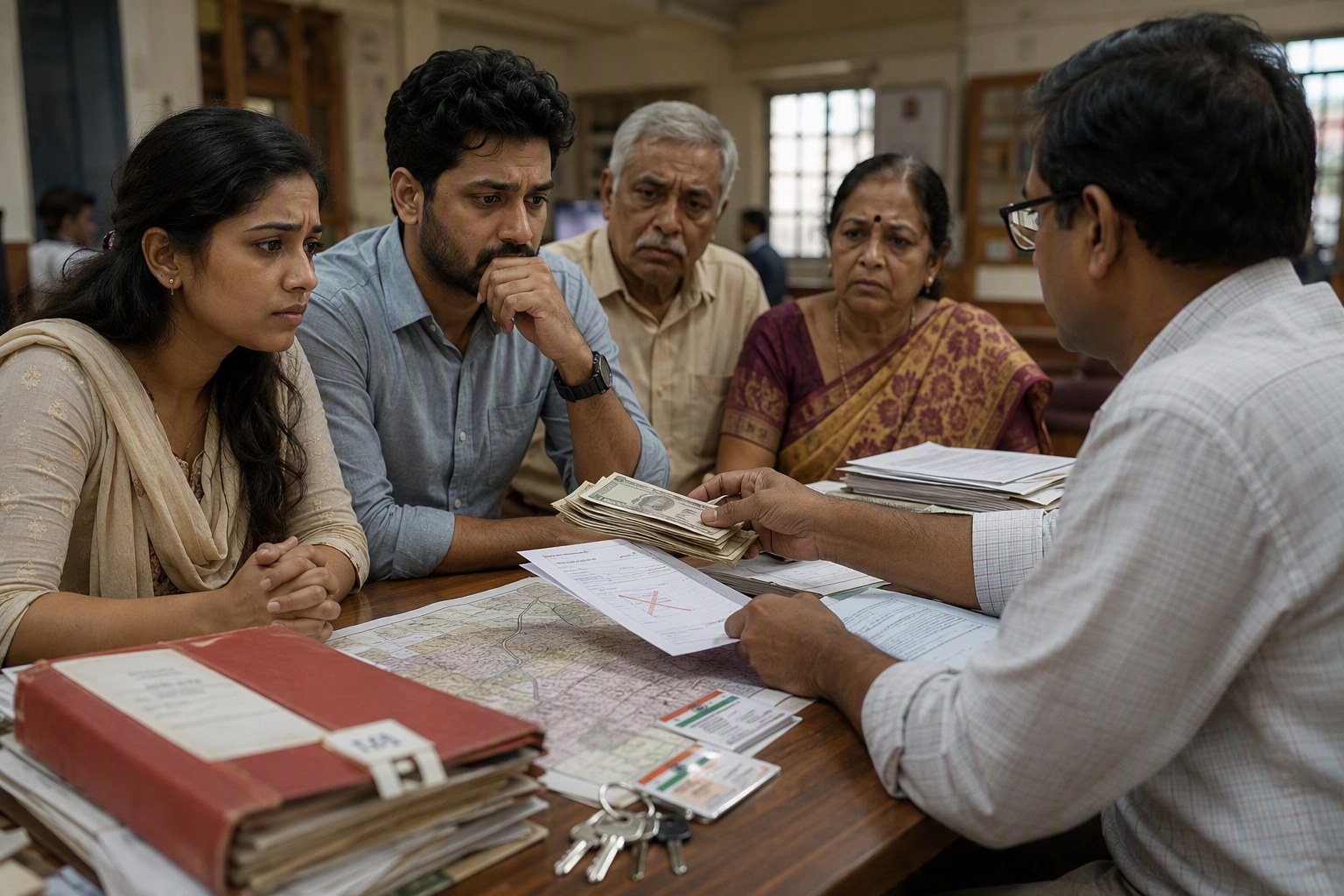
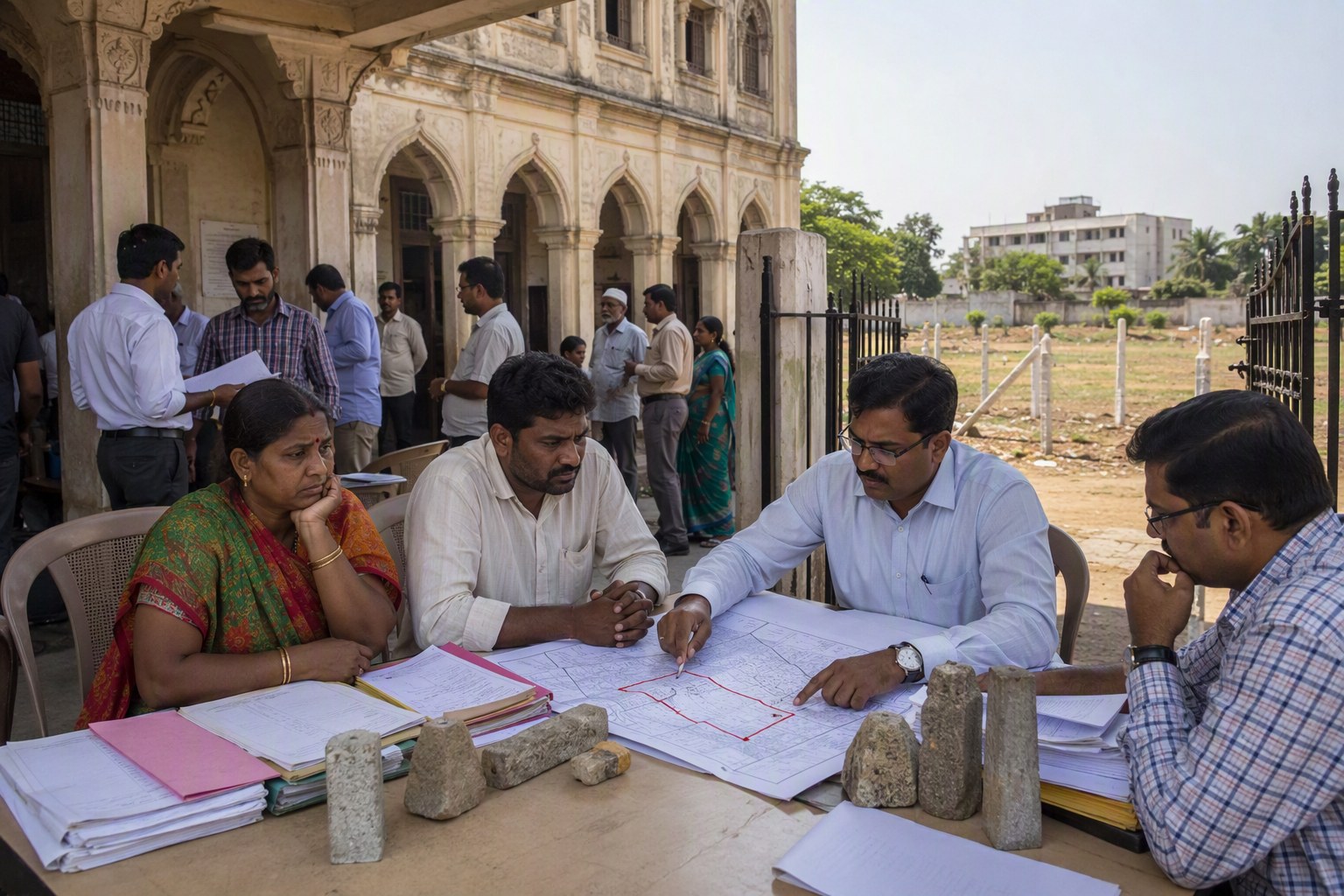
Telangana Mulls Public Correction Log for 22-A Land Records as a possible transparency step for buyers, banks and document writers who regularly get stuck at the registration stage because a survey number appears in the prohibited property list. The idea being discussed is simple: whenever an official correction is made to a 22-A entry, citizens should be able to see what changed, who corrected it, and when it was corrected.
For Telangana’s land market, this is not a small matter. The prohibited properties database under Section 22-A currently has 147,934 entries. Even if a small portion of these entries have spelling issues, extent mismatches, wrong sub-division references or old government notings, the impact is felt directly by buyers in Hyderabad’s growth corridors, from Mokila and Kollur to Shadnagar and Medchal.
Telangana Mulls Public Correction Log for 22-A Land Records: what may change
At present, a buyer usually checks the prohibited property list, pahani, Dharani record, Encumbrance Certificate and SRO status separately. If the land appears under Section 22-A, the registration office can refuse registration. The buyer then depends on the seller’s explanation, old proceedings, mandal office clarification, or a fresh representation to revenue authorities.
A public correction log would add one missing layer: history. If a survey number was wrongly included and later removed, the buyer could see that correction trail instead of depending only on word-of-mouth from brokers or half-readable photocopies.
In our experience, most disputes start with one line: ‘Sir, 22-A lo undi ani SRO chepparu.’ By that time, token advance is paid, agreement is signed, and both parties are already tense.
The proposed log, if implemented well, may show details such as:
- Survey number and sub-division number affected by the correction
- Village, mandal and district name
- Old 22-A status and revised status
- Date of correction and proceeding number
- Department or authority that approved the change
- Extent of land corrected, for example 0.20 guntas out of a larger survey number
- Linked SRO office where registration impact is likely
Before paying any advance, buyers can already do a basic risk check using our Section 22-A Prohibited Property Check, Encumbrance Certificate Search and Survey Number Finder. A correction log would make these checks far more meaningful because the buyer can see whether a land parcel has a clean record or a history of repeated corrections.
Why Telangana Mulls Public Correction Log for 22-A Land Records now
The timing is linked to the sheer size of the prohibited list and the pressure on suburban land transactions. Hyderabad’s expansion has pushed ordinary buyers into areas where old agricultural survey numbers are being converted into plotted layouts, villa communities and apartment projects.
Look at the active belts. Kokapet and Neopolis in Gandipet mandal have premium land quoting roughly ₹1.2 lakh to ₹2 lakh per square yard in select pockets. Mokila and Shankarpally side plotted layouts often quote ₹35,000 to ₹65,000 per square yard depending on HMDA approval, road width and approach. Tellapur and Osman Nagar apartments are commonly seen in the ₹7,000 to ₹10,500 per sq ft range, while Bachupally and Nizampet flats move around ₹5,800 to ₹8,500 per sq ft. Shadnagar plotted land still attracts budget buyers at around ₹12,000 to ₹28,000 per square yard in many ventures.
These are not small cheque sizes. A wrong 22-A entry can block a ₹60 lakh plot, a ₹1.2 crore villa plot or a resale flat linked to underlying land records. Buyers are willing to verify, but the system must give them a visible audit trail.
A correction log will not make every property safe. But it can reduce the biggest pain point: uncertainty. Buyers need to know whether a 22-A issue is genuine, pending, corrected, or only being verbally explained away.
How the 22-A confusion plays out at SRO level
Section 22-A blocks registration of certain prohibited properties. These may include government lands, assigned lands, endowment lands, waqf lands, ceiling surplus lands, court-disputed properties and other notified categories. The SRO is expected to follow the prohibited list while accepting or refusing documents.
The problem is not the law itself. The problem is data quality and visibility. In villages around Shamshabad, Maheshwaram, Medchal, Patancheru, Shankarpally and Ghatkesar, old survey numbers have been split, merged, converted and sold over decades. One parent survey number may have government land in one portion and private patta land in another. If the list does not clearly mention extent and boundaries, the buyer is left guessing.
A public log can help document writers, banks and legal teams understand whether the correction was only clerical or material. For example, if Survey No. 112/A in a village was corrected from 5 acres to 0.25 acres, the difference matters hugely for layouts carved out in the same survey series.
What buyers should verify before registration
Even if the correction log comes, buyers should not treat it as a substitute for full due diligence. We have seen cases where the 22-A list is clear, but the EC shows an old mortgage. In other cases, Dharani reflects one pattadar, but the family settlement or succession paperwork is incomplete.
Use this practical sequence before you pay token advance:
- Check whether the survey number appears in the prohibited property list using the 22-A check tool.
- Confirm the correct SRO through Find Your SRO Office, especially for border areas like Narsingi, Kokapet, Tellapur and Kollur.
- Search the EC for at least 30 years where possible through EC Search.
- Compare government market value or ready reckoner rate using Market Value / Guideline Value Search.
- Estimate duty outgo before agreement using the Stamp Duty Calculator.
- For apartments and gated projects, verify project registration through RERA Project Lookup.
- Track later changes through Property Change Tracker if you are waiting for correction orders.
Current process vs possible correction log
| Issue | Current buyer experience | If correction log is published |
|---|---|---|
| Wrong 22-A entry | Buyer depends on seller, document writer or mandal office response | Buyer can see correction date, authority and proceeding number |
| Part survey number affected | Confusion over whether full survey number is blocked | Corrected extent may be visible, reducing wrong assumptions |
| SRO refusal | Registration attempt fails after agreement stage | Buyer can check risk before paying advance |
| Bank legal opinion | Bank asks for repeated clarifications | Legal team can refer to official correction history |
| Resale flat on old land parcel | Apartment buyer may not know underlying land history | Correction record can support title review |
What this means for Hyderabad buyers and sellers
For buyers, the benefit is obvious: less surprise at the SRO counter. For sellers, especially genuine pattadars whose land was wrongly tagged, a public correction log can reduce repeated explanations. For banks, it can speed up legal scrutiny. For the government, it creates accountability because every correction leaves a public trace.
But implementation will decide the real value. The log should not be a vague PDF dump. It should be searchable by district, mandal, village, survey number and SRO. It should show both the old and revised status. It should mention whether the correction is final, stayed by court, or under review. If citizens cannot search it easily, the confusion will simply move from one counter to another.
My view is that Telangana should also connect the correction log with Dharani, registration department data and village-level revenue records. A buyer checking a parcel in Kollur, Adibatla, Kompally or Shadnagar should not have to visit three offices to understand one survey number.
What to watch next
The key question is whether this becomes a public-facing dashboard or remains an internal departmental record. A public dashboard will help the market. An internal note will help officers, but buyers will still depend on intermediaries.
Until there is official rollout, treat every 22-A correction claim carefully. Ask for certified proceedings. Match survey number, extent, village and mandal. Check EC, Dharani, pahani, layout approval and RERA status where applicable. A clean-looking sale deed is not enough if the underlying land record has a pending prohibition issue.
Telangana’s land market is moving fast around ORR exits, Regional Ring Road expectations and new employment corridors. Transparency in 22-A corrections will not solve every title problem, but it can remove one major blind spot before registration.
Frequently Asked Questions
What is Section 22-A in Telangana property registration?
Section 22-A refers to prohibited properties that cannot be registered by the SRO. These may include government land, assigned land, endowment land, waqf land, ceiling surplus land and other notified properties.
How many prohibited property entries are there in Telangana?
As per the available database fact, Telangana has 147,934 prohibited property entries under Section 22-A. This is why a public correction log can be useful for buyers and officials.
Will a correction log make a property legally safe?
No. It will only show the correction history of 22-A records. Buyers must still verify EC, Dharani record, pahani, title deeds, layout approval, RERA status and SRO jurisdiction.
When should I check 22-A status?
Check it before paying token advance or signing an agreement of sale. Once money is paid, resolving a 22-A issue becomes stressful and time-consuming.
Which areas need extra care for 22-A checks?
Fast-growing land belts such as Mokila, Shankarpally, Kollur, Tellapur, Adibatla, Shadnagar, Medchal and Ghatkesar need careful survey number verification because many projects are linked to old agricultural land records.