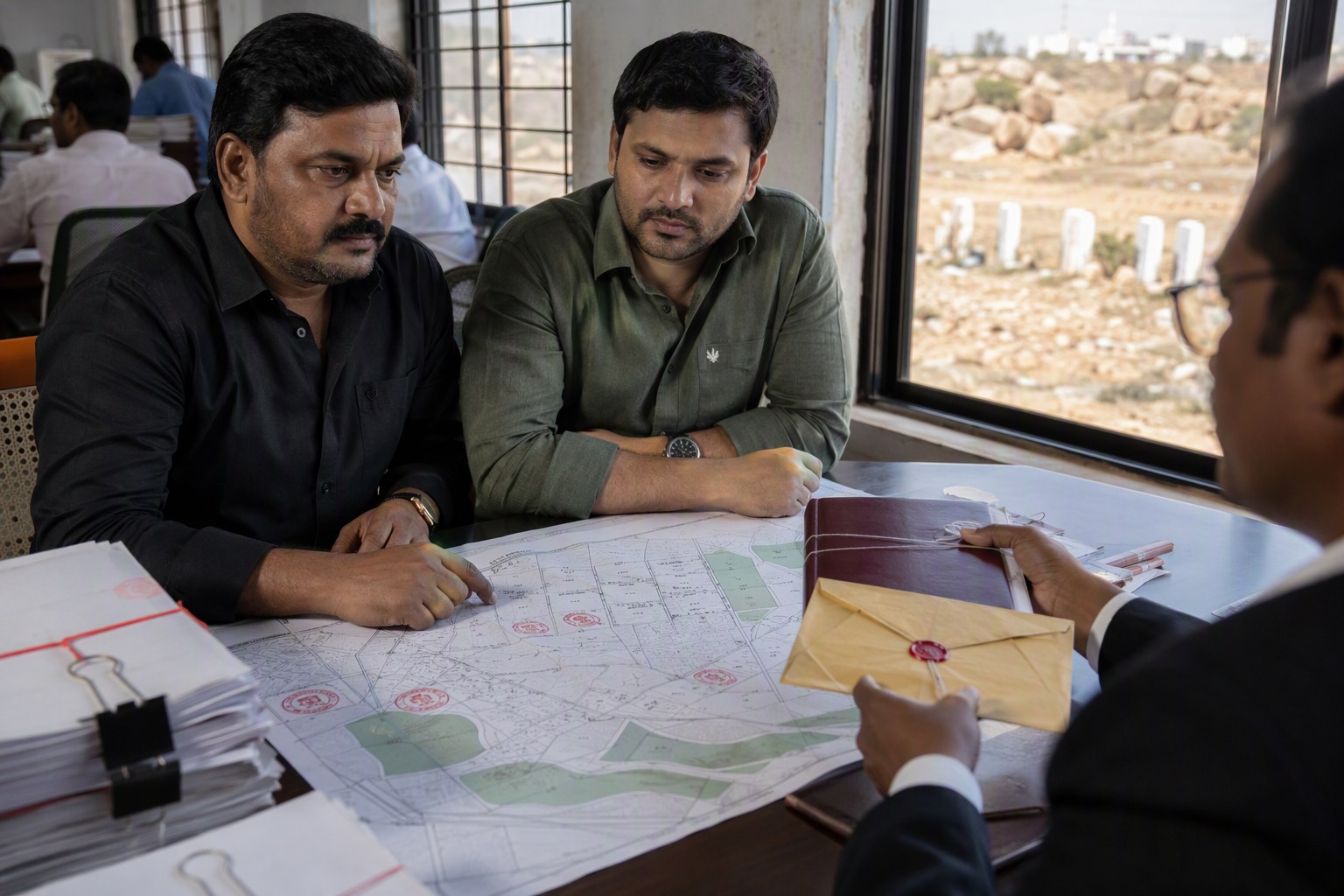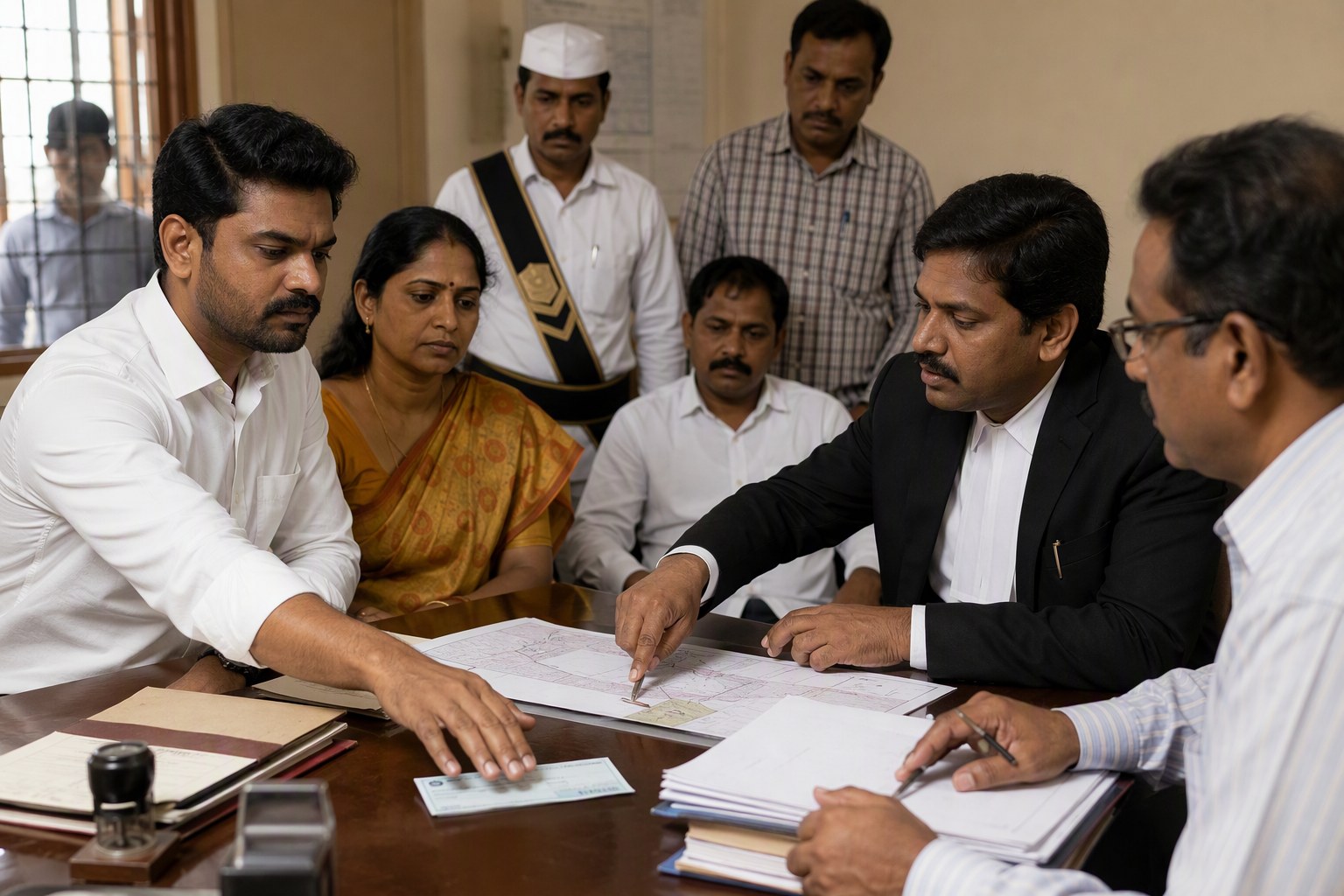
Telangana JV Land Deals May Add 22-A Carve-Out Clauses
Large land joint ventures in Telangana are quietly changing shape. The newer discussion in promoter cabins and boardrooms is not only about revenue share, built-up area share, refundable deposits or launch timelines. It is about one sharper question: what happens if one or two survey numbers in a proposed development parcel fall under a 22-A restriction, while the remaining land is clean enough for a transaction?
Until recently, many joint venture agreements tried to handle such issues after signing. The landowner would give broad title assurances, the developer would pay an advance, lawyers would run checks, and the parties would then attempt rectification, deletion, mutation correction or clarification with the authorities. That model is now looking risky, especially for corporate developers and funded platforms. The emerging preference is to carve out excluded survey numbers at the board-approval stage itself.
In simple Hyderabad market language, the deal is being structured around the bad patch instead of pretending the bad patch can be fixed later. That is a sensible shift.
For serious JV land deals, a 22-A issue is no longer a small legal footnote. It can affect valuation, FSI planning, approvals, launch sequencing, lender comfort and exit documentation.
What is changing in Telangana JV structuring?
Section 22-A entries generally relate to properties where registration is prohibited or restricted. In Telangana, buyers, developers and lenders have become more cautious about these entries because a single affected survey number can slow down a larger project. The concern is sharper in aggregation deals where land parcels are stitched from several pattadars, family branches or old layouts.
Verified.RealEstate's prohibited property database context currently carries 3,076,153 records for screening. That number is not a market forecast. It simply shows why diligence teams are no longer treating prohibited-property checks as a last-week activity before registration.
The practical change is this: JV term sheets and board notes may start naming excluded survey numbers clearly. Instead of saying “landowner shall cure all title defects”, the document may say that Survey No. X, or a defined extent within Survey No. X, is outside the project land unless and until the restriction is cleared through a legally acceptable route.
Why boards prefer carve-outs before signing
For listed developers, PE-backed platforms, family offices and large Hyderabad builders, a post-signing title fix creates awkward governance issues. Once a JV is signed, any major title problem becomes a disclosure issue, a valuation issue and sometimes a reputational issue. If money has moved, the discussion gets even tougher.
Board-level carve-out clauses give management a cleaner file. They show that the company knew the risk, quantified the affected extent and ring-fenced it. In my view, this is how land deals near growth corridors such as Shankarpally, Maheshwaram, Kongara Kalan, Medchal, Patancheru, Sangareddy side and parts of Yadadri road belt will increasingly be documented. Not every parcel has a problem. But where there is a problem, the paper trail will be stricter.
Typical clause movement
| Old approach | Newer approach | Why it matters |
|---|---|---|
| Sign full JV first, fix 22-A issue later | Exclude affected survey numbers before signing | Reduces project land ambiguity |
| General landowner indemnity | Specific indemnity linked to named survey numbers | Makes risk allocation easier to enforce |
| Single master development schedule | Clean land schedule plus excluded land schedule | Helps approvals and lender review |
| Advance paid against total land | Advance adjusted only for registrable or developable land | Protects cash flow and valuation |
What a 22-A carve-out clause may cover
A well-drafted carve-out is not just one line in the agreement. It should connect the land schedule, title report, survey sketch, commercial calculation and approval plan. If the clause is vague, both parties may fight later about whether the excluded land was part of the developer's entitlement.
Market-ready drafting usually covers these points:
Exact survey number and extent: The clause should mention the survey number, sub-division, village, mandal and extent being excluded.
Reason for exclusion: The document should say whether the issue arises from a 22-A entry, government land claim, assigned land concern, endowment reference, ceiling issue, court order or other restriction.
Commercial impact: Revenue share, built-up allocation, refundable deposit and landowner area should be recalculated on the clean land parcel.
Future inclusion mechanism: If the restriction is cleared, the parties should specify whether the land automatically joins the JV or requires a fresh board approval.
Approvals and phasing: The layout or building plan should not depend on land that is not presently part of the clean title pool.
Exit rights: If the affected extent is material, the developer may seek termination or price reset rights.
Due diligence is moving from legal desk to deal desk
One reason this trend is gaining ground is that land due diligence is no longer a back-office exercise. Deal teams themselves are checking survey numbers early. They want to know whether the land can be registered, mortgaged, converted, amalgamated, approved and sold without nasty surprises.
For early checks, parties are using tools such as Prohibited Property Check, Survey Number Finder, Ec Search and Verify My Land. These checks do not replace a legal opinion, but they help deal teams ask sharper questions before signing a term sheet.
Developers are also checking guideline values, SRO jurisdiction and land-use compatibility at an earlier stage through Guideline Value, Find Your Sro and Landuse Zone Finder. For apartment or plotted development planning, RERA status and approval feasibility remain central, so Rera review also becomes part of the transaction pack.
Impact on valuation and revenue share
The biggest commercial fight will be valuation. Landowners may argue that a 22-A entry is temporary and should not reduce the deal value. Developers will argue that until the restriction is cleared, the land cannot be treated as fully developable. Both sides have a point, but the developer's caution is understandable.
If a project depends on the excluded survey number for road access, open space planning, tower placement or contiguity, the impact can be serious. If the excluded piece sits at the edge and the balance land has independent access, the JV may still move ahead with revised boundaries. That is why a physical survey and planning overlay are as important as a legal title note.
In some deals, the parties may use a two-tier valuation. Clean land gets one commercial treatment. Excluded land gets a deferred value, payable only after removal of the restriction and successful inclusion into approvals. This is cleaner than loading the entire uncertainty into an indemnity clause.
Lenders and investors will ask tougher questions
Project lenders, alternative investment funds and structured credit desks are likely to support this shift. They do not like title uncertainty hidden inside broad representations. A clearly excluded schedule allows them to underwrite the project with known boundaries.
For a lender, the question is not emotional. Can the project land be mortgaged? Can the sale deeds be registered later? Can customer units be delivered without litigation over the underlying land? If the answer depends on a future correction of a 22-A entry, the lender may discount that land or insist on conditions precedent.
What landowners should watch
Landowners should not see every carve-out as an insult. In many cases, it may save the deal. If 90% of the land is clean and 10% is disputed or restricted, a carve-out allows development to proceed on the clean portion while the family or pattadar works on the issue separately.
But landowners must be careful about drafting. A temporary exclusion should not become a permanent loss of bargaining power. If the land is later cleared, the agreement should say how it will be valued, whether the same revenue share applies, who pays fresh charges and whether approvals can be revised.
What developers should insist on
Developers should avoid casual schedules. The excluded land must be shown in text and preferably in an annexed sketch. The board note should match the JV agreement. The title report should match both. If the internal approval says one thing and the registered document says another, future disputes are guaranteed.
They should also avoid accepting possession of excluded land unless the legal position supports it. Possession without registrable title comfort is a common source of trouble in peri-urban Telangana land deals.
The real shift: no more post-signing optimism
The old style of saying “we will manage it after agreement” is losing acceptability. Telangana land values have moved too far, project sizes are larger, and customer scrutiny is much higher. A 22-A entry can no longer be treated as a small pending item in a closing checklist.
My reading is that better JV documents will now have three schedules: clean project land, excluded/restricted land and future inclusion land. That sounds simple, but it changes the power balance. It forces both parties to price certainty and uncertainty separately.
For Hyderabad's real estate market, this is healthy. Clean documentation improves bankability. It also reduces the chance of buyers getting dragged into landowner-developer disputes years after launch. The smart money will prefer slower signing and cleaner structuring over quick MoUs with loose land schedules.
Frequently Asked Questions
What is a 22-A carve-out in a Telangana JV land deal?
It is a clause that excludes specific survey numbers or extents affected by registration restrictions from the main joint venture land until the issue is legally cleared.
Why are developers asking for carve-outs before signing?
Developers want board-approved clarity on title risk, valuation, approvals and lender comfort before committing money or project timelines.
Can excluded land be added to the JV later?
Yes, if the agreement provides a future inclusion mechanism and the restriction is cleared through proper legal and revenue records.
Should landowners reject a 22-A carve-out clause?
Not always. A carve-out may allow the clean portion of land to move forward, but landowners should protect future valuation and inclusion rights in writing.