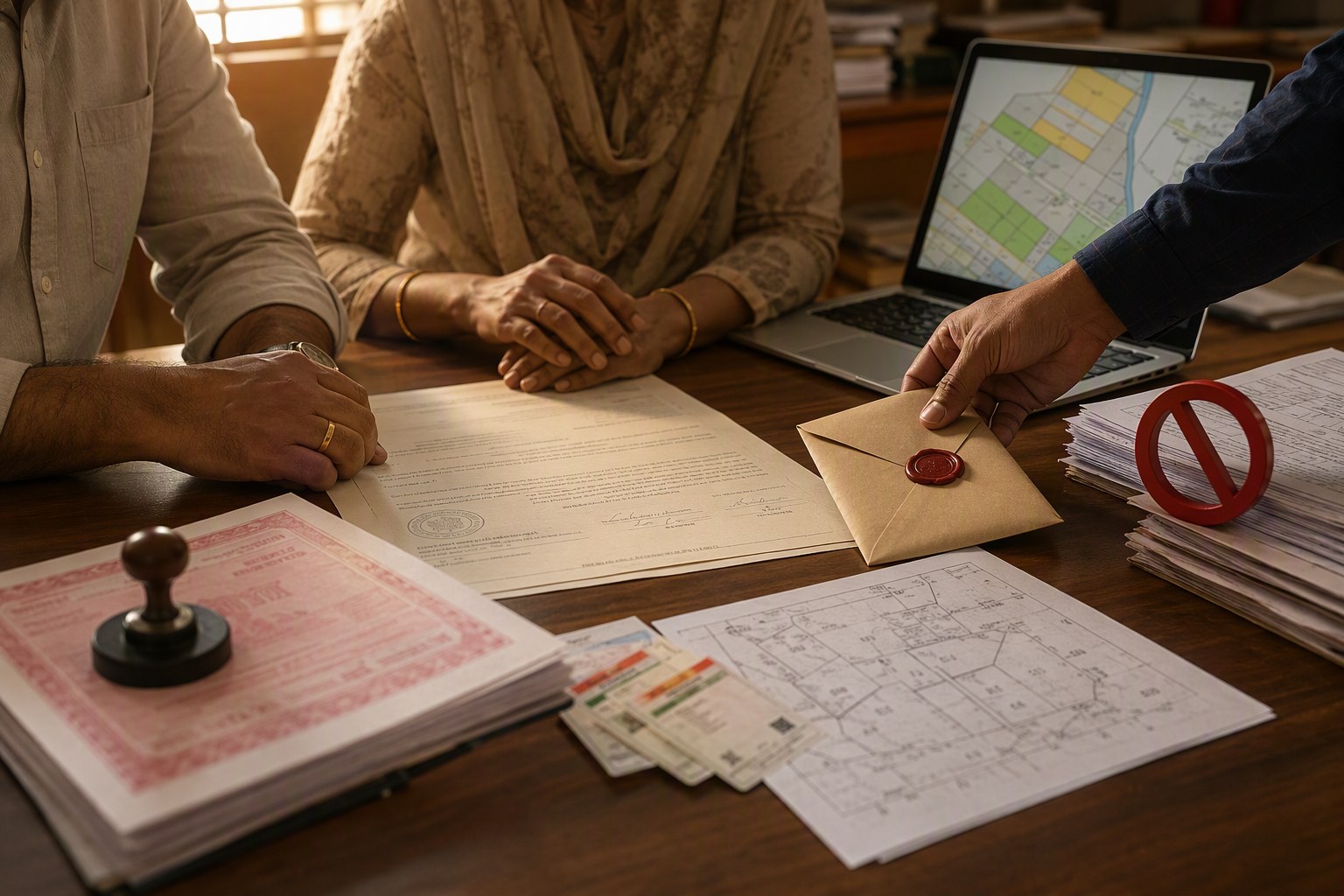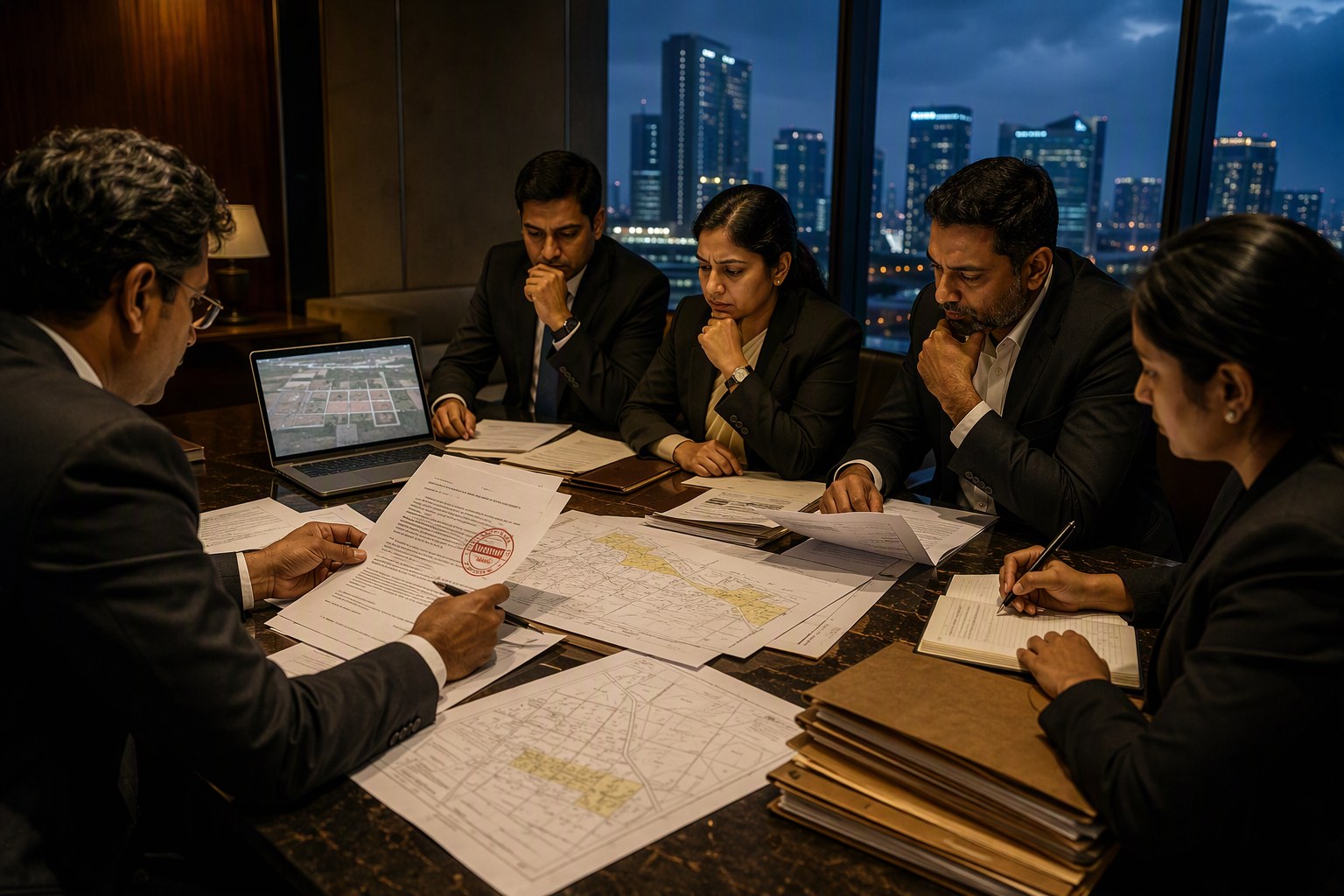
Hyderabad Land M&A Deals may soon see a tougher pre-signing habit: clean-room proof that the land is not hit by Section 22-A prohibited property entries. The reason is simple. Telangana’s prohibited properties database is large, with 3,076,153 records as per latest IGRS data. For any serious acquisition across Kokapet, Narsingi, Gandipet, Shamshabad, Maheshwaram, Patancheru, Medchal or the ORR growth belt, this is no longer a small legal checklist item. It is becoming a deal-condition issue.
In Hyderabad’s land market, M&A-style real estate transactions are no longer limited to buying a single plot or farm parcel. We are seeing larger assemblies, warehousing land purchases, plotted development tie-ups, industrial land exits, and joint development structures where one title issue can delay the whole transaction. Section 22-A risk now sits right in the middle of that discussion.
Why Hyderabad Land M&A Deals are focusing on 22-A before signing
Section 22-A entries can restrict registration of certain properties. These may include government lands, assigned lands, endowment-related properties, ceiling-surplus lands, court-disputed categories and other notified parcels. The exact reason has to be checked case by case through government records, SRO-level information and land revenue documents.
The problem for buyers is timing. In a large deal, the buyer may spend weeks on commercial negotiation, term sheet drafting, board approvals and lender discussions. If the Section 22-A issue appears only at the registration stage, the deal can get stuck after money, time and reputation have already been committed.
That is why sophisticated buyers may start asking for what I would call a 22-A clean-room proof. It is not just a casual screenshot. It is a controlled verification pack prepared before signing, where the seller’s documents, survey numbers, village, mandal, SRO jurisdiction, pahani entries, Dharani status, EC history and prohibited-property checks are reviewed together.
In our experience, the cleanest land files are not the ones with the thickest bundles. They are the ones where survey number, title flow, possession, revenue record and SRO record are all saying the same thing.
Hyderabad Land M&A Deals need a clean-room, not only a legal opinion
A traditional legal opinion still matters. But in land M&A, the buyer needs more than a lawyer’s final paragraph saying title is clear subject to assumptions. The investment committee wants proof. The lender wants traceability. The development team wants certainty on access, zoning and future approvals.
A proper clean-room process will normally separate sensitive seller documents from the buyer’s wider team, while allowing authorised legal, finance and technical teams to verify the core risk points. For example, if the land is in Gandipet mandal near the western corridor, the team should not only check registered sale deeds. They should match village name, survey number, subdivision, pattadar details, boundaries and revenue record history. The same discipline is needed in Shamshabad mandal, Maheshwaram mandal, Medchal mandal, Shankarpally mandal and Patancheru-side industrial belts.
For first-level checks, buyers can use the Section 22-A Prohibited Property Check, then cross-check title flow through the Encumbrance Certificate Search and identify registration jurisdiction using Find Your SRO Office. If the land description itself is unclear, the Survey Number Finder is useful before deeper diligence starts.
What a 22-A clean-room proof pack should contain
For big-ticket Hyderabad land acquisitions, I would expect buyers to ask for a structured pack before definitive agreements are signed. This is especially relevant where the transaction involves multiple survey numbers, family-owned parcels, GPA chains, old agricultural land conversions or revenue record mismatches.
| Clean-room item | Why it matters in land M&A |
|---|---|
| Survey number and village mapping | Prevents confusion between similar survey numbers, subdivisions and neighbouring parcels. |
| Section 22-A check | Confirms whether the land appears in prohibited property records as per latest government data. |
| EC and link document review | Shows registered transaction history and visible encumbrances. |
| Pahani and Dharani status | Helps compare revenue ownership, possession and land classification. |
| SRO jurisdiction confirmation | Ensures the correct registration office and village mapping are used. |
| Guideline value check | Supports stamp duty planning and valuation discussions without relying only on broker talk. |
| Charge and mortgage check | Identifies lender claims or security interests where available. |
For valuation support, teams can refer to the Market Value / Guideline Value Search and calculate likely registration outgo using the Stamp Duty Calculator. Where companies are buying land along with a project SPV, the CERSAI Charge Check can also be useful for loan charge visibility.
Why Section 22-A risk is sharper in Hyderabad growth corridors
Hyderabad’s growth has moved beyond the old city-centre model. Land action is active across the western IT corridor, ORR exits, airport-side locations, pharma and logistics belts, and plotted development zones. In many of these places, land has passed through agricultural, revenue, family partition, conversion and development-agreement stages.
That history can be messy. A parcel in Narsingi or Kokapet may have a very different risk profile from a parcel in Maheshwaram or Kandukur side. A Patancheru industrial land file may need a different style of review compared with a Shamshabad airport-belt land assembly. A Medchal warehouse acquisition may involve access-road, land-use and mortgage checks apart from title.
Section 22-A is not the only risk, but it is one of the few risks that can directly affect registration. That is why buyers cannot leave it to the last week. If a prohibited-property hit appears, the team must understand whether it is a true restriction, a data mismatch, a wrong survey mapping issue or a legacy entry needing official clarification. Each path takes time.
Deal clauses may change after 22-A clean-room checks
We may see more term sheets in Hyderabad using specific conditions around 22-A status. Instead of a broad seller warranty saying “title is clear”, buyers may ask for a pre-closing certificate-style confirmation, updated checks closer to registration, and indemnity if any undisclosed prohibited-property issue blocks the transaction.
Payment milestones may also become tighter. For example, a buyer may agree to a small token or escrow-linked advance, with larger payment only after Section 22-A, EC, SRO and revenue checks are completed. This is sensible. In land transactions, recovery after a failed registration fight can be painful, even when the buyer is legally strong.
For plotted development companies and warehousing players, the clean-room pack can also help internal approvals. Finance teams do not like vague land files. Developers need to know whether they can proceed towards layout approvals, land-use checks, road access planning and RERA registration where applicable. Tools like Land Use Zone Finder, Road Width Check and RERA Project Lookup can support the larger diligence process.
Seller-side preparation will become a deal advantage
Sellers should not treat this as only a buyer headache. A landowner or company selling a large parcel can improve negotiation strength by preparing the clean-room file in advance. That means keeping link documents, pattadar passbook details, pahani copies, mutation records, old sale deeds, partition deeds, conversion papers, tax receipts and survey sketches ready.
If there is a mismatch, address it early. If the village name has changed in records, explain it. If the survey number has been subdivided, show the trail. If an old EC does not capture a document, get the updated search done. If the land is near a government boundary, tank buffer, road widening line or assigned-land belt, do not hide it. Serious buyers will find out.
Clean disclosure usually protects the deal. Surprise kills the deal.
Our view: 22-A clean-room proof is becoming standard for serious Hyderabad land buyers
Given the scale of Telangana’s Section 22-A prohibited properties database, Hyderabad land buyers cannot rely only on confidence, relationship or old reputation. For small transactions also, caution is needed. For M&A-style land deals, it is now almost compulsory in practice.
The market is not saying every land parcel is risky. That would be unfair. Hyderabad still has many clean, bankable land holdings with proper title flow. But the cost of missing a Section 22-A issue is too high, especially when the deal involves board money, investor money or project timelines.
My view is straightforward: before signing a major land acquisition in Telangana, insist on a written 22-A clean-room proof pack. Match it with EC, pahani, Dharani, SRO and guideline value checks. If all records align, the buyer can move with confidence. If they do not align, negotiate the risk before the cheque leaves your account.
Frequently Asked Questions
What is 22-A clean-room proof in Hyderabad land deals?
It is a structured verification pack showing that the land has been checked against Section 22-A prohibited property records, along with EC, survey number, SRO, pahani, Dharani and related title documents.
Why is Section 22-A important before signing a land M&A deal?
If a property is affected by a prohibited-property entry, registration may be restricted. Finding this after signing can delay or damage the transaction, especially in large land acquisitions.
Which Hyderabad areas need extra care for land title checks?
Fast-growing areas such as Kokapet, Narsingi, Gandipet, Shamshabad, Maheshwaram, Patancheru, Medchal and ORR-side villages need careful survey number, revenue and SRO verification because land histories can be complex.
Can a clean EC alone prove that land is not under Section 22-A?
No. An EC shows registered transactions and visible encumbrances. Section 22-A status has to be checked separately against prohibited property records and matched with revenue and SRO details.
What should sellers prepare before offering large land parcels?
Sellers should prepare link documents, EC, pahani, Dharani details, mutation records, survey sketches, SRO jurisdiction details and a current Section 22-A check to reduce buyer-side objections.