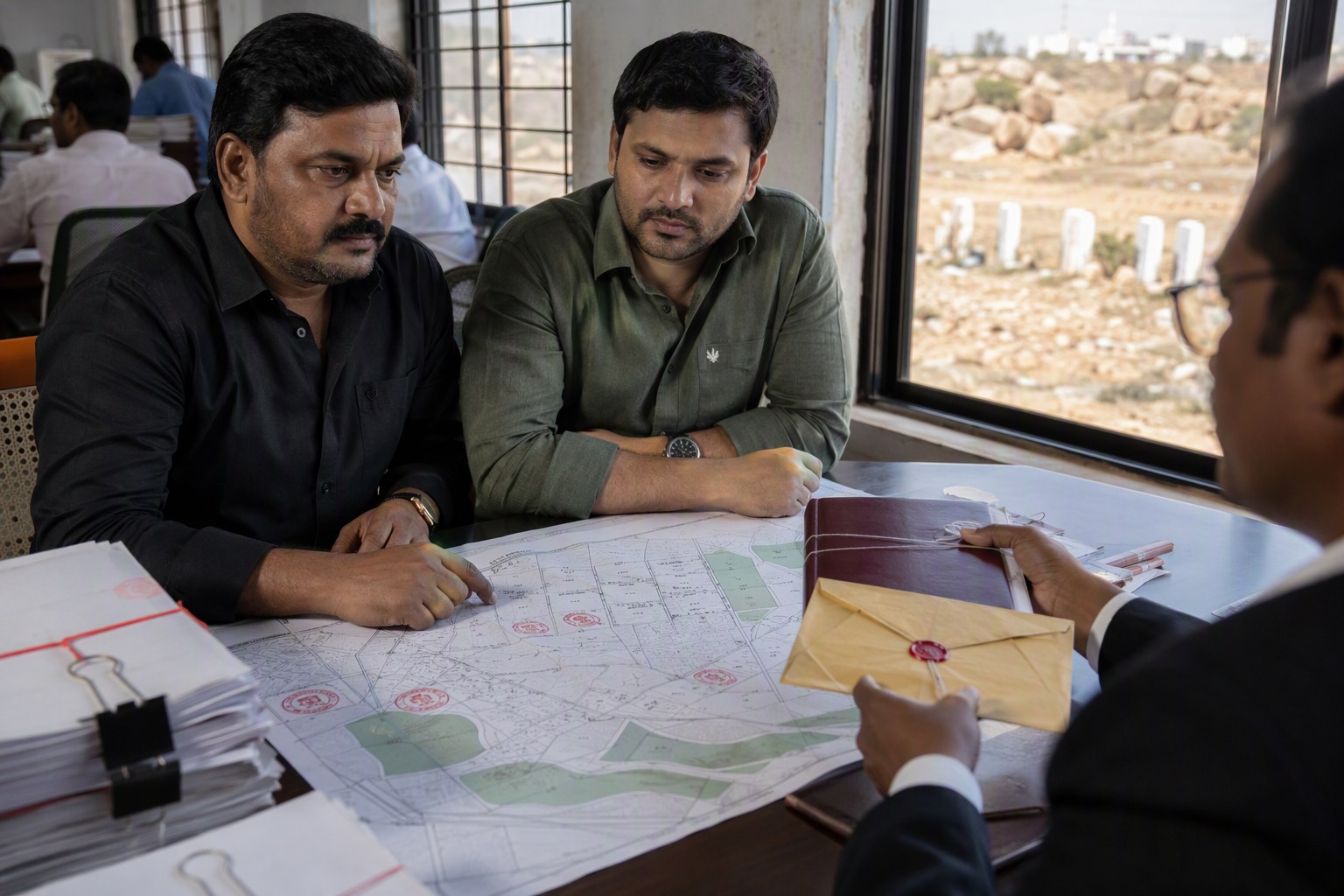
Telangana Land Deal Closings May Move to Escrow After 22-A Checks, especially for larger land parcels around Hyderabad where buyers are no longer comfortable releasing full payment before registration risks are cleared. The trigger is simple: Section 22-A prohibited property status, title history, pahani entries, survey number matching and SRO-level document checks are now being treated as deal-closing conditions, not paperwork to be handled at the last minute.
In our experience, this is a sensible shift. When a parcel in Kokapet, Mokila, Tellapur, Kollur, Maheshwaram or Shamshabad is being negotiated, the commercial pressure to close fast is high. But a single 22-A entry, mismatch in survey number, missing link document or unclear Dharani mutation trail can stop registration or weaken the buyer’s position after token money has already gone out.
As per the verified database available to us, Telangana has 3,076,153 prohibited property records under Section 22-A. That number alone explains why serious buyers, family offices, developers and land aggregators are asking for escrow-style payment structures until government and title checks are clean.
Telangana Land Deal Closings May Move to Escrow After 22-A Checks: What is changing?
The old closing style was straightforward: agree price, pay advance, prepare sale deed, go to SRO, register, release balance. That model still works for clean apartments and straightforward plots. But for larger agricultural, conversion-pending or development-potential land in Ranga Reddy, Sangareddy, Medchal-Malkajgiri and Yadadri-Bhuvanagiri belts, the risk is different.
Buyers are now asking sellers to accept staged payment. A smaller token is paid first. A larger amount is parked or conditionally held. Final release happens only after checks such as 22-A status, encumbrance certificate, Dharani record, pahani, market value, SRO jurisdiction and legal title review are completed.
This is not yet a uniform market practice, and Telangana does not have one standard escrow format for every private land deal. But in negotiated transactions, particularly where the land has development potential, we are seeing the language of “payment against clearance” becoming more common.
For high-value land, the deal is no longer closed when hands are shaken. It is closed when the survey number, title chain and registration eligibility survive scrutiny.
Why Telangana Land Deal Closings May Move to Escrow After 22-A Checks
Section 22-A matters because it deals with properties prohibited from registration. These can include government lands, assigned lands, endowment properties, waqf-linked lands, certain ceiling surplus lands and other notified categories. If a property is reflected as prohibited, the SRO may not allow registration even if buyer and seller are ready.
In Hyderabad’s growth corridors, the confusion often comes from old revenue descriptions. A buyer may be shown a land parcel in a village under Gandipet mandal, Shankarpally mandal, Patancheru mandal, Maheshwaram mandal or Shamshabad mandal, but the documents may carry older village names, merged survey numbers, sub-divisions or past agricultural entries. That is where trouble starts.
Before paying a major advance, buyers should run a Section 22-A Prohibited Property Check, verify the survey details through the Survey Number Finder, and review the registration history with the Encumbrance Certificate Search. These are not substitutes for a lawyer, but they help identify red flags before the cheque is written.
How escrow-style closings may work in Telangana land deals
A practical escrow-linked closing can be simple. The buyer and seller agree that payment will be released in stages. Each stage is linked to a document or registration milestone. This gives the seller confidence that the buyer has funds, and gives the buyer comfort that money will not be fully released before title and registration eligibility are tested.
| Deal stage | Typical check | Why it matters |
|---|---|---|
| Before token | Survey number, village, mandal, seller identity | Confirms that parties are discussing the correct property |
| After token | 22-A prohibited status, Dharani record, pahani | Checks whether registration may be blocked or disputed |
| Before sale deed | EC, link documents, SRO jurisdiction, ready reckoner value | Tests title chain and registration cost assumptions |
| At registration | Final deed, stamp duty, registration slot, witness details | Completes legal transfer at the correct SRO |
| After registration | Mutation, possession, revenue record update | Protects the buyer after the sale deed is executed |
For stamp duty planning, buyers can use the Stamp Duty Calculator. For SRO mapping, the Find Your SRO Office is useful, especially when a village falls near jurisdiction boundaries. To check government market value before negotiating the deed value, use the Market Value / Guideline Value Search.
Hyderabad land corridors where this issue is sharper
The escrow conversation is strongest in areas where land values, development interest and documentation complexity meet. Kokapet and Gandipet have a different profile from interior agricultural land. Mokila, Shankarpally and Chevella-side parcels often involve old family holdings, agricultural records and layout conversion questions. Tellapur, Kollur and Patancheru-side deals may involve industrial, residential and mixed-use expectations. Maheshwaram, Shamshabad and Kandukur-side land is watched closely because of airport-side growth and warehousing interest.
In these locations, buyers are not only asking, “Is the land available?” They are asking, “Can it be registered, developed, financed and defended if challenged?” That is a better question.
For developer-led acquisitions, the checks go beyond 22-A. Land use zoning, road width, FSI potential and RERA obligations can change the economics of the deal. A buyer planning plotted development or villa projects should use the Land Use Zone Finder, Road Width Check and FSI/FAR Calculator before committing major money.
What sellers should expect in these new closings
Sellers may feel escrow slows down the deal. That is understandable. Many landowners in Telangana prefer direct payment and quick registration. But clean sellers can also benefit. If the documents are good, escrow-linked closing gives the buyer confidence and reduces last-minute bargaining.
A seller with clear title, clean pahani, matching Dharani record, proper succession documents and no 22-A issue can use this process to prove quality. In fact, good documentation can become a premium point during negotiation, especially in competitive localities around Hyderabad.
Sellers should keep these documents ready before meeting serious buyers:
- Latest Dharani record or relevant revenue extract
- Pahani or adangal details, where applicable
- Complete link documents and prior sale deeds
- Survey number and sub-division clarity
- EC for the relevant period as advised by counsel
- Identity, succession and family consent documents, if needed
- Any conversion, layout, NALA or development permissions, where applicable
If the seller is unsure about the English meaning of Telugu revenue terms, the Telugu-English Property Terms Dictionary can help during preliminary review.
Buyer checklist before releasing major land payment
For buyers, my view is clear: do not treat 22-A checking as a formality. It should happen before major payment, not after sale deed drafting. The same applies to encumbrances, CERSAI charge search in relevant cases, pending litigation inputs and family title issues.
Use the Property Verification Tool for a structured review starting point. If there is any hint of a bank charge or secured loan, the CERSAI Charge Check is worth using. For longer title chains, the EC Analyzer can help spot patterns that need legal attention.
Escrow does not remove risk fully. It only controls payment risk. A poor agreement, vague conditions or unclear release trigger can still create disputes. The agreement should clearly say what happens if 22-A status is found, if SRO refuses registration, if survey boundaries do not match, or if legal title is not satisfactory.
What this means for Telangana land market
This shift is healthy for the market. Telangana land deals have become larger, faster and more professional, particularly around Hyderabad’s western and southern growth belts. When transaction values are serious, the closing process also has to mature.
Escrow-linked payments will not suit every deal. Small family transfers, apartment purchases and clean plotted sales may continue in the usual way. But for major land parcels, especially where development potential is the main attraction, conditional release of funds after 22-A and title checks is likely to become part of serious negotiation.
The message is simple. If the land is clean, escrow should not scare the seller. If the buyer is genuine, staged payment should not scare them either. The people who may resist the most are those relying on speed, pressure and incomplete disclosure. In Telangana’s current land market, that approach is becoming harder to defend.
Frequently Asked Questions
Will every Telangana land deal need escrow after 22-A checks?
No. It is not mandatory for every transaction. But for major land parcels, development land and high-risk title situations, escrow-style staged payment is becoming a practical negotiation tool.
What is Section 22-A in Telangana property registration?
Section 22-A refers to properties that are prohibited from registration. These may include government, assigned, endowment, waqf-linked or other notified properties, depending on the record.
When should a buyer check 22-A status?
Before paying a major advance. Ideally, the buyer should check 22-A status, EC, survey number, Dharani record and SRO jurisdiction before the sale deed is finalised.
Does escrow guarantee clear title?
No. Escrow controls payment release. It does not replace legal due diligence. Buyers still need title verification, document review and local revenue checks.
Which Hyderabad areas need extra caution in land deals?
Growth corridors such as Kokapet, Gandipet, Mokila, Shankarpally, Tellapur, Kollur, Patancheru, Maheshwaram and Shamshabad need careful survey, title, zoning and 22-A checks.