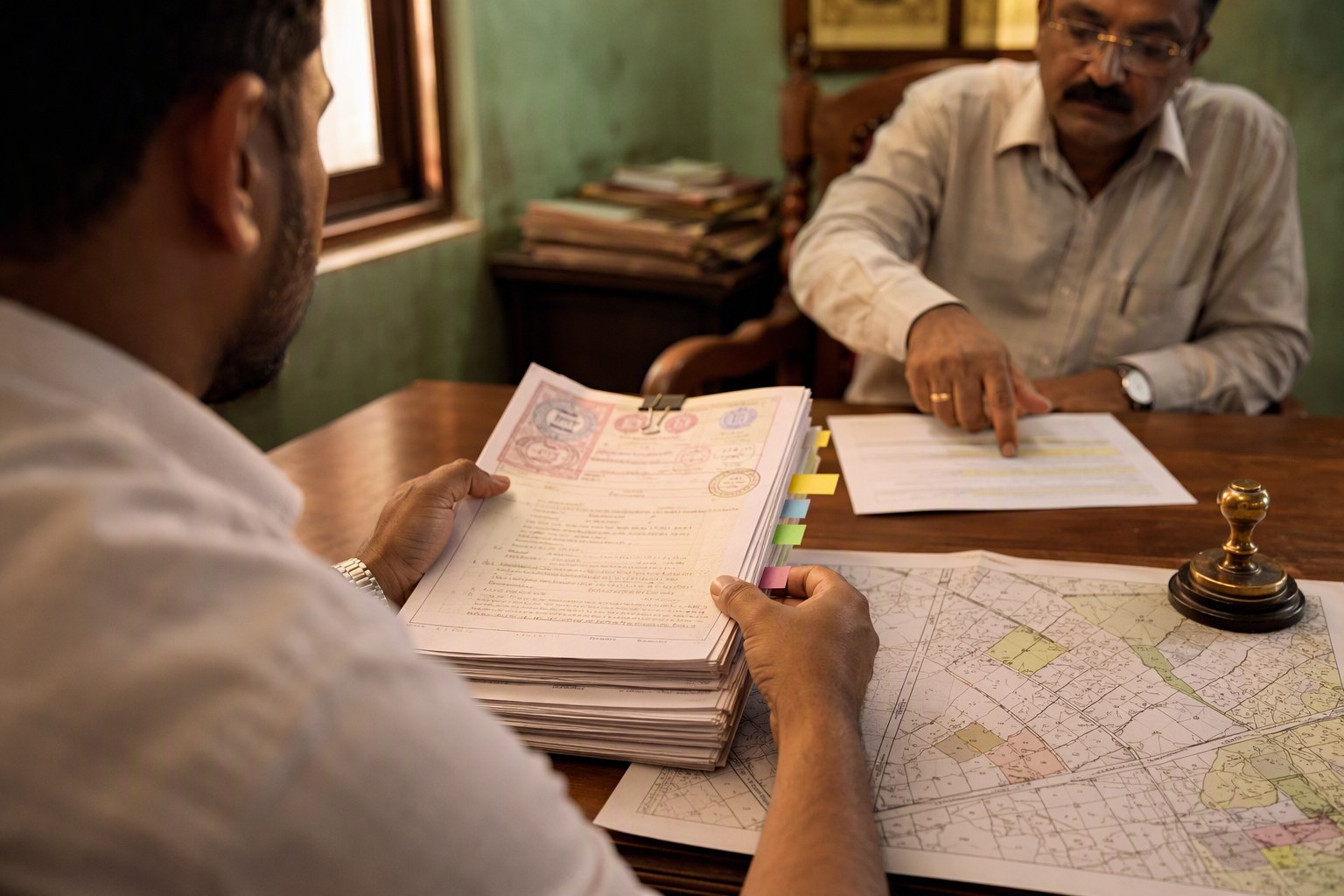
Telangana May Standardise Court Decree Checks in Land Deals, a move that could make property due diligence sharper for buyers dealing with disputed land, delayed mutations and Section 22-A prohibited property entries. If this verification step becomes a standard practice across registrations and private legal checks, buyers in Hyderabad’s growth corridors will have one more layer of protection before paying token advance or signing an agreement of sale.
The issue is not small. As per the Verified.RealEstate database context, Telangana has 3,076,153 prohibited property records under Section 22-A. These entries cover different categories of land where registration may be blocked or restricted. When a court decree, pahani entry, Dharani mutation and SRO record are not read together, buyers can easily miss a serious title problem.
Telangana May Standardise Court Decree Checks in Land Deals: What Buyers Should Expect
A standardised court decree check would mean that buyers, advocates, document writers and possibly registration-facing teams follow a fixed method to verify whether a property is affected by any civil court order, partition decree, injunction, compromise decree, specific performance decree or title declaration.
In practical terms, the check should answer a few basic questions before the buyer proceeds:
- Is there any court decree involving the same survey number, plot number, flat number or house number?
- Do the names in the decree match the present seller’s chain of title?
- Has the decree been acted upon in revenue records, mutation records and SRO records?
- Is there any mismatch between the decree, Dharani data, pahani and encumbrance certificate?
- Does the land appear in the Section 22-A prohibited property list?
We’ve seen this problem most often in high-demand belts like Kokapet, Narsingi, Puppalaguda, Manikonda, Tellapur, Kollur, Mokila, Shankarpally, Tukkuguda, Adibatla, Bachupally and Miyapur. These are not “bad” localities. They are active markets. That is exactly why old family disputes, unimplemented decrees and mutation delays become expensive surprises.
Our view is simple: EC alone is not enough. A clean encumbrance certificate may still miss a court dispute if the decree has not translated properly into registration or revenue records.
Why Telangana May Standardise Court Decree Checks in Land Deals Now
The pressure is coming from three sides: rapid land value appreciation around Hyderabad, digitised revenue systems such as Dharani, and recurring buyer complaints where legal title is not matching ground reality. In mandals such as Serilingampally, Gandipet, Rajendranagar, Shankarpally, Moinabad, Maheshwaram, Hayathnagar and Medchal, one survey number may have a long history: agricultural land, layout conversion, family partition, sale deeds, GPA transactions and then apartment development.
When a court decree enters this chain, the buyer must know whether it has been properly reflected. A decree in favour of one branch of a family is not automatically harmless. If mutation is delayed, if the seller’s name is not updated, or if another party has filed an appeal, the buyer may get dragged into litigation after purchase.
This is where a standard checklist can help. It will not replace an advocate’s opinion, but it can reduce casual verification. Before paying advance, buyers should run an Encumbrance Certificate Search, check the property against the Section 22-A Prohibited Property Check, and confirm the correct registration jurisdiction using Find Your SRO Office. For land parcels, the Survey Number Finder can also help buyers avoid checking the wrong survey number.
Court Decree Checks and Section 22-A Prohibited Property Risk
Section 22-A entries are a major concern because they can stop registration. But the bigger headache is when 22-A risk overlaps with a court decree or mutation dispute. A buyer may hear from the seller that “case is already settled” or “mutation will happen after registration”. That is not enough. The decree copy, order sheet, appeal status and revenue implementation must be checked carefully.
According to government records, prohibited property lists are maintained to prevent registration of certain categories of properties. The Verified.RealEstate database context records 3,076,153 Section 22-A prohibited property entries. For a normal buyer, that number shows why a quick verbal assurance from a broker or seller is risky.
In our experience, buyers should be extra alert in these situations:
- The seller says land came through a court decree, but cannot provide certified copies.
- Dharani shows one name, while the sale deed chain shows another name.
- Pahani entries are old and mutation has not been completed.
- The EC has gaps or missing transactions.
- The survey number appears in a prohibited property search or has a similar number in the same village.
- The land is in a village where government, assigned, endowment, waqf or ceiling-related claims are common.
For flats, buyers should also check whether the project is registered through RERA Project Lookup. RERA registration does not automatically cure land title defects, but it gives another layer of project-level information. For independent houses and plots, use the Property Verification Tool as an early screening step before legal drafting.
How a Standard Court Decree Verification Step May Work
A good standard process should not be complicated. It should be disciplined. The buyer or advocate can start with the seller’s title documents, identify the key survey numbers and parties, and then check whether any decree affects the property. If a decree exists, the next step is to confirm whether it is final, appealed, stayed, modified or already implemented in the revenue and registration records.
| Risk area | Where it commonly appears | Why decree check matters |
|---|---|---|
| Family partition dispute | Kokapet, Tellapur, Mokila, Shankarpally belt | A decree may divide rights differently from later sale deeds. |
| Mutation delay | Revenue villages under Gandipet, Moinabad, Maheshwaram and Medchal mandals | Seller may not have updated revenue title even after decree. |
| 22-A overlap | Assigned land, government land, endowment or other restricted categories | Registration can be blocked even if private parties have signed agreements. |
| Layout and plot chain mismatch | Bachupally, Miyapur, Hayathnagar, Adibatla, Tukkuguda | Old survey disputes can continue after plotting and resale. |
The ready reckoner or guideline value is also part of the transaction picture. Buyers can verify area-wise government values using Market Value / Guideline Value Search and estimate registration outgo through the Stamp Duty Calculator. But valuation checks and title checks are different. A property may have a correct market value and still carry a title defect.
What Buyers in Hyderabad Should Do Before Paying Advance
My practical advice: do not wait till registration week. Once the seller shares documents, create a verification file. Include link documents, EC, Dharani extract, pahani, mutation proceedings if available, layout approvals, RERA details for projects, tax receipts and any court papers. If the seller says there was a case, ask for certified decree copies and not just photocopies circulated on WhatsApp.
For land in villages around Hyderabad, insist on exact village, mandal and survey number. Many disputes happen because buyers check one survey number while the agreement mentions a sub-division or old number. In areas like Narsingi, Manikonda and Puppalaguda, old village records and new municipal descriptions may not look alike. In Shankarpally or Moinabad, agricultural survey numbers can have family partitions that are not obvious from one sale deed.
A standardised court decree check will be useful only if buyers treat it as one part of due diligence, not as a stamp of perfection. The safer approach is layered verification: EC, 22-A, SRO jurisdiction, Dharani or revenue record, court decree status, land use, approvals and possession.
Telangana May Standardise Court Decree Checks in Land Deals: Market Impact
If implemented well, this move could slow down risky transactions and improve confidence in genuine ones. Sellers with clean records may benefit because buyers will have fewer doubts. Developers assembling land in the Hyderabad outskirts may also face stricter scrutiny, especially where several family members, GPA holders and decree holders appear in the title chain.
Some transactions may take longer. That is not a bad thing. A few extra days of verification is better than years in a civil court. In Telangana’s current market, buyers are already spending serious money on plots and apartments across western, northern and southern Hyderabad. They deserve a process that catches legal red flags before registration, not after housewarming.
For now, buyers should behave as if this standard is already required. Ask the seller direct questions. Put document conditions in the agreement of sale. Use verification tools early. And if a court decree appears anywhere in the title chain, get a property lawyer to read it along with revenue and SRO records.
Frequently Asked Questions
What is a court decree check in a Telangana land deal?
It is a verification of whether any civil court decree, injunction, partition order, compromise decree or title declaration affects the property. The decree must be read along with sale deeds, EC, Dharani records, pahani and mutation entries.
Why is an encumbrance certificate not enough for title verification?
An EC shows registered transactions and encumbrances available in SRO records. It may not clearly show every court dispute, mutation gap or unimplemented decree. Buyers should use EC as one layer, not the full legal opinion.
How does Section 22-A affect property registration in Telangana?
Section 22-A covers prohibited properties where registration can be restricted or blocked. Telangana has 3,076,153 prohibited property records in the Verified.RealEstate database context, so buyers should check this before paying advance.
Which Hyderabad areas need extra caution for decree and mutation checks?
Fast-moving land markets such as Kokapet, Narsingi, Tellapur, Kollur, Mokila, Shankarpally, Tukkuguda, Adibatla, Bachupally and Miyapur need careful checks because old survey numbers, family partitions and layout conversions often overlap.
Should buyers verify court decrees before or after agreement of sale?
Preferably before paying a large advance. If time is short, the agreement of sale should clearly make the transaction subject to satisfactory verification of court records, EC, 22-A status, revenue records and approvals.