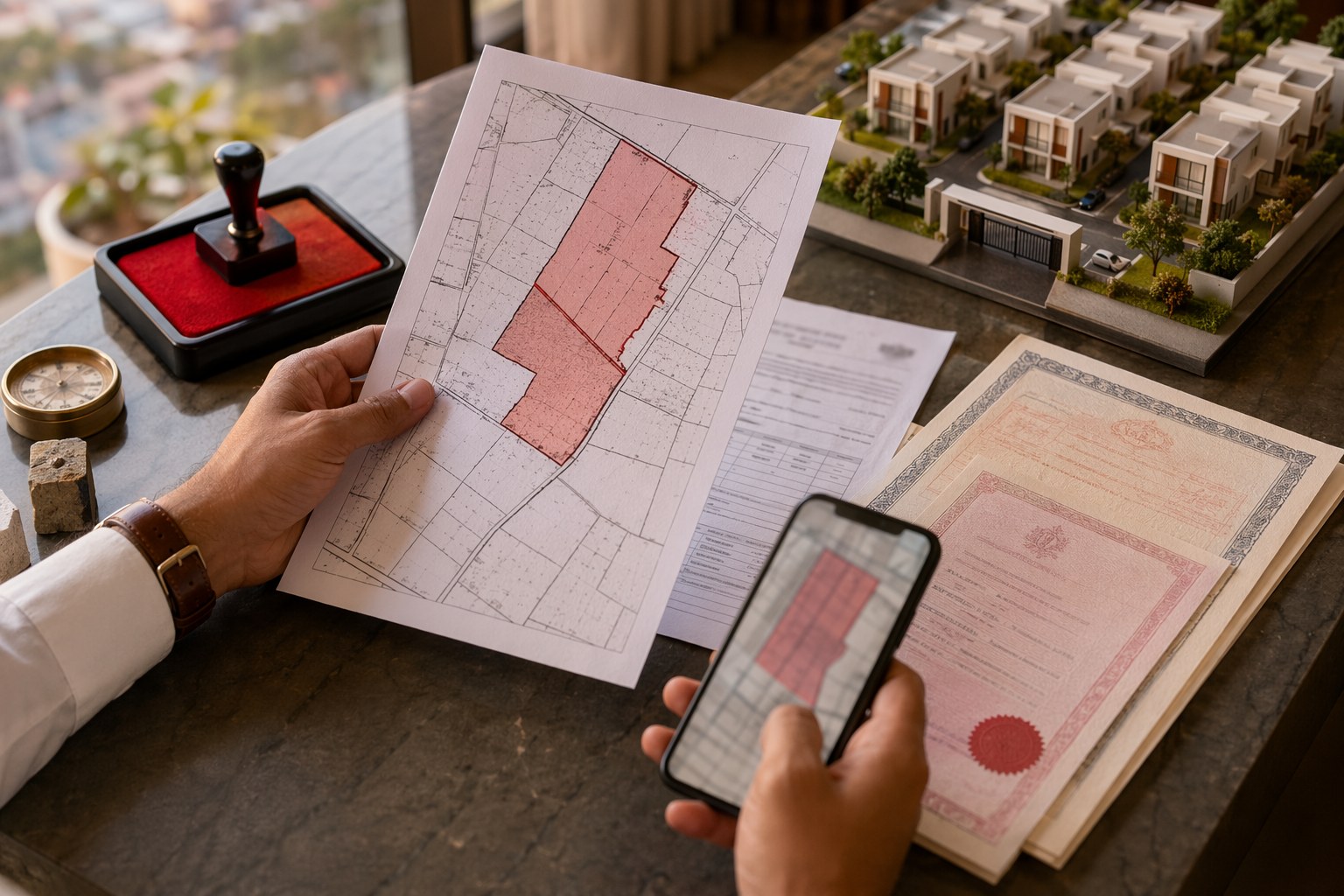
Telangana Courts May See More Writs Over 22-A Delistings as owners, legal heirs and buyers face a large prohibited-property database under Section 22-A. As per latest IGRS-linked government records available with Verified.RealEstate, Telangana has 3,076,153 prohibited-property entries. That number itself explains why disputes are moving from SRO counters to court halls: one wrong survey number entry can freeze a sale, block a mortgage, delay family partition, or push a genuine owner into a writ petition for delisting.
The immediate message for buyers in Hyderabad and nearby growth corridors is simple. Do not treat a clean-looking sale deed as final proof of title. Before paying token advance for land in areas like Kokapet, Narsingi, Tellapur, Mokila, Shamshabad, Adibatla, Patancheru or Shankarpally, check whether the survey number is hit by a 22-A entry, whether the pahani and Dharani records match, and whether the SRO will accept registration.
Why Telangana Courts May See More Writs Over 22-A Delistings
Section 22-A of the Registration Act is meant to stop registration of certain prohibited properties. In practice, it covers categories such as government land, assigned land, endowment land, wakf land, ceiling surplus land, court-disputed land and other notified properties. Once a survey number enters this list, the local Sub-Registrar generally refuses registration.
That is where the friction begins. Owners say some entries are old, broad, wrongly mapped, or continued even after orders in their favour. Revenue officials may say the property cannot be cleared unless the file moves through the proper channel. Buyers get stuck in between. In our experience, many such cases do not start as aggressive litigation. They start with a simple failed registration attempt at the SRO.
With 3,076,153 entries sitting in the prohibited-property database, the possibility of more writ petitions is real. A writ is often used when the owner claims that a government authority has failed to act, delayed a decision, or continued a restriction without proper basis. For 22-A matters, typical prayers may include a direction to consider a delisting request, correction of land classification, or permission to register subject to lawful verification.
For Hyderabad buyers, the key risk is not only whether the seller has a document. The key risk is whether the land can legally move from seller to buyer at the SRO level.
Telangana Courts May See More Writs Over 22-A Delistings, But Buyers Cannot Wait For Litigation
One practical problem is timing. A buyer may identify a plot near the Outer Ring Road, agree on a price, pay an advance, and only later discover that the survey number has a prohibited-property mark. By then, the seller may say the issue is “only a technical problem”. The buyer’s family may already have arranged funds. A bank may refuse the file. The SRO may not accept the deed. This is when pressure builds.
We have seen this pattern in several fast-moving belts around Hyderabad: land parcels near Narsingi and Kokapet in Gandipet mandal, open plots around Tellapur and Kollur in Sangareddy district limits, agricultural conversions near Shamshabad, and village lands around Adibatla in Ibrahimpatnam side. Not every property in these localities has a problem. In fact, many are perfectly marketable. But when a locality is hot, buyers sometimes skip basic title checks because they fear losing the deal. That is a costly mistake.
Before paying advance, use the Section 22-A Prohibited Property Check. If the survey number is not clear, verify the chain through the Encumbrance Certificate Search and run a broader review through the Property Verification Tool. For older village lands, the Survey Number Finder can also help identify whether the number quoted in the sale deed matches the present revenue reference.
What Usually Triggers A 22-A Delisting Challenge?
Most 22-A delisting disputes are not identical. The facts change from one mandal to another. Still, some triggers are common across Telangana.
- Wrong survey number tagging: A private patta land may get mixed with an adjoining government survey number or sub-division.
- Old classifications: Revenue records may still show a restriction that the owner believes is no longer applicable.
- Assigned land confusion: Families may claim long possession and sale history, while authorities may treat the land as non-transferable assigned land.
- Court order not reflected: Even after a favourable order, the SRO database may not update immediately.
- Dharani mismatch: The owner’s claim in old pahani, ROR or sale deed may not align with the present Dharani entry.
- Endowment or wakf claim: Some lands face institutional claims, and buyers must be extra careful before entering any agreement.
A delisting request generally needs documents, not just oral claims. Owners may need old sale deeds, link documents, pahani copies, mutation proceedings, pattadar passbooks, court orders if any, and correspondence with revenue authorities. If the land falls under an urban development area, layout permissions, conversion records and local body approvals also become relevant.
Why The SRO Counter Is Becoming The First Warning Signal
In Telangana, the Sub-Registrar’s office is often where the problem becomes visible. The buyer and seller may come prepared with draft sale deed, identity proofs and stamp duty calculations. Then the SRO system flags the property. The registration is stopped or refused. At that stage, the parties realise that the issue is not just a private title concern; it is an official restriction.
This is why buyers should identify the correct SRO before entering into any sale agreement. Use the Find Your SRO Office tool and cross-check the village jurisdiction. For lands falling between municipal and gram panchayat zones, do not assume that the nearest SRO is the right one. Village mapping matters. Mandal mapping matters. Survey number mapping matters even more.
Stamp duty planning is also secondary if title is blocked. You can estimate costs through the Stamp Duty Calculator and check government market value using the Market Value / Guideline Value Search, but those steps should come after the title and 22-A position are checked. A low token advance is safer than a large unprotected payment.
Hyderabad Growth Corridors Need Stronger Title Verification
The pressure is highest where land values and buyer interest are rising quickly. Western Hyderabad has seen sustained attention in areas like Kokapet, Neopolis belt, Narsingi, Tellapur, Kollur, Mokila and Shankarpally. Southern and eastern corridors around Shamshabad, Maheshwaram, Adibatla, Tukkuguda and Yacharam also attract buyers looking at long-term land appreciation. These are exactly the places where old agricultural titles, conversion records and village maps must be read carefully.
My opinion is direct: buyers should stop treating “HMDA nearby” or “ORR close” as title comfort. Location can be excellent and title can still be messy. A property may have road access, compound wall, electricity connection and even old sale deeds, yet the registration can fail if the survey number is prohibited under Section 22-A.
For apartment buyers, the risk is different but not absent. If a project’s underlying land has unresolved classification issues, it can affect approvals, funding and resale comfort. Buyers should check RERA status through the RERA Project Lookup, but RERA registration alone should not replace land title verification. RERA helps with project disclosure; it is not a full title insurance certificate.
What Owners Should Do Before Filing A Writ
Not every 22-A issue needs an immediate writ petition. Courts usually expect the owner to approach the relevant authority first, unless there is a clear legal urgency. A cleaner path is to collect documents, file a proper representation, obtain acknowledgements, and track the response. If the authority does not act, delays without reason, or rejects the request mechanically, legal options become stronger.
| Step | What To Check | Why It Matters |
|---|---|---|
| 1 | Survey number and sub-division | A small mismatch can trigger refusal at SRO level. |
| 2 | Pahani, ROR and Dharani entry | Revenue classification is central to 22-A disputes. |
| 3 | Link documents and EC | Shows title flow and past registered transactions. |
| 4 | Government or institutional claim | Endowment, wakf, assigned or government land claims need deeper review. |
| 5 | Prior orders or representations | Useful if the owner later approaches court. |
Owners should also avoid casual online advice. A 22-A entry is a legal and revenue issue. The facts must be read with documents. If a seller tells you, “Court lo clear aipothundi,” ask for the case number, order copy, department response and current database status. A promise is not a title document.
Buyer Checklist Before Dealing With Disputed Land
If you are buying land in Telangana, especially in Hyderabad’s expansion belts, follow this working checklist before signing an agreement of sale.
- Run a Section 22-A check on the exact survey number, not just the village name.
- Confirm the village, mandal and SRO jurisdiction.
- Take an EC for the relevant period and compare names with link documents.
- Check whether the seller’s name appears in current revenue records.
- Ask for pahani copies and mutation proceedings where applicable.
- For plotted layouts, verify layout approval, road access and land use.
- For projects, check RERA details and land ownership disclosures.
- Do not pay a large advance without a refund clause tied to title clearance.
The safest deal is not always the cheapest deal. It is the one where the seller can prove title, the land is registrable, the SRO has no restriction, and the buyer’s lawyer is satisfied. With 3,076,153 prohibited-property entries in the system, caution is not negativity. It is basic self-protection.
What This Means For Telangana’s Property Market
The rise in 22-A delisting challenges may slow some transactions, but it can also clean up the market. Genuine owners deserve a fair route to remove wrong entries. Buyers deserve early warning before they put hard-earned money into disputed land. Government departments need consistent updating so that cleared properties do not remain stuck in old lists.
For now, the market response should be practical. Check first, negotiate later. If the land is clean, move ahead with proper documentation. If it is disputed, price alone should not tempt you. Telangana courts may see more writs over 22-A delistings, but a buyer’s best protection still begins before the sale agreement is signed.
Frequently Asked Questions
What is a 22-A prohibited property in Telangana?
A 22-A prohibited property is a property that the registration department is restricted from registering due to government, legal, revenue or institutional reasons such as government land, assigned land, endowment land, wakf claim or court-related restrictions.
Why are more writ petitions expected over 22-A delistings?
As per latest government records available with Verified.RealEstate, Telangana has 3,076,153 prohibited-property entries. When genuine owners believe their land is wrongly included or not updated after clearance, they may approach the High Court seeking action from authorities.
Can I buy land if the survey number appears in the 22-A list?
You should not proceed casually. A 22-A entry can block registration at the SRO. Get legal verification, check revenue records, ask for delisting documents if any, and avoid large advances until the restriction is resolved.
Which documents should I check before buying land near Hyderabad?
Check the sale deed chain, EC, pahani, Dharani entry, mutation records, survey number details, SRO jurisdiction, layout approval if applicable, and Section 22-A status. For projects, also check RERA registration.
Does a clean EC mean the land is safe from 22-A issues?
No. An EC shows registered transactions and encumbrances, but it may not fully reflect revenue restrictions. A separate Section 22-A prohibited-property check is needed before purchase.