Telangana apartment energy use may soon become a serious due diligence point for homebuyers if the State moves towards tracking or disclosure norms for large gated communities. For Hyderabad buyers, this is not only an environmental story. It can affect monthly maintenance, resale value, builder claims, clubhouse running costs and the premium paid for a genuinely efficient flat in Kokapet, Narsingi, Gachibowli, Tellapur, Bachupally or Uppal.
The idea being discussed in real estate circles is simple: bigger apartment communities may have to monitor or disclose their power consumption pattern, especially for common areas such as lifts, pumps, STPs, lighting, ventilation, clubhouses and EV charging points. No buyer should treat this as a small technical point. In our experience, common-area electricity is one of the most under-checked costs during flat purchase.
My view is clear: if energy-use disclosure comes in, serious buyers will start asking better questions. Builders with efficient design will gain. Projects with fancy amenities but poor operating economics will face tougher scrutiny.
Telangana apartment energy use: why buyers should care now
Most buyers calculate EMI, registration charges and interiors. Very few calculate how much the community itself will cost to run. In Hyderabad’s large gated projects, monthly maintenance can range from about ₹3 to ₹8 per sft in many mid to premium communities. In high-amenity towers, especially around Financial District, Kokapet, Nanakramguda and Gachibowli, the effective outgo can go higher once sinking fund, clubhouse charges, diesel generator costs and special repairs are included.
Take a 1,800 sft flat. At ₹4 per sft, maintenance is ₹7,200 per month. At ₹7 per sft, it becomes ₹12,600. That ₹5,400 monthly gap is not small. Over five years, it is ₹3.24 lakh before considering annual increases. A project with efficient pumps, solar common-area support, good daylighting in corridors, sensor lighting and properly sized STP can control this better than a project designed only for brochure value.
This is where a possible Telangana apartment energy use disclosure can change buyer behaviour. Instead of asking only “Is there a swimming pool?”, buyers may ask “What is the monthly common-area power bill per flat?” That is a much sharper question.
Telangana apartment energy use and Hyderabad price premiums
Hyderabad buyers already pay large premiums for location and brand. In Kokapet and Narsingi, under Gandipet mandal and nearby growth pockets, many premium apartment quotes are seen in the ₹8,500 to ₹13,500 per sft band, with marquee projects quoting even higher depending on tower, view and possession status. In Financial District, Gachibowli and Nanakramguda, prices commonly move around ₹9,000 to ₹15,000 per sft for strong projects. Tellapur and Osman Nagar have active quotes from roughly ₹6,500 to ₹10,500 per sft. Bachupally and Nizampet are usually more moderate, often around ₹5,500 to ₹8,500 per sft, depending on builder and stage.
At these rates, buyers are no longer purchasing only four walls. They are buying the long-term operating quality of the community. If one project has better energy performance and another has high common-area consumption, the difference can show up in resale conversations. A flat with lower monthly outgo, better ventilation and credible energy systems may command a cleaner premium, especially from IT employees, NRIs and rental investors.
We have seen this pattern earlier with RERA registration, OC status and title checks. Initially, buyers ignored them. Later, these became non-negotiable. Energy data may follow the same path.
What should buyers ask before paying booking amount?
If you are buying in a large apartment community, ask for practical numbers, not only green certificates. A certificate has value, but actual bills tell a stronger story.
- What was the average monthly common-area electricity bill for the last 6 to 12 months?
- How many lifts are operational per tower and what is their power rating?
- Is solar power used for common areas or only shown as a feature?
- What is the STP capacity and monthly running cost?
- Are corridor lights sensor-based or permanently running?
- What is the diesel generator usage during peak summer?
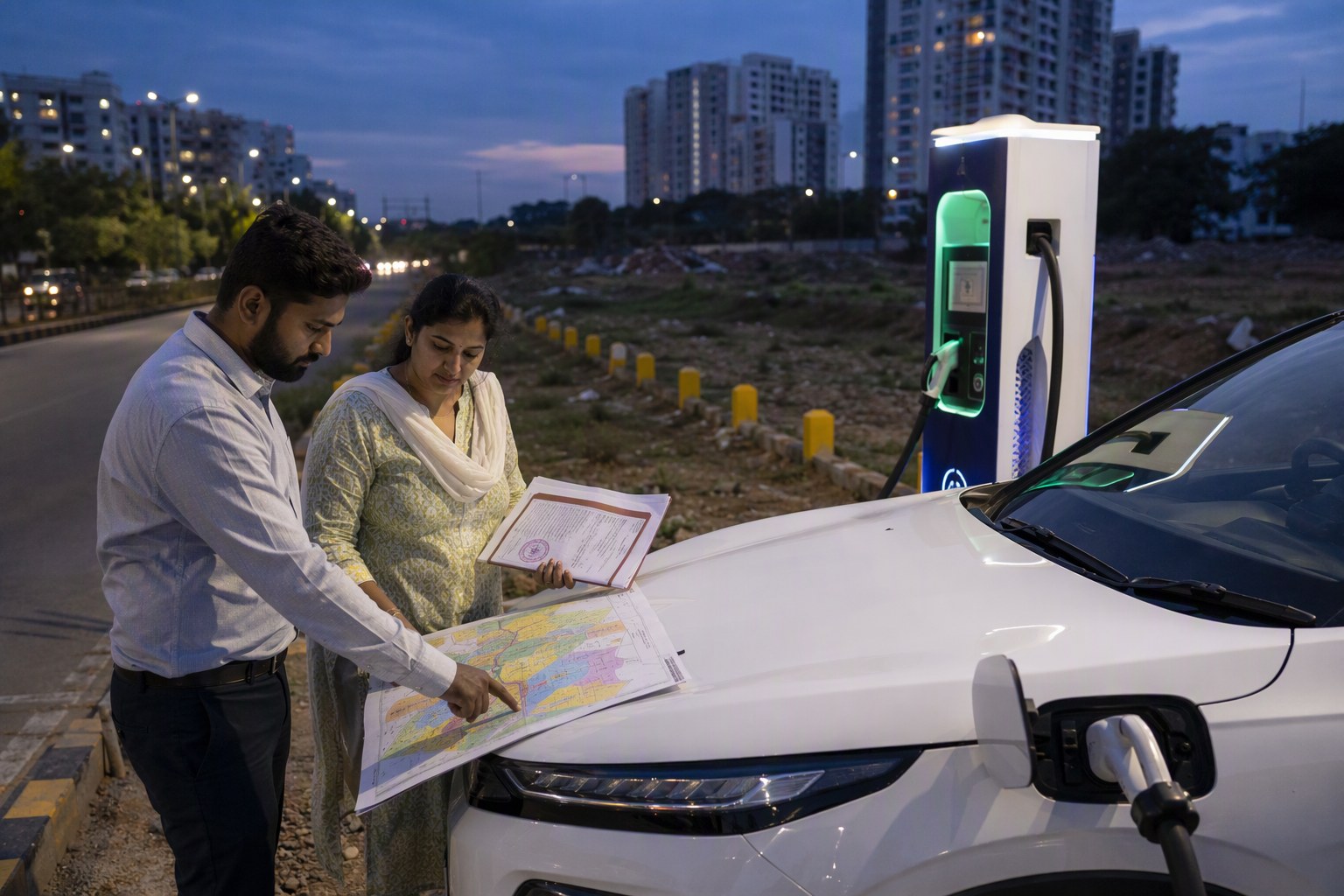
- Is EV charging separately metered or loaded into common maintenance?
- Does the association have an energy audit report?
For under-construction projects, ask the builder to give estimated common-area maintenance with assumptions. If the sales team says “society will decide later”, be careful. That usually means the buyer is accepting an unknown recurring liability.
Due diligence should still start with land and approvals
Energy tracking is useful, but it does not replace core property verification. Telangana has a large title-risk universe. As per available database facts, there are 147,934 prohibited properties under Section 22-A. That number is a reminder: before discussing solar panels and EV chargers, buyers must check whether the land itself is clean.
Use the Section 22-A Prohibited Property Check before you fall in love with a project brochure. Cross-check the survey number through the Survey Number Finder, especially in developing corridors like Mokila, Kollur, Shankarpally, Maheshwaram, Adibatla and Shadnagar where land conversion history matters.
For apartments, verify the project on the RERA Project Lookup. Check promised amenities, completion date, approvals and registered carpet area details. If you are buying resale, run an Encumbrance Certificate Search and confirm the SRO chain of transactions. The Find Your SRO Office tool helps when buyers are confused between adjoining registration jurisdictions.
Before finalising price, compare the transaction value with the government market value through the Market Value / Guideline Value Search. Registration cost can be estimated using the Stamp Duty Calculator. For high-rise apartments where land share and construction value are discussed separately, the Composite Value Calculator gives a useful reference point.
How energy disclosure can affect maintenance expectations
In many Hyderabad communities, maintenance debates begin after handover. Residents ask why the bill is high, builders blame usage, and associations struggle with old design decisions. If energy-use data is disclosed earlier, that conversation moves to the pre-purchase stage.
| Buyer question | Why it matters |
|---|---|
| Common-area power bill per flat | Shows actual running burden, not sales promise |
| Solar contribution | Reveals whether solar is meaningful or symbolic |
| STP and water pumping cost | Critical in high-rise towers and tanker-dependent pockets |
| DG backup consumption | Impacts summer bills and air quality inside the community |
| Lift and ventilation load | Major cost in tall towers with many basements |
Buyers in Manikonda, Puppalaguda, Kondapur and Miyapur should pay special attention to basement ventilation, water pumping and lift density. In high-rise clusters, these are not minor expenses. For villas in Mokila, Kollur and Tukkuguda, street lighting, clubhouse load, water treatment and security systems form a bigger share of common costs.
Will efficient homes get a resale premium?
Yes, but only if the efficiency is measurable. Buyers will not pay extra for vague claims like “eco-friendly living”. They may pay extra if the association can show lower common-area bills, stable maintenance, good water recycling, low heat gain, better natural light and reliable metering.
Rental investors should also watch this closely. Tenants in the IT corridor compare total monthly outgo, not only rent. A 2BHK in Kondapur at ₹42,000 rent with ₹8,000 maintenance may lose to another at ₹44,000 rent with ₹4,500 maintenance if the second community is better managed. Energy performance quietly affects tenant preference.
For end-users, comfort matters. West-facing flats with poor insulation, weak ventilation and heavy AC dependence will cost more to live in. Efficient design is not only about common areas. It affects your own electricity bill too.
Builder claims need proof, not polished brochures
Hyderabad’s premium market is full of green language. Buyers hear about solar panels, rainwater harvesting, EV charging, smart lighting and sustainable living. Some projects genuinely implement these systems. Some only tick boxes for marketing.
Ask for drawings, sanctioned plans, equipment specifications and operating estimates. If the builder claims better open space, check site layout and approvals. If density looks very high, use the FSI/FAR Calculator to understand built-up intensity. For layout projects, the OSR Calculator can help buyers understand open space requirements. Road access also affects long-term livability, so a Road Width Check is useful before buying in fast-growing gram panchayat or municipality edges.
My advice: treat energy performance like title verification. Do not accept only verbal assurances. Ask for records and compare across projects.
What this means for Telangana homebuyers
If Telangana moves towards energy-use tracking for large apartments, the immediate impact may be more paperwork for builders and associations. The bigger impact will be buyer awareness. Maintenance will become a price factor. Resale listings may mention energy bills. Associations may demand audits. Builders may invest more seriously in efficient systems because buyers can compare outcomes.
For now, buyers should create their own checklist. Verify land, RERA, EC, SRO details, guideline value and prohibited status first. Then study energy use, maintenance and long-term operating costs. A cheaper flat with high monthly outgo may not be cheaper. A premium flat with transparent running costs may be the better buy.
Frequently Asked Questions
Will Telangana apartment energy use tracking apply to all flats?
There is no confirmed final rule yet. If introduced, it is likely to focus first on large apartment communities, high-rise projects or bulk consumers where common-area power use is significant.
Can energy-use disclosure reduce my monthly maintenance?
Disclosure alone will not reduce maintenance, but it can create pressure on builders and associations to manage lifts, pumps, STPs, lighting and DG backup more efficiently.
Should I pay extra for an energy-efficient apartment in Hyderabad?
Pay extra only when the project can show measurable benefits such as lower common-area bills, good ventilation, solar contribution, efficient equipment and transparent maintenance records.
What property checks should I do before checking energy claims?
Start with RERA registration, EC, SRO records, survey number, guideline value and Section 22-A prohibited property status. Energy efficiency matters, but clean title and approvals come first.