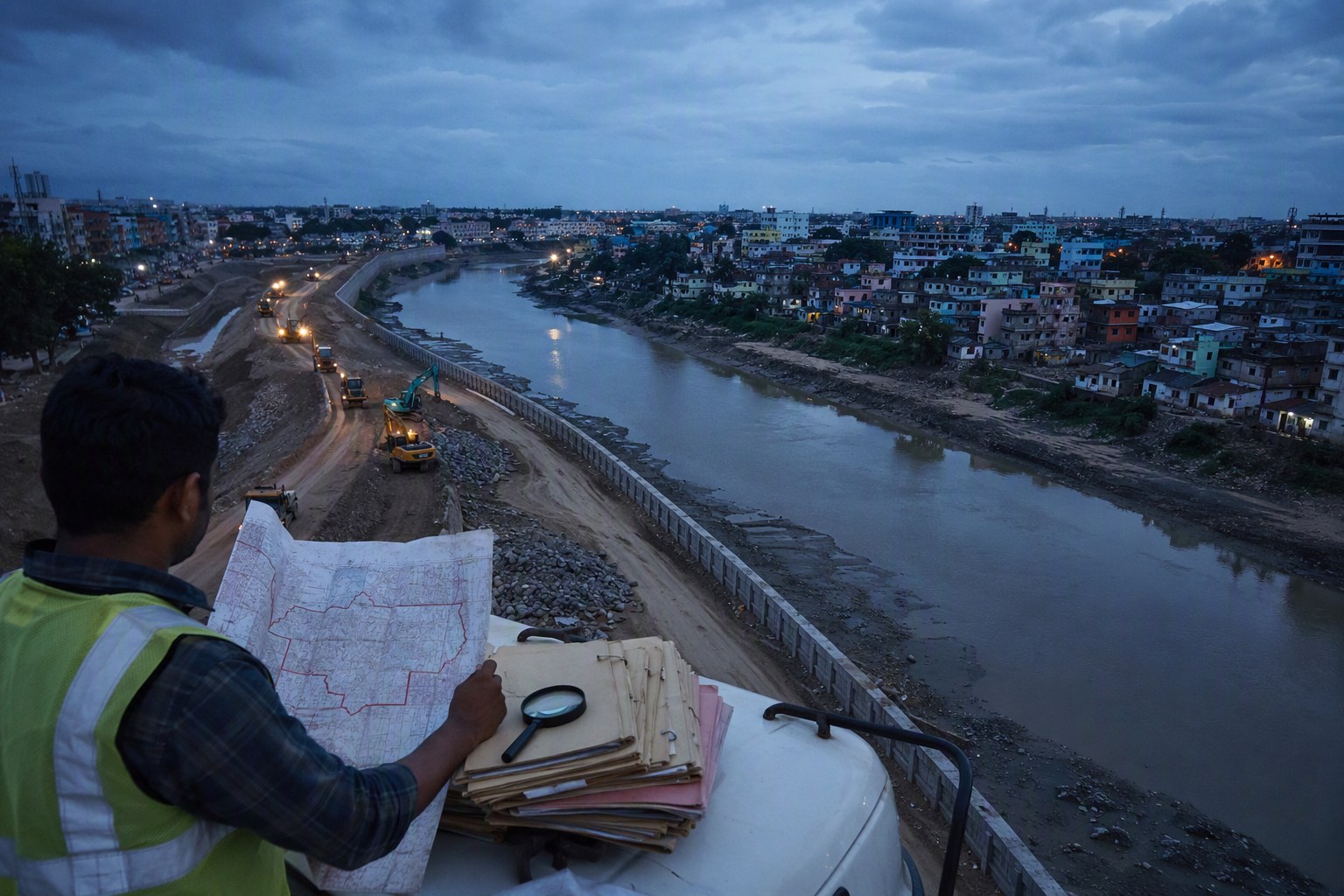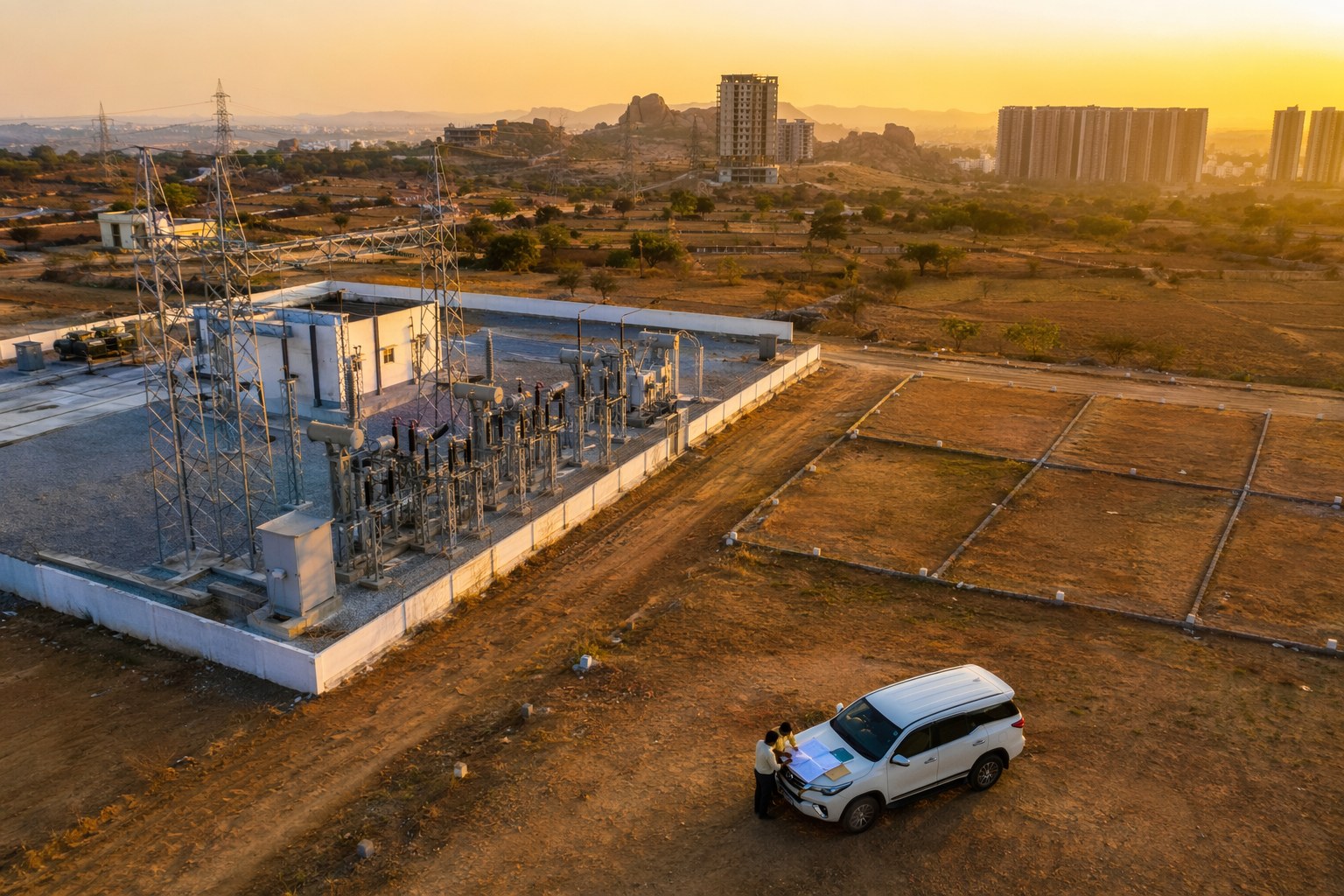



Hyderabad Sewage Network Upgrades are changing the way buyers should look at low-lying plots across the city’s growth corridors. The immediate story is not only about better civic infrastructure. For land buyers, it is about checking access levels, flood history, nala proximity, layout approvals, SRO records and Section 22-A status before paying token advance.
In our experience, sewage and drainage works can improve long-term liveability, but they can also expose weak plot choices. A site that looks fine in summer may behave very differently during heavy rain, especially in pockets of Serilingampally, Rajendranagar, Gandipet, Bachupally, Nizampet, Kompally, Peerzadiguda, Boduppal, Hayathnagar and around the expanding western and northern suburbs.
My view is simple: when drainage work reaches an area, buyers must not assume every plot nearby becomes safe. The file has to speak. The ground level has to support it. The access road has to drain properly.
Hyderabad Sewage Network Upgrades: Why low-lying plots need sharper checks
Sewage lines, storm-water drains and road-level works often bring attention to places that were earlier treated as peripheral or semi-developed. That attention can lift buyer interest. It can also bring old problems to the surface — blocked natural flow, raised neighbouring roads, unauthorised filling, plots carved out near nalas, and layouts where internal drains were never executed as per approval.
Hyderabad buyers usually ask one first question: “Will the area develop?” That question is fair, but for low-lying plots, the better first question is: “Where will the water go?” If the answer is unclear, pause the deal.
We’ve seen this pattern around localities such as Miyapur, Hafeezpet, Kondapur edges, Manikonda, Narsingi, Tellapur, Osman Nagar, Kollur, Mallampet, Dundigal side pockets, Uppal outskirts and LB Nagar fringe areas. Not every low-level site is risky. Some have proper formation levels, sanctioned drains and road access. But buyers must verify, not guess.
Before registration, check the survey number, village, mandal and SRO mapping. Use the Survey Number Finder to identify the land parcel correctly, then cross-check registration jurisdiction through Find Your SRO Office. A wrong village or SRO assumption can delay verification and sometimes hide a bigger title issue.
Hyderabad Sewage Network Upgrades and approval files: What buyers should ask
For low-lying plots, the approval file is not a formality. It is the first defence. Ask whether the layout is HMDA-approved, DTCP-approved, municipal-approved or only being sold on old gram panchayat papers. Ask for the layout copy, proceedings, L.P. number if available, road widths, open space marking, utility corridor details and any later regularisation documents.
If the seller says “drainage work is coming, so no issue,” do not treat that as proof. Civic work in the neighbourhood does not automatically validate a private layout. A sewage line passing nearby does not confirm that the plot has legal access, proper formation level or building permission eligibility.
For apartments or plotted projects marketed by developers, check project registration through the RERA Project Lookup. For independent plots, run basic land and title screening through the Property Verification Tool. If you are comparing the registration value with the ready reckoner or government market value, use the Market Value / Guideline Value Search.
Key ground checks before paying advance
- Plot level: Compare the plot with the road level, neighbouring plots and nearby drain points. A site below the road may need filling, retaining walls and careful plinth planning.
- Access road: Check whether the road is existing on ground, shown in the approval plan and usable in the monsoon. Road width matters for permissions too; verify it using Road Width Check.
- Nala and tank buffer: Look for nearby nalas, feeder channels, cheruvu boundaries and full tank level markings. Do not depend only on broker sketches.
- Flood history: Speak to residents, shopkeepers and watchmen. Local memory is often more useful than a polished brochure.
- Drainage connection: Confirm whether there is a sanctioned sewer connection possibility or only septic tank dependence.
- Land use: Check zoning before assuming residential permission. The Land Use Zone Finder is useful for this first-level check.
Section 22-A risk is separate from drainage risk
A low-lying plot can have clean title, and a high-level plot can still be legally blocked. Buyers should not mix physical risk with title risk. Both must be checked separately.
As per latest IGRS data available in our database, prohibited properties under Section 22-A stand at 3,076,153. That figure is a reminder of how large the prohibited property universe is in Telangana records. It does not mean your target plot is automatically restricted. It means you should check before the sale agreement, not after the banker or SRO raises a query.
Use the Section 22-A Prohibited Property Check before paying a major advance. Then pull the Encumbrance Certificate through Encumbrance Certificate Search and review mortgage, sale, gift, release or court-related entries with care. If the EC is long or confusing, the EC Analyzer can help you read the sequence better.
Locality lens: Where buyers should be extra alert
The issue is not limited to one belt of Hyderabad. Western suburbs have seen fast land conversion, raised roads and intense construction. Northern pockets around Kompally, Mallampet and Bachupally have many plotted pockets where road formation and drainage quality vary from colony to colony. Eastern belts near Peerzadiguda, Boduppal, Uppal and Hayathnagar have their own mix of older habitations, layouts and water-flow issues.
In Serilingampally mandal areas, a buyer may be tempted by location value near IT corridors. In Gandipet and Rajendranagar side pockets, scenic surroundings can distract from nala and lake buffer questions. In Medchal side growth pockets, the challenge is often layout-level infrastructure. In all these places, the same rule applies: do not buy only on future promise.
What to ask the seller or developer
| Buyer question | Why it matters |
|---|---|
| Is the plot level above the approach road? | Low plinth planning can create repeat waterlogging and extra construction cost. |
| Is the access road shown in the approved layout? | Physical road and legal road are not always the same. |
| Is there any nala, tank, buffer or government land nearby? | Buffer violations can affect permission, resale and bank funding. |
| Which SRO and village records apply? | Registration, EC, pahani and Dharani checks depend on correct jurisdiction. |
| Is the land in any prohibited list? | Section 22-A restrictions can block registration or create serious title risk. |
Cost checks after Hyderabad Sewage Network Upgrades
Once civic works improve in an area, sellers may quickly revise expectations. That does not mean every quote is justified. Compare the government market value, recent EC patterns if available, access quality, approval status and physical level. For registration cost planning, use the Stamp Duty Calculator. If there is an existing structure or partly built house on the land, the Building Value Calculator may help separate land value from construction value.
For villa plots and larger parcels, also check soil behaviour. Filled-up low land may look compact after levelling, but foundation planning can change once soil condition is tested. A first-level check through Soil Type Detector is useful, though final construction decisions should be based on professional soil testing.
My practical advice: visit the plot twice — once on a normal day and once after heavy rain. Take photos from the road, plot corner, nearest drain and lowest visible point. Ask neighbours where water stands. Then match that ground truth with documents.
Buyer takeaway
Hyderabad’s sewage and drainage upgrades are positive for the city. They can improve hygiene, reduce local stagnation and support denser urban growth. But for land buyers, the news should trigger stricter due diligence, not blind confidence.
A safe purchase is not just about the locality name. It is about survey number accuracy, SRO records, Dharani and pahani consistency where applicable, approval file strength, road access, land use, flood behaviour and Section 22-A status. If even one of these checks gives a weak answer, slow down. There will always be another plot. There may not be an easy exit from a bad one.
Frequently Asked Questions
Do Hyderabad sewage network upgrades make low-lying plots safer to buy?
Not automatically. Upgrades may improve civic infrastructure, but buyers must still check plot level, flood history, nala proximity, approval files, land use and title records before buying.
Which documents should I check for a low-lying plot in Hyderabad?
Check the sale deed chain, EC, approved layout, survey number, village and mandal records, Dharani or pahani details where relevant, SRO jurisdiction, land use and Section 22-A status.
Is a plot near a drain or nala always risky?
No, but it needs careful verification. Check buffer limits, approved layout markings, local flood history and whether the plot or access road falls in a natural water-flow path.
How can I verify if a Hyderabad plot is prohibited under Section 22-A?
You can run a Section 22-A check before agreement and also verify EC, SRO records and seller documents. Do this before paying a large advance.