One wrong survey number can spoil a Telangana plot buy even when the seller sounds genuine, the layout has a nice entrance arch, and the Encumbrance Certificate looks clean. As per latest IGRS data, Telangana has 30,3,076,153 prohibited properties listed under Section 22-A. That single figure should make every plot buyer pause before paying token money. In our experience, the biggest mistake is not buying in a bad location. It is buying the wrong land parcel on paper.
A clean EC tells you about registered transactions for the property details you searched. It does not magically confirm that the survey number itself is safe, correctly mapped, free from Section 22-A issues, or matching the land shown to you on ground.
This is especially true around Hyderabad’s growth belts — Mokila in Shankarpally mandal, Kokapet in Gandipet mandal, Gachibowli in Serilingampally mandal, Bachupally mandal, Tukkuguda in Maheshwaram mandal, Adibatla in Ibrahimpatnam mandal, and Kollur side near Ramachandrapuram mandal. In these places, buyers often see one plot, receive documents for another survey sub-division, and realise the mismatch only when the SRO raises an objection or a bank lawyer asks hard questions.
Why one survey number can derail a Telangana plot buy
A survey number is not a casual detail. It is the identity of the land parcel in revenue records. In Telangana, survey numbers connect your agreement, pahani, Dharani entry, village map, layout approval, EC, market value, and SRO registration record. If the number is wrong, the whole chain becomes weak.
For example, a seller may show you a plot near an existing road in a village near Shankarpally. The agreement mentions Survey No. 120/A. The passbook may show 120/AA. The layout plan may mention 120/Part. The EC search may be done on 120, without the sub-division. On paper, all of this looks close enough to a first-time buyer. To a registration officer, bank panel advocate, or revenue official, these are not small spelling mistakes. They can point to different pieces of land.
We have seen buyers treat the survey number like a formality, while spending more time negotiating borewell points, east-facing plot premium, and clubhouse promises. That is risky thinking. In Telangana, especially where agricultural land is converted into plotted layouts, the survey number is the starting point of title verification.
Before trusting any brochure or WhatsApp location pin, use the Survey Number Finder to identify the land reference, then cross-check the same number through the Section 22-A Prohibited Property Check. Only after that should you move to EC, SRO, and agreement drafting.
The 30,76,153 warning: prohibited properties and your Telangana plot buy
The figure of 30,3,076,153 prohibited properties under Section 22-A is not a small clerical list sitting in some corner. It is a practical warning for buyers. Section 22-A entries can include properties restricted from registration under government records. If your proposed plot falls in such a survey number, the SRO may refuse registration or ask for clarifications. Your token amount then becomes a negotiation headache.
Many buyers assume, “If the seller has a pattadar passbook, what is the problem?” That is not enough. Another common line is, “The neighbouring plot was registered last month.” That also is not enough. Prohibited status, sub-division mismatch, government land classification, assigned land history, endowment land concerns, waqf references, ceiling issues, and court orders can affect one part of a survey number while another part appears active in market conversations.
In fast-moving pockets like Kollur, Velimela, Mokila, Nandigama, Tukkuguda, Adibatla, Maheshwaram, Kandukur side, and Bachupally, the land story changes from village to village. A clean-looking layout board does not answer revenue questions. A sales executive cannot replace survey-level checking. I say this bluntly because most plot disputes start before the agreement, not after registration.
Why a clean EC is not enough for a Telangana plot buy
The Encumbrance Certificate is useful. It shows registered transactions, mortgages, releases, gifts, sales, and other registered movements for the details searched. You should definitely check it through the Encumbrance Certificate Search and review it carefully. But EC has limits.
An EC depends on the accuracy of the search input. If you search the wrong survey number, wrong village, wrong SRO, or incomplete sub-division, the result may look clean simply because you searched the wrong property. This is why a “nil EC” is not always good news. It may mean no encumbrance. It may also mean the record was searched in the wrong way.
Use the EC Analyzer to read patterns in the EC, but do not stop there. Match the EC with the parent document, link documents, pahani, passbook details, mutation trail, layout approval, and Section 22-A status. If the property is in an HMDA or DTCP layout, match the approved layout plan with the survey number and plot number. If it is a gram panchayat layout or older unapproved layout, be even more careful.
| Check | What buyers usually think | What it actually confirms |
|---|---|---|
| Clean EC | No problem with the plot | Only registered encumbrances for the searched details |
| Seller passbook | Seller owns the exact plot | Revenue record in seller name for a land extent, subject to further checks |
| Layout brochure | All plots are approved | Marketing material; must be matched with approval plan |
| Survey number match | Small document detail | Core identity of the land parcel |
| Section 22-A check | Needed only for doubtful lands | Needed before token payment in every serious plot deal |
Where survey number mistakes commonly happen around Hyderabad
Survey number errors usually happen in three situations. First, when a large agricultural land parcel is divided into multiple saleable plots. Second, when old documents use one survey reference and later revenue records use sub-divisions. Third, when brokers market a layout across village boundaries without clearly explaining which plots fall in which revenue village.
Take Kokapet and nearby areas in Gandipet mandal. A buyer may casually say “Kokapet plot”, but the actual revenue village, survey number, and SRO jurisdiction matter. In Gachibowli and surrounding Serilingampally areas, old land records, high-value apartments, and plotted parcels can sit very close to each other, but their legal treatment is different. In Mokila and Shankarpally belt, many deals involve conversion history and layout approvals. In Tukkuguda and Maheshwaram side, buyers must check whether the shown land matches the approved plan and road access.
Even the SRO can change based on the village. That is why you should verify jurisdiction using the Find Your SRO Office before assuming where registration will happen. A wrong SRO assumption may not kill the deal, but it reveals that the paperwork has not been handled seriously.
Before token money in a Telangana plot buy: the exact survey number checklist
Token money is where buyers lose control. Before token, the buyer has bargaining power. After token, the seller and broker start saying, “Sir, we already blocked it for you.” That pressure is avoidable. Do these checks before paying even a small advance.
1. Ask for the full survey number, not a shortened version
Do not accept “Survey No. 45 part” as a final answer. Ask for the exact survey number, sub-division, village name, mandal, district, plot number, layout name, extent, and boundaries. In Telangana documentation, small suffixes matter. 45/A and 45/AA may not mean the same thing.
2. Match the survey number with pahani and Dharani entries
For agricultural-origin land, check pahani details and revenue entries. See whether the seller name, extent, classification, and survey number align. If the land was converted for non-agricultural use, ask for conversion-related documents and layout approval papers.
3. Run a Section 22-A prohibited property check
Given the 30,3,076,153 prohibited properties figure in the IGRS data, skipping this check is not sensible. Use the Section 22-A Prohibited Property Check at the survey number level. If any doubt appears, do not rely on verbal assurance. Ask for written clarification and get an advocate to review it.
4. Check EC using the exact property details
Search the EC with the correct SRO, village, survey number, document numbers, and seller details wherever available. If the seller gives only a recent EC, ask for link documents and older transaction history. A short EC window may hide older title issues.
5. Verify market value and ready reckoner before drafting
Registration cost depends on the applicable government market value and property details. I am not quoting a generic rupee rate here because Telangana values vary by village, road, land use, and property type. Check the current value through the Market Value / Guideline Value Search and estimate registration charges using the Stamp Duty Calculator. This also helps you spot undervaluation games.
6. Confirm land use and access
A plot may have a correct survey number but still face trouble if the land use, road access, or layout approval is weak. For growth corridors near ORR exits, buyers should check road width, zoning, and development restrictions. Use the Land Use Zone Finder and Road Width Check when the plot is being bought for construction.
Red flags buyers should not ignore
Some warning signs are very common in Telangana plot deals. If you hear any of these lines, slow down.
- “Survey number will be given after token.” No. It must be given before token.
- “EC is clean, so no need for other checks.” Wrong approach.
- “All plots in this venture have same survey number.” Maybe, but verify the exact approved plan.
- “Registration happened for nearby plots, yours also will happen.” Nearby is not legal proof.
- “This is patta land, no issue.” Patta is only one part of the title story.
- “Government value is low, we can register for less.” Check ready reckoner and tax implications properly.
- “Approval copy is in office, we will share later.” Do not pay first.
In our experience, genuine sellers do not hesitate to share basic land identity documents. If a seller avoids survey number, village, mandal, or SRO details, treat that as a serious red flag.
How survey number mismatch affects banks and future resale
Some buyers think, “Even if there is a small mismatch, I will manage during registration.” That attitude can hurt later. Banks are stricter than brokers. When you apply for a loan, the bank’s legal team checks title flow, survey number, approval, EC, and boundaries. If the numbers do not align, the bank may reject or ask for clarifications.
Future resale is another issue. Today’s buyer may be relaxed, but tomorrow’s buyer may be sharper. If your document carries a confusing survey reference, you may have to spend time correcting records, obtaining affidavits, or convincing the next buyer’s advocate. In high-demand localities like Kokapet, Tellapur, Narsingi, Gachibowli, and Kollur, clean documentation commands confidence. In emerging areas like Mokila, Nandigama, Tukkuguda, and Adibatla, clear survey identity is even more valuable because land is still transitioning from agricultural to urban use in many pockets.
If you are buying in a RERA-registered project, check the project record through the RERA Project Lookup. RERA details do not replace title verification, but they help confirm project-level disclosures. For independent plots, use the Property Verification Tool to bring multiple checks into one workflow.
Documents to collect before signing a plot agreement
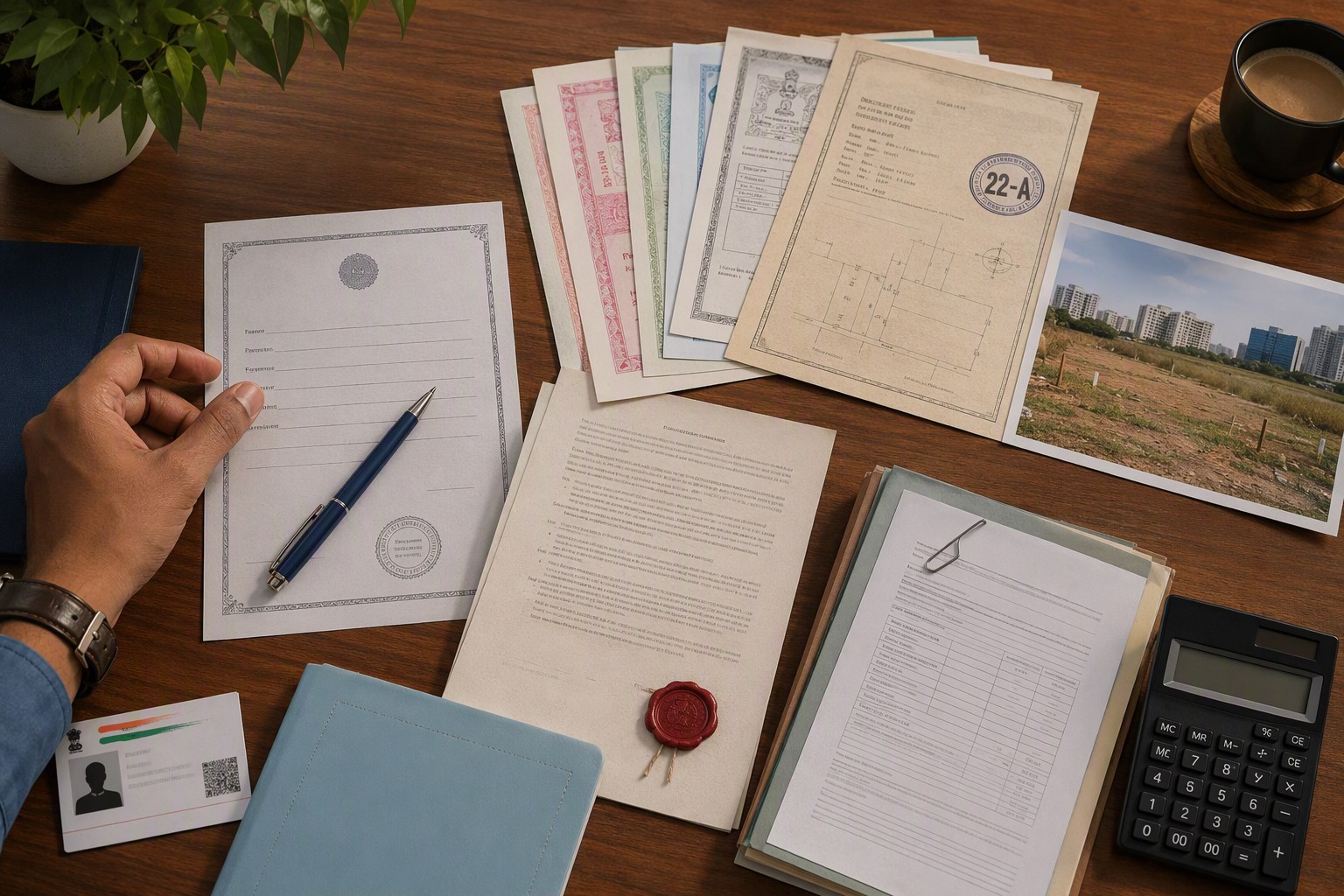
Do not sign an agreement based only on a site visit and Aadhaar copy of the seller. Ask for a proper document set. The exact list can change based on the property type, but for a Telangana plot, these are the usual starting documents:
- Sale deed or parent deed of the seller
- Link documents showing title flow
- Latest EC searched with correct survey number and SRO
- Pattadar passbook details, where applicable
- Pahani or revenue record extracts, where applicable
- Mutation details, where applicable
- Land conversion papers, if agricultural land became non-agricultural
- HMDA, DTCP, municipality, or gram panchayat layout approval papers, as applicable
- Approved layout plan with plot number and survey number
- Section 22-A prohibited property check result
- Tax receipts or local body records, where applicable
- Seller identity and legal heir documents, if title came through inheritance
Once the documents are collected, do not read them in isolation. Match every document against the same survey number and extent. If the agreement says one extent, the layout says another, and the pahani shows a third number, pause. That is not a “minor adjustment”.
Practical example: why “same village” is not the same land
Suppose a buyer is shown a plot in a venture near Mokila. The broker says the land is in Shankarpally mandal and gives a location pin. The buyer likes the approach road and pays token. Later, while preparing the sale agreement, the documents show a different survey sub-division from the one shown in the layout plan. The EC is clean because it was searched only against the document number supplied by the seller. Section 22-A check was never done at the exact sub-division level.
Now the buyer has three problems. First, the land identity is unclear. Second, the token money is stuck. Third, if the buyer proceeds, resale and bank funding may suffer. This is not rare. It happens because buyers treat the site visit as proof. In land buying, the ground and the record must meet each other.
My field rule for any Telangana plot buy
My rule is simple: no exact survey number, no token. No Section 22-A check, no token. No matching layout plan, no token. A seller who genuinely owns clean land can provide these details. A serious developer will have the records ready. If the answer is always “later”, your answer should be “after verification”.
Hyderabad’s land market rewards speed, but it punishes careless paperwork. Whether you are buying near Kokapet, Tellapur, Kollur, Mokila, Bachupally, Adibatla, Tukkuguda, or Maheshwaram, the discipline is the same. Verify the survey number first. Then check prohibited status. Then read the EC. Then check ready reckoner value, SRO, layout approval, and land use. Only after that should money move.
A plot is not just a location pin. It is a survey number sitting inside a village record, under a mandal, linked to an SRO, carrying a title history. Get that identity right, and half your risk reduces. Get it wrong, and even a beautiful plot can become a long argument.
Frequently Asked Questions
Is a clean EC enough before buying a Telangana plot?
No. A clean EC is useful, but it only reflects registered transactions for the property details searched. You must also verify the exact survey number, Section 22-A status, layout approval, pahani or revenue records, SRO jurisdiction, and seller title documents.
When should I check the survey number in a plot deal?
Check it before paying token money. Ask for the full survey number, sub-division, village, mandal, district, plot number, and layout plan. If the seller refuses to share these details before token, treat it as a red flag.
What does Section 22-A mean for property buyers in Telangana?
Section 22-A refers to properties restricted from registration under government records. As per latest IGRS data, Telangana has 30,3,076,153 prohibited properties listed. If your plot’s survey number falls under such a restriction, registration may be refused or delayed.
Can two plots in the same layout have different survey number issues?
Yes. Large layouts may cover multiple survey numbers or sub-divisions. One portion may have clean records while another may have title, approval, or prohibited property concerns. Always verify your exact plot against the approved layout and survey number.
Which tools should I use before buying a plot in Hyderabad outskirts?
Start with the Survey Number Finder, Section 22-A Prohibited Property Check, EC Search, Market Value / Guideline Value Search, and Find Your SRO Office. For construction plans, also check land use and road width.