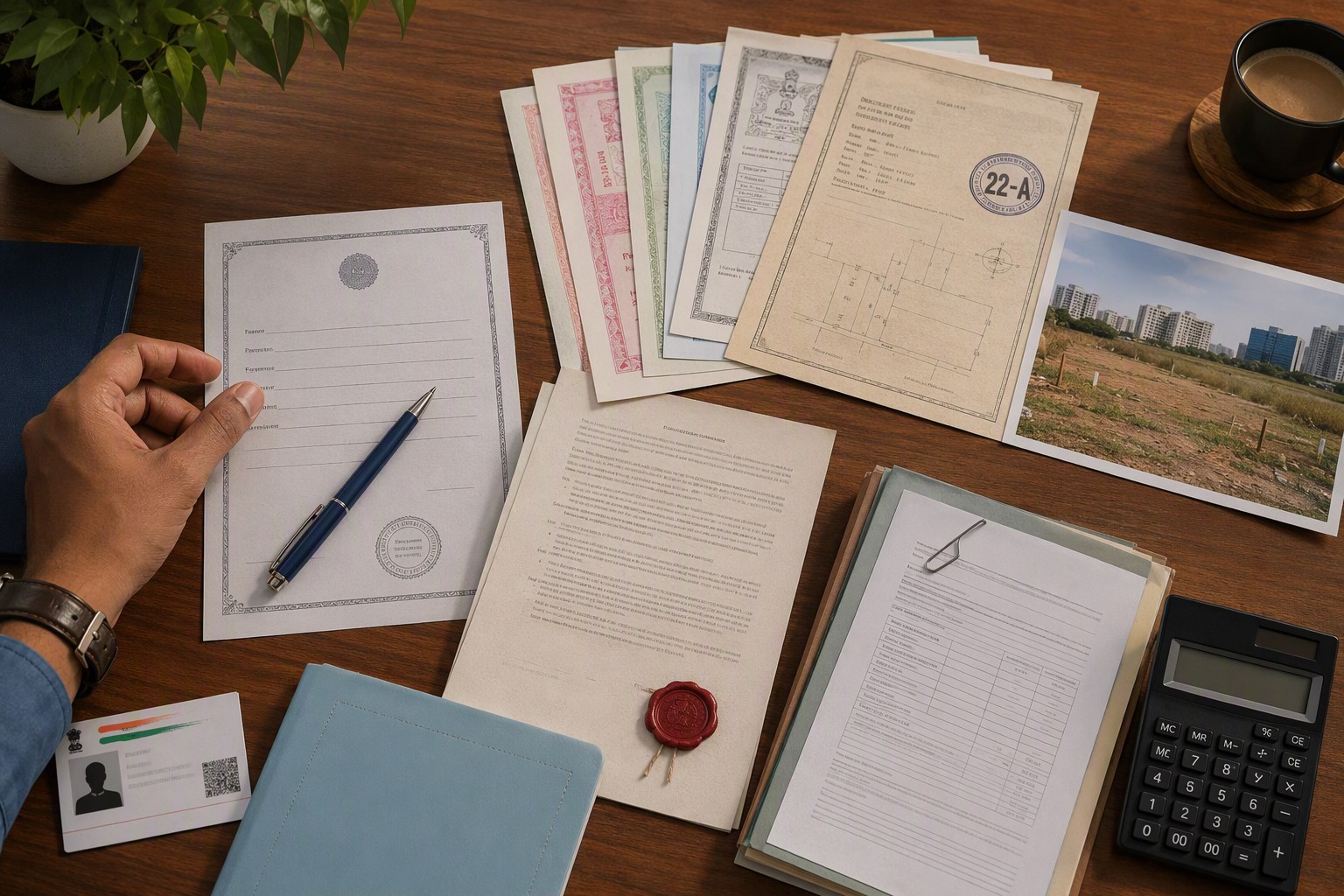
The Family Land Pitch sounds comforting. A seller says, “This is our ancestral land, our family has held it for generations, no bank loan, no builder issue, clean title.” Many buyers in Hyderabad’s growth corridors hear this line and relax too early. In our experience, that is exactly when due diligence must become stricter, not lighter.
A typical call we get starts like this: a buyer has seen land near Mokila in Shankarpally mandal, or around Tukkuguda in Maheshwaram mandal, or a plotted piece near Shamirpet. The seller is polite. The family elders are present. The price is positioned as a friendly deal because the property is “family land”. Token advance is requested quickly, usually before the buyer has checked the pahani, Dharani records, Encumbrance Certificate, heirs, partition history and Section 22-A status.
My straight view: ancestral land can be excellent, but only when the chain of title is boring. If the story is emotional and the documents are thin, slow down.
Telangana buyers must take Section 22-A risk seriously. Our database context shows 3,076,153 prohibited property entries. That single number should make every buyer cautious before paying token on land that is being sold through a family narrative rather than a clean document trail.
The Family Land Pitch can hide heir disputes
When a seller says “ancestral land”, the first question is not about price. The first question is: who exactly inherited it, and who has the legal right to sell it today?
In areas like Gandipet, Serilingampally, Moinabad, Shankarpally, Hayathnagar, Ibrahimpatnam, Maheshwaram and Medchal, land values have moved sharply over the years. Families that ignored old partitions suddenly become active when sale discussions begin. A cousin working abroad may object. A married daughter may not have signed. A legal heir of a deceased pattadar may be missing from the sale deed. A minor’s share may be involved. Sometimes, one branch of the family sells based on revenue records, while another branch holds an old partition deed or court order.
Do not treat mutation as title. A name in Dharani, pahani or revenue record is useful, but it does not automatically prove marketable ownership. Revenue entries support possession and administration. Title comes from valid registered documents, inheritance, partition, court orders and legally recognised succession.
What to ask when the seller says ancestral land
- Who was the original owner from whom the present family claims title?
- Has that original owner passed away? If yes, collect the death certificate and legal heir proof.
- Was there a registered partition deed, family settlement deed or release deed?
- Did all heirs sign the previous transfer or current proposed sale deed?
- Are any heirs minors, deceased, abroad, separated from the family or not traceable?
- Is there any pending civil dispute, injunction, partition suit or revenue appeal?
- Does the extent in documents match the extent on ground and in Dharani?
We have seen buyers get impressed by a neat family meeting at the site. That is not due diligence. A meeting is only a conversation. Your real verification starts with names, dates, survey numbers, SRO records and the flow of ownership.
The Family Land Pitch checklist before token advance
Before paying token advance for any family land, create a document folder and verify it point by point. Do not rely only on photocopies sent on WhatsApp. Ask for readable scans, certified copies where needed, and original documents for inspection before agreement.
| Verification item | What to check | Why it matters |
|---|---|---|
| Heirship | Death certificate, legal heir details, family tree, succession documents | Confirms who must sign the sale deed |
| Partition | Registered partition deed, family settlement, release deeds | Shows whether the selling branch has exclusive rights |
| EC history | Registered sale deeds, mortgages, agreements, court attachments if reflected | Shows past transactions and encumbrances |
| Dharani and pahani | Pattadar name, khata details, land nature, extent, classification | Helps match revenue records with title documents |
| Section 22-A | Prohibited property status for survey number and village | Can block registration or expose serious title risk |
| SRO mapping | Correct Sub-Registrar Office for village and property | Prevents wrong-office assumptions during document search |
| Physical possession | Boundaries, access road, neighbouring claims, cultivation or fencing | Ground reality must match paper title |
For a quick starting point, buyers can use the Survey Number Finder to cross-check survey details, the Encumbrance Certificate Search for EC history, and the Section 22-A Prohibited Property Check before even discussing advance payment. These tools do not replace a lawyer, but they help you avoid blind trust.
Verify heirs before you verify the rate
Many buyers jump straight to pricing. “Is this rate good for Nandigama?” “Is this cheap for Kandukur side?” “Will this appreciate if the road improves?” These are valid questions, but not the first ones.
In family land, the rate is secondary until the seller’s right to sell is clear. A below-market quote may simply mean there is a hidden issue: unsigned heirs, old mortgage, boundary dispute, 22-A entry, assigned land background, missing link document or an unregistered oral partition.
Ask the seller to give a written family tree. It should start from the person whose name appears in the earliest available title document and move branch by branch to the present sellers. Then match that tree with death certificates, legal heir documents, Aadhaar or identity proofs, and registered documents. If any heir has died, their heirs may also have rights. If any heir released rights, the release deed must be registered where registration is legally required.
Be especially careful where the seller says, “All family members agreed orally.” Oral comfort is not enough for land purchase. A sale deed signed by the wrong people can pull you into years of litigation. If one rightful heir later objects, your possession, resale and bank funding may all suffer.
EC history: do not read only the latest entry
An Encumbrance Certificate is not just a formality for bank loan buyers. Even cash buyers must study it. The EC tells you what has been registered against that property in the SRO records for the period searched. Sale deeds, gift deeds, mortgage deeds, release deeds, partition deeds and some court-related entries may appear depending on registration.
But an EC has limits. It may not show every risk. Unregistered family arrangements, pending suits not registered as encumbrances, possession disputes, revenue objections and certain government restrictions may not be visible in a simple EC extract. That is why EC verification should sit alongside document review, Dharani check and ground inspection.
Use the EC Analyzer after collecting EC details. Look for gaps in the ownership chain. If a person appears as seller without a clear document showing how they became owner, raise a red flag. If a mortgage appears and no release is visible, do not accept verbal assurance that it was cleared. Ask for the registered release or bank closure proof, and where relevant, run a CERSAI Charge Check.
In Hyderabad outskirts, we often see old agricultural land moving into plotted layouts. In that shift, one survey number may have multiple transactions: agricultural sale, partition, development agreement, layout sale, gift deed to local body, and later individual plot sale. If the seller is giving you only the latest document, you are seeing the last page of the story, not the full book.
Section 22-A risk in family land purchases
Section 22-A is where many casual buyers get a shock at the SRO. Certain properties can be prohibited from registration due to government classification, assigned land concerns, endowment issues, wakf claims, court orders, ceiling matters or other restrictions. The exact reason must be checked property by property.
Our database context has 3,076,153 prohibited property entries. That does not mean every ancestral land parcel is risky. It means buyers cannot treat 22-A as a rare clerical issue. Before token, check the survey number, village, mandal and extent. If the land falls in or near a prohibited category, take legal advice before moving even one rupee.
Common buyer mistake: checking only the plot number. For agricultural or converted land, the deeper reference is usually the survey number, subdivision, village and mandal. A plot number created in a private layout does not erase the parent survey history.
How to approach a 22-A warning
- Do not accept “it will be cleared after agreement” as a safe answer.
- Ask the seller for the exact government reason behind the prohibition, if any.
- Check whether the restriction applies to the full survey number or only part extent.
- Verify at the correct SRO and revenue office where needed.
- Do not pay major advance until a lawyer reviews the prohibition status and title chain.
You can identify the relevant office using Find Your SRO Office and cross-check village jurisdiction through the SRO Village Directory. For land parcels, also run the Property Verification Tool before finalising the agreement draft.
Dharani, pahani and ground reality must match
For Telangana land, Dharani and pahani details are not optional checks. Look at the pattadar name, land nature, extent, survey number, classification and transaction history. If the document says dry agricultural land but the seller is selling it as villa plot, ask for conversion, layout and permission documents. If the land is inside a gram panchayat layout, HMDA layout, DTCP layout or an unapproved plotting scheme, the approvals will decide what you can safely build or resell.
In mandals like Shankarpally, Moinabad, Chevella and Maheshwaram, buyers often purchase for long-term appreciation. That makes clean title even more vital. A property held for years with a defect is not an investment; it is a locked file.
Check physical access also. A family may own land, but the access road may pass through a relative’s land or an informal pathway. During site visits, speak to neighbouring landholders, not just the broker. Ask where the boundaries are. Look for stones, fencing, cultivation, borewell use and any sign of possession by someone other than the seller.
Ready reckoner and market value: check after title comfort
Once the title chain looks clean, then check value. Compare the seller’s quote with the official market value or ready reckoner value as per latest IGRS data. Use the Market Value / Guideline Value Search for a base reference. For registration cost planning, use the Stamp Duty Calculator.
I would not judge a family land deal only by whether the price is below the current local asking rate. In areas like Kollur, Tellapur, Mokila, Adibatla, Ghatkesar and Shamirpet, quoted rates can vary widely based on road width, land use, approvals, frontage, litigation history and seller urgency. A slightly higher priced clean property is often better than a cheap parcel where heirs are fighting quietly.
If you are buying a plot carved out of ancestral land, verify land use and building potential too. The Land Use Zone Finder, Road Width Check and FSI/FAR Calculator can help you understand whether your intended use is practical. Title is the first gate. Planning feasibility is the next.
Agreement drafting for family land
A weak agreement can damage even a decent deal. When land is inherited, your agreement of sale should name all necessary sellers and consenting parties. If any seller is represented through a General Power of Attorney, get that GPA checked carefully. Confirm whether it is valid, registered where required, and still legally effective. If the principal has died, the GPA may not help.
Add clear conditions before payment milestones. The agreement should say that the sale depends on satisfactory title verification, EC review, 22-A clearance, revenue record match, possession confirmation and production of original documents. Do not allow vague lines like “buyer satisfied with title” unless you are truly satisfied.
Use the Legal Document Generator only as a drafting support tool, not as a substitute for legal review in a complex ancestral land transaction. Family land needs customised clauses because the risk comes from people as much as paper.
Red flags we do not ignore
- Seller refuses to share link documents and says “everything is in Dharani”.
- Only one family member negotiates, but documents show multiple heirs.
- Land is sold as plotted property without proper layout papers.
- Survey number extent differs across sale deed, pahani and ground measurement.
- EC shows mortgage, but release deed is missing.
- Seller pushes token before 22-A check.
- Original documents are said to be “with relatives” or “lost long back”.
- Boundary holders disagree during site visit.
- There is an old court case, but the seller says it is “almost over”.
My opinion is simple: pressure is a due diligence signal. If the title is clean, a genuine seller should allow reasonable verification. If the seller becomes irritated when you ask about heirs, partition and EC, take that behaviour seriously.
Final buyer position on The Family Land Pitch
The Family Land Pitch should be treated as a starting statement, not proof. In Telangana, especially around Hyderabad’s expanding mandals, ancestral land can carry strong value. It can also carry old family cracks, revenue complications and registration blocks that only appear when you check properly.
Before paying token, verify heirs, partition documents, EC history, Dharani and pahani records, SRO jurisdiction, physical possession and Section 22-A status. If all these match, then discuss rate, stamp duty, registration planning and development potential. If they do not match, do not let emotion or urgency push you into a bad purchase.
We've seen careful buyers walk away from attractive deals and later thank themselves. Land does not become safe because a family owned it for long. It becomes safe when every rightful owner, every document and every government record supports the sale.
Frequently Asked Questions
Is ancestral land safer than builder land in Telangana?
Not automatically. Ancestral land may have clean title, but it can also involve missing heirs, oral partitions, unsigned release deeds and old revenue issues. Verify the full title chain before paying advance.
What should I verify first in a family land deal?
Start with heirs and ownership rights. Check the family tree, death certificates, legal heir proof, partition deeds, release deeds, EC history, Dharani records and Section 22-A status.
Does Dharani name prove ownership?
Dharani records are valuable, but they are not the only proof of title. Match Dharani and pahani details with registered documents, inheritance records, partition papers and ground possession.
Why is Section 22-A check needed before token advance?
If a property is prohibited under Section 22-A, registration may be blocked or legally risky. Since our database context has 3,076,153 prohibited property entries, buyers should check this before committing money.
Can I buy if one heir is abroad?
Yes, but only with proper legal documentation. The absent heir may need to sign directly or through a valid, legally reviewed power of attorney. Do not rely on oral family consent.