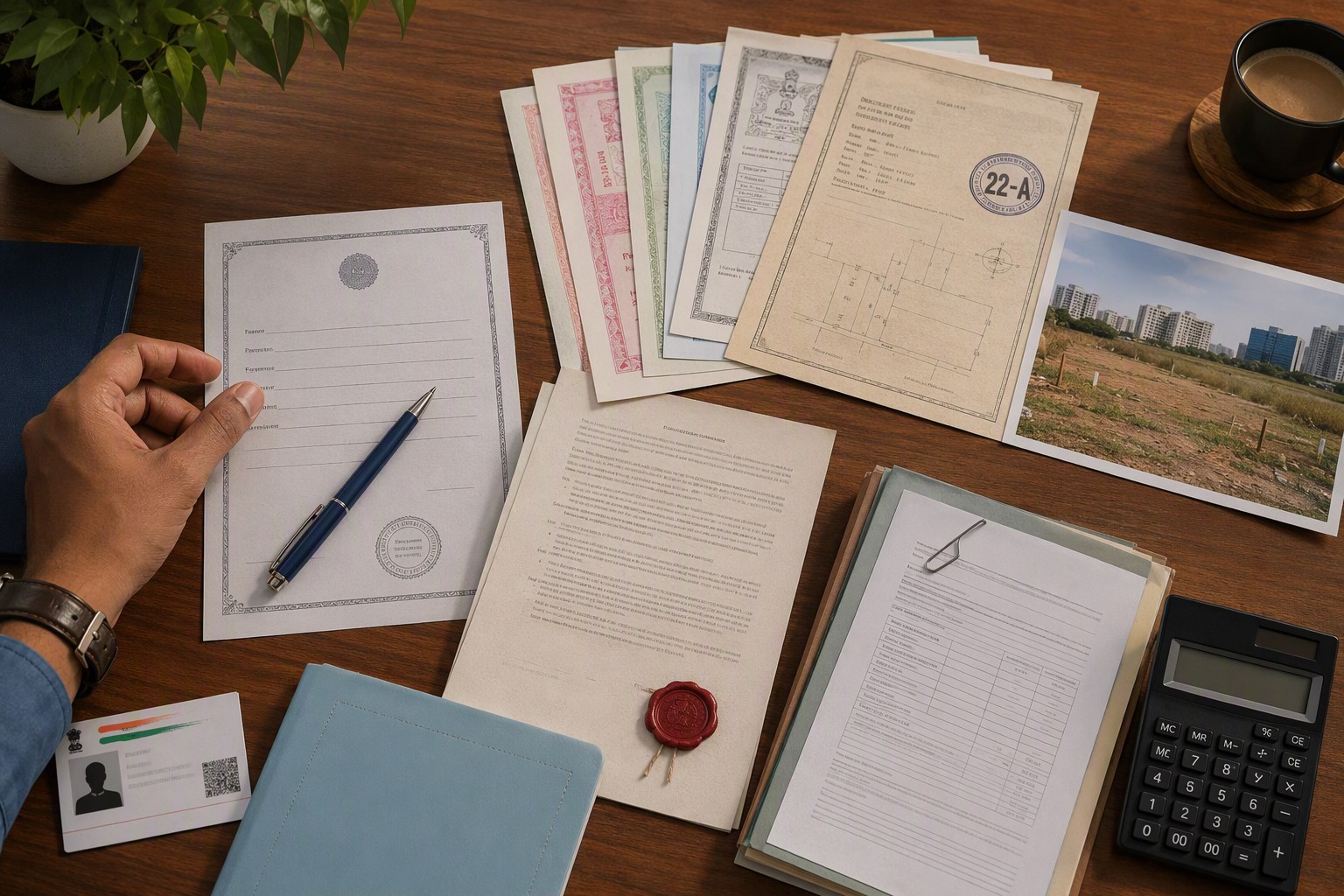
Can Mutation Alone Prove Land Ownership in Telangana? No. Mutation by itself cannot prove full ownership. It only shows that the revenue department has updated its records for tax and land administration purposes. For a buyer in Hyderabad, Rangareddy, Medchal-Malkajgiri, Sangareddy or Yadadri-Bhuvanagiri, treating mutation as final title proof is risky. Before paying token advance, check the registered title deed, parent documents, Encumbrance Certificate, pahani/ROR, Dharani status, Section 22-A prohibition, SRO records and, where relevant, layout or RERA approvals.
We have seen this confusion many times in land deals around Kokapet, Narsingi, Tellapur, Mokila, Tukkuguda, Kollur, Shankarpally, Maheshwaram and Patancheru. A seller opens Dharani, shows his name in revenue records, and says, “See, land is on my name.” That is a good starting point. It is not the finishing point.
Can Mutation Alone Prove Land Ownership in Telangana? Short answer
Mutation is a revenue entry. Ownership is a legal title issue. These two are connected, but they are not the same.
Our view: Mutation supports possession and revenue recognition, but it does not cure a bad sale deed, missing parent document, family dispute, court attachment, government land issue or Section 22-A prohibition.
In Telangana, mutation usually means the new pattadar or claimant’s name has been entered in revenue records after a transaction, inheritance, partition, gift, court order or other recognised process. It helps in land revenue records, passbook updates and administrative recognition. But if the underlying document is defective, mutation will not magically make the title clean.
Think of it like this: registration records a transaction, mutation updates revenue records, and title depends on the strength of the entire chain of documents. A buyer should not mix these three.
Why Can Mutation Alone Prove Land Ownership in Telangana? is the wrong question
The better question is: “What documents together show that the seller has a safe, marketable and transferable title?”
In land purchases, especially in fast-moving belts like Gandipet mandal, Shankarpally mandal, Maheshwaram mandal, Abdullapurmet mandal, Shamshabad mandal, Keesara mandal and Medchal mandal, buyers often rush after seeing a good location and a confident seller. That is when mistakes happen. A name in Dharani or revenue records is only one layer.
For example, a seller may have mutation in his name, but the land may still have one of these issues:
- Earlier sale deed not properly registered
- Missing link document in the title chain
- Family settlement dispute among legal heirs
- Minor’s share not handled legally
- Land falling under Section 22-A prohibited category
- Assigned land, ceiling land, wakf claim, endowment claim or government claim
- Pending civil suit or injunction
- Mortgage or bank charge not disclosed
- Layout approval problem
- Mismatch between survey number, extent and physical boundaries
This is why we tell buyers: never pay token advance just because the seller has a mutation entry or pattadar passbook.
What mutation actually means in Telangana land records
Mutation is the process of updating the revenue record after a change in interest. In Telangana, this is closely linked with Dharani for agricultural lands. In older discussions, people also refer to pahani, adangal, ROR-1B, passbook and pattadar details. The words change depending on the document and period, but the core idea is the same: the government revenue record is being updated.
For agricultural lands in villages around Hyderabad, such as Mokila in Shankarpally mandal, Velimela and Kollur in Ramachandrapuram/nearby revenue areas, Tukkuguda in Maheshwaram belt, Adibatla in Ibrahimpatnam side, and Shamirpet villages in Medchal-Malkajgiri, mutation is often the first thing buyers ask for. That is fair. But buyers must ask the next questions also.
| Record | What it indicates | Can it alone prove ownership? |
|---|---|---|
| Mutation entry | Revenue department has updated the name | No |
| Pahani / Adangal | Cultivation, possession and land particulars as recorded | No |
| Registered sale deed | Recorded transfer document at SRO | Strong evidence, but chain must be checked |
| Encumbrance Certificate | Registered transactions and encumbrances for selected period | No, but very useful |
| Section 22-A check | Whether property is prohibited from registration | No, but critical before payment |
| Court order or decree | Legal decision affecting rights | Depends on facts and finality |
What a buyer should verify before token advance
Token advance is where many Hyderabad buyers lose bargaining power. Once money is paid, the seller may push for quick agreement, quick registration and “small-small issues later”. Please don’t accept that line blindly. Before token, do a minimum title hygiene check.
1. Registered title deed and parent documents
Start with the seller’s registered deed. Then go backwards. Who sold to him? Who sold to that person? Was it a sale, gift, partition, release, settlement or inheritance? If the seller acquired the land through inheritance, verify legal heirship and whether all heirs have signed where required.
In our experience, this is where many disputes hide. A person may have mutation in his name after the father’s death, but siblings may still dispute shares. A buyer must check whether the seller alone can sell.
2. Encumbrance Certificate from the right SRO
The Encumbrance Certificate, or EC, shows registered transactions for the period searched. Use the correct SRO jurisdiction. For example, a property near Narsingi, Kokapet or Gandipet will not be checked in the same way as a plot near Uppal, LB Nagar, Hayathnagar or Medchal. If you are unsure of the office, use Find Your SRO Office.
You can also start with Encumbrance Certificate Search and review the entries carefully. If there is a mortgage, sale agreement, court attachment, release deed or rectification deed, don’t ignore it.
3. Section 22-A prohibited property check
This is one of the biggest red flags in Telangana. Section 22-A covers properties that are prohibited from registration for reasons such as government interest, assigned land, endowment, wakf or other restrictions. Our database context includes 3,076,153 prohibited property records under Section 22-A. That number itself tells you why this check cannot be skipped.
Before paying token, run a Section 22-A Prohibited Property Check. If the land is listed, do not assume “we can manage at registration”. A prohibited property issue can stop the transaction at the SRO level and may also lead to long legal trouble.
4. Survey number, extent and boundaries
Survey number mismatch is common in peri-urban belts. A seller may show one piece of land physically and quote another survey number in papers. This is seen in land parcels near Mokila, Kondakal, Shankarpally, Moinabad, Chevella, Kandukur, Maheshwaram and Abdullapurmet side.
Check survey number, sub-division number, extent, boundaries and village name. Use Survey Number Finder for an initial lookup, then match it with revenue records and site measurements. If the land is one acre on paper but physical access and fencing show something else, pause the deal.
5. Dharani and pahani details
Dharani details are useful for agricultural land checks. Look at pattadar name, khata number, survey number, extent, nature of land and any restrictions shown. Pahani or adangal entries help understand possession and cultivation history. But again, these are support documents, not final title proof.
6. Guideline value and stamp duty
Check the government guideline value before negotiation. In Hyderabad’s growth corridors, market asking prices and ready reckoner values can be far apart. For stamp duty planning, use Market Value / Guideline Value Search and Stamp Duty Calculator. This helps you understand registration cost before committing funds.
7. Land use and layout approvals
Agricultural land, residential zone, conservation zone, industrial zone and bio-conservation belt are not the same. Around Osman Sagar and Himayat Sagar influence areas, Chevella side, Moinabad belt, Shankarpally villages and Shamshabad surroundings, land use checks are not optional. Use Land Use Zone Finder as an initial screen.
For plotted layouts, check whether the layout is approved by the right authority. HMDA, DTCP, gram panchayat legacy approvals and unauthorised layouts all carry different risk levels. If the seller says “regularisation will come later”, price the risk properly or walk away.
8. RERA for apartments and gated community villas
For flats, villas and plotted development projects that fall under RERA, verify project registration. Mutation of the underlying land in the developer’s name does not tell you whether the project has required approvals. Use RERA Project Lookup for a quick project-level check.
9. Bank loan and CERSAI charge
A property can have a bank mortgage even if the seller looks genuine. Ask for loan closure documents, release deed where applicable, and bank NOC. For a starting point, use CERSAI Charge Check. Do not rely only on verbal statements like “loan is almost closed”.
10. Physical inspection and access road
Paper title may look fine, but if access is through another person’s land, the plot may be difficult to use or resell. Check road width, approach road, nala, lake buffer, high-tension line and boundary stones. In areas like Tellapur, Kollur, Bachupally, Kompally, Adibatla and Tukkuguda, road widening and master plan alignments can affect future use.
Mutation versus registration: what carries more weight?
Registration and mutation serve different purposes. A registered sale deed records the transfer between parties. Mutation updates the revenue department about that change. If there is a conflict, courts usually examine title documents, possession, conduct of parties, revenue records and other evidence together.
A clean registered deed without mutation may still require mutation to update revenue records. A mutation entry without a valid registered deed may not be enough to prove ownership in a sale transaction. That is the practical position buyers should understand.
| Point | Registration | Mutation |
|---|---|---|
| Where it is recorded | SRO records | Revenue records / Dharani |
| Main purpose | Records transfer document | Updates revenue name |
| Used for | Title chain, transaction proof, EC entries | Revenue administration, pattadar details |
| Buyer risk if ignored | High | High, especially for agricultural lands |
| Enough alone? | No, chain and restrictions still matter | No |
Can Mutation Alone Prove Land Ownership in Telangana? Common buyer traps
Here are the traps we see in Telangana property due diligence.
Trap 1: “Dharani name is there, so no problem”
Dharani name is helpful, but it does not answer every question. It may not reveal old family disputes, private agreements, unregistered arrangements, physical boundary conflicts or pending civil cases.
Trap 2: “EC is nil, so title is clean”
A nil EC only means no registered transaction or encumbrance appeared for the searched period and details. It does not prove possession, identity, land use, government claim or family consent. Wrong survey number or wrong SRO search can also mislead buyers.
Trap 3: “Agreement of sale is enough for token”
Agreement terms matter. If you pay token before due diligence, include a refund clause if title is defective, property is prohibited, approvals are missing or loan charges are found. Use proper drafting instead of a casual WhatsApp receipt. You can create a first draft with Legal Document Generator, then have it reviewed by your lawyer.
Trap 4: “All nearby lands are selling, so this one is safe”
One survey number may be clean; the next may be assigned land or affected by a road, lake buffer, government claim or court stay. Local hype is not a title document. We have seen buyers in growth pockets pay advance because friends bought nearby. That is not due diligence.
Trap 5: “Seller is politically connected, no need to worry”
Connections do not remove title defects. At registration, resale, bank loan or development stage, documents will be checked. If the title is weak, the problem will come back.
Local examples: how mutation confusion plays out around Hyderabad
In Kokapet and Narsingi, many buyers focus on location premium and ignore old village records. These areas fall in a high-demand corridor, so sellers can create urgency. Still, survey number and title chain checks are needed.
In Tellapur, Kollur and Osman Nagar side, buyers often compare gated community plots, villas and agricultural conversion lands. Mutation of agricultural land does not automatically mean plotted layout approval exists. Check layout permissions and land use.
In Mokila, Kondakal and Shankarpally mandal, old family lands have changed hands multiple times. Parent document gaps are common. If a legal heir has not signed or a partition is unclear, mutation alone will not protect the buyer.
In Tukkuguda, Maheshwaram and Kandukur belts, the airport-side growth story attracts many first-time land buyers. Here, check land use, access roads, assigned land risk and Section 22-A status before paying any advance.
In Medchal, Kompally, Shamirpet and Keesara areas, industrial use, residential conversion, HMDA/DTCP approvals and village boundary issues can overlap. Do not treat one document as the whole story.
Minimum document checklist before paying token advance
If you are buying land in Telangana, keep this list ready. It is not a substitute for legal opinion, but it will stop many avoidable mistakes.
- Seller’s registered title deed
- Parent documents for a reasonable title chain
- Latest EC from the correct SRO
- Dharani details / pattadar passbook details where applicable
- Pahani / adangal / ROR records where relevant
- Section 22-A prohibited property check
- Survey number and extent verification
- Village, mandal and district confirmation
- Legal heir documents if inherited property
- Partition deed or release deed if family property
- Bank loan closure proof if mortgaged earlier
- CERSAI check for charges
- Land use and master plan check
- Layout approval for plots
- RERA check for applicable projects
- Physical site inspection with boundary and access verification
- Token agreement with refund protection
For a quick consolidated starting point, use Property Verification Tool. It will not replace a lawyer’s title opinion, but it helps you ask sharper questions before money leaves your account.
What if mutation is pending?
A pending mutation is not always a deal-breaker. Sometimes the seller has a valid registered sale deed but has not completed mutation. Sometimes mutation is delayed due to technical or administrative reasons. But you must understand why it is pending.
Ask these questions:
- When did the seller acquire the property?
- Was the deed registered properly?
- Is the application for mutation filed?
- Is there any objection from family members or third parties?
- Is the survey number blocked, disputed or prohibited?
- Is the land agricultural, converted or part of a layout?
If mutation is pending because of a title dispute, don’t treat it as a small clerical delay. If it is pending only because the seller never applied after a clean registered deed, the risk may be different. Facts matter.
What if seller has mutation but no original documents?
This is a serious caution point. Original documents matter. If originals are lost, ask for police complaint, paper publication, certified copies and indemnity. Also check whether originals are with a bank or private lender. A seller who says “mutation is there, originals are not needed” is asking you to take unnecessary risk.
For flats and plotted developments, original mother deeds may be held in common by an association, builder, landowner or bank depending on the structure. That situation needs separate review. But for individual land, missing originals need careful handling.
Final view: mutation is useful, not decisive
Mutation is a strong supporting record when it matches the registered documents, physical possession, survey details and government records. But mutation alone cannot prove land ownership in Telangana. If you remember only one line from this article, remember this: buy the title, not just the revenue entry.
Before paying token advance in Hyderabad or surrounding Telangana districts, check title deed, EC, Dharani, pahani, Section 22-A, SRO jurisdiction, land use and approvals. Spend time before token, not after dispute.
Frequently Asked Questions
Can mutation alone prove land ownership in Telangana?
No. Mutation is a revenue record update. It supports the seller’s claim, but full ownership depends on registered documents, title chain, possession, restrictions, court disputes and other records.
Is Dharani pattadar name enough to buy agricultural land?
No. Dharani pattadar details are useful, but buyers should also verify the registered sale deed, parent documents, pahani, survey number, Section 22-A status, EC and physical possession.
What should I check before paying token advance for land in Hyderabad outskirts?
Check title deed, parent documents, EC, Dharani records, pahani, Section 22-A prohibition, survey number, land use, layout approval, access road and seller identity before paying token.
Can a registered sale deed be valid if mutation is not done?
A registered sale deed may still be a strong title document, but mutation should be completed for revenue records. Pending mutation must be examined carefully to see whether it is only administrative delay or due to a dispute.
Why is Section 22-A check needed even when mutation is available?
Because a property may appear in revenue records but still be restricted from registration under Section 22-A. Always check prohibited property status before token advance or agreement.