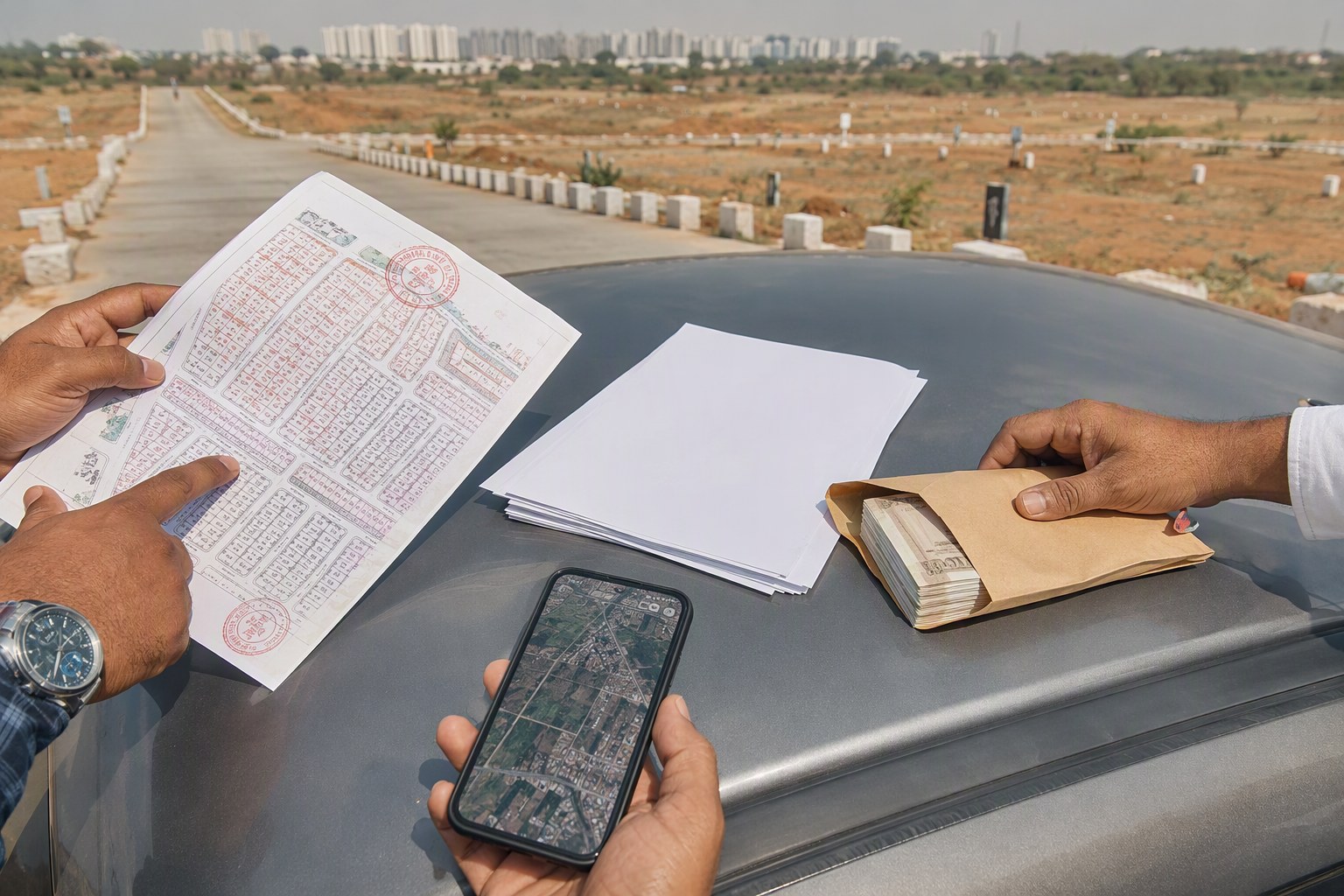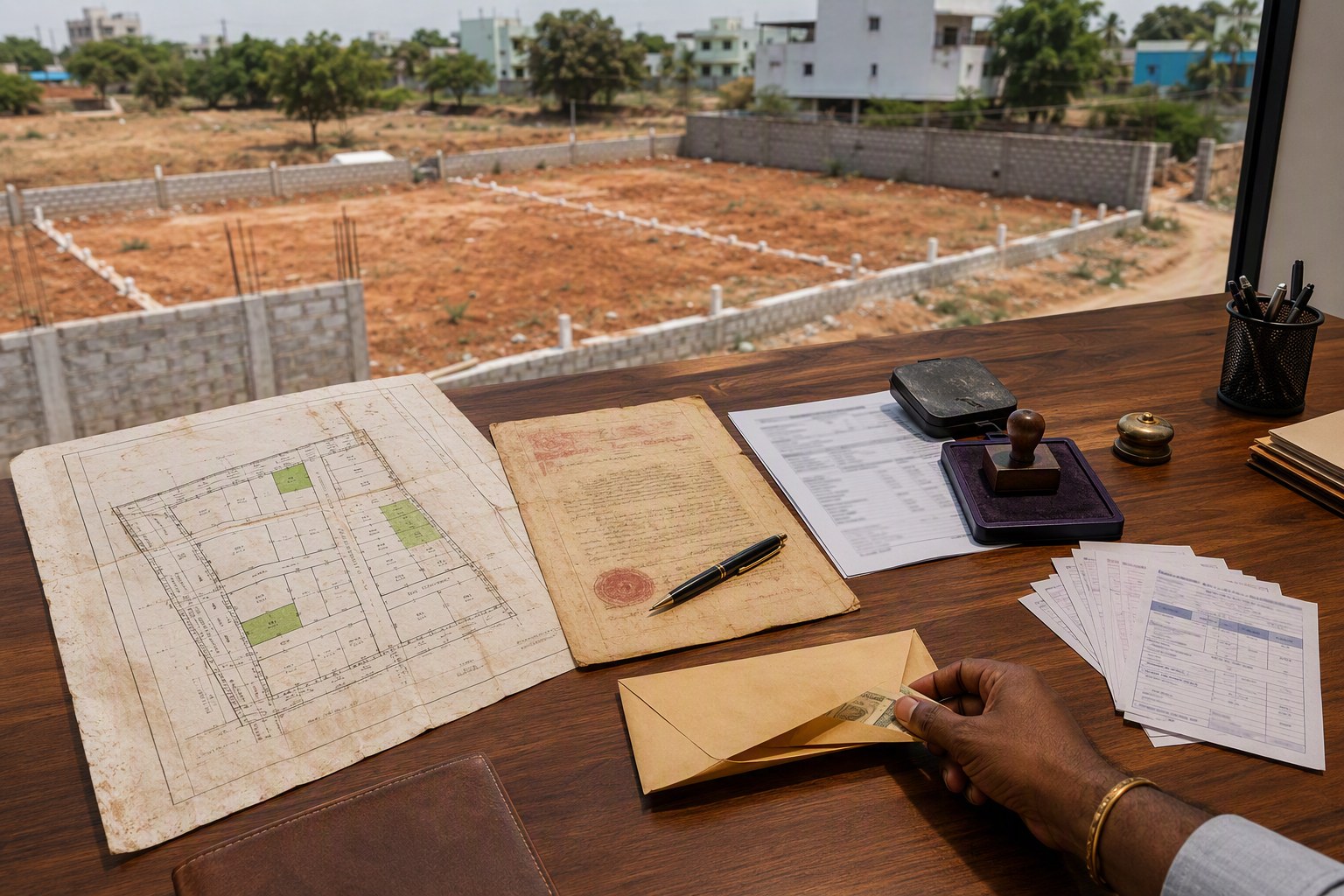



The Exit Check Telangana Plot Investors Often Miss usually shows up only when they try to sell. I will start with a familiar Hyderabad story. An investor buys a plot on the city edge because the entry price feels attractive. The layout is near a growing road, the broker says the area will move fast, and the seller is ready to close. A few years later, when the investor finds a buyer, the real test begins: will the next buyer accept the papers, will the bank fund it, and will the SRO register it without objection?
That is where many plot investments in Telangana either become liquid assets or get stuck as files. Profit is not just the difference between buying price and selling price. Profit is what remains after title, land classification, survey number history, 22-A status, EC entries, bank comfort, and registration clearance are all passed.
In our experience, the best plot investors in Hyderabad do not ask only, “What is the rate?” They ask, “Who can buy this from me later, and how easily can they register it?”
Why The Exit Check Telangana Plot Investors Often Miss decides the real profit
Plot buying around Hyderabad often starts with location excitement. Mokila, Shankarpally, Kollur, Tellapur, Patancheru, Tukkuguda, Adibatla, Maheshwaram, Shadnagar, Ghatkesar, Medchal, Kompally, Dundigal, Bachupally, Shamshabad and Ibrahimpatnam all attract different types of buyers. Some are end-users waiting for villa growth. Some are NRI investors. Some are local traders. Some are people buying one small plot with savings.
But when it is time to exit, the buyer profile matters. A cash buyer may take a title risk after discount. A salaried buyer will usually need a home loan or plot loan. The bank legal team will ask harder questions than a broker. If there is a mismatch in survey number, old pahani, Dharani entry, conversion order, layout approval, EC flow, or prohibited property status, the loan may not move.
Then comes the registrar. Even if the buyer likes the plot and the bank is okay, the SRO has its own registration checks. If the property appears in a prohibited list, or the survey number is under a restricted category, the sale deed can hit a wall. Telangana’s prohibited property database has 3,076,153 entries. That number should make every plot investor pause before buying only because the entry price is low.
This is not a generic warning about Section 22-A. The sharper point is liquidity. A plot can look profitable on paper and still be difficult to sell because the next buyer cannot get comfortable. A clean exit needs three clearances in practical terms: buyer confidence, bank confidence, and registrar acceptance.
The Exit Check Telangana Plot Investors Often Miss is not only a 22-A check
Many people hear “prohibited property” and immediately think the job is done after one search. No. Section 22-A status is a critical filter, but exit quality is wider. A buyer’s advocate or bank lawyer may still ask for link documents, EC continuity, layout approval, land conversion, approach road status, and village-level survey consistency.
Take a common case around Chevella mandal or Moinabad side. A plot may be marketed as a peaceful weekend investment. The location may have good road access. The seller may produce a registered sale deed. But if the parent land has old government assignment issues, ceiling proceedings, missing link documents, or inconsistent survey boundaries, the next buyer may ask for a heavy discount or simply walk away.
Similarly, in Maheshwaram, Kandukur, Ibrahimpatnam and Tukkuguda belts, the Hyderabad growth story is strong. But growth does not cure title defects. We have seen investors focus on airport connectivity, ORR access and proposed development corridors, while not checking whether the underlying land record supports smooth resale.
Before paying an advance, use the Section 22-A Prohibited Property Check. Then run the Encumbrance Certificate Search and review the chain through the EC Analyzer. These checks do not replace a lawyer, but they give you early red flags before emotions take over.
Entry price is visible; exit risk is hidden
Low entry price is seductive. Brokers know this. A buyer may hear that the neighbouring village is quoting higher, or that a road widening will change the area, or that the land is “almost same as HMDA layout but cheaper”. Sometimes the opportunity is genuine. Sometimes the discount is the market’s way of pricing legal friction.
In Telangana land, discount can come from many reasons:
- Survey number confusion between old and new records.
- Land shown differently in pahani, Dharani or older revenue documents.
- Plot falling in an unapproved layout or unclear layout boundary.
- Missing link document from an earlier owner.
- Family partition not properly documented.
- Pending mortgage, charge or court reference.
- Part of the survey number appearing in prohibited property records.
- Access road existing on ground but not cleanly reflected in documents.
None of these issues may stop a buyer from paying token advance. They usually become visible when a serious buyer asks for verification. That is why exit checking must happen before entry.
A practical exit checklist before buying a Telangana plot
When we assess a plot for investment, I like to work backwards. Imagine you are selling it after a few years. What will the next buyer ask? What will the bank’s legal panel ask? What will the SRO system show? This reverse approach quickly separates marketable plots from risky bargains.
| Investor’s entry question | Smarter exit question |
|---|---|
| Is the rate lower than nearby plots? | Why is it lower, and will a future buyer accept the reason? |
| Is the plot near ORR, airport road or a growth corridor? | Do title, land use and layout papers support bank funding? |
| Does the seller have a registered deed? | Is the full link document chain clean and traceable? |
| Can I register now? | Can my buyer register later without a 22-A or SRO objection? |
| Is the broker saying many people bought here? | Have recent resales happened through normal bank-funded buyers? |
Start with the survey number. If you do not know the correct survey number and village, every other check becomes weak. Use the Survey Number Finder and cross-check the SRO jurisdiction through Find Your SRO Office. For village and SRO mapping, the SRO Village Directory is also useful.
Next, compare the government market value through the Market Value / Guideline Value Search. I am not suggesting that guideline value equals market price. Hyderabad market prices often move differently based on road, layout brand, approvals and buyer sentiment. But the ready reckoner gives you an official baseline, and sudden mismatch between quoted price and official value deserves closer questioning.
How banks look at plot resale in Hyderabad growth belts
A bank does not fall in love with a location. It looks for enforceability. If the borrower defaults, can the bank safely hold and recover the asset? That mindset is very different from an investor who is betting on future appreciation.
For plots around Shankarpally mandal, Mokila side, Kollur, Tellapur, Patancheru or Bachupally, banks may ask for layout approvals, link documents, EC, tax receipts where applicable, and clean title opinion. For areas around Adibatla, Ibrahimpatnam, Maheshwaram, Kandukur, Shamshabad and Shadnagar, they may examine land conversion, revenue history and approach road with extra care depending on the property type.
If the property is in a plotted development, check whether the project has RERA applicability. For applicable projects, use the RERA Project Lookup. If you are buying an open plot outside a project, RERA may not answer your title questions; you still need revenue and registration checks.
A bank-funded buyer is usually the best exit buyer because payment discipline is better and due diligence is formal. If your plot cannot pass bank scrutiny, your resale pool becomes smaller. Smaller buyer pool means weaker negotiation power.
Registrar clearance: the final gate many investors ignore
Every investor should respect the SRO stage. A private agreement, a broker assurance, even a lawyer’s broad comfort cannot override a registration block. If the property is in a prohibited category, or if the survey number triggers a restriction, the transaction can stall.
The presence of 3,076,153 prohibited property entries in Telangana’s records is not a small clerical matter. It tells us that land restrictions are widespread enough to deserve routine checking. The issue may be government land, endowment land, waqf-related entry, assigned land, ceiling land, court-related restriction, or another category reflected in government records. Each case needs its own reading.
Do not assume that because one part of a village is saleable, every survey number in that village is safe. Do not assume that because a neighbouring plot was registered, your plot will also register. Telangana land records work at survey number and sub-division level. The exact identifiers matter.
For any plot in a developing belt, I would also keep a watch after purchase. Records can change, disputes can surface, and new entries can affect buyer confidence. The Property Change Tracker helps investors monitor changes instead of waking up only at resale time.
What to verify in the sale deed, pahani and Dharani records
The sale deed is only one layer. It tells you what was registered between parties. Revenue records tell another story. Pahani entries, Dharani data, mutation history and land classification help you understand whether the seller’s title is supported by government records.
For agricultural land converted into plots, ask for the conversion order and layout approval wherever relevant. Check whether the extent in the deed matches the layout and the ground position. If the plot is carved from a larger survey number, confirm how the parent extent moved through earlier documents.
Common Telangana terms can confuse first-time investors. If words like pahani, sethwar, kasra pahani, mutation, patta, occupancy rights, gramakantam or 22-A are not clear, use the Telugu-English Property Terms Dictionary. One misunderstood word can change the risk reading of a property.
For plotted layouts, also check road width and land use. A plot may be fine for holding, but building permission later may face issues if road width, zoning or layout compliance is weak. Use the Road Width Check and Land Use Zone Finder before assuming future construction value.
Locality examples: same Hyderabad story, different exit quality
Let us take three broad patterns we see in Hyderabad’s outer markets.
1. Premium western belt plots
Mokila, Shankarpally, Kollur and Tellapur attract buyers who compare plots with villas, apartments and future family use. Exit quality here depends heavily on approval clarity, layout reputation, approach road and clean title. Buyers are better informed, and many use bank funding. A weak document file can get exposed quickly.
2. Airport and southern growth plots
Shamshabad, Tukkuguda, Maheshwaram, Kandukur and Shadnagar side investments are often sold on future infrastructure and land banking. The upside story may be attractive, but investors must check whether the land has valid conversion, whether the survey number has any restriction, and whether the layout is saleable to normal families later.
3. Eastern and northern expansion plots
Adibatla, Ibrahimpatnam, Ghatkesar, Medchal, Kompally, Dundigal and nearby belts see mixed demand from workers, small investors and long-horizon buyers. Here, affordability may bring quick interest, but resale can slow down if documents are not bank-friendly.
The point is simple. Locality growth can bring enquiries. Clean exit papers convert those enquiries into money.
My minimum file before I call a plot investment-ready
For a Telangana plot, I would not rely on one glossy brochure or one registered deed. My minimum file would include:
- Latest sale deed and full link documents.
- Correct survey number, village, mandal and SRO details.
- EC covering the relevant ownership chain.
- 22-A prohibited property check for exact survey details.
- Pahani or Dharani record review, as applicable.
- Layout approval and conversion documents, if the land was converted.
- Road access proof and ground-level boundary clarity.
- CERSAI or charge check where loan history is suspected.
- Guideline value reference for official market value baseline.
You can start many of these checks with the Property Verification Tool. For loan or mortgage concerns, use the CERSAI Charge Check. For transaction cost planning, the Stamp Duty Calculator helps you understand registration outgo based on the property details you enter.
The profit question every Telangana plot investor should ask
Before buying, ask this blunt question: “If I had to sell this plot to a bank-funded buyer tomorrow, what objections would come?”
If the answer is vague, wait. If the seller says, “No need for all this, everyone here is buying,” slow down. If the broker says, “Registration will happen somehow,” do not treat that as legal comfort. A proper investment should not depend on shortcuts.
Good plot investing in Telangana is not about fear. It is about discipline. Hyderabad’s expansion is real across multiple corridors, and land remains an emotional asset for many Indian families. But the investors who sleep peacefully are not always the ones who bought at the lowest entry price. They are the ones who bought something the next buyer, the bank and the registrar can all clear.
That is the exit check Telangana plot investors often miss. Do it before the advance, not after the buyer is sitting across the table asking uncomfortable questions.
Frequently Asked Questions
What is the exit check Telangana plot investors often miss?
It is the pre-purchase check of whether a future buyer, bank and SRO can clear the plot without title, EC, 22-A, survey number or layout objections. It focuses on resale liquidity, not just buying price.
Is a registered sale deed enough to buy a plot in Telangana?
No. A registered deed is necessary, but you should also verify link documents, EC, pahani or Dharani records, survey number, prohibited property status, layout approval and SRO jurisdiction.
Why does Section 22-A matter for plot resale?
If a property or survey number appears under prohibited property records, registration may be blocked or questioned. Telangana records show 3,076,153 prohibited property entries, so this check should be routine before buying.
Which Hyderabad plot locations need extra document checking?
All locations need checking, but investors should be extra careful in fast-growing belts such as Shankarpally, Mokila, Kollur, Tukkuguda, Maheshwaram, Shadnagar, Adibatla, Ibrahimpatnam, Ghatkesar and Medchal where land conversion and survey history can vary widely.
Can online tools replace a property lawyer?
No. Online tools help you catch early red flags and organise your due diligence. For purchase decisions, especially high-value plots, get a local property lawyer to review the full document chain and revenue records.