


Telangana’s 30.76 Lakh Blocks: Investor’s First Filter
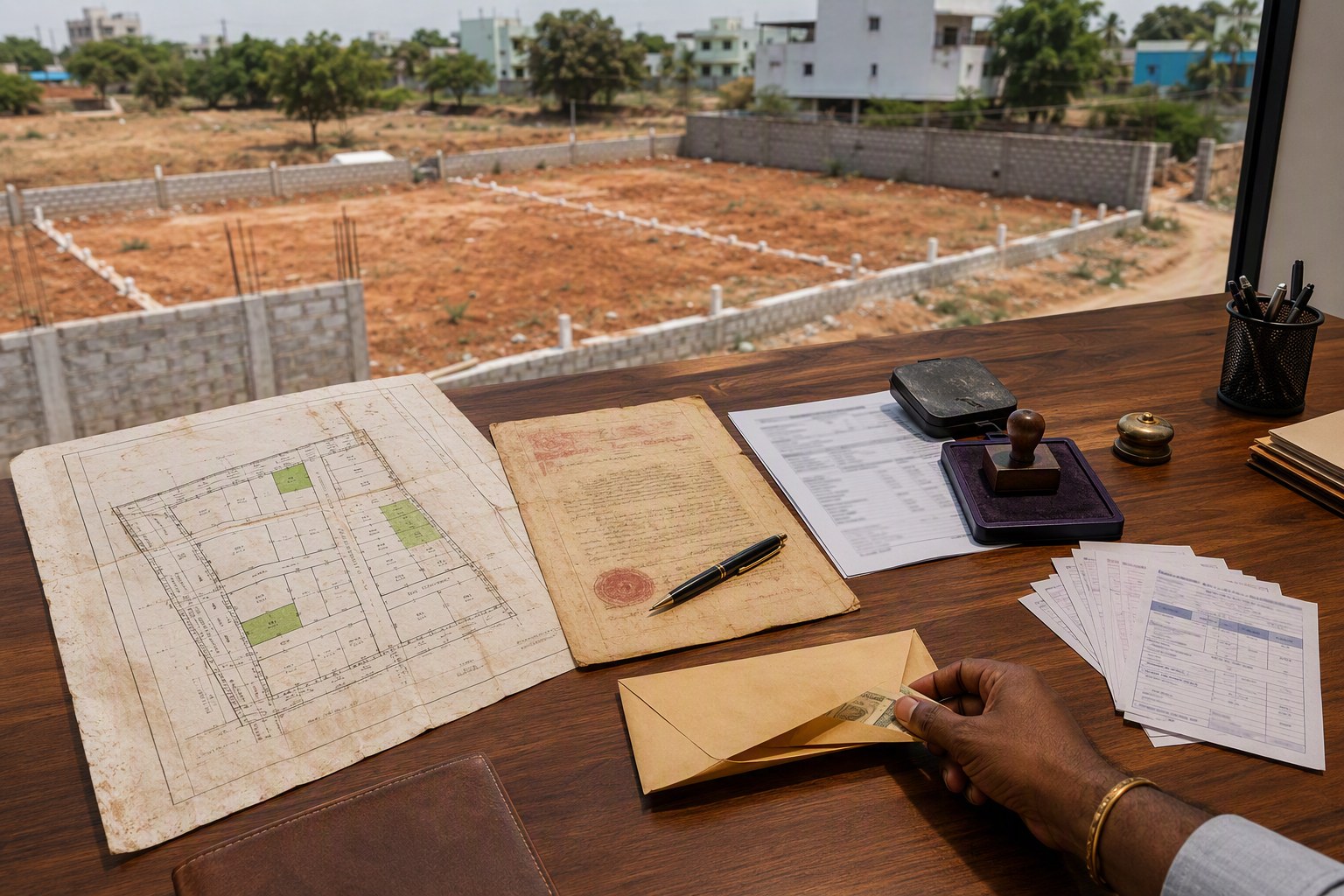
Telangana’s 30.76 Lakh Blocks should be the first screen for any land or flat investor, even before price talk, token advance, site visit, or loan discussion. As per latest IGRS data available with us, prohibited properties under Section 22-A stand at 3,076,153 records. That single number tells a very practical story: title risk is not a small side issue in Telangana property buying. It is the starting point.
In our experience, many buyers in Hyderabad spend days comparing quotes in Kokapet, Tellapur, Kollur, Mokila, Adibatla, Tukkuguda, Shamshabad, Kompally, and Patancheru. They bargain hard, check road approach, ask about future growth, and only then ask for survey number or old link documents. That order is wrong. If a land parcel is blocked, disputed in revenue records, notified, government-linked, assigned, wakf-related, endowment-related, ceiling-affected, or otherwise restricted, the quoted rate becomes almost meaningless.
My opinion is simple: a serious investor should reject title-risky property before negotiating price. A cheap blocked asset is still blocked.
Telangana’s 30.76 Lakh Blocks: What the Number Means for Investors
The phrase Telangana’s 30.76 Lakh Blocks refers here to the large volume of prohibited-property entries recorded under Section 22-A. Our database count is 3,076,153. These records are not all the same type, and every entry may not mean the same risk level. But for an investor, the message is clear: prohibited-property screening is not a legal formality to be done at the end. It is a business filter.
Section 22-A restrictions can stop registration at the Sub-Registrar Office. That means you may like the location, the seller may be genuine in conversation, the price may look attractive, and the village may be booming. Still, the SRO may not accept registration if the property falls under a prohibited category. This is why a buyer looking at land in Gandipet mandal, Serilingampally mandal, Rajendranagar mandal, Shankarpally mandal, Maheshwaram mandal, Hayathnagar mandal, or Patancheru mandal should start with the survey number and village name, not with the seller’s final offer.
Hyderabad’s investment market has become very locality-driven. Kokapet and Narsingi attract premium residential buyers. Nanakramguda and Gachibowli attract office-linked demand. Tellapur and Kollur attract apartment and plotted development interest. Mokila and Shankarpally attract villa and land buyers. Tukkuguda and Adibatla attract ORR-side and airport-side speculation. In all these markets, title-risk filtering saves both time and face. Nobody wants to sit in a registration office and discover that the document cannot move.
Why Telangana’s 30.76 Lakh Blocks Must Come Before Site Visits
Most investors behave emotionally during the first site visit. A good road, corner bit, compound wall, nearby villa project, or a persuasive agent can create urgency. We’ve seen buyers say, “Sir, just block it today, papers we will check later.” That is exactly where avoidable trouble begins.
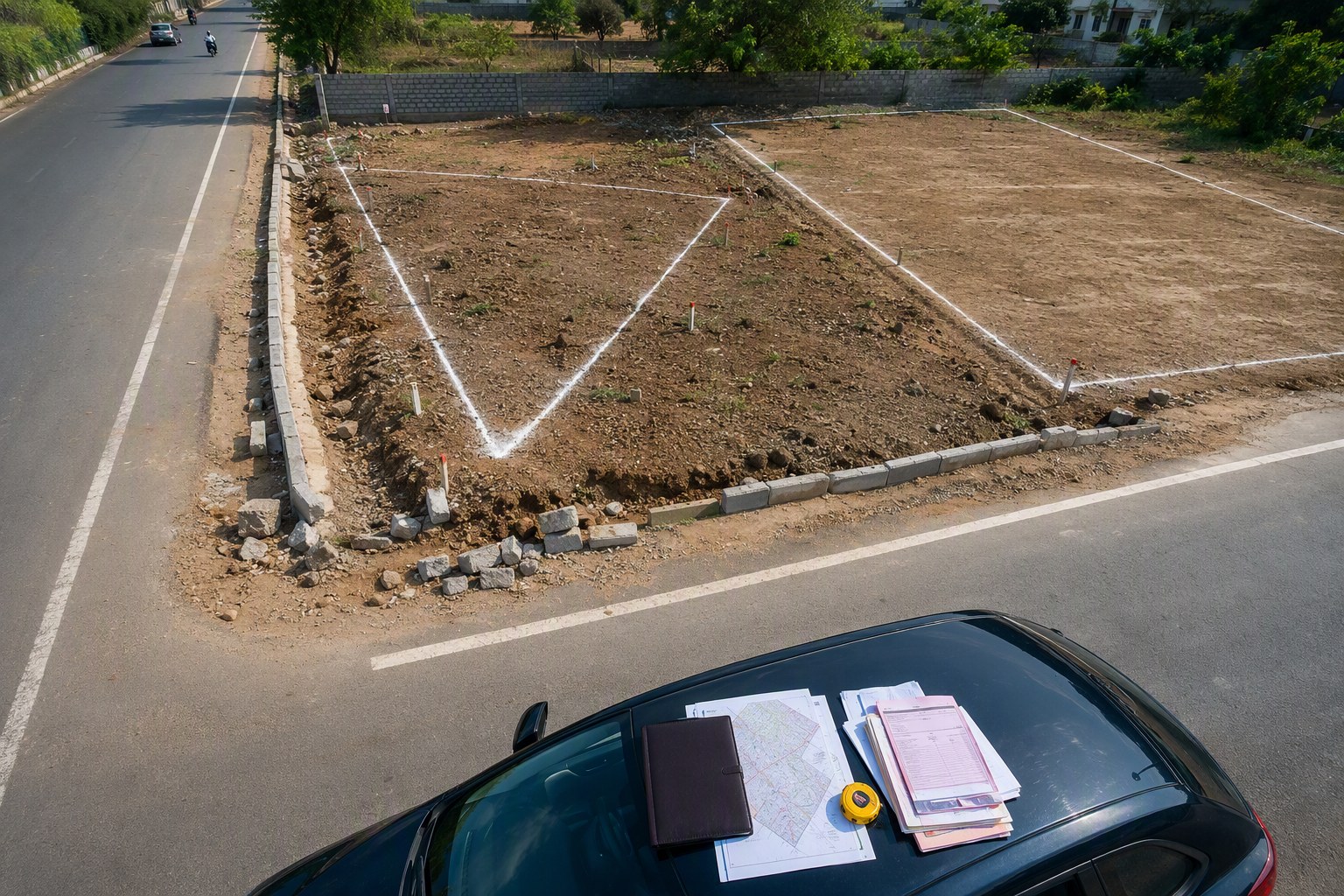
A site visit tells you what is visible. Section 22-A risk is mostly invisible at the site. The land may have crop, fencing, a borewell, a shed, or even an old house. None of that proves that the SRO will register it. The village revenue record, pahani, Dharani entry, old link documents, encumbrance history, and prohibited-property status matter much more than a freshly painted boundary stone.
Before you drive to Shankarpally, Maheshwaram, Moinabad, Abdullapurmet, or Medchal side, ask for basic identifiers. You need the district, mandal, village, survey number, extent, seller name as per record, and document history if available. If the seller or broker avoids survey details before the visit, treat that as a warning signal. Genuine sellers may negotiate privacy, but they should not hide the identity of the property indefinitely.
Use the Section 22-A Prohibited Property Check as the first filter. Then verify location and survey identity with the Survey Number Finder. For document history, use the Encumbrance Certificate Search and, where you already have EC data, the EC Analyzer. These checks will not replace a lawyer’s title opinion, but they reduce blind risk before you spend time and money.
The Investor’s Order of Work: Title First, Rate Later
In Hyderabad property discussions, the word “rate” dominates everything. Buyers ask the per-square-yard rate, built-up rate, landowner share rate, undivided share, and guideline value. Sellers quote based on nearby transactions, road width, project brand, HMDA layout talk, ORR proximity, or future development story. But the first real rate to respect is the official market value or ready reckoner value used for stamp duty calculation. Even then, guideline value is not a title certificate.
My preferred order is different from the usual market habit:
- First: identify the exact property through survey number, village, mandal, and SRO jurisdiction.
- Next: check whether it appears in prohibited-property records under Section 22-A.
- Then: review EC, link documents, pahani, Dharani details, mutation trail, pattadar passbook position, and layout approvals where relevant.
- After that: compare guideline value, quoted rate, development potential, access road, land use, and exit liquidity.
- Only then: negotiate token, advance, agreement terms, and registration date.
This order protects investors from a common trap: negotiating hard on a property that may not be registrable. If a property fails the first filter, your bargaining skill has no value. If it passes the first filter, then price negotiation becomes meaningful.
How Prohibited-Property Risk Shows Up in Hyderabad Deals
Every locality has its own market behaviour. In west Hyderabad, buyers in Kokapet, Narsingi, Gandipet, Tellapur, Kollur, Mokila, and Osman Nagar often chase growth corridors. In south Hyderabad, Tukkuguda, Maheshwaram, Adibatla, Shamshabad, and Kothur attract buyers expecting airport-side and industrial-side growth. In north Hyderabad, Kompally, Medchal, Shamirpet, and Dundigal pull end-users and long-hold investors. In east Hyderabad, Hayathnagar, Abdullapurmet, Ghatkesar, and Pocharam remain active for land and budget housing.
The problem is not that these markets are bad. Many are strong, active, and genuinely demanded. The problem is that a hot locality can make buyers careless. A seller may say the land is near a famous project, near ORR, near a proposed road, or near a university. These are location arguments, not title proofs.
Prohibited-property issues can appear in different ways. Sometimes the issue is visible in government lists. Sometimes an EC shows earlier transfers, but revenue status does not support the seller’s claim. Sometimes the property belongs to a larger survey number where part of the land has clean history and part of it is risky. Sometimes the layout marketing material looks polished, but approvals and survey-level status need separate checking. That is why survey-level verification matters more than brochure-level confidence.
Telangana’s 30.76 Lakh Blocks and the SRO Reality
The Sub-Registrar Office is where many casual assumptions meet the system. If a property is under prohibition, registration can be refused or held up. Buyers often discover this late because they treat the SRO as a final step. Actually, SRO jurisdiction should be understood early.
For example, land around Tellapur may involve different administrative and registration details from land around Shankarpally. A flat in Gachibowli has a different verification style from agricultural land in Maheshwaram mandal. A plotted layout near Patancheru requires different checks from a villa plot near Mokila. The correct SRO, village mapping, survey number, and document chain decide how the file should be read.
You can use Find Your SRO Office and SRO Village Directory to identify the relevant registration office and village mapping. For rate comparison, the Market Value / Guideline Value Search is useful. For stamp duty planning, use the Stamp Duty Calculator. These tools are practical checkpoints, not decoration.
| Investor Question | First Check | Why It Matters |
|---|---|---|
| Can this property be registered? | Section 22-A status | A blocked property can stop the deal before registration. |
| Is the survey number clear? | Village and mandal mapping | Wrong survey identity leads to wrong due diligence. |
| Is the seller’s chain supported? | EC and link documents | Past transactions must match the claimed title path. |
| Is the quoted price sensible? | Guideline value and local market reading | Price review is useful only after title risk is filtered. |
| Is there a future development angle? | Land use, road width, approvals | Growth potential needs legal usability. |
Flat Buyer or Land Buyer: The Filter Changes, But It Still Starts Early
For apartments in localities like Financial District, Gachibowli, Nallagandla, Kondapur, Miyapur, and Manikonda, the title-risk filter usually includes land ownership history, development agreement, GPA, building permissions, RERA registration where applicable, EC, and mortgage or charge checks. A buyer should not depend only on the brand name or sales office confidence.
For plotted land or agricultural land around Kollur, Mokila, Shankarpally, Chevella, Maheshwaram, Shadnagar side, or Yadagirigutta side, the checks become more survey-focused. Pahani, Dharani record, pattadar details, old sale deeds, family partition history, prohibited-property status, land classification, approach road, and conversion or layout approvals all become relevant. A small mismatch in survey identity can create a big investment headache.
For RERA-related checking, use the RERA Project Lookup. If you are examining land development potential, the Land Use Zone Finder, Road Width Check, and FSI/FAR Calculator can help you ask better questions. For a wider first-pass review, use the Property Verification Tool.
What I Would Ask Before Paying Token Advance
Token advance is where many buyers lose control. Once money is paid, the seller or broker may push you to adjust. The tone changes from “check everything freely” to “sir, why are you delaying?” So, before paying even a small token, ask for documents and identifiers in writing.
- Exact village, mandal, district, and survey number.
- Seller name as per current record and previous link documents.
- Latest EC and available link deeds.
- Pahani or Dharani-related record where applicable.
- Layout approval, building permission, or RERA details where applicable.
- Clear statement on Section 22-A status.
- SRO jurisdiction and proposed registration process.
If the seller says all papers will be shown only after token, I would slow down. In a clean transaction, basic verification should not be treated like a favour. Serious investors are not wasting anyone’s time by asking for title identifiers. They are protecting capital.
How to Read a Clean-Looking Deal More Carefully
Not every risk is dramatic. Sometimes the documents look neat, but the issue is in the classification. Sometimes the EC is available, but a revenue record creates doubt. Sometimes the seller has possession, but the legal route to ownership is weak. Sometimes the property is not fully blocked, but part of the parent survey has restrictions. This is common enough to justify early filtering.
Also, do not confuse registered sale deed with perfect title. Registration proves that a document was registered. It does not automatically cure every defect in ownership, classification, family claim, government interest, or prohibited status. A good lawyer will look beyond stamp paper and registration seal.
For investors planning exit, title clarity affects resale. A clean property can be financed, resold, partitioned, developed, or transferred more easily. A doubtful property may attract only cash-heavy buyers, deep discounts, or long legal follow-up. That is not investment freedom. That is trapped capital.
The Practical Filter We Use at Verified.RealEstate
At Verified.RealEstate, our working approach is straightforward. We do not start with “best area” talk. We start with identifiability and risk. Can the property be precisely identified? Does the survey number match the village? Is the SRO correct? Does Section 22-A show a block? Does EC support the seller’s chain? Does the land use match the proposed plan? Is the guideline value understood? Are approvals traceable?
Only after these questions are answered should an investor discuss rate seriously. This is especially true in fast-moving pockets of Hyderabad where word-of-mouth pricing changes quickly. A buyer may feel that delaying one day means losing the deal. But losing a risky deal is not a loss. Many times, that is discipline.
Use Property Change Tracker for ongoing watch after you shortlist a property. For mortgage or charge risk, check CERSAI Charge Check. If you are comparing built property value and land component, Composite Value Calculator and Building Value Calculator can help with valuation thinking. These tools work best when used before emotion enters the deal.
Final Word for Telangana Property Investors
Telangana’s 30.76 Lakh Blocks is not just a database headline. It is a warning label for every serious buyer. The presence of 3,076,153 prohibited-property records under Section 22-A means title filtering must sit at the front of your investment process.
Do not start with coffee-shop negotiation. Do not start with “last rate.” Do not start with a Sunday site visit. Start with the survey number, village, mandal, SRO, EC, pahani, Dharani status, guideline value, and Section 22-A check. Once the property survives that first filter, then your price discussion has substance.
Hyderabad will keep throwing attractive opportunities at investors. Some will be genuine. Some will be half-clean. Some will be best avoided. The investor who filters title risk first will always have a better chance of protecting capital than the investor who only chases a discount.
Frequently Asked Questions
What does Telangana’s 30.76 Lakh Blocks mean for property buyers?
It refers to the large set of prohibited-property records under Section 22-A. As per latest IGRS data available with us, the count is 3,076,153 records. Buyers should treat this as a reason to check title risk before price negotiation.
Should I check Section 22-A before visiting a site?
Yes. A site visit shows physical features, not legal registrability. If the property is blocked or restricted, a good location and attractive quote will not solve the registration problem.
Is an Encumbrance Certificate enough to prove clean title?
No. EC is necessary, but it is not the full title opinion. You should also check Section 22-A status, link documents, pahani or Dharani records where applicable, approvals, seller identity, and SRO mapping.
Which Hyderabad areas need extra care for land verification?
Every area needs care, but investors should be extra alert in active growth pockets such as Kokapet, Tellapur, Kollur, Mokila, Shankarpally, Maheshwaram, Adibatla, Tukkuguda, Shamshabad, Patancheru, and Kompally.
When should I negotiate the price?
Negotiate after the property is properly identified and screened for title risk. Price discussion is meaningful only when Section 22-A status, EC, SRO details, survey number, and basic title documents are checked.