

Corner Plot vs Regular Plot: Which Investment Risk Is Lower?
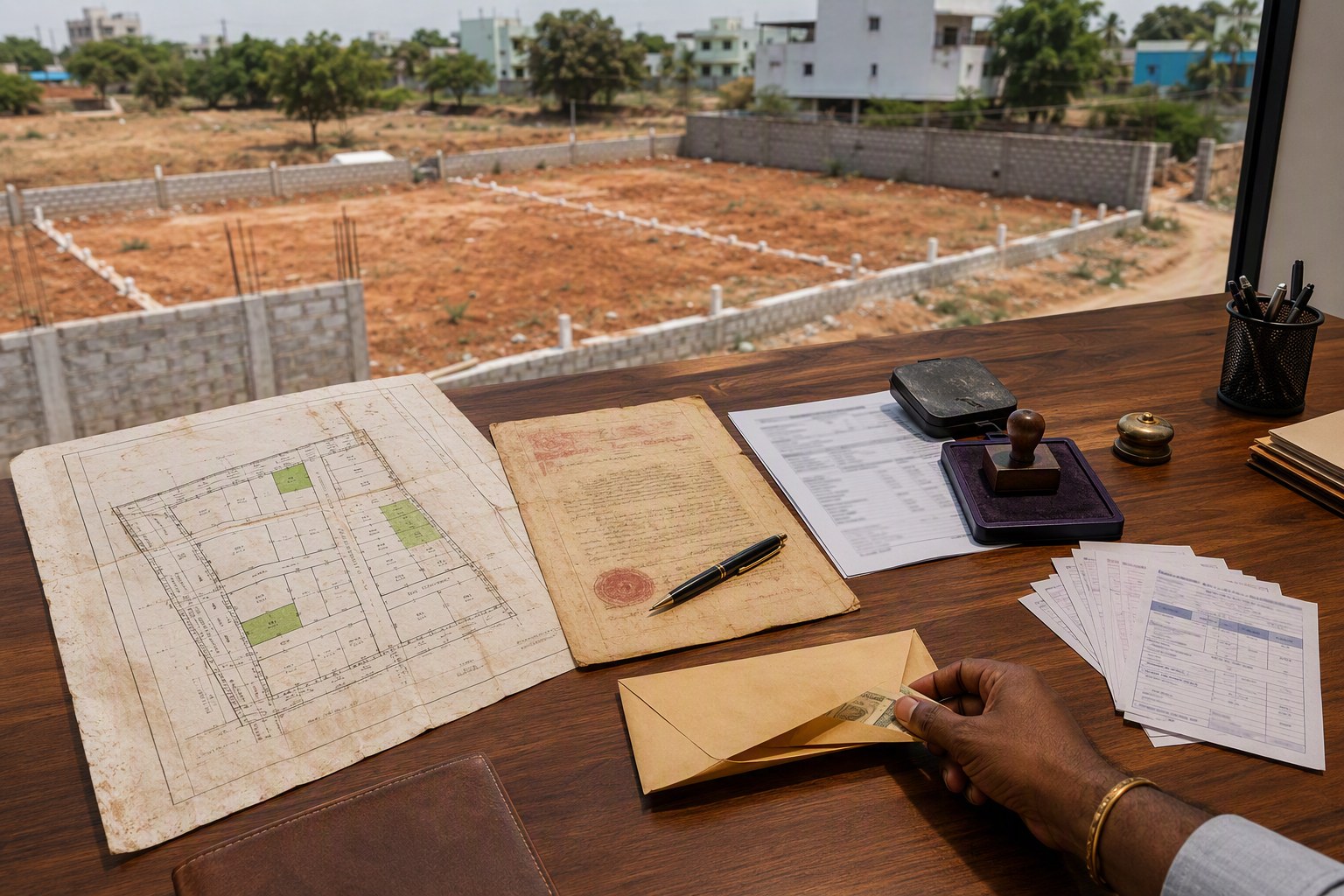
Corner Plot vs Regular Plot is a common debate in Hyderabad plotted investments, especially in areas like Mokila, Shankarpally, Tukkuguda, Adibatla, Ghatkesar, Bachupally, Narsingi and Tellapur. My straight answer: a regular plot usually carries lower investment risk because it has fewer road-facing variables, simpler setback interpretation, and cleaner usability. A corner plot can fetch better buyer attention and may suit certain house plans or commercial-facing uses, but the premium is justified only after road width, splay, road widening, layout approval, EC, Dharani, pahani and Section 22-A checks are clean.
We've seen buyers pay extra for a corner without checking whether the second road actually improves the plot. Sometimes it does. Sometimes it eats into usable space, creates gate-placement issues, or brings future road-widening risk. So this is not a simple “corner is always better” decision.
Verified.RealEstate view: Pay a corner premium only when the plot has clean title, approved layout, clear road widths on the sanctioned plan, no adverse EC entries, no Section 22-A issue, and practical house-planning advantage. Otherwise, a regular plot in the same venture may be the safer investment.
Corner Plot vs Regular Plot: the short answer for Telangana buyers
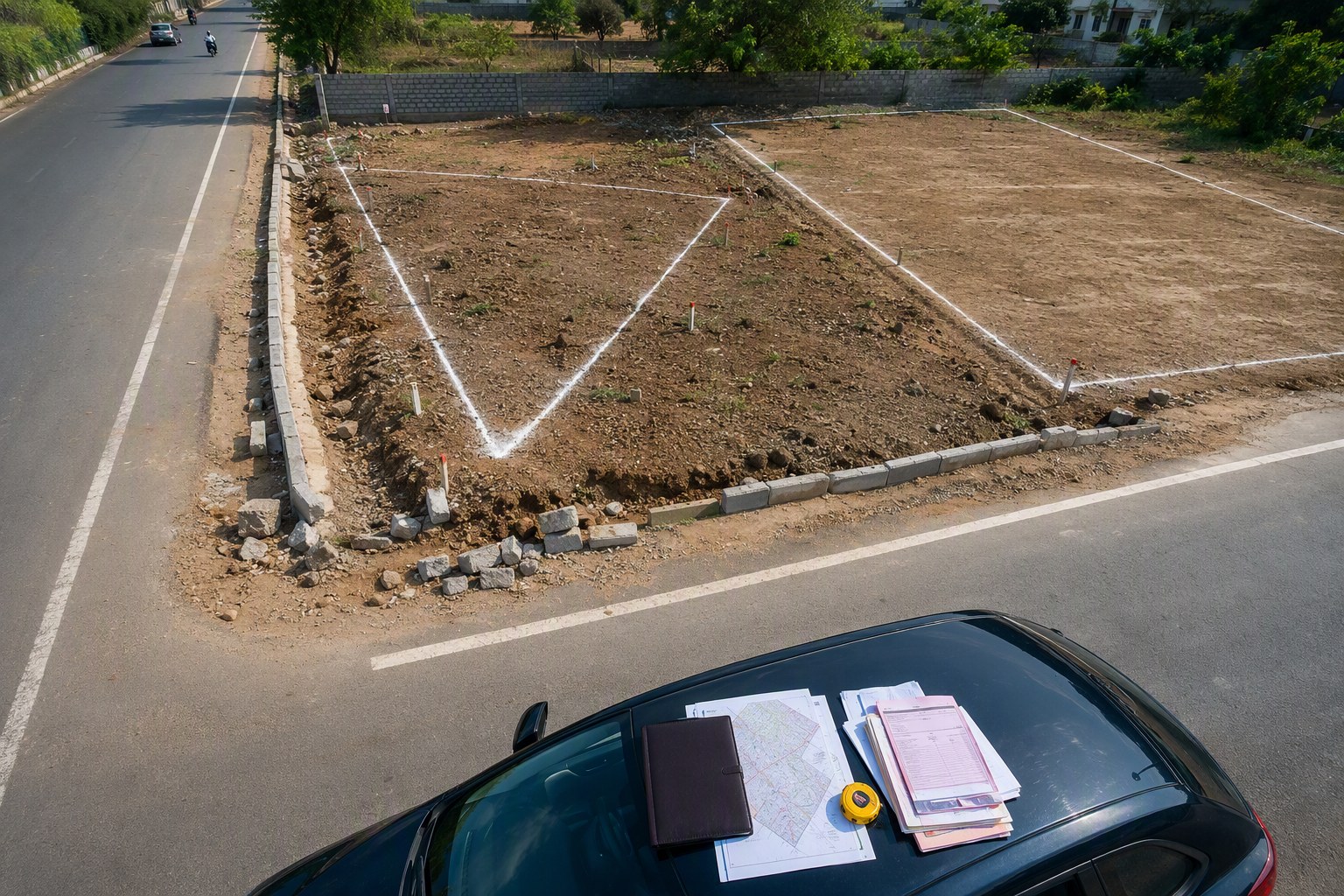
In Telangana real estate, a corner plot means the site touches two roads. A regular plot usually touches one road and shares boundaries with neighbouring plots on the other sides. That one extra road is the main attraction. It can give better light, ventilation, visibility and access. In resale conversations, many brokers in Hyderabad will pitch it as a premium feature.
But risk is not only about resale attraction. Risk also includes whether your usable area is affected, whether the building setbacks are correctly applied, whether the roads shown in the sale brochure match the approved layout, whether the land falls under a prohibited category, and whether future buyers or banks will raise questions. On that score, regular plots often have an edge because the planning is more predictable.
For example, a regular plot in a properly approved layout at Mokila in Shankarpally mandal may be easier to assess than a corner plot in the same layout where one side road is shown differently in marketing material and approval drawings. Similarly, in Tukkuguda of Maheshwaram mandal or Adibatla side of Ibrahimpatnam mandal, road width and land-use checks matter more than the word “corner” printed on a brochure.
Corner Plot vs Regular Plot: comparison at a glance
| Factor | Corner plot | Regular plot | Lower-risk choice |
|---|---|---|---|
| Resale attention | Gets faster attention from buyers because of two-road access and visibility | Depends more on layout quality, road width, facing and locality demand | Corner for visibility, regular for stable expectations |
| Usable planning | May need careful gate, parking and setback planning on two exposed sides | Usually simpler for a standard residential house plan | Regular |
| Setback interpretation | Can be more sensitive because two roads, corner splay and road-widening lines may apply | Usually one road-facing setback plus side and rear setbacks | Regular |
| Privacy and noise | More exposed to traffic, streetlights, dust and pedestrian movement | Better privacy if internal location is peaceful | Regular |
| Document checks | Needs special attention to both road boundaries and layout drawing | Still needs full title checks, but fewer boundary-related doubts | Regular |
| Premium justification | Valid only if the second road improves utility and resale | Price comparison is easier within the same layout | Regular for conservative investors |
Why corner plots attract a premium in Hyderabad
Corner plots have genuine appeal. In dense residential pockets like Miyapur, Chandanagar, Bachupally, Kompally and Peerzadiguda, buyers like the extra openness. In growth corridors like Narsingi in Gandipet mandal, Tellapur around the western side, and Mokila-Shankarpally belt, many villa and plotted-layout buyers see corner sites as status plots.
There are three practical reasons for this premium. First, a corner plot can allow better natural light and cross ventilation. Second, it may provide flexible entry points, provided the road widths and municipal rules allow it. Third, it may appeal to future buyers who want a house that stands out in the layout.
In some cases, a corner plot near the entrance of a layout may also have commercial visibility. But be careful here. Residential layout approval does not automatically mean you can use the plot for shop, clinic, office or other non-residential activity. Land-use zone, road category, building permission and local rules will decide that. Before assuming commercial value, check the applicable zone using Land Use Zone Finder and verify the sanctioned layout.
Where the corner plot risk starts
The risk starts when buyers treat “corner” as a guarantee. It is only a physical feature. It is not a title certificate, it is not layout approval, and it is not a bank clearance.
One common issue is corner splay. At a road junction, the corner may be cut or kept open for visibility and turning movement. If the buyer casually measures the site from compound edge or existing peg stones without checking the approved layout, the usable shape may be misunderstood. This becomes a problem during construction permission or resale.
Another issue is road widening. In fast-growing stretches like Kollur, Osman Nagar, Mokila, Shankarpally, Tukkuguda, Ghatkesar and Adibatla, roads change character as development increases. A plot touching two roads has two sides to verify. That means more scope for mismatch between ground reality, layout drawing, village map, master plan proposal and future road alignment.
There is also the matter of privacy. A corner home has two public-facing sides. Some families love the open feel. Others later complain about vehicle movement, street dogs, dust, headlights, roadside parking and people using the corner as a stopping point. As an investment, this affects the type of resale buyer you can attract.
Regular plots: boring, but often lower-risk
Regular plots are not glamorous in broker talk, but investors should respect them. A regular plot in a good approved layout with proper approach road, clear title and clean EC can be easier to buy, easier to fund, easier to plan, and easier to sell to a family buyer.
For a house construction plan, most architects find regular plots more predictable. Your road-facing side is clear. Your parking entry is clear. Your compound wall and setbacks are simpler to visualise. There is less confusion about whether a side road should be treated differently.
In our experience, conservative investors in Hyderabad often do better by choosing the best regular plot in a strong layout rather than the most hyped corner plot in a weak layout. The layout quality, title chain, road access, drainage, electricity, water prospects and neighbourhood development matter more than corner status.
Take an example without quoting artificial rates. If you are comparing two plots in the same approved venture near Shankarpally mandal, one corner and one regular, first check the government guideline value using Market Value / Guideline Value Search. Then compare the seller’s demanded premium with the actual usability difference. If the premium is only for emotional attraction and not for better frontage, access or resale comfort, the regular plot is the calmer choice.
Corner Plot vs Regular Plot: resale reality
Resale is where the corner plot story becomes mixed. A good corner plot sells well when it has clean roads on both sides, no odd shape, no splay confusion, good facing, and enough depth for a proper house. It can stand out in listings and site visits.
But resale buyers and banks are becoming sharper. A buyer in Gachibowli or Serilingampally mandal may ask for EC, link documents, mutation trail and layout approval before even discussing premium. Buyers in outer growth areas are also asking better questions now, especially after seeing disputes around unapproved layouts, assigned lands, government lands, wakf claims, ceiling surplus issues and road access disputes.
This is where regular plots score. A normal rectangular plot in an approved HMDA or DTCP layout, with clear boundaries and one road, is easier for the next buyer to understand. Less explanation means lower transaction friction.
The resale question should not be, “Will someone like a corner?” Many will. The better question is, “Will the next buyer’s advocate, bank officer and family members all accept this corner without extra doubts?” If the answer is yes, the corner premium may be acceptable. If the answer is weak, do not pay extra.
Document checks before paying extra for a corner plot
Before paying token advance, do a document check like you are buying the land for your own family, not for a quick flip. In Telangana, the base documents usually include link documents, registered sale deeds, EC, pahani or revenue records where applicable, Dharani status, mutation details, layout approval, LP number, village map reference, and SRO jurisdiction.
Start with title and encumbrance. Use Encumbrance Certificate Search and, where you already have the EC, review the chain carefully using EC Analyzer. Look for mortgages, repeated sales, court-related entries, GPA transactions, partition references and mismatched survey numbers.
Then check prohibited status. Telangana has a large universe of prohibited property entries. Our verified database context records 3,076,153 Section 22-A prohibited property entries. That number alone should make every plot buyer slow down. A corner plot can still be affected by prohibited status. Use Section 22-A Prohibited Property Check before paying a corner premium.
Next, verify the survey number and village. In places like Bachupally mandal, Gandipet mandal, Shankarpally mandal, Maheshwaram mandal, Ibrahimpatnam mandal and Ghatkesar mandal, locality names used in marketing may not match revenue village names. Use Survey Number Finder and confirm the correct SRO through Find Your SRO Office. A wrong village or SRO assumption can lead to wrong market value checks and wrong document review.
Road width, setbacks and building permission risk
Road width is a major point in the corner plot vs regular plot debate. Two-road access sounds attractive, but both roads must be legally shown and practically usable. Check the road width in the approved layout, not just on Google Maps or site pegs. For this, use Road Width Check.
Setbacks depend on plot size, road width, building height and applicable local body rules. A corner plot can create more design choices, but it can also restrict the design if the corner splay or road-facing rules reduce the buildable rectangle. Before assuming you can build a larger house, test the numbers with FSI/FAR Calculator.
If you are looking at a plotted development marketed with villa potential, also check whether the project needs RERA registration or whether the plotted venture details are available. Use RERA Project Lookup. For HMDA or DTCP layouts, ask for the approved layout copy, not only a colourful brochure. In gram panchayat areas, be even more alert because past local permissions may not satisfy present buyer or bank expectations.
Price discipline: do not let the word “corner” control the negotiation
Hyderabad land sellers often quote a premium for corner plots. Some premiums are fair. Many are just market psychology. The only sensible method is to compare three values: the ready reckoner or government guideline value, the asking price of similar regular plots in the same layout, and the actual advantage of that specific corner.
I am not going to print random rupee-per-square-yard figures here because rates change by exact village, road, layout approval, plot size, facing, negotiation urgency and title quality. For real registration baseline, use Market Value / Guideline Value Search. For stamp duty impact, check Stamp Duty Calculator. If you are buying a plot with existing structure or compound valuation involved, Composite Value Calculator can also help you frame the transaction better.
For investors, the premium should be paid only if it can be recovered on resale. Ask yourself: will the next buyer pay more for this exact corner, or will they ask for a discount because of traffic, odd shape, road widening, open drain, transformer, electrical pole or street vendor activity? A regular plot avoids many of these arguments.
Locality examples: where the decision changes
In Narsingi and Kokapet side of Gandipet mandal, corner plots inside premium layouts can attract end-users because the built-home market is strong. Still, the master plan road, internal road width and layout approval matter heavily. Do not pay only for location glamour.
In Mokila and Shankarpally mandal, buyers often purchase for medium-term appreciation or future villa construction. Here, regular plots in approved layouts with clean road access may be safer if the corner is on a developing internal road whose future usage is unclear.
In Tukkuguda and Maheshwaram mandal, airport-side growth has created strong plotted interest. Corner plots near wider roads may look attractive, but check land-use zone and road hierarchy before assuming commercial potential.
In Adibatla and Ibrahimpatnam mandal, industrial and residential demand both influence land conversations. If the corner plot is exposed to heavy vehicle movement, the same feature that attracts attention can reduce family-buyer comfort.
In Ghatkesar and Medchal-side growth pockets, road access, drainage and layout legality are often more important than corner status. A clean regular plot can beat a doubtful corner plot any day.
My investment rule: pay for clarity, not drama
If two plots are in the same approved layout and both have clean title, good road width and similar orientation, the corner can be considered. But if the corner plot needs five explanations and the regular plot needs one, the regular plot is usually the lower-risk investment.
For end-use, choose the plot that suits your house design, family privacy and vehicle movement. For investment, choose the plot that the next buyer can understand quickly. Real estate resale works better when the story is simple: approved layout, clean documents, correct survey number, clear road, practical shape and fair price.
Corner plots are not bad. In the right layout, they are excellent. But a corner premium is not a birthright. It must be earned by documentation, usability and resale logic.
Final verdict on corner plot vs regular plot risk
For most Telangana investors, the regular plot has lower risk. It is easier to verify, easier to plan, and easier to explain during resale. A corner plot is worth the extra payment only when the second road improves real utility and does not create setback, splay, privacy, road-widening or title doubts.
Before you pay advance, run the checks: EC, Section 22-A, survey number, SRO, road width, land-use zone, guideline value and layout approval. The best plot is not the one with the loudest broker pitch. It is the one that survives document scrutiny and still makes sense at the negotiated price.
Frequently Asked Questions
Is a corner plot always better than a regular plot?
No. A corner plot is better only when both roads are legally shown, the shape is practical, setbacks are clear, and the premium is reasonable. A regular plot often has lower risk for conservative investors.
Why can a regular plot be safer for investment?
A regular plot usually has simpler boundaries, one road-facing setback, better privacy and fewer road-widening or corner-splay doubts. This makes resale and bank scrutiny easier in many cases.
What should I check before buying a corner plot in Hyderabad?
Check EC, link documents, Dharani status, pahani where applicable, Section 22-A status, survey number, SRO, approved layout, road widths, corner splay, land-use zone and building permission feasibility.
Does a corner plot get better resale value?
It can, but only if the corner improves usability and does not create legal or planning doubts. Buyers may pay extra for openness and visibility, but they may also negotiate down if there is traffic, odd shape or road-widening risk.
Should I pay a premium for a corner plot in an unapproved layout?
No. First verify layout approval, title and prohibited-property status. Paying extra for a corner in a legally weak layout increases risk instead of reducing it.