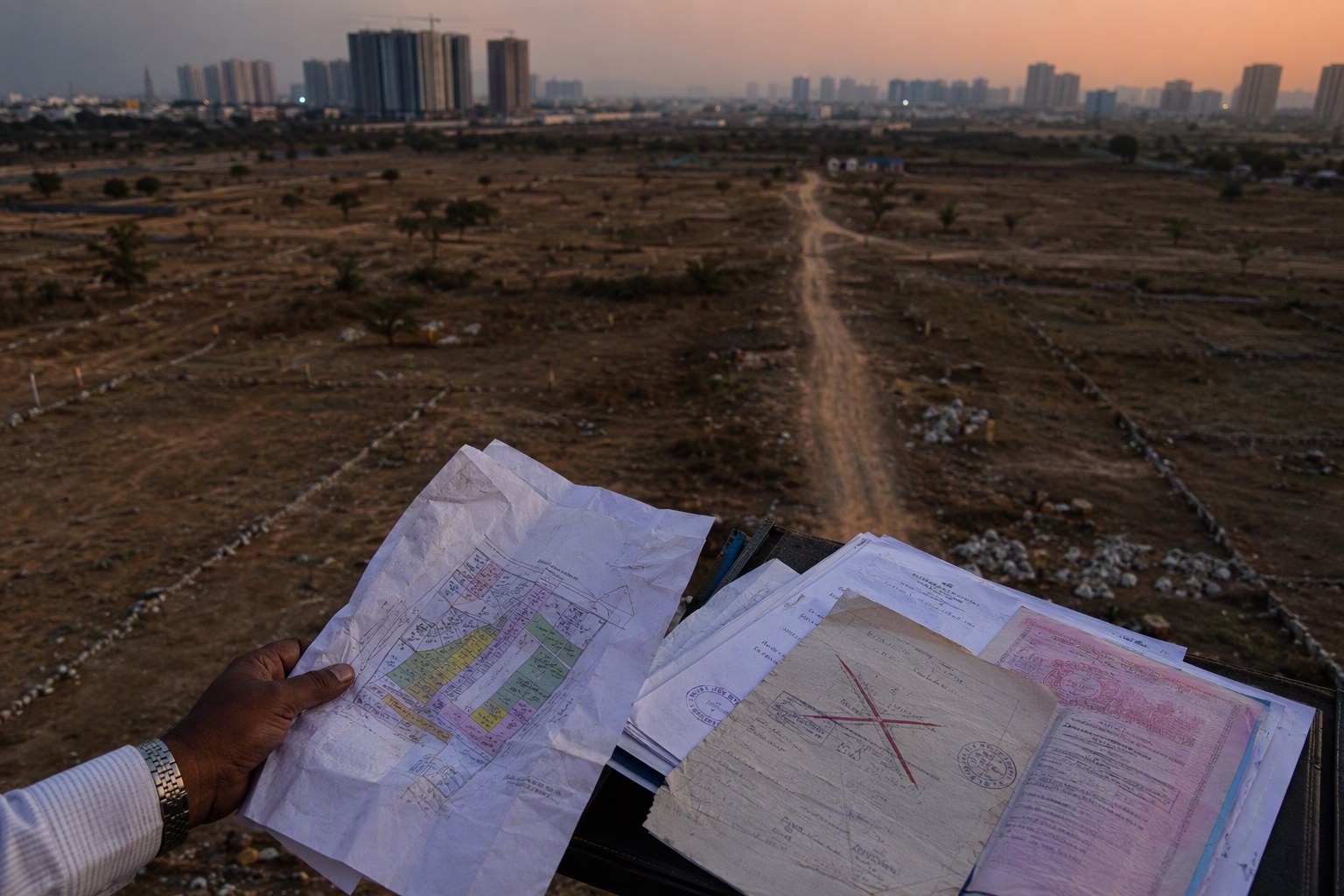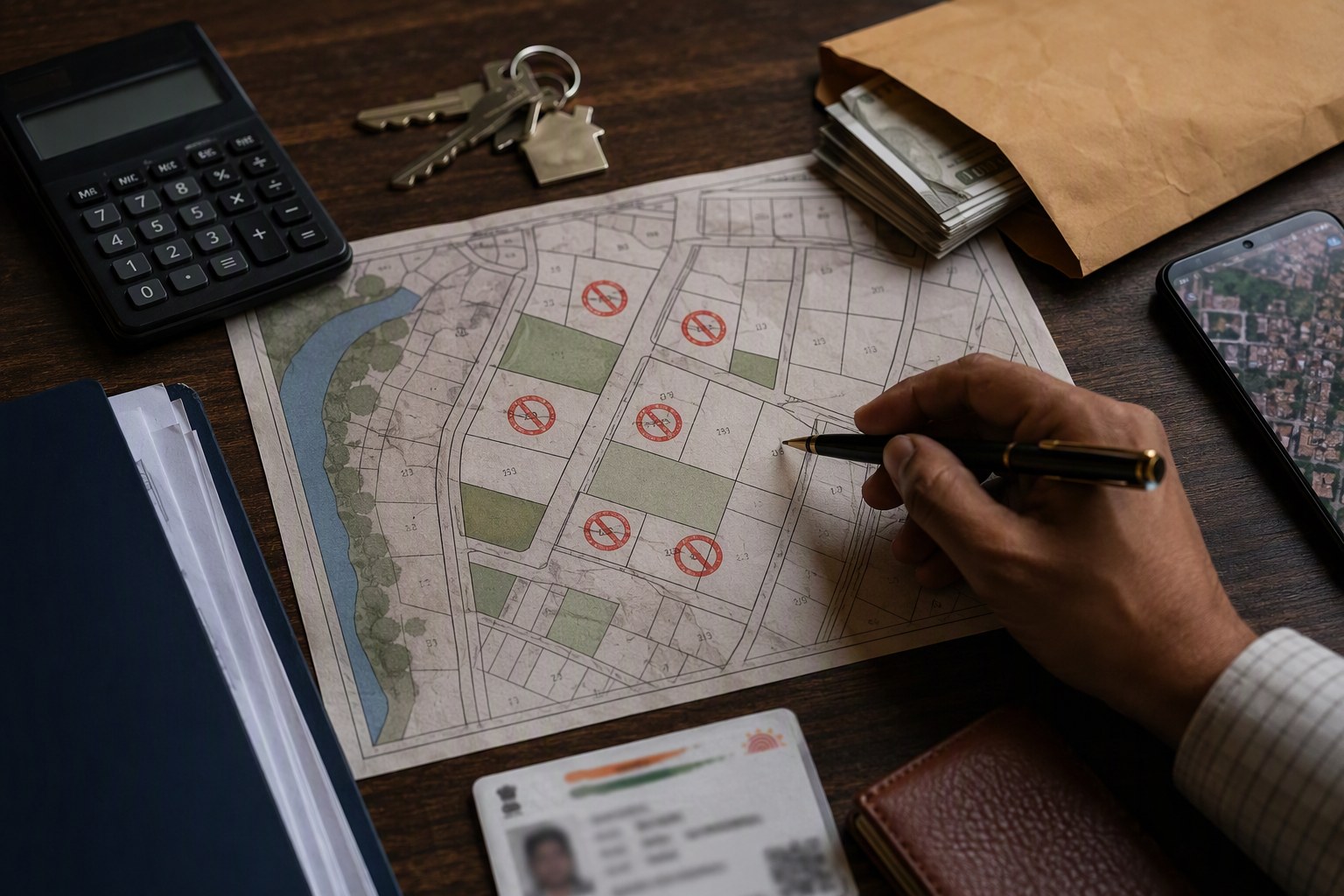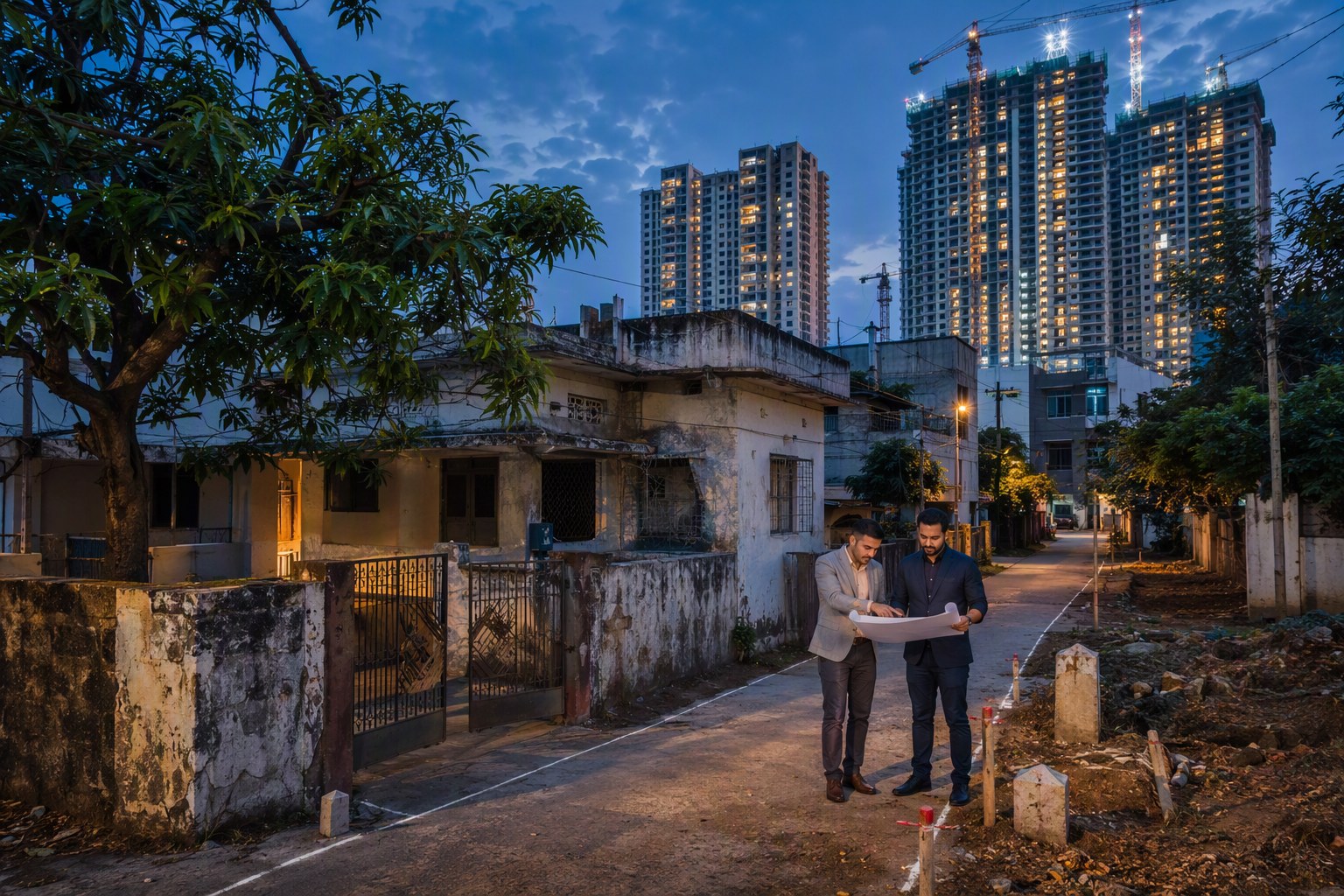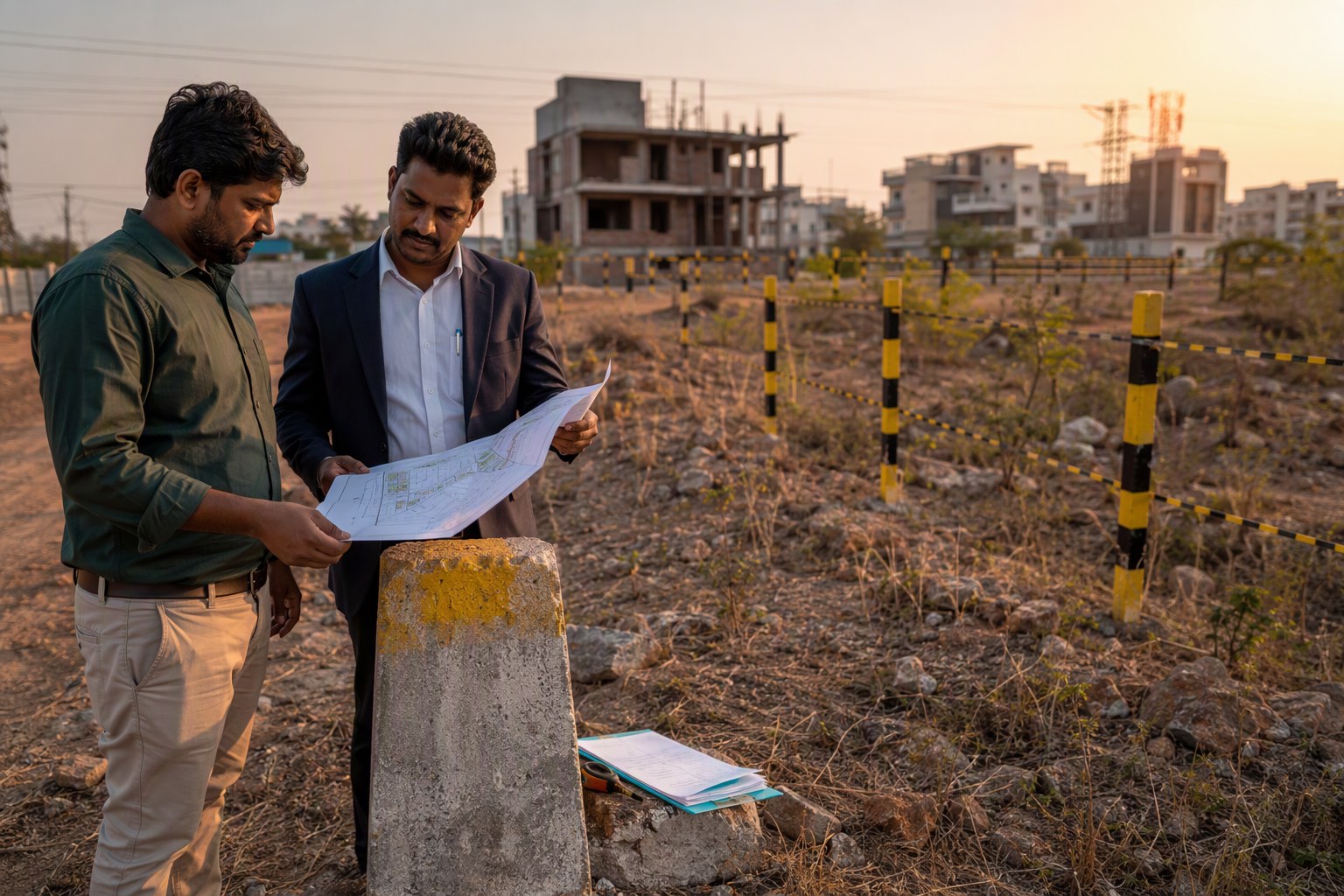
Yes, nearby 22-A land can drag down your plot’s exit value, even when your own survey number is clean. The hit may not show up on day one. It usually appears when you try to resell, when a buyer’s lawyer studies the village map, or when a bank valuer asks why a prohibited parcel sits beside the approach road, nala, buffer, government land, temple land, assigned land or disputed survey boundary. In Telangana, Section 22-A is not a small side issue. As per latest IGRS data, there are 3,076,153 prohibited properties recorded under Section 22-A. That scale is enough reason for plot buyers around Hyderabad to check not only the plot, but also the surrounding land fabric.
We’ve seen this many times around growth corridors like Mokila in Shankarpally mandal, Narsingi and Kokapet in Gandipet mandal, Tellapur in Ramachandrapuram mandal, Adibatla in Ibrahimpatnam mandal, and village belts near Maheshwaram, Shamshabad and Ghatkesar. The plot document may look fine. The layout brochure may look neat. But if a neighbouring parcel has a 22-A tag or an unresolved government claim, buyer confidence becomes softer. That softness gets converted into negotiation pressure at exit.
22-A land near your plot: the short answer for investors
If your plot is inside a clean approved layout but the adjacent land is prohibited, your sale deed may still be registerable. But resale comfort is a different matter. A buyer is not only buying your registered document. They are buying future peace, road access, bankability, construction confidence and the ability to sell again without drama.
That is why nearby 22-A land matters in three practical ways:
- Resale confidence: Buyers may fear boundary disputes, access issues, future notices, or confusion in survey numbers.
- Lender comfort: Banks and housing finance companies may ask extra questions if the neighbouring survey numbers are under prohibition or litigation.
- Exit pricing: Even a technically clean plot may attract lower offers if the micro-location carries a risk tag.
Before paying token advance, check the target plot through the Section 22-A Prohibited Property Check. Then verify the survey number and nearby survey numbers using the Survey Number Finder. For a second layer, run the chain through the Encumbrance Certificate Search and compare the ready reckoner using the Market Value / Guideline Value Search.
Why 22-A land can affect exit value even when your plot is not prohibited
Property value is not decided only by your sale deed. It is decided by market trust. In Hyderabad’s plotted development market, trust comes from title clarity, approach road clarity, layout approval, land use, mutation trail, tax records, and the comfort that a new buyer can register, mortgage and build without running from one office to another.
Section 22-A properties are properties where registration is prohibited or restricted under government records. This can involve government land, assigned land, endowment land, wakf-related entries, ceiling surplus issues, court-attached properties, disputed survey entries or other notified restrictions. The exact reason must be checked case by case. The risk for a nearby buyer is not that every surrounding 22-A parcel automatically contaminates their plot. That is not how title works. The risk is perception plus practical difficulty.
For example, say you are buying a plot near a village boundary in Gandipet mandal. Your plot number is part of a layout, but the rear side touches an old survey number that appears in prohibited property records. A future buyer may ask: Was the layout carved correctly? Is the compound wall within private patta land? Is the access road laid through government land? Was any buffer area shown as saleable? If the answers are not documented, your buyer will bargain hard.
In our experience, the market punishes uncertainty faster than it rewards clarification. A seller can show documents, but a buyer with cash has options. If another plot in the same locality gives similar location benefit without nearby 22-A noise, the cleaner plot gets preference.
How nearby 22-A land changes buyer psychology
Hyderabad buyers have become more alert. Earlier, many people looked at only passbook, pahani and sale deed. Now even first-time plot buyers ask for village map, HMDA or DTCP layout copy, EC, link documents, land use and SRO remarks. NRIs are even stricter because they cannot personally visit mandal office or SRO office again and again.
When a prohibited land parcel is nearby, four doubts usually start:
- Boundary doubt: Is my plot sitting fully inside private land, or has some portion overlapped with a government or assigned survey number?
- Road doubt: Is the road shown in the layout actually passing through allowed land?
- Future development doubt: Will any government action, court matter or survey correction affect compound walls, roads or open spaces?
- Mortgage doubt: Will my bank reject or delay the loan later?
These doubts may or may not be legally valid. But real estate pricing is not purely legal. It is emotional and practical. A buyer who feels even mild discomfort will either walk away or ask for a discount. That is where exit value gets hit.
22-A land and lender comfort: why banks become cautious
Bankers and valuation teams are not paid to take title risk. They check the property offered as security. If their lawyer sees 22-A entries around the parent survey, adjacent survey or approach road, the file may move slowly. Sometimes they ask for extra certificates, revenue clarification, layout sanction copies, old pahanis, mutation extracts, or a fresh legal opinion.
For flats, lenders usually focus on project approval and land title held by the developer. For open plots, especially in peripheral belts, they look more closely at the survey history. This is why buyers in places like Mokila, Kollur, Velimela, Shankarpally, Kandukur, Maheshwaram, Tukkuguda and Ghatkesar should not stop at a sale deed scan. The land story matters.
A plot may be attractive because it sits close to a highway, ORR service road, proposed growth node or employment belt. But if the approach passes beside land under prohibition, the lender may ask: What is the legal status of the road? Is the layout road approved? Is it gifted to the local body where required? Is the road shown in revenue records or only on a private brochure?
Use the Find Your SRO Office tool to identify the relevant sub-registrar office, and then match registration jurisdiction with village and mandal details. If there is a CERSAI concern on an existing transaction, the CERSAI Charge Check can also help you spot registered security interests.
Exit value is not the same as current asking price
Many investors make one common mistake. They judge a plot by the current seller’s confidence, not by the future buyer’s fear. A seller may say, “Sir, our plot is clear. Only neighbouring land has issue.” That may be true. But your exit buyer will again ask the same question after a few years. If the surrounding issue remains unresolved, you inherit the explanation burden.
Exit value is the price a cautious buyer is ready to pay when they have alternatives. In active markets like Tellapur, Kokapet, Narsingi and Mokila, alternatives are usually available. If your plot needs ten minutes of explanation and another plot needs none, the second plot becomes more liquid.
Liquidity is a hidden part of pricing. A plot that sells quickly at a fair rate is often better than a plot that looks cheaper today but takes months to exit because every buyer’s advocate raises the same red flag.
22-A land near layouts: what to check before buying
For open plots, I prefer a layered verification. Do not depend only on the layout salesperson or broker. Good brokers will support verification. Weak brokers will rush you with “last plot available” pressure.
1. Check your survey number and adjacent survey numbers
Start with the exact survey number, sub-division number, village and mandal. Then check neighbouring survey numbers on all sides, especially land touching the road, open space, nala, lake buffer, hillock, graveyard, temple, government school, forest edge or assigned land pocket. The Section 22-A Prohibited Property Check is the first stop for this.
2. Compare EC with the land story
An Encumbrance Certificate is not a full title certificate, but it is still useful. It shows registered transactions for the period searched. If the parent land was split, sold, mortgaged or transferred, the EC should broadly match the seller’s story. Use EC Analyzer after obtaining the EC to read transaction patterns more comfortably.
3. Match layout approval with ground reality
If the plot is in an HMDA or DTCP layout, check whether the road, open space, plot boundaries and total extent match the approval. Do not assume every plotted venture using a fancy arch has valid approval. In fast-growing areas, unauthorised internal plotting still happens.
4. Check land use and road width
A clean title is not enough if land use and road access are weak. For construction-led exit, use the Land Use Zone Finder and Road Width Check. Buyers who plan to build will ask these questions later.
5. Speak to the right local office
For village-level doubts, the mandal revenue office trail, pahani history and local survey inputs matter. For registration doubts, SRO feedback matters. For layout approval, check the planning authority records. One office rarely gives the entire picture.
When nearby 22-A land is a manageable risk
Not every nearby 22-A entry should scare you away. Some situations are manageable if the boundary is clearly demarcated and your access is independent.
- Your plot is inside an approved layout with clear sanctioned plan and released plots.
- The prohibited parcel is physically separated by a public road, nala, buffer or another clearly identified boundary.
- Your parent survey number does not overlap with the prohibited survey number.
- The approach road is approved and not dependent on the disputed or prohibited land.
- The seller provides link documents, EC, layout approval and revenue records that speak the same language.
In such cases, a buyer may proceed after legal review. Still, keep all clarifications in writing. Oral comfort is useless at resale time.
When nearby 22-A land should make you pause
Some warning signs deserve a harder pause. I would be cautious if the plot’s access road passes through a prohibited parcel, if the boundary stones are missing, if the seller cannot identify the exact survey limits, or if the layout plan shows one thing while ground occupation shows another.
Also be careful when the land is near old village commons, cheruvu areas, shikam land, assigned land clusters, endowment land, wakf land or government land pockets. Hyderabad’s expansion has pulled many such lands into the investment market. Some parcels are perfectly private and clean. Some are not. The difference is in documents, not in marketing words.
My simple rule: if a plot needs a story to explain why the neighbouring prohibited land will never affect it, verify that story before paying advance. Stories are free. Corrections after registration are not.
How to price a plot when 22-A land is nearby
Do not blindly reject, and do not blindly accept. Price the risk. But pricing the risk does not mean inventing a discount percentage. It means comparing liquidity, documentation quality and buyer comfort.
Ask yourself:
- Will a bank-funded buyer accept this plot without delay?
- Will an NRI buyer’s lawyer clear it without multiple clarifications?
- Can I show the boundary and approach road clearly on documents and ground?
- Is the ready reckoner value aligned with the property description and SRO jurisdiction?
- Will this plot be easier or harder to sell than other plots in the same village?
Use the Market Value / Guideline Value Search to understand government market value references, and the Stamp Duty Calculator to estimate registration cost for the transaction value you are considering. If you are comparing land plus building potential, the Composite Value Calculator can help structure your assessment.
22-A land due diligence checklist for Hyderabad plot buyers
| Check | Why it matters | Where to start |
|---|---|---|
| Target survey number | Confirms whether your own land has a prohibition risk | Section 22-A Prohibited Property Check |
| Adjacent survey numbers | Shows nearby risk that can affect resale confidence | Survey Number Finder |
| EC and link documents | Checks registered transaction trail and title movement | Encumbrance Certificate Search |
| SRO jurisdiction | Helps match village, mandal and registration office | Find Your SRO Office |
| Land use and road | Supports future construction and lender comfort | Land Use Zone Finder |
Practical examples from Hyderabad’s growth belts
In Kokapet and Narsingi, the market is mature enough that buyers ask sharp questions on access, road width and planning status. A plot with a weak surrounding land story gets questioned quickly. In Mokila and Shankarpally mandal, many buyers are long-term investors, so they pay attention to village maps and parent survey clarity. In Tellapur and Kollur, the buyer pool includes IT employees and NRIs who usually prefer bankable, clean paperwork.
On the other side of the city, around Adibatla, Tukkuguda, Maheshwaram and Shamshabad, land conversion stories can be more complex because older agricultural parcels, plotted layouts, road proposals and institutional lands may sit close to each other. In Ghatkesar and Medchal-side belts, survey-level clarity is equally critical because village boundaries and old revenue entries can create confusion for inexperienced buyers.
The point is not that one locality is safe and another is risky. The point is that micro-location matters. Two plots in the same village can have very different exit comfort depending on what sits beside them.
Final view: nearby 22-A land is an exit risk, not always a title defect
Nearby 22-A land does not automatically make your plot illegal. But it can reduce buyer confidence, delay bank approvals and weaken your exit pricing. For investors, that is enough reason to check the neighbourhood survey fabric before signing.
My view is simple. If you are buying for self-use and the plot is clean, approved, well-demarcated and independently accessible, nearby 22-A land may be manageable after legal verification. If you are buying purely for investment, be stricter. Your profit depends on how easily the next buyer says yes.
With 3,076,153 prohibited properties recorded under Section 22-A as per latest IGRS data, Telangana buyers cannot treat this as a rare issue. Check early, ask specific questions, and keep written records. A clean exit begins before purchase, not after you decide to sell.
Frequently Asked Questions
Can nearby 22-A land stop my plot registration?
Not necessarily. If your plot survey number is not prohibited and the documents are clear, registration may be possible. But nearby 22-A land can still raise doubts about boundary, access road and resale comfort.
Should I check only my plot number or also surrounding survey numbers?
Check both. For open plots around Hyderabad, surrounding survey numbers matter because access roads, layout boundaries and future buyer confidence depend on the land around your plot also.
Will banks reject a loan if 22-A land is nearby?
Banks may not reject only because a nearby parcel is prohibited. But they may ask for extra legal clarification if the prohibited land affects boundary, approach road, parent survey or layout approval.
Is an approved layout safe from nearby 22-A risk?
An approved layout gives better comfort, but still verify the parent survey, released plots, approach road and adjacent land status. Approval reduces risk; it does not replace title due diligence.
What is the first tool I should use before buying a plot?
Start with the Section 22-A Prohibited Property Check for the target and nearby survey numbers. Then review EC, SRO jurisdiction, guideline value, land use and road access before paying advance.