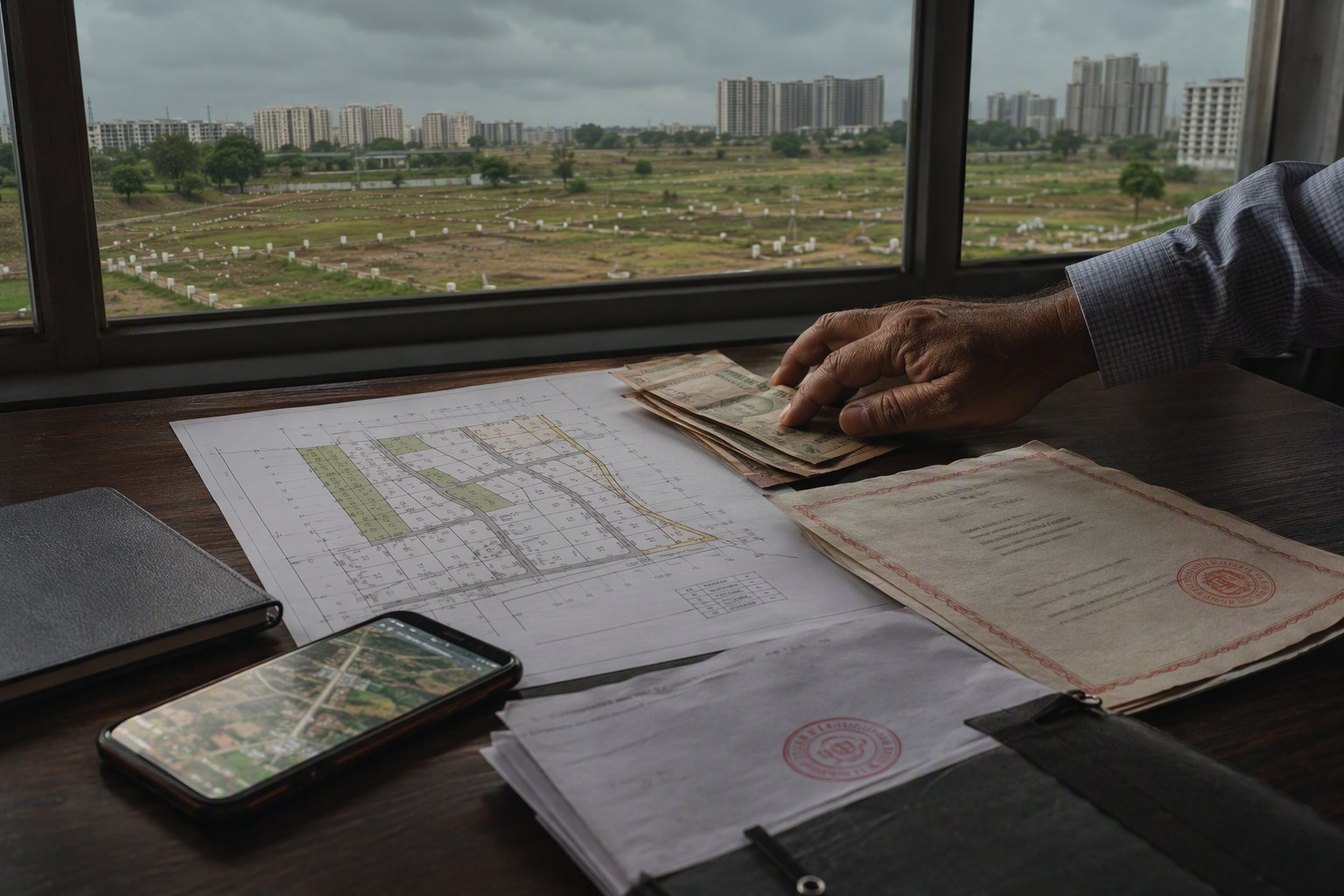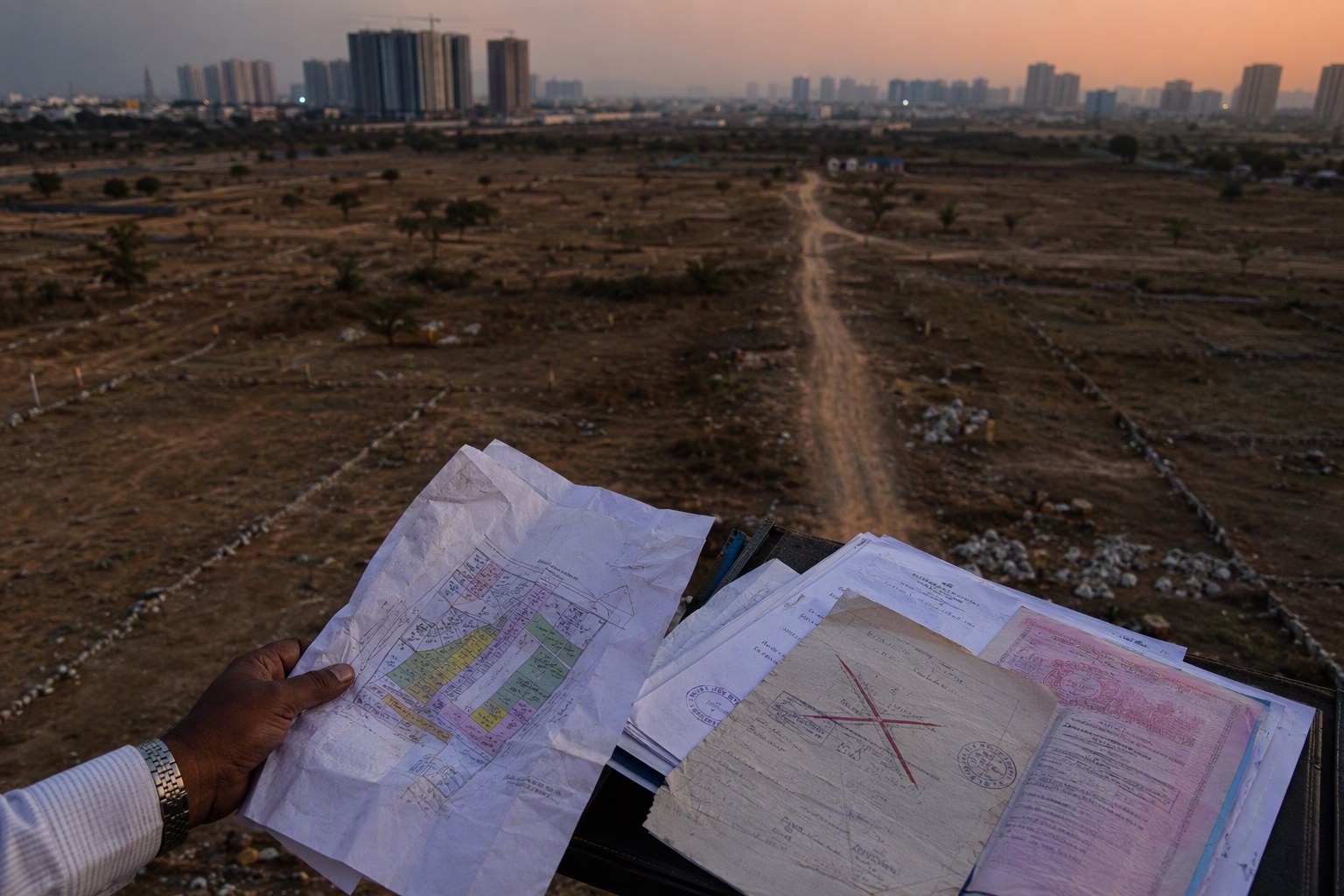
The Telangana Plot Trap That Looks Too Affordable at First usually begins with one tempting line: “Sir, this is much cheaper than the surrounding market.” In our experience, the real question is not whether the plot is cheap. The question is whether the next buyer, banker, SRO and registrar will treat it as clean, accessible and saleable when you want to exit.
One investor I’ll call Ravi, an IT professional from Kondapur, recently shortlisted a plot on the western side of Hyderabad. The quoted price looked lower than what he was hearing in Mokila, Kollur and Shankarpally circles. The brochure had the usual promises: growth corridor, future development, nearby villas, good appreciation. The land was not far on the map. The seller sounded confident. The layout photo looked neat.
Then came the field visit.
The approach road narrowed suddenly near the last stretch. The survey number shown by the broker did not match the village record he later checked. The EC did not clearly support the ownership story. The registration readiness was also doubtful because one adjacent parcel had a prohibited-property flag under Section 22-A. That one affordable plot started looking less like an opportunity and more like a resale problem waiting to happen.
Cheap land is not always risky. But land that is cheap without a clear reason needs tougher questioning than a premium plot in a known location.
Why The Telangana Plot Trap That Looks Too Affordable at First Hurts Resale Liquidity
Resale liquidity means how easily you can sell the plot when you need money, want to upgrade, or plan to book profits. In Hyderabad’s land market, liquidity is not decided only by location names like Tukkuguda, Adibatla, Shadnagar, Ghatkesar, Chevella or Patancheru. It is decided by boring but powerful details: access, title flow, EC history, SRO acceptance, land-use comfort, survey clarity and buyer confidence.
We’ve seen buyers get excited by a plot because it is quoted lower than nearby ventures. They compare only the asking price. That is dangerous. In Telangana, one survey number can be clean while the next one can carry restrictions, disputes, government classification issues, assigned land history, ceiling complications or registration refusal risk.
The database context is serious. Verified.RealEstate tracks 3,076,153 Section 22-A prohibited property entries in Telangana. In local language, people loosely say “22-A lo unda?” before touching a deal. That question is not formality. If a property or survey number is affected by Section 22-A, registration can become difficult or blocked depending on the nature of entry and current government records.
For a plot investor, the loss is not only legal. It is commercial. If the future buyer senses difficulty, they will ask for a discount. If their bank lawyer raises objections, the deal can fall through. If the SRO refuses or delays registration, the property becomes illiquid exactly when you want to sell.
The Telangana Plot Trap That Looks Too Affordable at First Often Hides in Access
Ask any experienced local broker in Hyderabad outskirts. They will tell you: access road can make or break resale. A plot may be near a main road on Google Maps, but the actual legal access may be through a narrow kutcha path, private land, nala edge, or a village road that is not sufficient for the buyer’s intended use.
In locations like Maheshwaram, Kandukur, Shankarpally, Moinabad, Ibrahimpatnam, Yacharam and Medchal side villages, the last 200 metres can decide value. A 30-feet internal road inside a layout is not enough if the approach road from the public road is disputed or too narrow. Buyers often forget this point because the site visit is done in the seller’s vehicle, at a convenient time, with a person who already knows the route.
Before paying token advance, walk or drive the full access route yourself. Check whether a car can pass comfortably. Check if there is a physical gate, bund, agricultural boundary, nala, graveyard, forest boundary, lake buffer, railway line or high-tension corridor nearby. Ask the locals what happens in monsoon. One waterlogged approach road can reduce buyer interest sharply.
Use the Road Width Check for an initial screening. It will not replace ground inspection, but it gives you a structured way to think about road width before emotions take over.
EC Review: The Part Many Plot Buyers Do Too Late
Many buyers ask for Encumbrance Certificate only after negotiating the price. That is backwards. EC review should come before price excitement. The EC shows registered transactions, mortgages, releases, partitions, gift deeds, sale deeds and other registered interests for the chosen period. It does not prove everything by itself, but it gives the first serious view of title movement.
For plots around Hyderabad, I prefer checking EC for a longer period where possible, then matching it with link documents and revenue records. A clean-looking sale deed is not enough if the earlier chain has gaps. If a seller bought from a GPA holder, inherited through family partition, or received land after conversion, every step needs to be understood.
Use Encumbrance Certificate Search to begin the EC review. For a deeper reading, run the document trail through EC Analyzer. If there is any bank loan or possible charge, check CERSAI Charge Check too. A buyer who does these three checks before token payment usually negotiates from a stronger position.
One practical tip: compare names in the EC with names in the latest sale deed, pattadar passbook, Dharani record where applicable, and pahani. Spelling variations are common, but unexplained ownership jumps are not small issues. If the EC mentions a document number, collect that document. Don’t accept “old paper missing saar” as a casual explanation.
Registration Readiness Is Not the Same as Having Documents
This is where many Telangana plot buyers get trapped. The seller may have a sale deed, layout copy, tax receipt, link documents and even a confident lawyer. Still, the plot may not be registration-ready at the concerned SRO. Registration readiness means the Sub-Registrar Office can accept and process the transaction based on current records, classification and restrictions.
In Telangana, you must check whether the property falls under the correct SRO and whether there are any restrictions connected to survey number, village, land classification or government entries. Use Find Your SRO Office and SRO Village Directory to identify the relevant office and village mapping.
The ready reckoner or market value is another signal. Do not rely only on the broker’s “running rate”. Check official market value guidance using Market Value / Guideline Value Search. If the quoted price is far below the surrounding conversation, ask why. It may be distress sale. It may be access issue. It may be title issue. It may be a non-saleable pocket. The reason matters.
For registration cost planning, use Stamp Duty Calculator. Even serious investors sometimes calculate land cost only and forget stamp duty, registration fee, mutation follow-up, boundary work, legal review and future resale costs.
Section 22-A: The Telangana Plot Trap That Looks Too Affordable at First Can Start Here
Section 22-A prohibited property entries are not a small side topic. With 3,076,153 entries in the Verified.RealEstate prohibited-property database context, a buyer cannot treat this as rare. The entry may relate to government land, assigned land, endowment land, Wakf concerns, court matters, surplus land, acquisition issues or other restricted categories depending on the record.
When a plot is quoted too affordably, ask for the exact survey number, sub-division, village and mandal. Then check whether the land or related survey number is appearing in prohibited lists or government records. Use Section 22-A Prohibited Property Check before you pay any non-refundable advance.
One more point from the ground: sometimes the seller says, “Our bit is clear, only neighbouring bit has issue.” That may be true. It may also be a half-truth. In old agricultural survey numbers, sub-division clarity is crucial. If the layout or plot document does not clearly connect to an approved, saleable portion, future buyers will become nervous.
Use Survey Number Finder to start the survey mapping exercise. Then match it with village maps, Dharani data where applicable, pahani and layout records. For any serious investment, take help from a local document writer or advocate who regularly deals with that mandal and SRO. A general opinion from a faraway office may miss local record issues.
Locality Name Premium Can Mislead You
Hyderabad land marketing uses broad locality names very creatively. A plot advertised as “near Kollur” may actually be in a different village pocket. “Shankarpally side” may mean several mandals and very different access profiles. “Tukkuguda growth zone” may be used for land that is not practically close to the ORR exit. “Adibatla belt” can cover clean HMDA layouts as well as raw land parcels with unclear road and conversion status.
This is why database context matters more than brochure language. Check the actual village, mandal, survey number, land-use zone and SRO. Use Land Use Zone Finder to understand whether the intended use is comfortable. If you are considering construction later, FSI/FAR Calculator can help you think about development potential, subject to applicable rules and approvals.
For villa plots and gated layouts, also see whether RERA applies. If it is a project that should be registered, check RERA Project Lookup. Not every standalone plot sale will be a RERA project, but where RERA is relevant, ignoring it is poor diligence.
How Smart Investors Compare a Cheap Plot with a Saleable Plot
Here is a practical comparison we use when reviewing land around Hyderabad outskirts.
| Check | Cheap-looking plot | Saleable plot |
|---|---|---|
| Access | Approach depends on informal path or unclear road | Clear public access and usable road width |
| EC | Gaps, old mortgage doubts, missing link papers | Traceable ownership flow with supporting documents |
| Survey clarity | Broker gives plot number but avoids exact survey details | Survey number, sub-division, village and mandal are clear |
| Registration readiness | “We will manage at SRO” type answer | Current SRO, market value and document requirements checked |
| Section 22-A risk | No clear prohibited-property check | Checked against government records before advance |
| Exit market | Only seller claims future appreciation | Multiple buyers can understand and verify the asset |
A plot becomes liquid when the next buyer can verify it without too much drama. If every answer depends on the seller’s personal assurance, resale will be slow. If every detail is document-backed, the buyer pool expands.
Due Diligence Order Before Paying Token Advance
Do not start with price negotiation. Start with identity of the land. In my view, this is the safer order:
- Get the exact village, mandal, survey number, sub-division and plot number.
- Check Section 22-A status using Section 22-A Prohibited Property Check.
- Review EC through Encumbrance Certificate Search and document history through EC Analyzer.
- Confirm the concerned SRO using Find Your SRO Office.
- Check guideline value using Market Value / Guideline Value Search.
- Inspect access road physically, preferably on a weekday and after rain if possible.
- Match layout approval, land-use zone and ground boundaries.
- Calculate registration cost with Stamp Duty Calculator.
- Pay advance only with clear refund terms if title, EC, 22-A or registration readiness fails.
If the seller refuses to share basic details before token payment, step back. Genuine sellers may be cautious, but they should not hide survey number or village information from a serious buyer.
My View on Affordable Plots Around Hyderabad
I am not against affordable plots. In fact, many sensible investors made money by buying before a location became popular. But the successful ones usually bought land that was boring on paper and clear on records. Not the land that needed too many explanations.
Hyderabad’s growth has pushed buyers towards outer belts like Shadnagar, Maheshwaram, Yacharam, Chevella, Shankarpally, Medchal and Ghatkesar. These markets have genuine opportunities. They also have mixed land histories. Agricultural conversions, layout approvals, gram panchayat legacies, HMDA permissions, Dharani records, pahani entries, family partitions and SRO practices all meet in these zones.
That is why the Telangana plot trap is not about one bad locality. It can appear anywhere a buyer is rushed, under-informed and emotionally attached to a low quote. The antidote is simple but strict: verify first, negotiate next, pay last.
If you remember only one line from this article, remember this: a cheap plot should become cheaper only after you understand the risk, not before.
Frequently Asked Questions
What is the biggest risk in buying a very cheap plot in Telangana?
The biggest risk is poor resale liquidity due to unclear access, weak title flow, EC gaps, Section 22-A restrictions or SRO registration issues. A low price is useful only if the plot can be verified and resold without major objections.
How do I check if a plot is under Section 22-A?
Collect the exact survey number, village and mandal, then check prohibited-property status using Section 22-A Prohibited Property Check. If there is any match or confusion, take a local legal opinion before paying advance.
Is an Encumbrance Certificate enough to prove plot ownership?
No. EC is a key document, but it must be read with link documents, sale deeds, pahani, Dharani record where applicable, layout approval and seller identity. EC tells you registered transaction history; it does not automatically clear every revenue or classification issue.
Why does road access matter so much for plot resale?
Future buyers and banks prefer plots with clear, usable and legally comfortable access. If the approach road is narrow, informal, disputed or waterlogged, the buyer pool reduces and resale negotiation becomes harder.
When should I pay token advance for a plot?
Pay token advance only after basic checks on survey number, EC, Section 22-A status, SRO, access and guideline value. The advance receipt should clearly mention refund terms if title, registration readiness or prohibited-property checks fail.