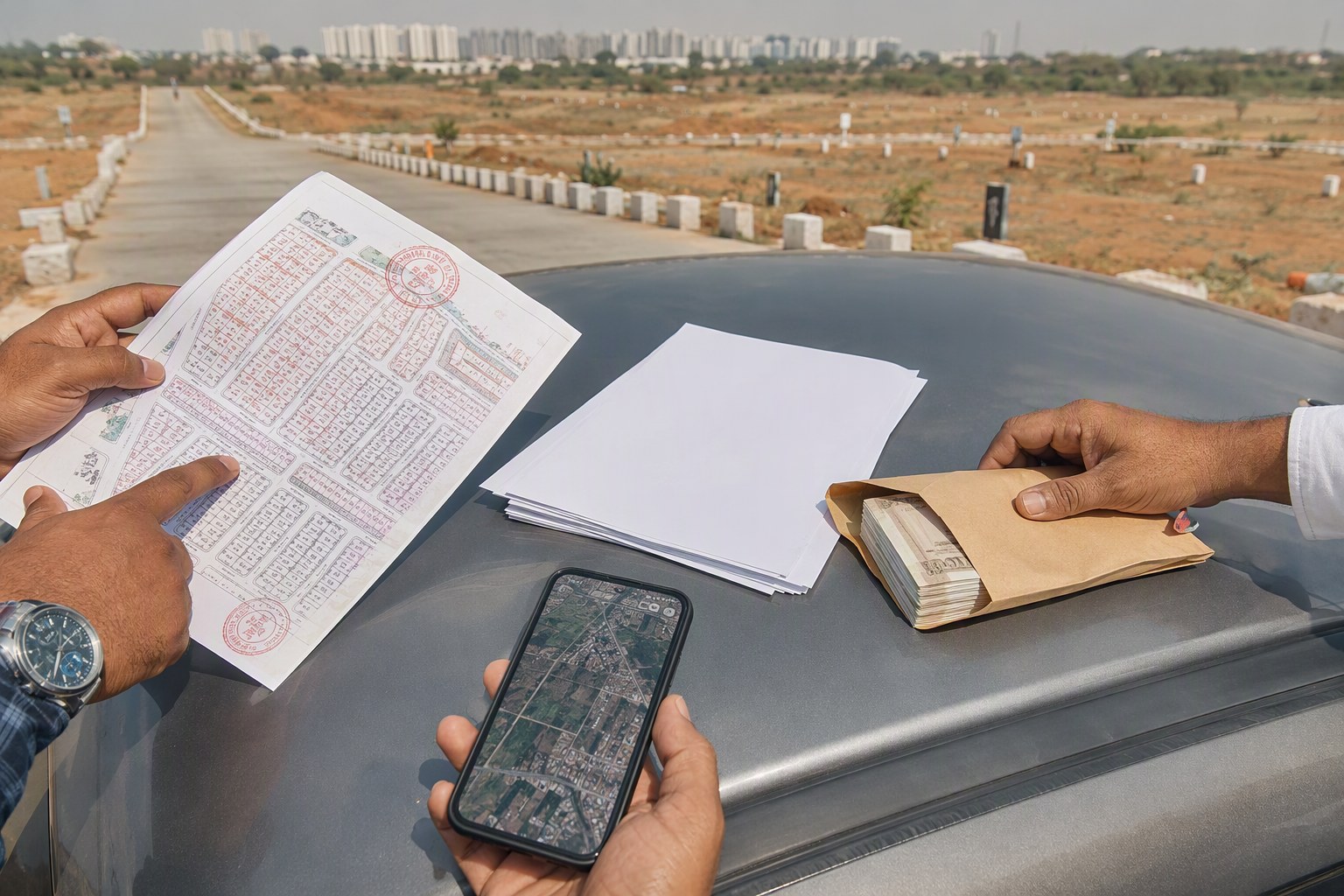



Land pooling notice risk is becoming one of the quietest plot investment traps around Hyderabad’s growth corridors. A buyer may check the sale deed, pahani, EC and market value, but still miss a planning notification that can change the size, shape, access, use or resale value of the land. This risk is sharper in Telangana because, as per latest IGRS data, the State already has 3,076,153 prohibited property entries under Section 22-A. That number should make every plot buyer slow down before paying advance.
Here is the news-style takeaway: a clean-looking plot on paper is not always a clean investment. Land pooling, road widening, master plan changes, layout regularisation issues, conservation zones, assigned land history and Section 22-A restrictions can sit in different corners of the government record. If you check only one record, you are seeing only one side of the property.
In our experience, the biggest plot losses do not happen because buyers ignored the price. They happen because buyers ignored the notification.
Hyderabad’s outer growth has made this more urgent. Buyers are moving towards Kokapet, Narsingi, Mokila, Kollur, Tellapur, Shankarpally, Moinabad, Shamshabad, Tukkuguda, Adibatla, Maheshwaram, Kandukur, Ibrahimpatnam, Yacharam and Shadnagar side land pockets. Many of these locations are seeing roads, planning zones, public infrastructure proposals and layout conversions. That is good for long-term growth, but only if the specific survey number survives the checks.
Land Pooling Notice: What plot buyers must understand first
A land pooling notice is not the same as a regular sale document issue. In simple terms, land pooling is a planning method where government or a planning authority may reorganise land parcels for roads, infrastructure, public use and planned development. Owners may receive reconstituted plots, adjusted extents or benefits depending on the scheme and rules. The exact impact depends on the notified area and the authority involved.
For a plot investor, the risk is not only whether the land will be taken. The bigger issue is uncertainty. A survey number under a planning process can become difficult to sell, finance, register or develop until the position is clear. Even if registration is technically possible, a smart buyer will discount the price heavily when a notification is hanging over the land.
We have seen this mindset in Hyderabad’s plot market. A buyer may happily pay a premium for a plot near an upcoming road, but the same buyer will step back if that road line passes through the plot. Location and notification can push value in opposite directions.
Land Pooling Notice and Section 22-A: Two separate checks, one serious risk
Many buyers mix up land pooling notices and Section 22-A prohibited property entries. They are different, but both can damage a plot transaction.
Section 22-A is connected to prohibited properties where registration may be refused or restricted under law. Telangana has 3,076,153 such entries as per latest IGRS data. These can include government land, assigned land, endowment land, wakf-related entries, ceiling surplus lands and other categories based on official records.
A land pooling or planning notice may not automatically mean the land is under Section 22-A. Still, the buyer has to check both. Why? Because a land parcel can have more than one problem. One survey number may have an old assignment trail, another may fall in a proposed road, and another may have a layout approval mismatch. In some villages, old revenue history and new planning proposals sit on top of each other.
Before paying token amount, use the Section 22-A Prohibited Property Check and then verify the survey details through the Survey Number Finder. These two checks will not replace legal opinion, but they will catch many early warning signs.
Why plot investors miss land pooling notice risk
Most plot buyers follow a familiar routine. They see a layout brochure, visit the site, ask about road width, compare nearby ventures, negotiate the price and ask for EC. This is not enough anymore, especially around fast-changing mandals near Hyderabad.
The common mistake is assuming that a plotted layout boundary is final. In reality, the planning authority, revenue department, municipal body or development authority may have records that affect that boundary. A road proposal, land pooling area, buffer, public purpose reservation or zoning condition can change how the land behaves in the market.
Another mistake is relying only on the seller’s word. Sellers may say, registration is happening in this village, so no issue. That line is dangerous. Registration happening in the village does not mean every survey number is safe. Even within one village, one survey number may be clean, another may be partly affected, and another may be fully restricted.
In places like Mokila in Shankarpally mandal, Moinabad side villages, Tukkuguda in Maheshwaram mandal, Adibatla in Ibrahimpatnam mandal and Kollur-Tellapur belt, buyers should not treat all plots as equal. The difference between a safe plot and a stuck plot can be one survey boundary, one missing layout approval or one notification line.
Land Pooling Notice due diligence before buying a plot
A good plot check in Telangana should move from broad to narrow. First check whether the village and mandal are facing any planning change. Then check the exact survey number. Then check the plot number, layout approval and title chain. The last step is checking whether the same details are accepted at the SRO level.
Here is a practical due diligence table we use while reviewing plot investments:
| Check | What to verify | Why it matters |
|---|---|---|
| Section 22-A status | Whether the survey number appears in prohibited property records | Registration may be refused or legally disputed |
| Land pooling or planning notice | Whether the land falls inside a notified planning area or public purpose proposal | Plot size, access, use and resale value may change |
| EC and title chain | Past transactions, mortgages, court references and ownership flow | Confirms whether the seller has a clean transferable interest |
| Pahani and Dharani details | Owner name, nature of land, classification and survey extent | Revenue record mismatch can delay or block transaction |
| Layout approval | HMDA, DTCP or local body approval and final layout plan | Unapproved plots can face development and resale issues |
| Land use zone | Residential, commercial, conservation, agriculture or other zone | Wrong land use can hurt construction and bank funding |
| SRO mapping | Correct Sub-Registrar Office for the village | Wrong SRO assumption causes document and value errors |
For these checks, start with Property Verification Tool, then use the Encumbrance Certificate Search and Land Use Zone Finder. If you are not sure about the registering office, use Find Your SRO Office.
How a land pooling notice affects plot value
A land pooling notice can affect value in several ways. The first is market confidence. Buyers dislike uncertainty. If there is doubt about final plot extent or access road, they either reduce their offer or avoid the property.
The second impact is liquidity. A normal plot in a known approved layout can be resold faster. A plot under planning uncertainty needs a more patient buyer, usually one who understands government process and can wait.
The third impact is bankability. Banks and NBFCs may ask tougher questions when land records show planning restrictions, revenue mismatch or unclear layout approval. Even if a private buyer is ready, lack of finance can reduce the buyer pool.
The fourth impact is development. If the road width, setbacks, FSI or land use are affected, the buyer’s construction plan may not work. For larger plots, check buildable potential through the FSI/FAR Calculator and confirm the public road position using the Road Width Check.
In Hyderabad’s plot market, buyers often pay for future potential. But future potential depends on lawful development. A plot near an infrastructure corridor can be attractive. A plot inside the wrong line of that corridor can become a negotiation headache.
Red flags in mandal and village records
Plot buyers should read revenue and planning records together. A pahani may show pattadar details, but it will not always tell the full planning story. Dharani may show ownership and classification, but layout approval, road proposals and zoning may sit elsewhere.
Watch for these warning signs:
- The seller is avoiding survey number-level checks and only showing the layout brochure.
- The EC is shown only for a short period, while the land has a longer title history.
- The plot is described as near HMDA limits or near ORR, but approval copy is unclear.
- The land is agricultural in revenue records, but sold as a ready residential plot without proper conversion or approval clarity.
- The village has planning activity, but the seller says no need to check notifications.
- The plot boundary on ground does not match the layout plan.
- The road shown on brochure is not visible in revenue map or planning records.
- The seller pushes for immediate advance before sharing link documents.
Do not be shy to ask for the pahani, link documents, mutation details, layout approval proceedings, approved plan, latest EC and tax receipts if applicable. A genuine seller may take time, but will not refuse basic papers.
Ready reckoner value is not a safety certificate
Many buyers check the government market value and feel safe. Ready reckoner value is useful for stamp duty and registration cost planning, but it does not prove that the plot is free from planning or legal issues.
Use the Market Value / Guideline Value Search to understand the official value band and the Stamp Duty Calculator for transaction cost planning. But after that, move to legal and planning checks. A property can have a market value entry and still face restrictions, disputes or development limits.
This is where many first-time investors go wrong. They compare only price per square yard quoted by nearby ventures. Price comparison is helpful, but it is the last layer. First confirm that the land can be purchased, registered, held and developed without hidden government objections.
What to ask the seller when a land pooling notice is suspected
If someone tells you that a village or survey number is under land pooling discussion, do not panic. Ask direct questions and ask for documents. A serious seller should be able to answer.
- What is the exact survey number and sub-division number?
- Which mandal and revenue village does it fall under?
- Is the land part of an approved layout? If yes, who approved it?
- Has any notice been received from a development authority, municipality or revenue office?
- Is any portion marked for road, park, open space or public purpose?
- Are there old assignment, ceiling, endowment, wakf or government land references?
- Has the same plot or survey number been registered recently at the SRO?
- Is there any pending court case, family dispute or mortgage?
Also ask your document writer or advocate to compare the sale deed schedule with the approved plan and ground location. A beautiful entrance arch and compound stones do not cure a bad title.
Hyderabad localities where planning checks matter more
Planning checks matter across Telangana, but they are more sensitive in growth belts around Hyderabad. The western side, including Kokapet, Narsingi, Tellapur, Kollur, Mokila and Shankarpally, has strong buyer interest because of IT corridor spillover and road connectivity. The southern belt, including Shamshabad, Tukkuguda, Maheshwaram and Kandukur, attracts airport-side and industrial corridor interest. The eastern side, including Adibatla, Ibrahimpatnam and Yacharam, sees a mix of plotted layouts, agricultural land conversions and long-term bets.
None of these locations is automatically risky. In fact, many clean projects exist in these belts. The point is different: high-growth locations attract more planning activity. When government planning, private layouts and investor demand all meet, paperwork must be checked carefully.
We’ve seen smart buyers walk away from a cheap plot and later buy a costlier one in the same mandal because the second plot had better approval clarity. That is not fear. That is discipline.
Practical buying sequence for safer plot investment
If you are buying a plot in Telangana, follow this order before paying a non-refundable advance:
- Take the exact survey number, plot number, village and mandal in writing.
- Check Section 22-A status.
- Check EC and title chain.
- Verify pahani, Dharani and seller identity details.
- Check land use zone and any planning notification risk.
- Confirm layout approval and match it with the plot on ground.
- Check correct SRO and registration feasibility.
- Take written legal opinion before final payment.
If the seller refuses to give documents before advance, treat it as a warning. A small refundable token after basic papers is different from a large advance based on trust. In land transactions, trust should come after verification, not before.
Final view: Land pooling notice is a value issue, not only a legal issue
The market often talks about title as if it is only a lawyer’s subject. For plot investors, title and planning status directly decide value. A land pooling notice, a Section 22-A entry, a wrong land use zone or a road marking can change the resale story completely.
Telangana’s 3,076,153 prohibited property entries under Section 22-A show why buyers cannot rely on casual checks. Add planning notifications to that landscape, and the message is clear: verify the land before you fall in love with the location.
My opinion is simple. A plot with clean records, clear approval and predictable development rights is better than a cheaper plot with unanswered questions. Hyderabad will keep expanding, but not every survey number will benefit equally. The buyer who checks the notification wins before the buyer who only negotiates the price.
Frequently Asked Questions
What is a land pooling notice in Telangana plot buying?
A land pooling notice indicates that a land parcel or area may be part of a planning or reconstitution process for roads, infrastructure or public development. Buyers should check whether the exact survey number is affected before paying advance.
Is land pooling the same as Section 22-A prohibited property?
No. Section 22-A relates to prohibited property entries where registration may be restricted. Land pooling is a planning process. A buyer should check both because a plot can have planning risk and legal restriction risk separately.
Can I buy a plot if the village has a land pooling proposal?
You should not decide based only on the village name. Check the exact survey number, layout approval, land use, notices and SRO position. Some plots may be unaffected, while others may face extent, access or resale issues.
Which documents help identify land pooling notice risk?
Ask for survey number details, pahani, Dharani record, EC, link documents, layout approval, approved plan and any notices from planning or revenue authorities. Also verify land use and Section 22-A status.
Does ready reckoner value prove that a plot is safe?
No. Ready reckoner or guideline value helps estimate registration value and stamp duty. It does not confirm clean title, layout approval, land use or absence of land pooling and planning restrictions.