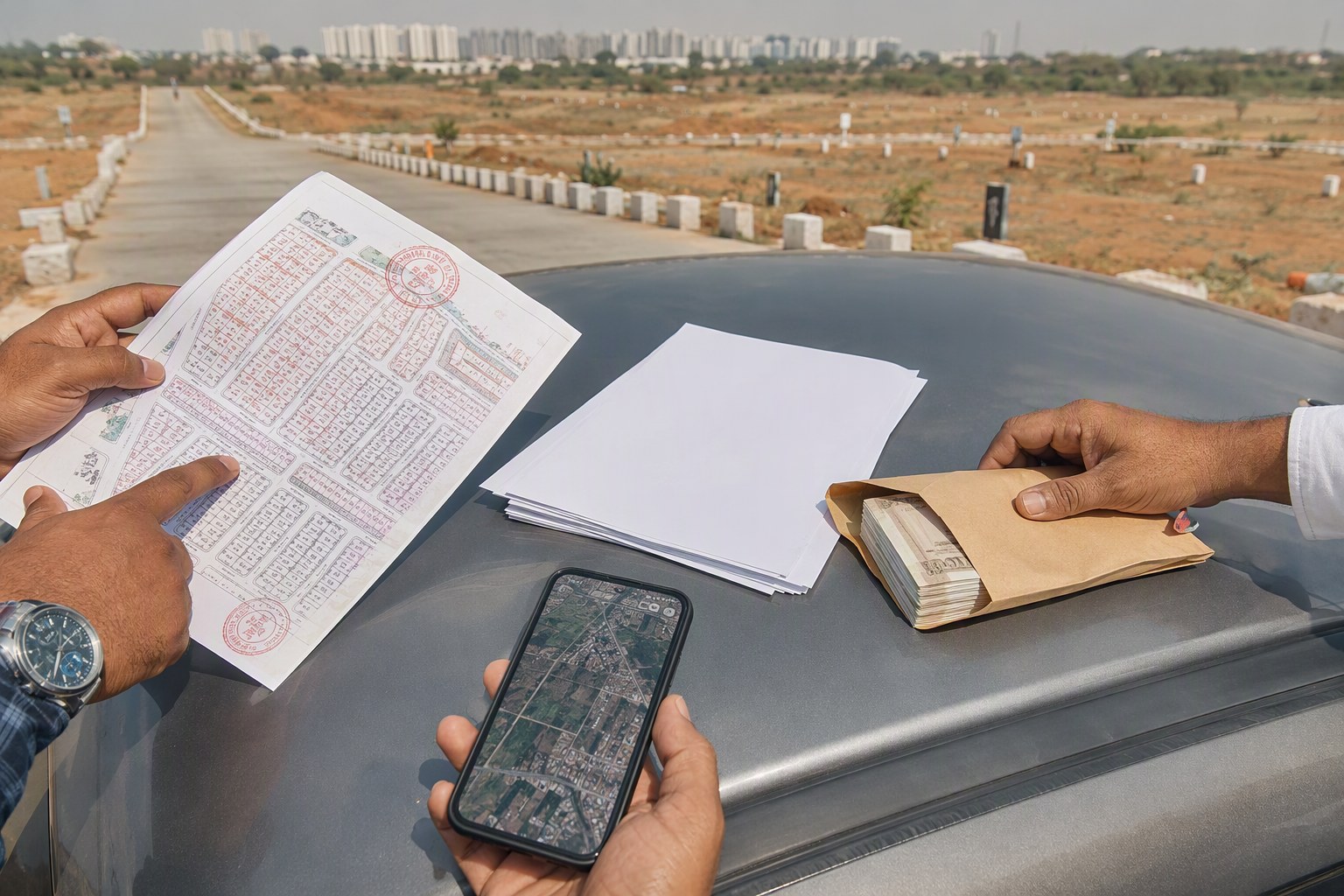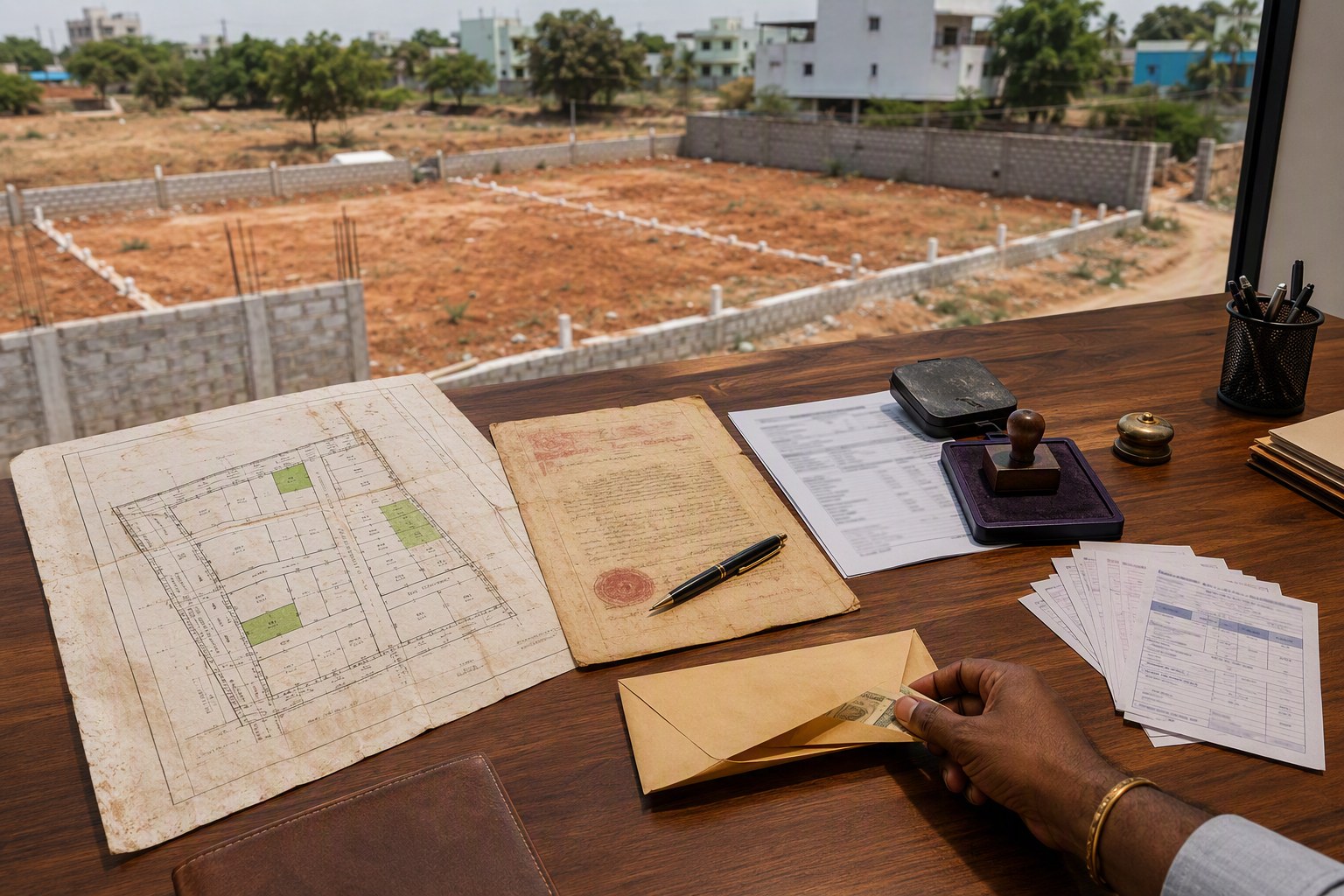



Telangana Land Filter should be the first step in any land purchase, not the last-minute legal formality before registration. As per latest IGRS data, Telangana has 3,076,153 prohibited properties listed under Section 22-A. In local language, that is about 30.76 lakh prohibited properties. For investors looking at Kokapet, Mokila, Kollur, Tellapur, Shankarpally, Maheshwaram, Ibrahimpatnam, Medchal or Ghatkesar, this one number should change the way every deal is screened.
My blunt view: do not start with price, road width, appreciation story or neighbour’s resale rate. Start with whether the land can be legally registered. A plot may look perfect on Google Maps, the seller may show old pahani copies, and the quoted rate may sound attractive. But if the survey number is hit by Section 22-A, your negotiation skill will not save the transaction.
Before asking “what is the rate?”, ask “is this survey number registrable?” That is the Telangana Land Filter every serious buyer needs.
Telangana Land Filter: why 30.76 lakh prohibited properties matter
Section 22-A prohibited property entries are not a small technical issue. They affect registration. The government record shows 3,076,153 prohibited properties in Telangana. That figure is large enough to make casual land buying risky, especially in fast-moving peri-urban belts around Hyderabad.
We’ve seen investors spend weeks comparing plots in Shankarpally mandal, Moinabad mandal, Maheshwaram mandal, Kandukur mandal and Ghatkesar mandal. They check HMDA talk, future road rumours, nearby villa projects and local broker pricing. Then, at the SRO stage, the survey number throws a problem. By then, token advance is paid, emotions are high, and the seller starts saying, “Sir, small issue only.” In land, “small issue” can become a long headache.
The Telangana Land Filter is a simple discipline: remove legal-risk land from your shortlist before comparing location advantages. This means checking the survey number, village, mandal, ownership trail, pahani references, Dharani status, EC, SRO jurisdiction and Section 22-A risk at the start itself.
For a flat in a RERA-registered project, the risk profile is different. For open land, especially agricultural land, converted plots, gram panchayat layouts, old ventures and family partition lands, the buyer has to be more careful. Land does not come with a glossy brochure that solves title issues.
Telangana Land Filter before price comparison
In Hyderabad real estate circles, price usually dominates the first conversation. “Kollur lo rate entha?”, “Mokila lo acre rate ekkada undi?”, “Maheshwaram side future ela untundi?” These are natural questions. But they are second-stage questions.
A buyer should first split every land lead into two buckets:
- Bucket 1: Survey numbers that are clean enough to investigate further.
- Bucket 2: Survey numbers with Section 22-A, title, EC, boundary, access or land-use doubts.
Only Bucket 1 deserves price comparison. Bucket 2 needs legal correction, government clarification or complete rejection depending on the problem. In our experience, disciplined investors save more money by rejecting bad land early than by bargaining hard on risky land.
Use the Section 22-A Prohibited Property Check before you calculate stamp duty or compare guideline value. Then check the Encumbrance Certificate Search and confirm the correct registration office through Find Your SRO Office. These checks are not fancy. They are basic survival in Telangana land buying.
What is Section 22-A in Telangana land transactions?
Section 22-A refers to properties prohibited from registration. When a property or survey number falls under this restriction, the SRO may not allow registration. The reasons can vary depending on government records and the nature of the land. Buyers usually come across 22-A issues in cases linked to government land, assigned land, endowment land, wakf-related entries, ceiling issues, court disputes or other restricted categories recorded by the authorities.
I am deliberately not oversimplifying it as “all 22-A land is fraud land.” That is not a fair statement. Some entries may need clarification. Some may be old. Some may need official rectification. But from a buyer’s angle, the practical point is this: if registration is blocked or doubtful, your investment is exposed.
That is why a land filter is not only about legal purity. It is about liquidity. Clean land can be sold, mortgaged, developed and inherited with fewer obstacles. Prohibited or doubtful land may trap capital even if the location is excellent.
Hyderabad growth corridors where this filter is non-negotiable
Hyderabad’s land appetite has moved far beyond the old city limits. Investors are actively tracking the western corridor around Kokapet, Narsingi, Kollur, Tellapur, Mokila and Shankarpally. On the southern side, Maheshwaram, Kandukur, Tukkuguda and Shamshabad attract land buyers. Towards the east, Ghatkesar, Bibinagar, Yadadri side villages and Ibrahimpatnam belts remain active discussion points. North Hyderabad has its own demand around Medchal, Shamirpet, Kompally surroundings and nearby mandals.
Each belt has different land histories. Some villages have old agricultural holdings. Some have layouts. Some have family partitions. Some have assigned land complications. Some have boundary mismatches between paper extent and ground possession. Some have survey numbers where one bit is saleable and another bit is disputed or restricted.
This is why village-level checking matters. Do not say, “Mokila is good, so this land is good.” Do not say, “Maheshwaram is developing, so all land there is safe.” Locality strength and title safety are two different things.
| Investor focus | Common buyer question | Better first filter |
|---|---|---|
| Kokapet, Narsingi, Kollur | Is this near premium development? | Check survey number, title chain and registration eligibility. |
| Mokila, Shankarpally mandal | Is this good for long-term land holding? | Check pahani, Dharani record, EC and Section 22-A risk. |
| Maheshwaram, Kandukur mandal | Is this close to future growth? | Check land-use, access road, SRO records and seller title. |
| Ghatkesar, Ibrahimpatnam side | Is the quoted rate attractive? | Check ownership trail, boundaries and prohibited property status. |
| Medchal, Shamirpet belt | Can this become a layout later? | Check classification, approvals, access and legal restrictions. |
Telangana Land Filter checklist for 22-A risk
Here is the practical checklist I would use before taking any land deal seriously. This is not a replacement for a property lawyer, but it gives you a sharp first screen.
1. Start with exact survey number and village
Do not accept vague descriptions like “near Kollur”, “beside Mokila road” or “Shamshabad side”. Ask for village name, mandal, district, survey number, sub-division number if available, extent and seller name as per records. Without this, no serious verification can begin.
If the seller is unable to provide the survey number, pause the discussion. For land, survey number is not a minor detail; it is the base identity of the property. Use the Survey Number Finder when you need help matching location clues with survey details.
2. Check Section 22-A status early
Run the survey details through the Section 22-A Prohibited Property Check. If there is a hit or doubt, do not pay advance casually. Ask the seller to produce official clarification and take legal opinion. If the land is genuinely clean, the seller should not object to basic verification.
3. Match Dharani, pahani and ownership trail
For agricultural land, Dharani entries and pahani references are central. Check whether the seller’s name, extent, nature of land and possession story are consistent. Many risky deals start with one name in revenue records and another person negotiating as “family representative”. Family arrangement may be genuine, but it must be supported by documents.
4. Pull the EC and read it properly
An Encumbrance Certificate is not just a formality for the bank. It gives the registered transaction trail for the property. Use the Encumbrance Certificate Search and, where needed, analyse the entries carefully. If there are old mortgages, releases, court-related documents, GPA transactions or missing links, get a lawyer to review.
5. Confirm SRO jurisdiction
Wrong SRO assumptions can waste time. Land on the edge of two mandals or near expanding municipal limits can confuse new buyers. Check the correct registration office using Find Your SRO Office. SRO-level practice also matters because the registration desk is where 22-A risk becomes real.
6. Compare guideline value only after legal screening
Once the land passes the first legal filter, then check government value through Market Value / Guideline Value Search. Guideline value helps you understand registration value and stamp duty basis. But it does not certify clean title. A property can have a guideline value and still carry separate legal concerns.
7. Calculate transaction cost last
Only after the land clears the initial screen should you estimate registration costs through the Stamp Duty Calculator. I see buyers doing this backwards. They calculate duty, plan funds, negotiate payment schedule and only then check land records. That is poor sequencing.
Why cheap land with 22-A doubt is not a bargain
Every market has tempting deals. A seller says he needs urgent money. A broker says the neighbouring land is much higher. A relative says the area will boom. In Telangana, especially around Hyderabad’s expanding edges, the word “future” is used to sell many weak files.
If the land has Section 22-A risk, a lower price does not automatically make it attractive. In fact, the discount may be the market’s way of pricing the legal uncertainty. If you cannot register, mortgage, develop or resell easily, the entry price becomes less relevant.
There is also an opportunity cost. While your money is stuck in a doubtful survey number, cleaner opportunities may move ahead. Real estate investors often count visible costs like advance, stamp duty and legal fee. They forget mental cost, delay cost and liquidity cost.
How to read seller behaviour during land verification
Seller behaviour gives early signals. A genuine seller may be firm on price but usually cooperates with document checking. A risky seller or broker becomes impatient when you ask for survey number, link documents, pahani, Dharani details, EC or 22-A verification.
Watch for these lines:
- “No need to check, registration will happen.”
- “Many people are ready, decide today.”
- “Survey number we will give after token.”
- “Old issue is there, but manageable.”
- “Lawyer check will delay the deal.”
In our experience, pressure tactics are common in land transactions. Do not get bullied by scarcity talk. Good land will stand verification. If the deal collapses because you asked for records, it was not your deal.
Where RERA, EC and 22-A checks fit together
For apartment buyers, RERA lookup is usually one of the first checks. Use RERA Project Lookup for projects and builder-side details. For land buyers, RERA may not always apply in the same way, especially for pure agricultural land or individual land parcels. So the verification stack changes.
For land, the stronger sequence is: survey number, 22-A check, revenue record review, EC, SRO jurisdiction, land-use and physical inspection. If it is a plotted layout, approval status and layout documents also come into the picture. If development potential is the reason for buying, then road width, zoning and buildability should be checked after title basics.
Use tools as filters, not as blind final verdicts. Government records, legal opinion and ground verification must talk to each other. If one says clean and another shows doubt, do not ignore the mismatch.
Documents to ask before paying advance
Before paying even a token advance, ask for copies of the basic file. The seller may watermark documents if needed. That is fine. But refusing to share anything is a red flag.
- Latest title deed or sale deed.
- Previous link documents.
- Dharani details where applicable.
- Pahani or revenue extracts where relevant.
- EC for the required period.
- Survey number and sub-division details.
- Village, mandal and district details.
- Passbook details where applicable.
- Layout approval documents if it is a plotted venture.
- Identity and authority proof of the person signing the agreement.
The agreement of sale should also mention what happens if registration is refused due to 22-A or title defect. Do not leave this to verbal promise. A clean exit clause is useful when a legal defect appears after advance.
Practical investor rule: reject faster, buy slower
Good investors are not people who inspect hundreds of properties physically. Good investors reject weak files quickly. With 3,076,153 prohibited properties recorded in Telangana, the market is telling us to use filters, not gut feeling.
My preferred order is simple:
- Get survey number and village.
- Run Section 22-A check.
- Check EC and title chain.
- Confirm SRO and revenue records.
- Inspect boundaries and access road.
- Check guideline value and transaction cost.
- Only then negotiate final commercial terms.
This order may feel slow when a broker is pushing you. But it is faster than fighting a bad purchase later. In Telangana land, patience is not weakness. It is risk control.
Final word on Telangana Land Filter
The Telangana Land Filter is not about being negative on land. I remain positive on well-located, well-documented land around Hyderabad’s growth corridors. But clean documentation must come before price excitement. Section 22-A risk is too big to ignore, especially when government records show 30.76 lakh prohibited properties.
If you are buying in Kokapet, Mokila, Kollur, Tellapur, Shankarpally, Maheshwaram, Ibrahimpatnam, Ghatkesar, Medchal or any village belt around Hyderabad, start with the survey number. Check the 22-A status. Read the EC. Confirm SRO. Then talk price.
That one habit can save investors from the most painful mistake in land buying: purchasing a property that looked good everywhere except in the registration records.
Frequently Asked Questions
What is the Telangana Land Filter?
Telangana Land Filter is a practical screening method where buyers first check survey number, Section 22-A risk, EC, Dharani or pahani records and SRO details before comparing price or location.
How many prohibited properties are recorded in Telangana?
As per latest IGRS data provided for this analysis, Telangana has 3,076,153 prohibited properties under Section 22-A, which is about 30.76 lakh properties.
Should I pay advance if a land parcel has 22-A doubt?
Avoid paying advance until the issue is clarified through official records and legal opinion. If you still proceed, the agreement should clearly mention refund terms if registration is refused due to title or 22-A issues.
Is guideline value proof that land is legally safe?
No. Guideline value helps estimate government value and registration costs, but it does not certify title. You still need 22-A check, EC review, revenue record matching and legal verification.
Which details are needed to check land properly in Telangana?
You need village name, mandal, district, survey number, sub-division details if any, seller name, extent, title deed, link documents, EC and relevant Dharani or pahani records.