

Should You Invest Before Final Layout Approval Is In?
Short answer: no, you should not rush into a plot before final layout approval is in. A low entry price may look tempting in Mokila, Shankarpally, Tukkuguda, Adibatla, Shadnagar or Ghatkesar, but an unapproved layout can quietly transfer the developer’s risk to your pocket. In our experience, the right order is simple: first check ownership and EC, then Section 22-A prohibited status, then final layout approval. Only after these three filters pass should you discuss payment schedule, registration and resale plans.
Across Telangana, government records list 3,076,153 Section 22-A prohibited properties. That single number should make every plot buyer pause. If a property is already caught in a prohibited category, registration itself can become difficult. If the land passes that filter but the layout approval is still pending, the risk has not ended. It has only shifted from title risk to planning risk.
Use Encumbrance Certificate Search and Section 22-A Prohibited Property Check before you even talk about token advance. After that, check the layout approval trail, land use and SRO fitment. A plot is not just a piece of land. It is a bundle of permissions, access, survey boundaries, land classification and future saleability.
Should You Invest Before Final Layout Approval Is In? My Direct View
My direct view: avoid it unless you are a highly informed investor, the discount is backed by proper legal comfort, and your agreement protects you if approval fails or changes. For most buyers, especially salaried families buying one plot near Hyderabad, it is better to pay a bit more for a final approved layout than save money on a half-baked promise.
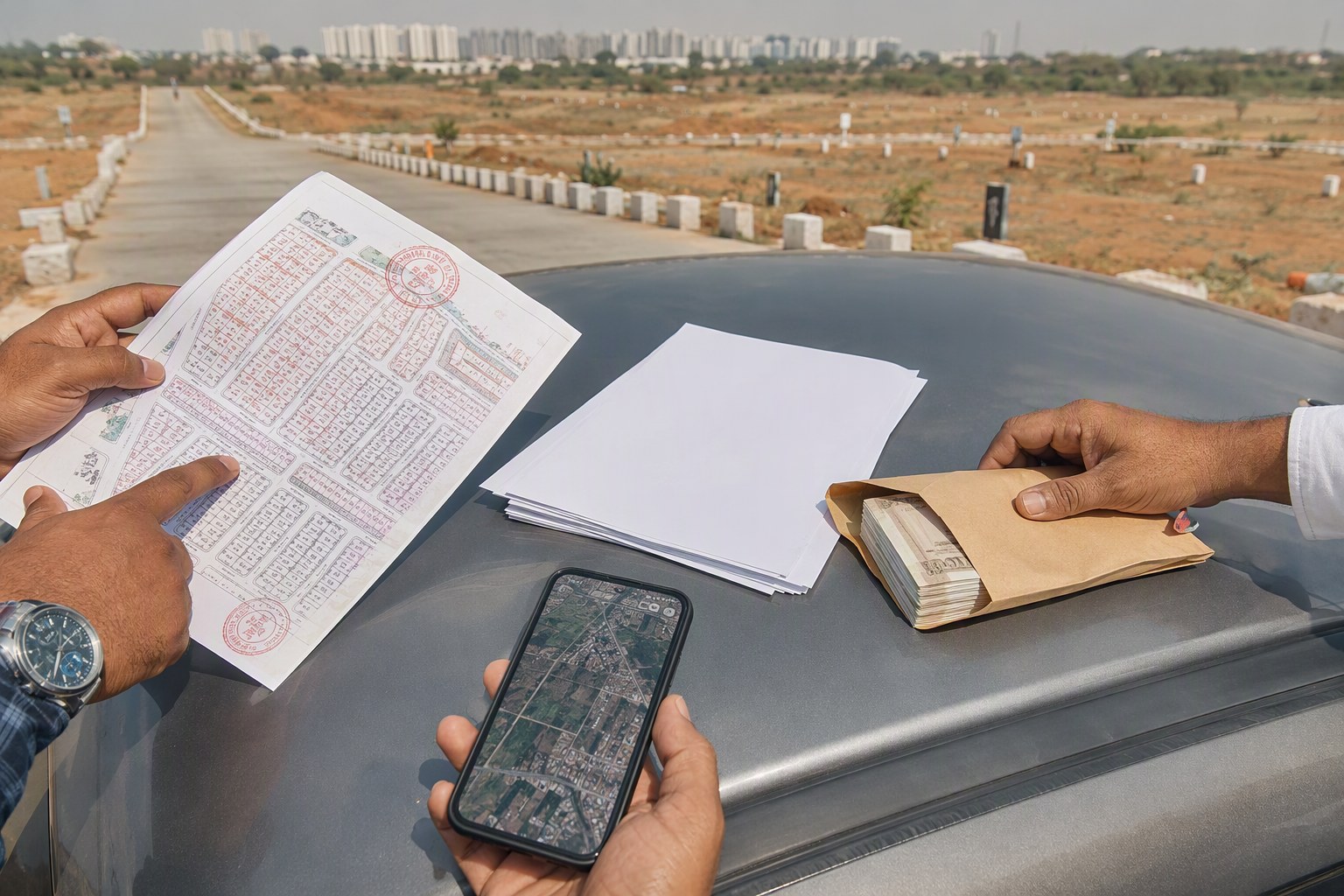
In Hyderabad’s extended growth belt, pre-approval plot selling is common. You will hear lines like: approval is in process, LP number will come shortly, final approval expected soon, only few plots left at old price. These phrases are not illegal by themselves, but they are not proof of approval. A WhatsApp brochure, colourful master plan or temporary board at site is not the same as final layout permission from the competent authority.
The risk is highest when a buyer sees only the price gap. For example, a promoter may show a lower quote in a developing pocket of Maheshwaram mandal compared with a nearby approved layout in Tukkuguda. Or a farmland-to-plot conversion pitch may come in Shankarpally mandal near Mokila, Velimela or Kondakal. The question is not whether these areas have growth potential. Many of them do. The question is whether your specific plot is legally saleable as a plotted unit with roads, open space, drainage, land use conformity and approval conditions properly met.
Cheap land becomes costly when approval, access road, land use or survey number history is unclear. We have seen buyers save on booking price and lose bargaining power later.
Should You Invest Before Final Layout Approval Is In? Use It As The Third Filter
For plot due diligence, I prefer a three-filter method. It is practical and works well for Hyderabad, Rangareddy, Sangareddy, Medchal-Malkajgiri, Vikarabad and Yadadri-Bhuvanagiri side investments.
Filter 1: Encumbrance Certificate and ownership trail
The EC tells you whether the land has recorded sale, mortgage, gift, release, court attachment or other registered transactions. It is not the full story, but it is the first story. Check the seller’s chain of documents, pattadar details, old sale deeds, link documents and any mortgage entry. If the EC is confusing, use EC Analyzer to read patterns before you involve an advocate.
Filter 2: Section 22-A prohibited property check
Section 22-A status is non-negotiable. Telangana’s prohibited property database is large, with 3,076,153 records as per the Verified database context. A land parcel may be government land, assigned land, endowment land, waqf-related, court-restricted or otherwise blocked for registration. Buyers should run Section 22-A Prohibited Property Check using village, mandal and survey details before any payment.
Filter 3: Final layout approval
If the first two filters are clean, the next question is: can this agricultural or revenue land legally become a plotted layout? That is where final layout approval matters. It checks whether the layout aligns with planning norms, approach roads, open space reservation, road widths, land use and technical conditions. In many deals, buyers stop after EC and pattadar passbook comfort. That is a mistake. For plotted investment, planning approval is not optional paperwork; it is the backbone of marketability.
What Final Layout Approval Actually Protects
Final layout approval is not just a stamp on a map. It tells you that the competent planning authority has examined the proposed division of land into plots and roads. Depending on location, authority and planning jurisdiction may vary. Around Hyderabad, buyers commonly hear of HMDA, DTCP, municipal permissions, gram panchayat references and land conversion files. Do not assume the same rule applies in every village. A plot near Kollur is not the same as a plot in Farooqnagar mandal, and a parcel near Pocharam is not the same as one near Yacharam.
A final approved layout usually gives comfort on these points:
- Road pattern: Internal roads are marked and expected road widths are recorded.
- Open space: Required open space or park area is earmarked, instead of being sold as private plots.
- Plot numbers: Plot boundaries and numbering are aligned to an approved plan.
- Land use: The layout is checked against the relevant zoning or planning framework.
- Mortgage plots or conditions: In many layouts, certain plots may be mortgaged to the authority until development works are completed. Buyers must know whether their plot is free for sale.
- Future resale comfort: Approved layouts are easier for the next buyer, banker and advocate to understand.
Before booking, also run Land Use Zone Finder and Road Width Check. These two checks can save you from buying a technically attractive plot with a planning problem.
Why Investors Still Get Tempted Before Approval
The temptation is genuine. Early-stage plots are sold with a story: airport corridor, pharma city side growth, ORR connectivity, upcoming radial roads, future villas, nearby employment zone, low launch price. Some of these stories may be partly true. But a true macro story does not automatically make your plot safe.
We have seen three common buyer mindsets:
- The early-bird investor: Wants to enter before approval because the price may rise later.
- The NRI buyer: Depends on relatives or sales team updates and may not visit the SRO or mandal office.
- The first-time family buyer: Believes that if many people are booking, the project must be safe.
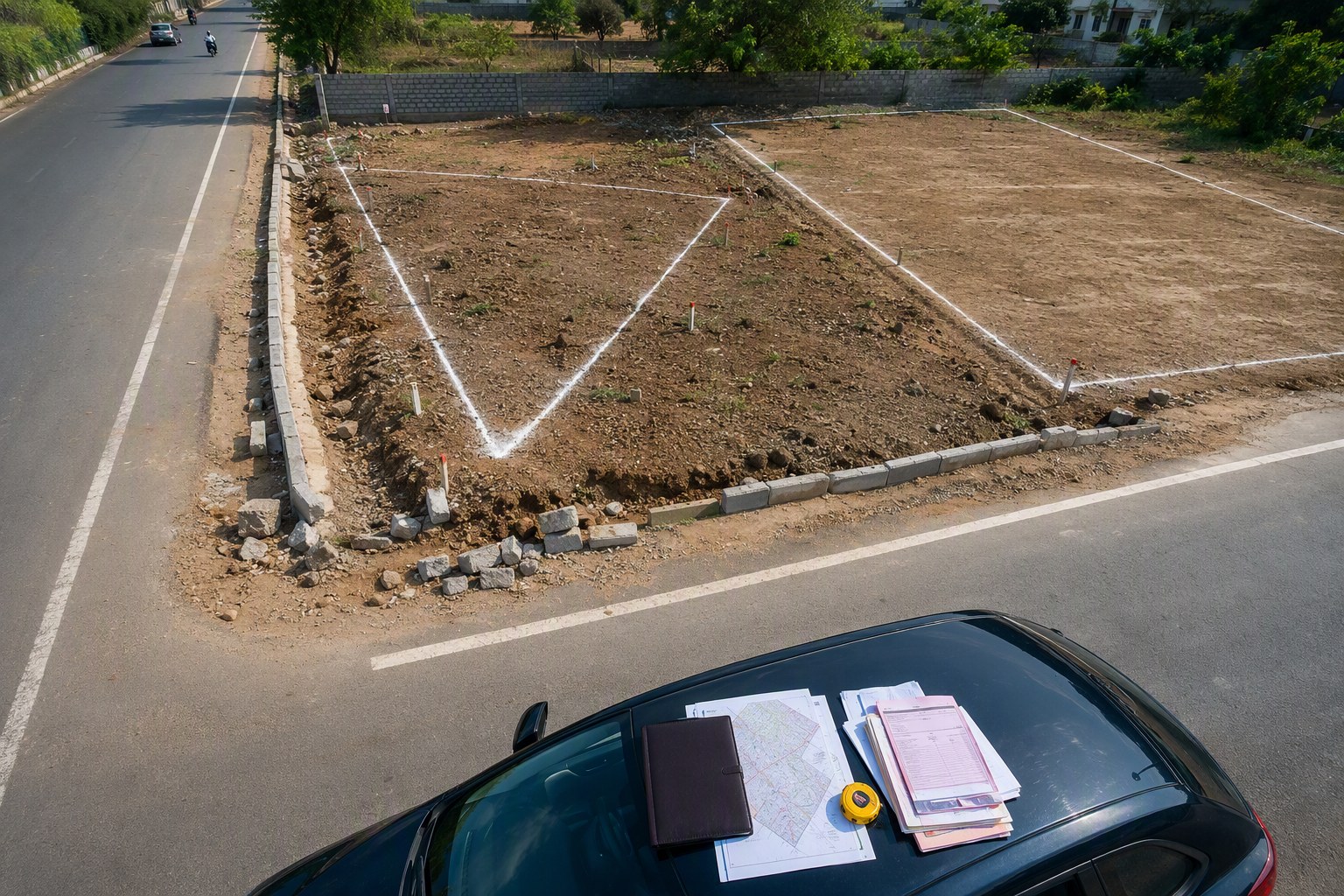
All three can get trapped if they confuse activity with approval. Site fencing, venture gate, road marking with chalk powder, YouTube videos and drone shots are marketing signals, not legal permissions.
Hyderabad Localities Where This Question Comes Up Often
The final layout approval question comes up repeatedly in growth belts where land conversion and plotting activity is active. I hear it often in and around these pockets:
- West and south-west: Mokila, Kondakal, Velimela, Kollur, Tellapur, Shankarpally mandal, Patancheru side villages.
- South and airport belt: Shamshabad, Tukkuguda, Maheshwaram, Kandukur, Shadnagar and Farooqnagar mandal areas.
- East and south-east: Adibatla, Bongloor, Yacharam, Ibrahimpatnam, Pocharam and Ghatkesar side.
- North-east extension: Bibinagar and nearby Yadadri-Bhuvanagiri growth pockets.
I am not saying these locations are bad. In fact, many serious investors track them closely. But in these belts, village boundaries, mandal jurisdiction, SRO mapping, survey number history and land use need careful checking. If you are not sure which SRO applies, use Find Your SRO Office or SRO Village Directory. If the seller gives only a venture name and not the survey number, use Survey Number Finder and insist on exact survey/sub-division details.
Pre-Approval Plot Versus Final Approved Plot
Here is the practical difference a buyer should understand before paying token amount.
| Point | Before final layout approval | After final layout approval |
|---|---|---|
| Price appeal | Usually marketed as early-entry or discounted | Usually costlier because permission risk is reduced |
| Approval certainty | Not guaranteed; plan may change | Approved plan can be verified |
| Plot number | May change if road, open space or authority conditions change | Plot identification is clearer |
| Registration comfort | Depends on land status, approval stage and SRO practice | Generally easier to explain to buyer, banker and advocate |
| Resale | Next buyer may ask hard questions | Cleaner resale conversation |
| Risk owner | Buyer may carry approval delay risk | Developer has already crossed a major permission stage |
The table is simple, but the lesson is serious. If you buy before approval, you are not just buying land. You are partly financing the promoter’s approval journey.
Documents To Ask Before You Even Negotiate
Do not start with price. Start with papers. A genuine seller should not hesitate to share basic documents. Ask for:
- Survey number and sub-division number of the land.
- Village, mandal and district details.
- Latest pahani or revenue record reference.
- Owner’s link documents and title chain.
- EC for the relevant period.
- Land conversion or non-agricultural use document, where applicable.
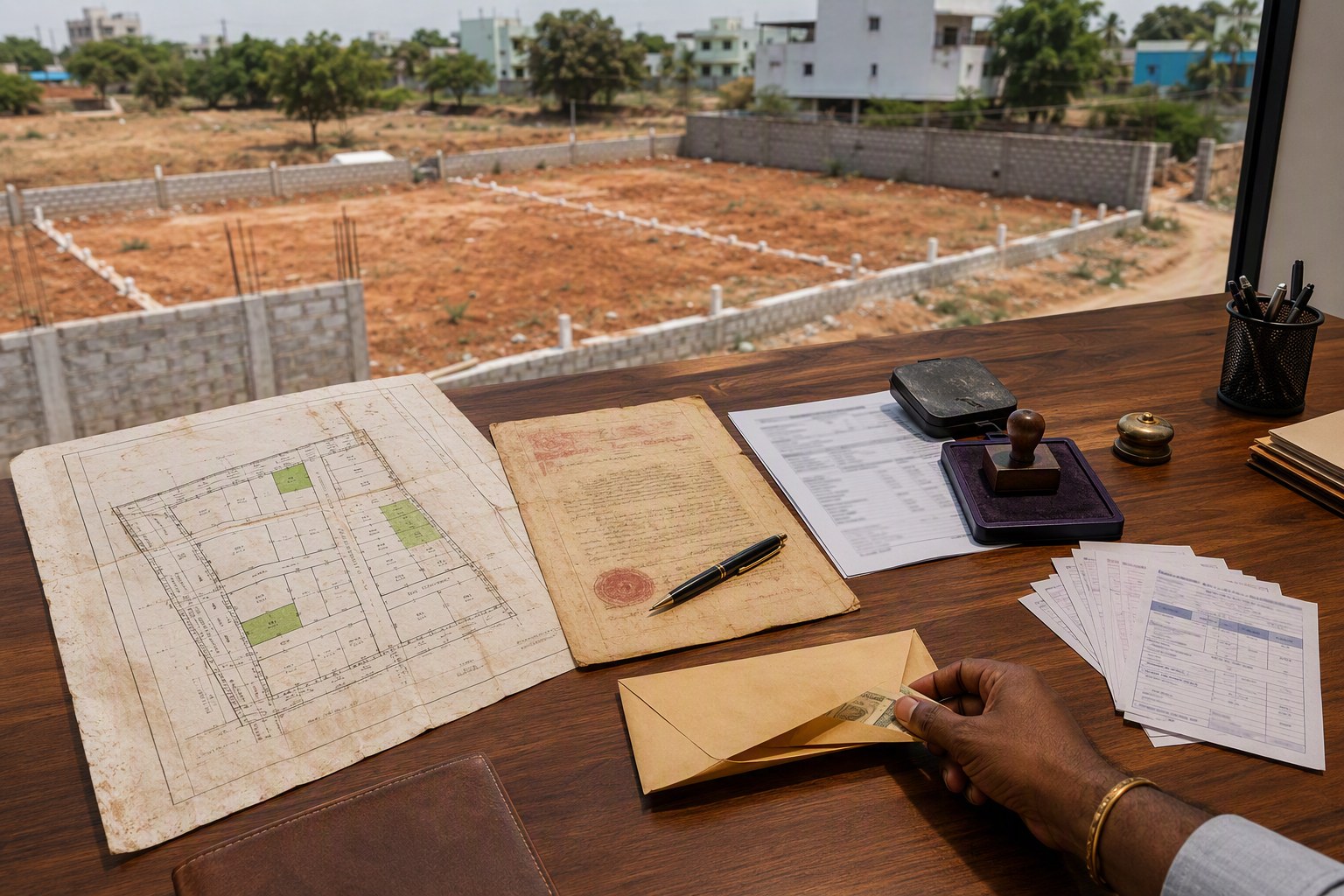
- Draft and final layout approval copies, if claimed.
- Proceedings or approval number from the competent authority.
- Approved layout plan showing your exact plot.
- List of mortgage plots, if any, and release status.
- RERA details, if the project requires registration.
For RERA-related checks, use RERA Project Lookup. For overall screening, Property Verification Tool can help you organise the first layer of checks before you pay an advocate for deeper scrutiny.
Red Flags In Layout Approval Claims
Some red flags are easy to spot if you slow down the deal.
- Only brochure approval: The sales team shows a layout image but no authority proceedings.
- Different survey numbers: The brochure, sale agreement and revenue records do not match.
- Token pressure: You are told the price is valid only today or only till evening.
- No SRO clarity: The seller cannot clearly say which SRO will register the document.
- Vague land use: The promoter says zoning will be managed later.
- Mortgage plot confusion: Your selected plot may be under authority mortgage or not yet released.
- Gram panchayat comfort in planning area: A local-level paper is shown where higher planning approval may be required.
- Road access doubt: The venture has a kutcha approach road, but no clear legal access documents.
If two or three of these appear together, pause. A good deal will survive questions. A weak deal becomes nervous when you ask for survey number, approval copy and SRO confirmation.
How To Read The Price Discount Correctly
Investors often ask: if I wait for final approval, will I miss the upside? Maybe. But you must compare the discount with the risk. A discount is meaningful only when you can measure what you are taking on.
Ask yourself:
- What happens if approval takes much longer than promised?
- Will the seller refund with clear terms if approval is refused or materially changed?
- Can my plot size, number or facing change after authority remarks?
- Is the agreement registered or only a receipt on letterhead?
- Are development charges, betterment charges or other costs clearly allocated?
- Can I resell before final approval if I need money urgently?
Do not rely only on spoken assurances. Put refund conditions, approval milestones and document obligations in writing. If the promoter refuses written protection but asks for quick payment, that tells you enough.
Where Guideline Value And Stamp Duty Fit In
Once the land passes EC, prohibited property and layout approval checks, then you can look at transaction cost. Many buyers calculate stamp duty first and legal risk later. That order is wrong. First decide whether the property is safe enough to buy. Then check market value, guideline value and registration cost.
Use Market Value / Guideline Value Search to check the government value basis for the village or locality. Use Stamp Duty Calculator to estimate registration-related outgo. If you are comparing plot sizes across square yards, acres and guntas, Area Unit Converter is handy, especially in mandal-level land discussions where sellers shift between local and formal units.
My Practical Rule For Hyderabad Plot Buyers
Here is the rule I give serious buyers: never pay more than a very small, refundable blocking amount before you have seen the title chain, EC, Section 22-A status, land use and approval position. Even that small amount should be backed by a written receipt with refund terms. For bigger payment, wait for final layout approval or get strong legal protection from a property lawyer who has checked the papers.
If the project is in a hot corridor like Kollur-Tellapur, Mokila-Shankarpally, Tukkuguda-Maheshwaram or Adibatla-Ibrahimpatnam, do not allow location excitement to override paperwork. Hyderabad investors sometimes behave as if location alone cures title and approval defects. It does not. A bad document in a good locality is still a bad document.
Also track changes after you shortlist. Land records, EC entries, mortgage releases and approval status can move over time. For repeat monitoring, use Property Change Tracker. If any charge or bank loan angle is suspected, run CERSAI Charge Check as part of your due diligence.
Final Answer: Wait For Approval, Or Price The Risk Ruthlessly
Should You Invest Before Final Layout Approval Is In? For most retail investors, no. Wait. If you are still entering early, price the risk ruthlessly, take legal advice, document refund rights and never depend on sales talk alone.
The clean sequence is: EC first, Section 22-A prohibited check second, final layout approval third, then valuation and registration cost. This order protects you from the most painful mistakes. A plot should help you sleep better, not keep you chasing approvals at mandal office, SRO, planning authority and developer office.
Hyderabad’s outskirts will keep offering attractive land stories. Some will become excellent investments. Some will remain stuck as paper ventures. Your job is not to buy every cheap plot. Your job is to buy the plot that can stand up to document scrutiny today and resale scrutiny tomorrow.
Frequently Asked Questions
Can I register a plot before final layout approval?
It depends on land status, SRO practice, planning jurisdiction and the exact document being registered. But registration alone does not make a plotted layout safe. Check EC, Section 22-A status, land use and final layout approval before paying major money.
Is EC enough to buy a plot near Hyderabad?
No. EC is only one filter. You should also check Section 22-A prohibited property status, survey number history, pahani or revenue records, land use, SRO jurisdiction and final layout approval.
What is the biggest risk in buying before layout approval?
The approved plan may change, approval may be delayed, some plots may fall under roads or open space, or the venture may not satisfy planning norms. Your selected plot may not remain the same after authority review.
Should I trust a pre-launch plot offer if the price is low?
Do not trust price alone. Ask for survey number, title documents, EC, Section 22-A result, land conversion papers, approval proceedings and written refund terms. A genuine seller should be comfortable with document-based questions.
Which tools should I use before buying a Telangana plot?
Start with EC Search, Section 22-A Prohibited Property Check, Survey Number Finder, Land Use Zone Finder, RERA Project Lookup where applicable, and Find Your SRO Office. These checks help you shortlist safer plots before legal verification.