

The Cheap Resale Plot With a Costly Mutation Pending
A cheap resale plot can look like the smartest buy in Hyderabad’s edge markets, especially when the seller is offering a discount and the location sounds familiar: Shankarpally, Maheshwaram, Kandukur, Ghatkesar, Medchal, Tukkuguda, Patancheru or Adibatla. But the moment someone says, “Mutation is pending, sir, but registration is clear,” the deal changes colour. In our experience, pending mutation does not always mean fraud. Still, it can slow down resale, weaken buyer confidence, and give the next buyer a strong reason to negotiate hard.
We have seen this pattern repeatedly with resale plots around HMDA and DTCP growth corridors. The buyer sees a lower price. The seller says the sale deed is available, EC is clean, and the layout is already developed. Then, at the last stage, the pahani or Dharani record still shows an older owner, a family member, or sometimes a different pattadar line. That is when the “discount” starts looking less like a bargain and more like a risk premium.
My view is simple: if mutation is pending, treat the discount as a warning signal, not as free profit.
Why a Cheap Resale Plot With Mutation Pending Can Become Expensive
In Telangana land transactions, mutation is the updating of revenue records after a transfer, inheritance, partition, gift, court order or other change. For agricultural land, buyers often look at Dharani records, pahani details, pattadar passbook status and survey number linkage. For converted layouts and plotted development, the focus shifts to sale deed, layout approval, link documents, EC, SRO records and municipal or gram panchayat documentation. But mutation still matters because it affects how comfortably the market accepts the title story.
Many buyers wrongly assume that once registration is done at the SRO, everything is fully completed. The sale deed is certainly central. It is the main title document. But mutation is the government record reflecting who is recognised in revenue entries. When that update is not completed, future buyers, banks, advocates and document writers start asking questions.
For example, take a resale plot near Mokila in Shankarpally mandal or near Lemoor in Kandukur mandal. The seller may have a registered sale deed. But if the parent land record is still under the old pattadar, or if a family settlement is not reflected properly, the next buyer may worry about hidden heirs, boundary mismatch, land conversion gaps, or a pending objection. Even when those fears are not true, the doubt itself reduces bargaining power.
That is the real cost. Not always a legal loss. Often it is a confidence loss.
The Cheap Resale Plot Story We Keep Seeing Around Hyderabad
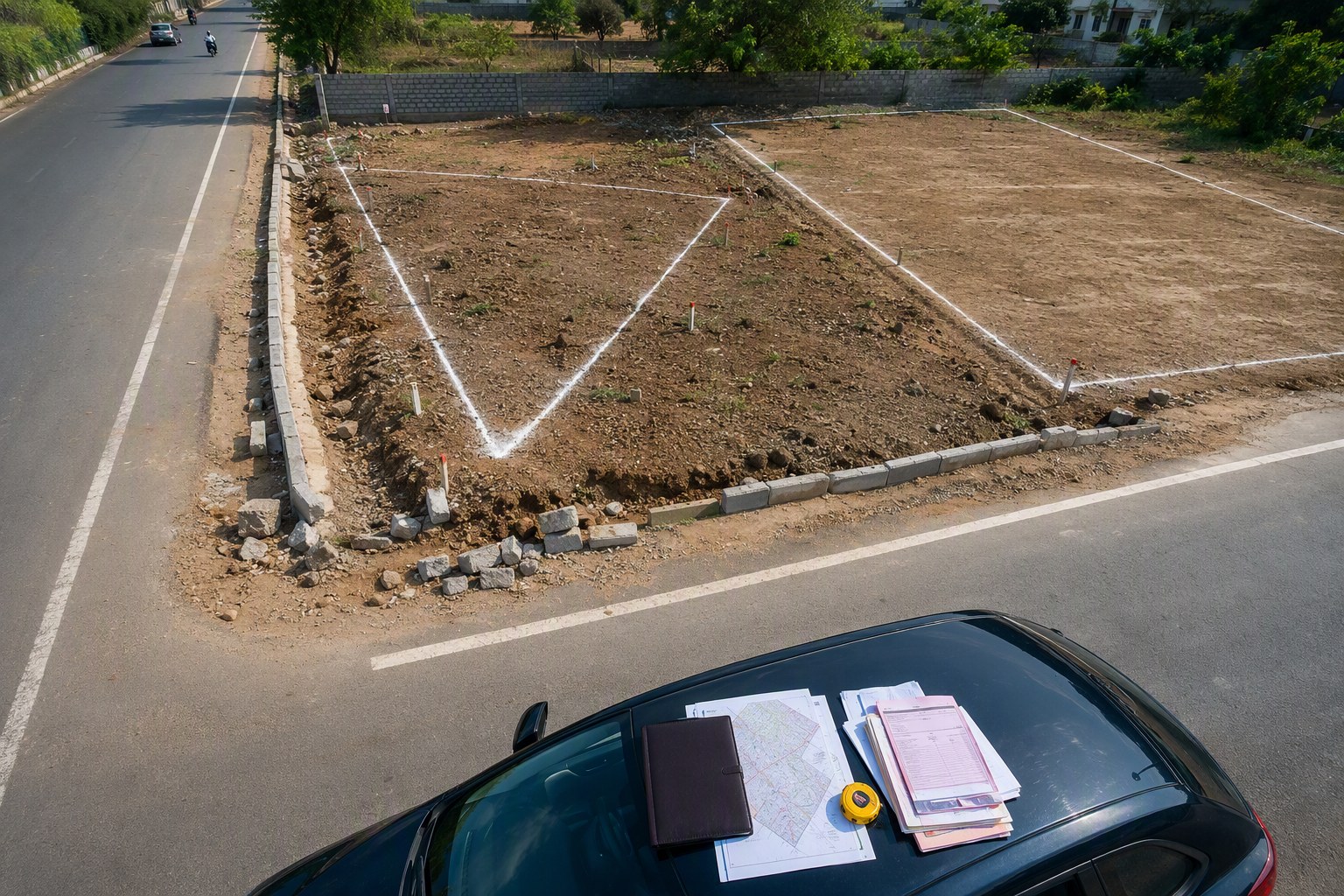
A typical case goes like this. An investor from Miyapur or Kondapur wants a plot outside the city because flat yields are not exciting and land feels easier to hold. He checks listings in Kollur, Velimela, Shankarpally, Ghatkesar, Yadagirigutta side, Maheshwaram, Ibrahimpatnam, Kandukur and Patancheru. One resale plot is cheaper than nearby options. The seller says he needs money urgently. The layout road is visible. A few boundary stones are there. There is some development nearby. It feels like a quick decision.
Then the document review begins.
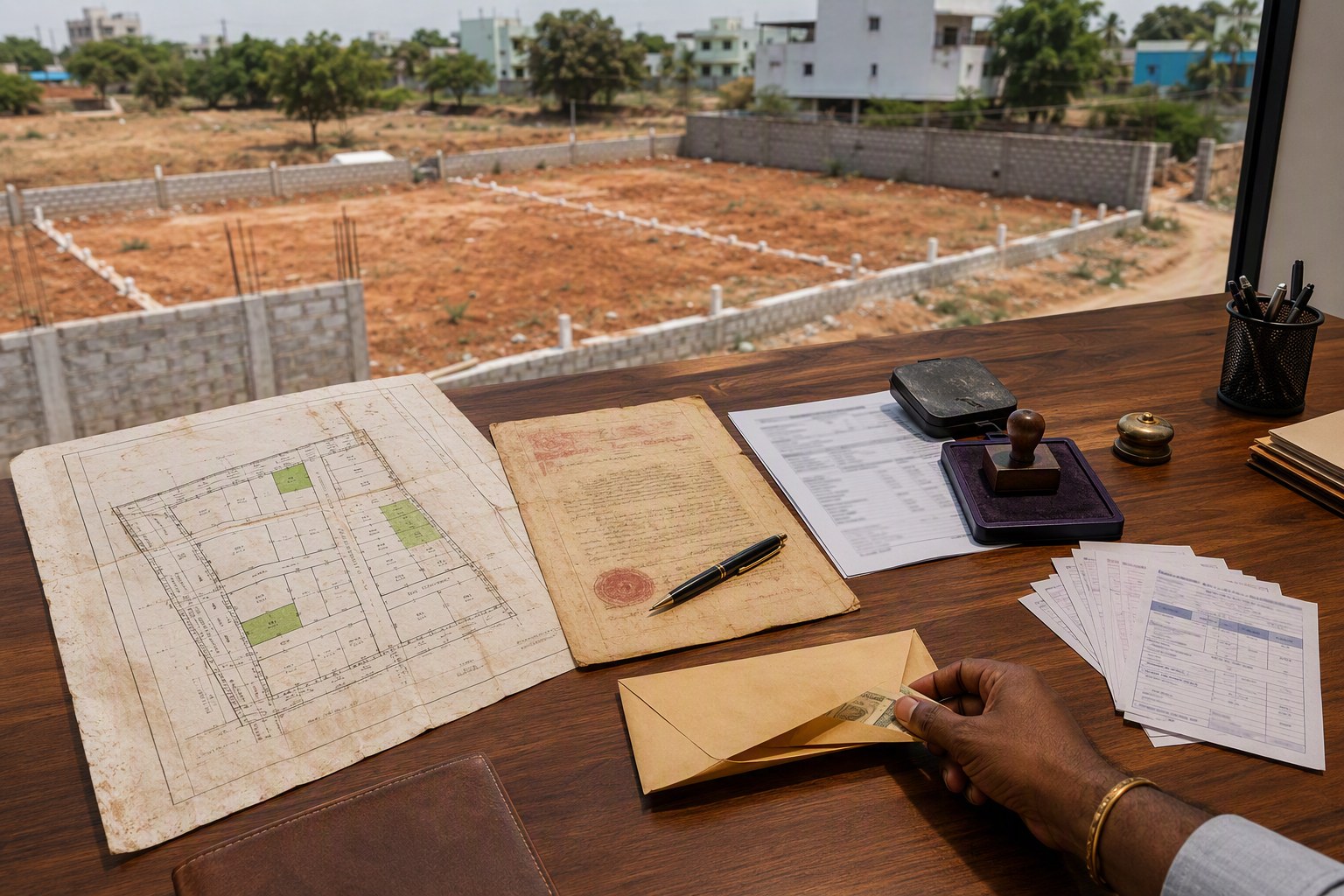
- The sale deed is available.
- The EC does not show an obvious mortgage for the period checked.
- The layout copy is shared on WhatsApp.
- The seller name appears in one document, but revenue records are not fully updated.
- The mutation application is “under process” or “pending”.
This is where many buyers split into two groups. One group says, “If registration happened, why worry?” The other group asks, “If everything is fine, why is it still pending?” I am closer to the second group. Not because every pending mutation is dangerous, but because land markets punish uncertainty.
A resale plot is not like buying a ready flat in a gated community where the builder has already handled many approvals and the buyer is mainly checking RERA, OC, UDS, amenities and association issues. In open plots, the buyer himself carries more due diligence load. Survey number, boundaries, layout approval, road access, land use, prohibited list, link documents and mutation all sit on the buyer’s table.
Mutation Pending Does Not Automatically Cancel Title
Let us be fair. Pending mutation is not equal to defective ownership in every case. Sometimes the delay is administrative. Sometimes the seller has applied but the update is not reflected. Sometimes a document correction is pending. Sometimes the land was converted and the revenue record trail is messy, even though the plotted layout has valid approvals. Sometimes the family has settled the property but one supporting paper is yet to be uploaded or verified.
But buyers do not pay only for legal theory. They pay for market confidence. If tomorrow you want to resell the plot near Tukkuguda, Isnapur, Bibinagar, Choutuppal or Sadashivpet, the new buyer will ask the same questions you are asking today. If you do not have clean answers, your exit will become slower.
That is why a cheap resale plot with mutation pending must be priced after checking the reason for the pending status. A small procedural delay is one thing. A disputed inheritance, unregistered family arrangement, wrong survey number mapping or government land classification issue is a completely different matter.
How Mutation Pending Affects Negotiation in a Cheap Resale Plot
Negotiation is not only about rate per square yard. It is about who is carrying the risk. If the buyer carries the pending mutation risk, the buyer should not pay as if the title is fully settled. Sellers usually say, “Sir, after registration you can complete it.” That sentence may sound harmless. But it means the buyer is taking responsibility for a problem created before his purchase.
In many resale plot discussions, I suggest three direct questions:
- Why exactly is mutation pending?
- Who has to sign, submit or clarify anything for mutation?
- Can the seller complete it before registration or make it a condition in the sale agreement?
If the seller becomes defensive, that itself tells you something. A genuine seller may not know every legal term, but he should be willing to share application proof, link documents, pattadar details, passbook status, layout approval copy, and any correspondence from the revenue office or concerned authority.
Do not accept casual lines like “Dharani issue only” or “Everyone in this layout has same problem” without verification. Sometimes that is true. Sometimes it is a cover for a deeper defect.
Check Section 22-A Before Falling for the Discount
One number should make every Telangana plot buyer slow down: 3,076,153 prohibited properties are recorded in the Section 22-A prohibited properties database as per the verified database available to us. That does not mean every resale plot is risky. It means the prohibited property check cannot be skipped, especially when a plot is being sold below the surrounding market.
Section 22-A issues can involve government land, assigned land, endowment land, waqf land, ceiling surplus land, court-disputed land and other restricted categories depending on the record. If a survey number or part of a survey number falls under such restriction, registration and resale confidence can be affected badly.
Before paying token advance, run a check using the Section 22-A Prohibited Property Check. Then verify the survey number through the Survey Number Finder. For SRO jurisdiction and registration office mapping, use the Find Your SRO Office. These are basic checks, not optional extras.
Due Diligence Checklist for a Cheap Resale Plot With Mutation Pending
When a plot is discounted and mutation is pending, your due diligence should be stricter than usual. I would not rely only on the broker’s file or one photocopy bundle. Build your own file.
1. Start with the sale deed and link documents
Check the seller’s registered sale deed, previous link documents, schedule of property, boundaries, survey number, plot number, extent and layout reference. If the seller bought from a developer, confirm whether the developer had title to the land and whether the plotted layout was approved by the correct authority.
2. Pull the Encumbrance Certificate
Use the Encumbrance Certificate Search and verify the transaction chain for the relevant period. EC is not a full title certificate, but it can reveal registered sales, mortgages, releases, gifts and some court-related registrations. If the EC story does not match the seller’s story, pause the deal.
3. Check guideline value, not WhatsApp rate
Many buyers compare only with online listing rates. That is not enough. Check the official market value or ready reckoner reference using the Market Value / Guideline Value Search. This helps you understand registration value and gives you a government reference point. It will not prove that your deal is safe, but it gives price context.
4. Verify prohibited property status
Run the survey number through the Section 22-A Prohibited Property Check. In our experience, buyers often do this after paying advance. That is the wrong order. Do it before any token amount.
5. Confirm layout approval and land use
For plots around HMDA and DTCP areas, layout approval matters. Do not accept “LP number is there” without checking whether the plot number falls inside the approved layout. Also check land use. A plot beside a growing road near Maheshwaram or Ghatkesar may still have planning restrictions, road widening risk or zone issues. Use the Land Use Zone Finder and Road Width Check as starting points.
6. Ask for mutation status proof
Do not depend on verbal statements. Ask for application number, acknowledgement, reason for pendency, objections if any, and the exact office or portal where the application is pending. If it is an inheritance matter, ask for legal heir documents, family member certificates where applicable, partition deed, release deed or court order, depending on the case.
What Buyers Should Put in the Sale Agreement
If you still want to proceed with a cheap resale plot despite pending mutation, the sale agreement should not be casual. Get it drafted properly. A two-page agreement with only amount and date is not enough.
Important clauses to discuss with your advocate:
- Seller’s declaration on title, possession and absence of undisclosed disputes.
- Clear mention that mutation is pending and reason for the same.
- Seller’s obligation to cooperate in mutation before or after registration.
- Documents the seller must provide before final payment.
- Refund clause if mutation-related defect, prohibited property issue, boundary mismatch or title objection is discovered.
- Timeline for registration and handover of original documents.
- Indemnity from seller for past claims, dues, family claims and document defects.
You can prepare a first draft with the Legal Document Generator, but do not treat any auto-generated draft as a substitute for a property advocate’s review. Land transactions need local reading: village, mandal, survey history, SRO practice and revenue record trail.
Where Buyers Make Costly Mistakes
The first mistake is paying advance because “two more buyers are waiting”. That pressure line is common in resale plot negotiations from Sadashivpet to Keesara. If the plot is so clean and so cheap, why has it not closed already? Ask calmly.
The second mistake is checking only plot number and ignoring survey number. Plot numbers are layout-level identifiers. Survey numbers connect the land to revenue records, prohibited lists, village maps and old ownership. If the survey number is wrong, your beautiful plot brochure is useless.
The third mistake is assuming that a bank loan approval for another plot in the same layout proves your plot is safe. Banks check a specific file. Their comfort may vary by plot, seller, document chain and loan policy. A previous loan in the layout is useful information, not a title guarantee.
The fourth mistake is treating mutation as a small clerical item. Sometimes it is. Sometimes it opens the whole file: family disputes, pattadar mismatch, land classification, sub-division confusion, old court cases or missing link documents.
How to Price a Cheap Resale Plot With Mutation Pending
There is no universal discount formula. Do not believe anyone who gives one without reading documents. The right price depends on the type of mutation pendency, seller cooperation, document chain, layout approval, road access, location demand, resale liquidity and whether the issue can be resolved within a reasonable time.
For a plot in a liquid micro-market like Mokila, Tellapur side villages, Kollur belt or Patancheru growth pockets, buyers may tolerate small paperwork delays if the title chain is otherwise clean. For a plot in a slower market or a layout with many unresolved records, the same pending mutation can become a major exit risk.
My practical advice: do not compare the discounted plot only with the highest quoted rate nearby. Compare it with a clean-title alternative. If the clean plot gives you sleep and quicker resale, it may be cheaper in real life even if the upfront price is higher.
What Sellers Should Do Before Listing
This is not only a buyer problem. Sellers lose money when mutation is pending. If you are selling a resale plot in Adibatla, Kandukur, Shankarpally, Ghatkesar, Medchal, Chevella or any Hyderabad growth corridor, complete the record trail before listing. A clean file attracts better buyers. A half-ready file attracts bargain hunters.
Keep these documents ready:
- Original sale deed and link documents.
- Latest EC.
- Layout approval copy and plot marking.
- Mutation proof or latest revenue record where applicable.
- Tax receipts or local body records, where relevant.
- Survey sketch, boundaries and access road proof.
- Any release deed, partition deed or legal heir document if the property came through family transfer.
Once the buyer’s advocate starts chasing missing papers, the seller loses control of the negotiation. Better to prepare first and quote with confidence.
Final View on the Cheap Resale Plot With Mutation Pending
A cheap resale plot with mutation pending is not automatically a bad investment. But it is never a simple bargain. The pending mutation must be explained, documented and priced. If the seller cannot explain it, the buyer should not fund the uncertainty.
Hyderabad’s land market rewards patience. The best investors we have met are not the ones who rush for the lowest quote. They are the ones who know when a discount is genuine and when it is only compensation for a file nobody wants to open properly.
Before you pay an advance, check EC, guideline value, SRO, survey number, prohibited status and land use. Speak to a local advocate. Visit the site. Match the boundaries. Read the documents slowly. In land, the cheapest mistake is the one you avoid before registration.
Frequently Asked Questions
Is it safe to buy a cheap resale plot with mutation pending?
It can be safe only if the reason for pending mutation is clear, documented and resolvable. Do not rely on verbal assurances. Check sale deed, EC, link documents, survey number, prohibited property status and mutation application proof before paying advance.
Does mutation prove ownership of land in Telangana?
Mutation is a revenue record update. The registered sale deed is the main title document, but mutation affects market confidence, revenue recognition and future resale comfort. Buyers should review both title documents and revenue records.
Can I register a plot if mutation is not completed?
It depends on the property type, document chain, SRO practice and whether any restriction or objection exists. A pending mutation may not always block registration, but it can create questions during due diligence and resale. Take an advocate’s opinion before proceeding.
What should I check before buying a resale plot near Hyderabad?
Check the registered sale deed, link documents, EC, survey number, layout approval, land use, road access, Section 22-A prohibited status, SRO jurisdiction and mutation status. Site inspection and boundary verification are also necessary.
Should mutation be completed before final payment?
Preferably yes, especially if the pending mutation is linked to inheritance, partition, survey mismatch or old ownership entries. If you proceed before completion, include strong clauses in the sale agreement for seller cooperation, refunds and indemnity.