


The Plot Investor Who Missed the Approach Road Check
The Plot Investor Who Missed the Approach Road Check is not a rare story in Hyderabad’s outer-ring plot market. We have seen buyers do every visible check — price, location, venture name, east-facing plot, nearby highway — and still miss the one thing that decides daily usability and resale: legal, motorable, financeable access to the plot.
Answer first: a plot without a proper approach road check can lose buyer interest, bank loanability and resale value, even when the sale deed looks clean. Before paying an advance, verify road width, road ownership, layout approval, survey number continuity, EC, Section 22-A status, land use and whether the road shown on paper exists on ground.
The Plot Investor Who Missed the Approach Road Check: A Hyderabad Story
A few months ago, a software professional from Kondapur called us about a plot near the western corridor. The location sounded attractive. It was within driving distance from Kokapet, Narsingi and Tellapur. The seller spoke confidently. The venture had boundary stones. The buyer liked the open sky, the breeze, and the idea that this side of Hyderabad still had future value.
He paid a token amount after seeing the plot on a Sunday evening. That is the first small mistake. Sunday evenings are when many plot sales happen emotionally. Roads look wider because traffic is less. Neighbouring owners are not around. Revenue offices are shut. The broker has full control of the story.
The buyer checked the sale deed draft. He checked the owner’s Aadhaar and PAN. He even asked for the pahani and old link documents. But he did not ask a boring question: “Which road legally takes me to my plot?”
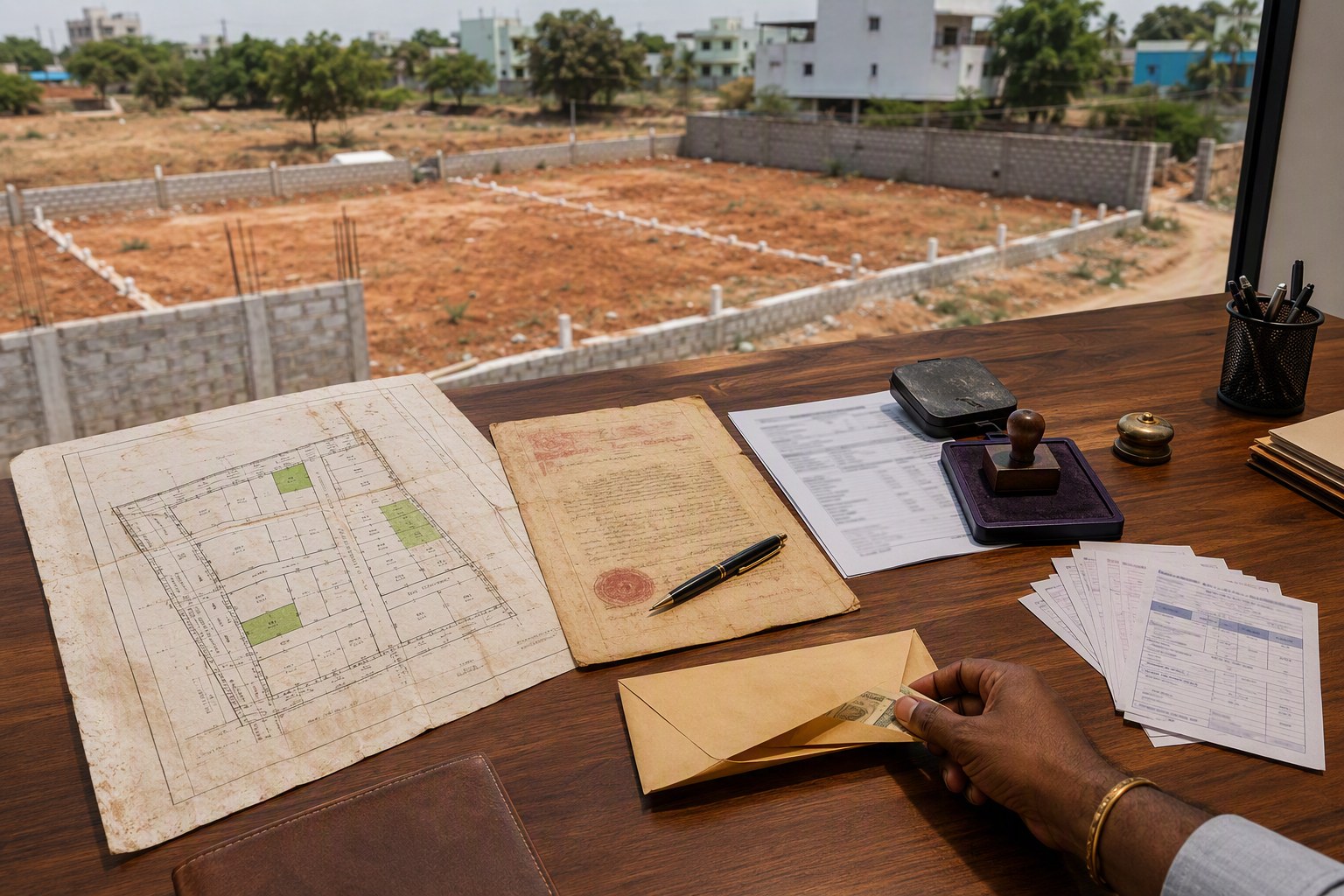
On paper, there was an access road. On ground, the access passed through a strip of land that was being used by everyone but owned by someone else. One neighbouring farmer later objected. Another owner said the path was only a temporary cart track. The bank’s legal team asked for layout approval and clear road access documents. The file stopped there.
That plot did not become useless overnight. But it became difficult. Difficult to get a housing loan. Difficult to resell to a cautious buyer. Difficult to build without a dispute. In our experience, this is how plot investments fail quietly — not because the land is fake, but because access is vague.
Approach Road Check Is Not Just About Seeing a Road
Many buyers think an approach road check means standing at the site and asking, “Can a car go till the plot?” That is only the visual part. In Telangana property verification, a proper road check has four layers:
- Physical access: Is there an actual road from a public road to the plot?
- Legal access: Is that road part of an approved layout, government road, gram panchayat road, municipal road, or private land?
- Width and usability: Is the road width enough for construction, future building permission and movement of vehicles?
- Loanability: Will a bank accept this access while funding purchase or construction?
These four points must match. If the site visit says yes but records say no, you have a problem. If records say there is a road but the ground has an encroachment, you still have a problem. Hyderabad outskirts have many such mixed situations, especially in fast-moving areas around Shankarpally mandal, Chevella mandal, Moinabad mandal, Maheshwaram mandal, Kandukur mandal, Ghatkesar mandal and Farooqnagar mandal.
Before visiting the site, run the plot through the Road Width Check. It gives you a structured starting point for asking the right questions. It cannot replace local verification, but it stops you from depending only on the broker’s WhatsApp location.
Why Approach Road Check Matters More in Outer Hyderabad Plots
In established city areas like Kukatpally, Miyapur, Uppal, LB Nagar or Secunderabad, approach roads are usually visible and in public use for many years. Problems can still exist, but they are easier to detect. In new plotted development belts, the story is different.
Take locations around Mokila and Kondakal in Shankarpally mandal, Kadthal in Kadthal mandal, Adibatla in Ibrahimpatnam mandal, Tukkuguda and Maheshwaram, or the Patancheru side towards Isnapur and Nandigama. Many plots are sold based on future potential. That is not wrong. Hyderabad’s expansion has rewarded early buyers in many pockets. But future potential does not cure defective access.
A plot may be near a highway, but the last stretch may be through private agricultural land. A venture may show a neat layout plan, but the layout approval may be missing or not applicable. A road may be marked on a paper sketch, but not transferred, gifted or vested with the local body. A buyer may assume that “everyone is using it, so it is fine.” That assumption is risky.
My simple rule: if the approach road cannot be explained clearly in documents, it should not be accepted casually on ground.
The Plot Investor Who Missed the Approach Road Check Also Missed Ownership of the Road
Road ownership is the most under-discussed part of plot buying. Buyers ask who owns the plot. They rarely ask who owns the road in front of the plot.
In a proper approved layout, internal roads are usually shown as part of the sanctioned plan. In some cases, roads are handed over to the local authority. In older gram panchayat areas, usage may be long-standing, but documentation can be weak. In agricultural conversions, developers sometimes carve roads internally but do not complete all statutory steps. In family partitions, a common passage may be described vaguely, creating trouble later.
Here is what a buyer should ask for:
- Approved layout copy, if the plot is in a layout.
- Proceedings or approval reference from the competent authority, wherever applicable.
- Village map, field map or related revenue sketch showing access, where relevant.
- Sale deed schedule describing boundaries and access clearly.
- Link documents to see whether road area was carved out legally.
- Local body confirmation where road status is doubtful.
Do not be shy to ask these questions. A genuine seller may take time, but will not object. A hurried seller who says “registration will happen, don’t worry” is asking you to carry the future risk.
Use Survey Number, EC and Section 22-A Checks Before Token Advance
In Telangana, survey number confusion is common in plot transactions. One venture name may cover multiple survey numbers. One survey number may have several sub-divisions. A plot may be shown in one location during site visit and described differently in the draft sale deed. This is why survey verification is not a formality.
Start with the Survey Number Finder to identify the correct survey number trail. Then use the Encumbrance Certificate Search and EC Analyzer to understand registered transactions, mortgages, releases and possible red flags. For land status, use the Section 22-A Prohibited Property Check.
As per the Verified database context, Telangana has 3,076,153 prohibited property records under Section 22-A. That number itself should make every plot buyer slow down before paying advance. A clean-looking boundary stone at site does not tell you whether the land is hit by a prohibition entry, government claim, assigned land issue, endowment concern or other restriction.
For a broader document review, the Property Verification Tool is useful before you commit money. It helps you organise checks instead of reacting only after the bank lawyer raises objections.
Approach Road Check and Bank Loanability
Many investors buy plots with own funds and assume loanability does not matter. That is a narrow way to look at land. Even if you are paying cash today, your future buyer may need a loan. Your future construction may need funding. If the plot is difficult for banks to accept, your resale pool becomes smaller.
Bank legal teams usually look for clear title, proper documents, access, layout approval where required, non-agricultural status where relevant, and absence of major encumbrance. They may also check whether the property can be reached from a recognised road and whether the boundaries match documents.
In Hyderabad’s plot market, loan rejection is not always because the owner is fraudulent. Sometimes it is because the file is incomplete. Sometimes the road is not properly documented. Sometimes the internal layout has no clear approval trail. Sometimes the property is in a grey area between revenue records and planning authority norms.
If the seller says, “Sir, loan not possible, only direct registration,” pause. There may be valid reasons, but you need to know them. In our experience, “loan not possible” should reduce excitement, not increase bargaining confidence.
What to Check During the Site Visit
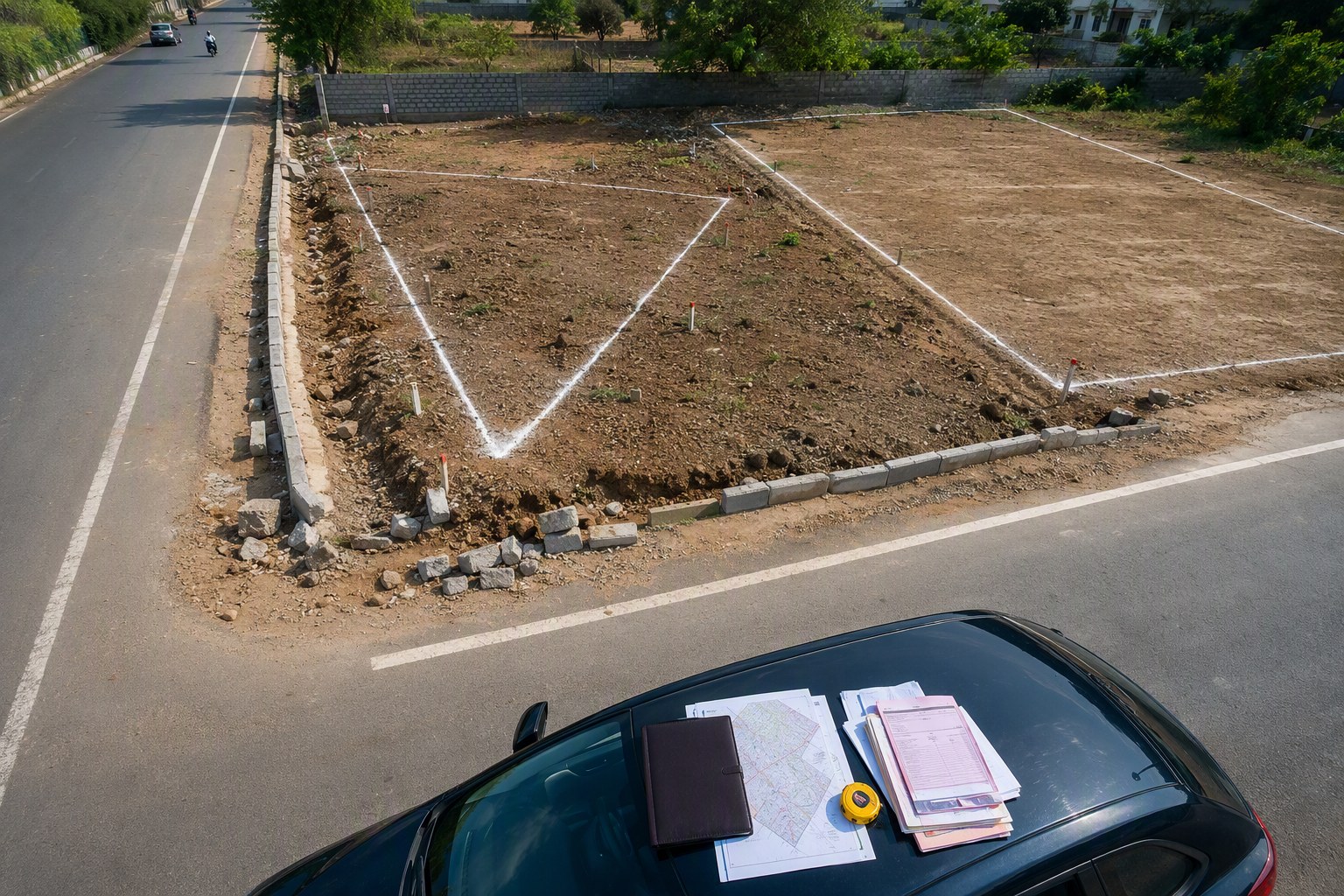
Site visits should not be only about vastu, facing and distance from the main road. Carry the documents, not just Google Maps. Stand at the plot and compare what you see with the schedule and layout.
| Site Point | What to Observe | Why It Matters |
|---|---|---|
| Entry from main road | Is the route continuous without gates, fences or disputed patches? | A broken approach can affect construction and resale. |
| Road width | Does the physical width match the layout or document claim? | Mismatch can create building permission and access issues. |
| Road surface | Is it a formed road, mud track or informal path? | An informal path may not prove legal access. |
| Neighbouring land | Are adjoining owners using or objecting to the road? | Local objections often reveal old access disputes. |
| Plot boundaries | Do stones, fencing and measurements match records? | Wrong identification is common in open land. |
| Water flow and low-lying land | Does rainwater collect on the access path? | Poor access during monsoon reduces practical value. |
Talk to neighbours. Ask the local watchman. Ask the panchayat staff or municipal field staff where relevant. In Telangana villages, oral local knowledge is not a substitute for records, but it is a good alarm bell. If three people give three different versions of the road, do not ignore it.
Do Not Confuse Highway Proximity With Good Access
This is a common marketing trick. A plot brochure says the land is near ORR, near RRR proposed influence, near a national highway, near an IT corridor, near Pharma City side, near airport road, near future growth zone. Some of these claims may be genuinely useful. But none of them answers the access question.
A plot can be close to a major road and still have poor last-mile access. On the other side, a plot slightly inside a village may have clear, long-used public road access and better practical value. Buyers in Hyderabad often overpay for the big road story and under-check the last stretch.
Use the Market Value / Guideline Value Search to understand government market value references, but remember that ready reckoner or guideline value does not certify road quality. For registration planning, the Stamp Duty Calculator helps estimate statutory costs, but again, stamp duty payment does not cure defective access. Registration is not the same as risk-free ownership.
Land Use and Planning Authority Angle
Approach road issues often sit together with land use issues. A buyer may be shown a residential plot in an area that needs planning scrutiny. Depending on location, HMDA, DTCP, municipal body, gram panchayat and revenue records may all become relevant. Do not assume that a neat layout board is enough.
Check land use through the Land Use Zone Finder. If a project claims RERA registration, verify it with the RERA Project Lookup. For plotted layouts, RERA may or may not apply depending on the nature of the project, but if the seller is using RERA as a trust signal, verify the claim instead of accepting a screenshot.
Planning rules can affect building permission, open space requirements, road hierarchy and future regularisation risk. If the road in front of your plot is not acceptable for the kind of construction you want, your investment story changes.
A Practical Pre-Advance Checklist for Plot Buyers
Before paying even a small token advance, follow this order. It may feel slow, but it is cheaper than fighting later.
- Confirm the exact village, mandal, survey number and plot number.
- Match the site location with the draft sale deed schedule.
- Check whether the approach road is public, approved layout road, private passage or informal path.
- Verify road width physically and against available records.
- Check EC for the property and link documents.
- Run Section 22-A prohibited property check.
- Verify land use and planning approval status.
- Ask whether banks have funded plots in the same layout or nearby properties.
- Check the relevant SRO using Find Your SRO Office before registration planning.
- Put access-related representations in the agreement of sale.
The agreement of sale should not be a casual one-page receipt. It should clearly mention the plot details, road access representation, document delivery, refund condition if title or access is defective, and timeline for verification. Use a lawyer who understands Telangana land records, not just a generic document typist near the SRO.
How Sellers and Developers Should Handle Road Clarity
This is not only buyer advice. Good developers and landowners should also treat road clarity as a selling strength. If the road is approved, show the approval. If it is handed over, show the document. If it is a long-used public road, help the buyer verify it through local records. If there is a private right of way, disclose it properly.
Hyderabad buyers are becoming sharper. NRIs, IT employees, doctors, small business owners and second-generation investors are no longer impressed only by a drone video. They ask for EC, layout, land use, pahani history and SRO details. A seller who gives clean answers can command better trust.
In our experience, the best plot investments are not always the loudest ones in the market. They are the ones where boring checks line up: title, access, approvals, land use, possession and registration history.
The Plot Investor Who Missed the Approach Road Check: Final Take
The Plot Investor Who Missed the Approach Road Check is a warning for anyone buying land in Telangana. A good plot is not just a rectangle on a layout. It is a legally reachable piece of land with clear access, clean records and practical resale value.
If you are evaluating plots in Shankarpally, Mokila, Maheshwaram, Adibatla, Ghatkesar, Shadnagar, Kadthal, Patancheru, Chevella or any other growth belt around Hyderabad, do not let excitement outrun verification. The approach road is not a side issue. It is the line that connects your investment to the real world.
Check it before token advance. Check it before agreement. Check it before registration. Once the sale deed is done, the road problem becomes your problem.
Frequently Asked Questions
What is an approach road check in plot buying?
An approach road check verifies whether your plot has clear physical and legal access from a recognised road. It includes road width, ownership, layout approval, ground condition and bank acceptability.
Can a registered plot still have road access problems?
Yes. Registration confirms transfer between parties, but it does not automatically certify that the approach road is legally clear, approved or dispute-free. Road access must be checked separately.
Why do banks reject some plot loan files?
Banks may reject or pause files due to unclear title, missing layout approval, weak access documents, encumbrances, Section 22-A concerns or mismatch between site and records.
Which tools should I use before buying a Telangana plot?
Start with road width, survey number, EC, Section 22-A, land use and SRO checks. These checks help you identify access and document risks before paying advance.
Is highway proximity enough to make a plot valuable?
No. Highway proximity helps only when last-mile access is clear, legal and usable. A plot near a major road can still suffer if the approach road is private, disputed or too narrow.