


Telangana Plot ROI: The 30.76 Lakh Entry Risk Factor
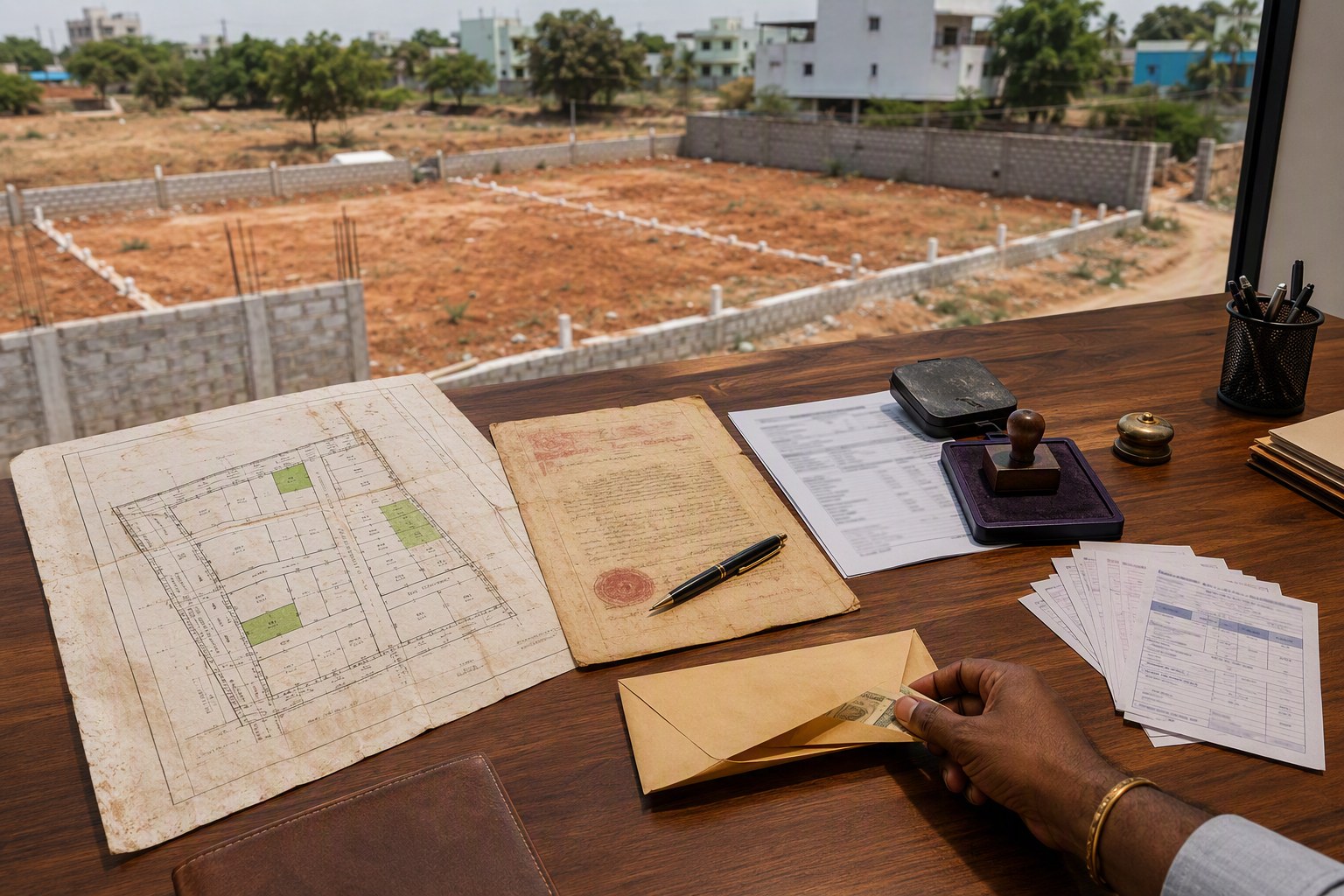
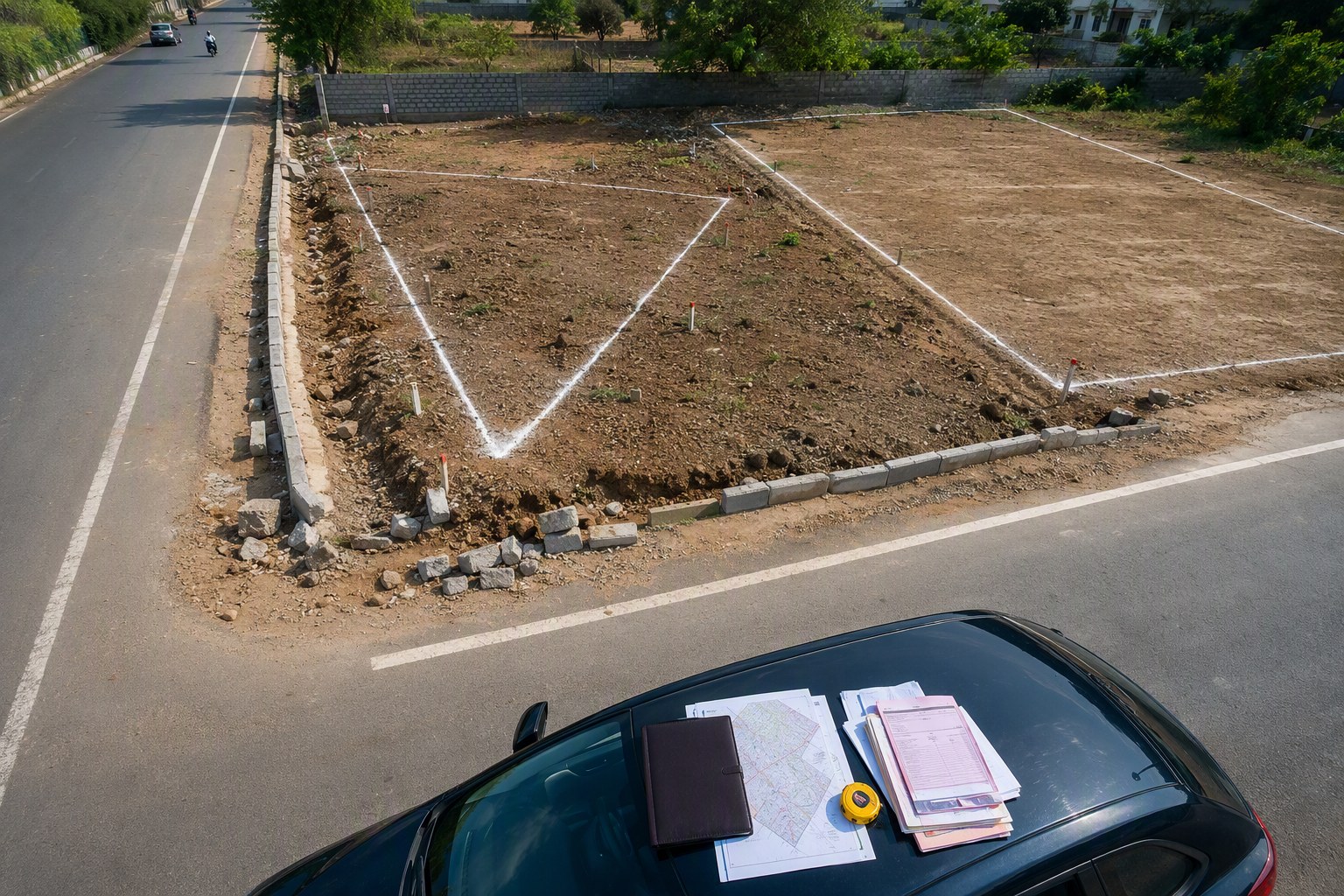
Telangana Plot ROI cannot be judged only by the selling price, brochure promise, or neighbour’s resale story. As per latest IGRS data, Telangana has 3,076,153 prohibited property entries under Section 22-A. That is the 30.76 lakh entry risk factor every plot investor must respect before calculating returns. In our experience, the biggest ROI killer is not slow appreciation. It is buying a plot that later becomes hard to register, hard to finance, or hard to resell.
A plot with unclear title is not an investment asset. It is a pending problem with a boundary wall.
Hyderabad investors usually ask one question first: “How much will this plot become after some time?” Fair question. But before ROI, ask whether the land can legally move from seller to buyer, whether banks will touch it, and whether another buyer will confidently take it from you later.
This is especially true in and around Kokapet, Narsingi, Tellapur, Kollur, Mokila, Shankarpally, Tukkuguda, Maheshwaram, Adibatla, Ghatkesar, Kompally and Medchal. These micro-markets attract genuine buyers, NRIs, plotted layout investors and speculative money. But they also attract weak paperwork, survey-number confusion, inherited land disputes, conversion gaps and marketing that runs ahead of approvals.
Telangana Plot ROI starts with the 30.76 lakh prohibited property reality
Section 22-A prohibited property entries are not a small side issue in Telangana land buying. The government record count of 3,076,153 entries tells us one thing clearly: title risk is not rare. It is part of the market.
For a buyer, a prohibited entry can mean the registering authority may not process a sale deed in the normal manner. In simple language, the SRO may not register the property because the land falls under a restricted category or is flagged in government records. The reason can vary: government land, assigned land, endowment land, ceiling issues, wakf-related entries, court-related restrictions, or other notified categories. The buyer may not always understand the legal label, but the market impact is simple. If registration becomes doubtful, ROI becomes meaningless.
We have seen investors compare plots in Gandipet mandal and Shankarpally mandal only on location and future road connectivity. That is risky. A plot near a growth corridor can still be a bad purchase if the survey number has a restriction, the pahani trail is broken, or the seller has only partial rights.
Before paying an advance, run a basic title-risk check using the Section 22-A Prohibited Property Check. Then verify the exact survey number through the Survey Number Finder. If the land is in a village where SRO jurisdiction is confusing, use Find Your SRO Office before assuming where the registration will happen.
Why Telangana Plot ROI fails when title risk is ignored
ROI is usually calculated like this: future sale value minus purchase cost, adjusted for expenses. That sounds neat on paper. But land is not a mutual fund unit. A plot has layers: title, access, zoning, layout approval, litigation, registration history, mortgage history, family claims, boundaries and market acceptability.
If any of these layers are weak, the buyer pool shrinks. Once the buyer pool shrinks, your resale value becomes theoretical. You may still quote a high price, but serious buyers will ask for documents. Banks will ask for documents. Their advocate will ask for documents. If the file cannot answer those questions, the deal slows down or dies.
That is why I prefer a risk-adjusted ROI approach for Telangana plots. First reduce the risk. Then discuss appreciation.
The three filters I use before discussing returns
- Title risk: Is the land free from prohibited property entries, court disputes, ownership gaps and suspicious document history?
- Bankability: Will a reputed bank or housing finance company consider the plot for funding after legal scrutiny?
- Resale liquidity: Can the owner resell without giving heavy discounts due to missing approvals, poor access or confusing records?
These filters matter more than a fancy entrance arch or a marketing board saying “near upcoming development”. In Telangana, a clean file usually sells faster than a dramatic promise.
Telangana Plot ROI and bankability: why loan eligibility matters even for cash buyers
Many plot buyers say, “I am buying with cash, why should I care about bank loan?” My answer is direct: you may be a cash buyer, but your future buyer may not be. If your plot is not bankable, you are silently cutting out a large section of resale buyers.
Bankability is not only about your income. It is about the property file. Banks and their legal teams usually examine link documents, EC, layout approval, ownership chain, conversion status, access road, mortgage charges and whether the property is marketable. If they hesitate, your resale liquidity also suffers.
Use the Encumbrance Certificate Search to check registered transactions. If you already have an EC, pass it through the EC Analyzer to understand the flow of transactions better. For mortgage-related caution, check the CERSAI Charge Check. These are not replacements for a lawyer, but they help you ask sharper questions before you block money.
In areas like Tellapur, Kollur and Mokila, many buyers focus on the growth story. That is understandable. But the loan officer will not approve a file because the location is fashionable. The file must stand on its own.
Telangana Plot ROI needs resale liquidity, not just appreciation talk
Resale liquidity means how easily you can sell when you actually need to exit. A plot may look valuable, but if every buyer asks for a discount because the road is unclear or the layout approval is weak, your ROI gets hit.
In our experience, resale liquidity improves when the plot has clean registration history, clear road access, proper layout approval, acceptable land use, reliable boundaries and a location that buyers understand. For example, a buyer looking at Kompally or Medchal may compare road access and municipal growth. A buyer near Maheshwaram or Tukkuguda may ask about airport-side connectivity and industrial activity. A buyer around Ghatkesar may check highway access and village records. Each locality has its own buyer psychology.
But one thing is common everywhere: unclear land records slow down exit. Even if the market is active, your specific plot may not move if documents create doubt.
Practical resale questions before buying a Telangana plot
- Will a cautious buyer understand the ownership chain without confusion?
- Can the seller produce link documents, EC and revenue records without delay?
- Does the plot have legal access from a road shown in approved documents?
- Is the land use suitable for the purpose being advertised?
- Can the SRO process the sale deed without a Section 22-A issue?
For land-use clarity, use the Land Use Zone Finder. If the road width is a key part of the resale pitch, check it using the Road Width Check. If you are comparing plot sizes in square yards, acres, guntas or square metres, use the Area Unit Converter so that the calculation does not go wrong at the first step.
The ROI calculation should come after verification, not before it
Many investors start with expected selling price. I would reverse it. Start with verification, then calculate ROI. A risky plot should not get the same return assumption as a clean, bankable, easily saleable plot in the same belt.
Here is the order I recommend for Telangana plot investors:
| Stage | What to check | Why it affects ROI |
|---|---|---|
| Title screening | Section 22-A status, link documents, pahani trail, ownership chain | Registration risk can destroy the investment thesis |
| Transaction history | EC, sale deeds, gift deeds, partition deeds, mortgage entries | Hidden claims and charges can reduce buyer confidence |
| Government value check | Ready reckoner or guideline value from official records | Helps estimate registration cost and compare quoted price with official value |
| Approval and land use | Layout approval, land use zone, road access, open space norms | Weak approvals reduce end-user demand |
| Exit quality | Bankability, location demand, document readiness | Better liquidity improves real-world ROI |
For government value reference, use the Market Value / Guideline Value Search. For registration cost estimation, use the Stamp Duty Calculator. If you are trying to understand total land-plus-building value later, the Composite Value Calculator can help frame the discussion better.
How I read Hyderabad plot markets through the ROI-risk lens
Every belt has its own risk-return character. Kokapet and Narsingi have strong brand recall, but entry pricing is usually serious and document scrutiny is also high because buyers are more aware. Tellapur and Kollur attract families and investors looking at the western corridor. Mokila and Shankarpally pull buyers who want larger plots and a less congested environment. Tukkuguda, Maheshwaram and Adibatla are often discussed with airport-side growth and industrial employment narratives. Medchal, Kompally and Ghatkesar attract buyers looking at northern and eastern connectivity.
None of these areas is automatically safe or unsafe. Good plots and weak plots exist in the same locality. Even within one village, one survey number may be clean while another may have complications. That is why the survey number matters more than the sales pitch.
A serious investor should ask for the exact survey number, village, mandal, district, SRO, layout approval reference, link documents and EC before talking about token advance. If the seller avoids these basics, treat it as a signal.
What a clean plot file usually contains
- Clear sale deed or title deed in the seller’s name
- Proper link documents showing how ownership moved over time
- Recent EC covering relevant registered transactions
- Revenue records such as pahani or related extracts, where applicable
- Layout approval and plot demarcation details
- Land use clarity and road access proof
- No visible Section 22-A restriction for the survey number
For a deeper pre-purchase check, start with the Property Verification Tool. If you are monitoring a property over time before purchase or after purchase, use the Property Change Tracker. These checks are especially useful when the seller says, “All papers are clear, sir,” but the file has not yet been tested.
Do not confuse low entry price with high Telangana Plot ROI
A cheap plot can be cheap for a reason. It may be far from usable access, stuck in family dispute, missing layout approval, sitting in a restricted survey number, or located in a zone where end-use is not what the brochure claims. A low purchase price does not automatically mean high ROI.
Real ROI comes from a mix of entry price, clean title, market demand, holding comfort and exit confidence. If you buy at a sensible price but the plot cannot be financed or resold easily, your return is trapped. If you buy a clean, bankable plot in a location with genuine demand, the exit becomes easier even when the market mood is not perfect.
We have seen buyers spend weeks bargaining on price but only minutes checking title. That is backward. A small saving at purchase can disappear if a legal issue surfaces later. In Telangana land, paperwork is not boring back-office work. It is the core of the investment.
A practical ROI checklist for Telangana plot buyers
Before you calculate return, complete this checklist:
- Check Section 22-A prohibited property status for the survey number.
- Confirm village, mandal and SRO jurisdiction.
- Read the EC and match it with link documents.
- Check whether any bank charge or mortgage appears in available records.
- Verify layout approval and road access.
- Check land use before believing future construction claims.
- Compare official guideline value with the quoted price.
- Estimate stamp duty and registration cost.
- Ask whether a future buyer’s bank will accept the file.
- Keep every seller statement in writing where possible.
Only after this should you sit with your ROI sheet. Put another way: title first, bankability second, liquidity third, appreciation after that.
The best plot investment is not the one with the loudest future story. It is the one where the documents, location and exit route all support the story.
Final view: the 30.76 lakh entry risk factor should change investor behaviour
The 3,076,153 prohibited property entries in Telangana are a reminder that land investing needs discipline. Hyderabad’s growth story is real in many pockets, but a growth story cannot clean a defective title. A road project cannot fix a prohibited entry. A neighbour’s resale cannot guarantee your survey number.
My view is simple. If you are buying a plot in Telangana, do not calculate ROI like a spreadsheet exercise. Calculate it like a land professional. Remove title risk as far as possible. Test bankability. Think like your future buyer. Then decide whether the expected return is worth the holding period and the paperwork burden.
That is how Telangana Plot ROI becomes a serious investment calculation, not just market gossip over tea.
Frequently Asked Questions
What does the 30.76 lakh prohibited property entry risk mean for Telangana plot ROI?
It means investors must check Section 22-A risk before calculating returns. As per latest IGRS data, Telangana has 3,076,153 prohibited property entries. If a plot is affected, registration, bank funding and resale can become difficult.
Should I calculate ROI before or after checking the EC?
Check the EC first. The Encumbrance Certificate helps you understand registered transactions, mortgages and ownership movement. ROI calculated without EC review can give false comfort.
Why is bankability important if I am buying a plot with my own money?
Because your future buyer may need a loan. If banks are uncomfortable with the property file, your resale market becomes smaller and your real ROI may reduce.
Which Telangana plot documents should I verify before paying advance?
Verify the sale deed, link documents, EC, pahani or relevant revenue records, layout approval, land use, road access, SRO jurisdiction and Section 22-A status for the exact survey number.
Can a good Hyderabad location overcome weak title documents?
No. A strong location may create demand, but weak title documents can block registration, funding or resale. In land investment, clean title is the base on which location value sits.