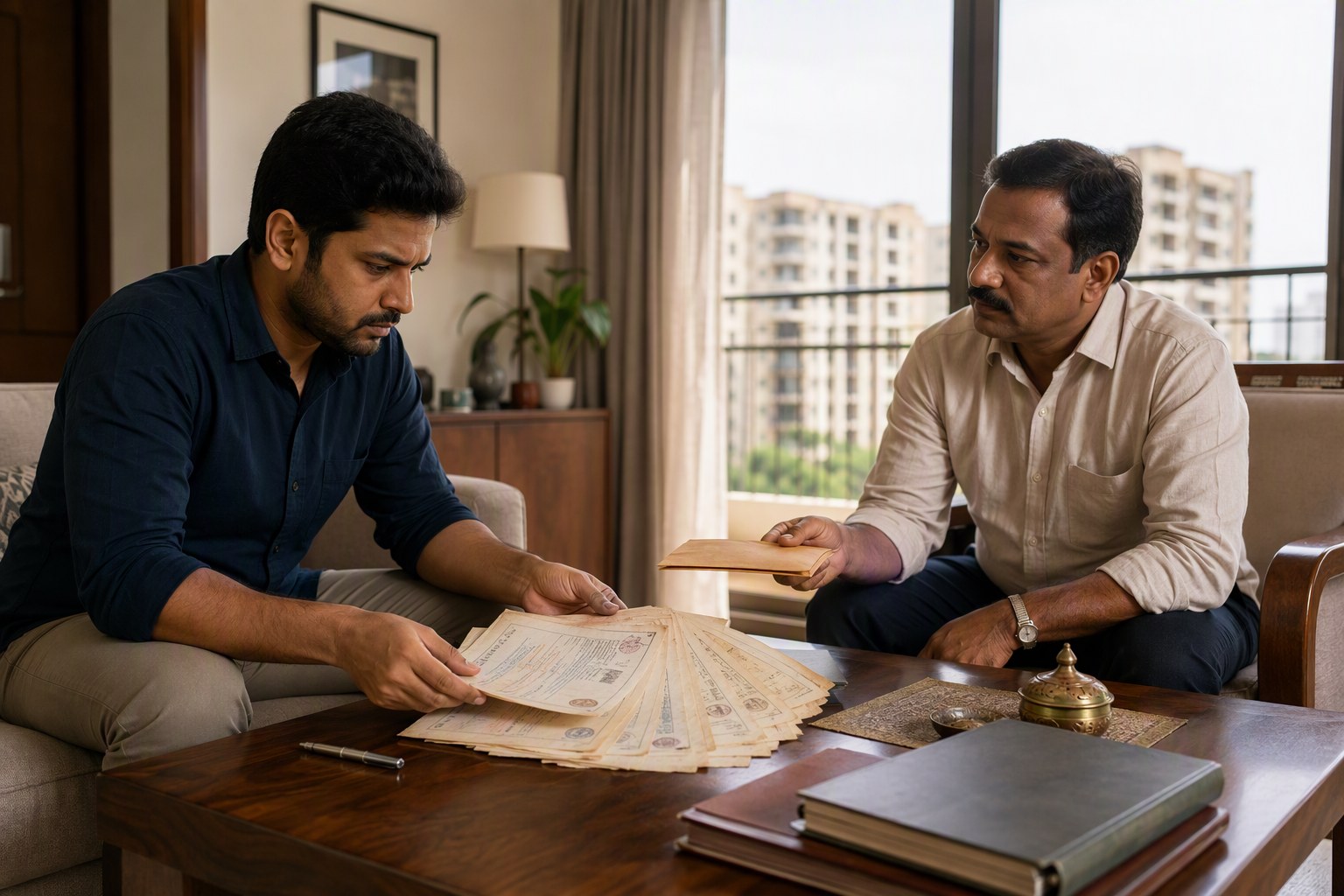
Telangana Sellers: 1.48 Lakh Records That Can Stall Deals
Telangana Sellers: 1.48 Lakh Records That Can Stall Deals is not a small warning sign. It is a loud siren for anyone planning to sell land, a flat, a villa plot or an inherited property in Hyderabad and surrounding districts. As per the available database fact, Telangana has 147934 prohibited-property records under Section 22-A. If your survey number, door number, extent, or title chain touches one of these records, the deal can stop at the SRO counter even after negotiation, token advance and bank processing.
In our experience, most seller-side trouble starts before the buyer even enters the picture. The seller quotes a price, puts the property on WhatsApp groups, receives a small token, and only then checks EC, Dharani, pahani, link documents, mutation and SRO restrictions. That order is risky. Sellers should reverse it: verify first, price next, list after that.
My opinion is simple: a seller who checks Section 22-A status, EC entries and document gaps before listing has stronger bargaining power than a seller who waits for the buyer’s lawyer to find faults.
Why Telangana Sellers Must Treat 147934 Section 22-A Records Seriously
Section 22-A entries are not ordinary objections. They are prohibited-property records. In plain language, the registration system may not allow transfer if the property is covered by government land, assigned land, wakf, endowment, court order, ceiling surplus, forest, tank bed, notified acquisition, or another restriction category.
The number 147934 matters because Telangana’s property market is no longer limited to old city houses and central Hyderabad apartments. Sellers are active in Kokapet, Narsingi, Gachibowli, Kondapur, Tellapur, Osman Nagar, Mokila, Shankarpally, Adibatla, Pocharam and many peri-urban mandals. These are exactly the zones where agricultural land conversion, layouts, old pahanis, HMDA approvals, Dharani entries and SRO records often have to be read together.
A buyer may love your property. A bank may be ready to fund it. But if the SRO system throws up a prohibition, the sale deed cannot move in the normal way. Even worse, the buyer may ask for refund with interest, damages, or a revised price. That is why a seller should not treat verification as a buyer’s job alone.
Telangana Sellers: 1.48 Lakh Records That Can Stall Deals Before Token Advance
Token advance is emotional in Hyderabad real estate. Once a buyer pays ₹1 lakh, ₹5 lakh or 1 percent of the deal value, both sides assume the deal is almost closed. But token is not registration. If your property has a restriction, missing link deed, wrong extent, mismatch in names, unreported mortgage, or old family claim, the same token becomes a dispute point.
We have seen sellers in Serilingampally mandal list apartments in Gachibowli and Kondapur without checking whether the mortgage release deed is reflected in the Encumbrance Certificate. We have seen land sellers in Gandipet mandal, especially around Kokapet, Narsingi and Manikonda, assume that a clean marketable location means clean title. That is not always true. Revenue records and registration records are two different streams, and both need reading.
Before taking even a symbolic token, sellers should run a basic pre-listing check using these tools:
- Section 22-A Prohibited Property Check to see whether the property is flagged in prohibited records.
- Encumbrance Certificate Search to check sale deeds, mortgages, releases, court attachments and other registered entries.
- Survey Number Finder to confirm the correct survey number, village and mandal before advertising land.
- Find Your SRO Office to identify the correct registration office and avoid confusion between nearby jurisdictions.
What Actually Gets Stalled At The SRO Counter
Many sellers think the only issue is buyer payment. That is not true. Registration can get delayed or stopped for several reasons. Some are legal. Some are clerical. Some are old family mistakes that nobody corrected for 20 years.
| Seller-side issue | How it affects the deal | What to check before listing |
|---|---|---|
| Section 22-A prohibition | SRO may refuse registration or ask for clarification | Run prohibited property check using survey number, village and mandal |
| EC shows mortgage not released | Buyer bank may reject loan or hold disbursement | Download latest EC and verify release deed entry |
| Name mismatch | Sale deed drafting and bank legal opinion get stuck | Compare Aadhaar, PAN, old deed, mutation, tax receipts |
| Extent mismatch | Buyer may renegotiate price or demand survey | Match pahani, Dharani, layout plan, link deed and physical possession |
| Missing link document | Title chain looks incomplete | Collect parent deeds, partition deed, gift deed, will probate where applicable |
| Wrong SRO assumption | Stamp duty planning and slot booking get delayed | Confirm the correct SRO before drafting sale deed |
Hyderabad Localities Where Sellers Should Be Extra Careful
Hyderabad’s selling market is very locality-specific. A flat in Kondapur is checked differently from a plotted layout in Mokila. A villa plot in Tellapur is not the same as agricultural land proposed for conversion in Shankarpally mandal. Sellers should understand the type of property they are selling and the records attached to it.
Gachibowli, Kondapur and Nanakramguda in Serilingampally mandal
These are high-demand apartment and commercial corridors. Resale flats in Gachibowli and Kondapur often get quoted in the broad band of ₹9000 to ₹14000 per sq ft, depending on builder, age, community, floor and view. For sellers, the common issues are not usually pahani-related but EC, mortgage release, undivided share, occupancy certificate, society NOC and pending maintenance.
If the seller has closed a housing loan, the release deed must reflect in EC. A bank closure letter alone is not enough for many buyers. Check the latest EC before you quote the final price.
Kokapet, Narsingi and Manikonda in Gandipet mandal
Kokapet and Narsingi have seen strong buyer interest because of access to Financial District, ORR and premium gated projects. Apartment asking rates commonly sit around ₹8500 to ₹13500 per sq ft, while premium units can vary based on brand and delivery stage. In land and villa transactions, sellers must be careful with survey numbers, layout approvals, land conversion, approach road and Section 22-A status.
This belt has both polished gated communities and older revenue land histories. Do not rely only on location glamour. Verify the record.
Tellapur and Osman Nagar in Ramachandrapuram mandal
Tellapur and Osman Nagar have become a favourite for families moving from Hitec City and Gachibowli. Resale and under-construction apartment quotes are often seen around ₹7000 to ₹11000 per sq ft. For sellers, the main checks are RERA status for projects, builder handover documents, UDS clarity, registered sale deed, EC and pending dues.
If you are selling in an under-construction project, check the project on RERA Project Lookup. Buyers increasingly ask for it before paying token.
Mokila and Shankarpally mandal
Mokila and Shankarpally attract plot buyers. Depending on layout approval, road width, location and development stage, asking rates in plotted layouts are often discussed in the broad range of ₹45000 to ₹90000 per sq yd. This is exactly where survey number accuracy matters. A one-digit survey number mistake can change the village, title history and legal risk.
Before listing a plot, check survey number, layout approval, land use, approach road and prohibited status. Use Land Use Zone Finder and Road Width Check when the property value depends on future construction potential.
Adibatla and Ibrahimpatnam mandal
Adibatla and nearby Ibrahimpatnam pockets are driven by plotted development, aerospace-SEZ related demand, ORR access and long-term investor interest. Plot asking prices can vary widely, often around ₹22000 to ₹45000 per sq yd depending on approval and location. Here, sellers should be strict about conversion, layout sanction, link documents, old pattadar passbooks, Dharani entries and any assigned-land angle.
Cheap-looking land can become expensive trouble if it is covered by restriction. Run the checks before accepting buyer money.
Price Quoting Without Verification Can Backfire
Sellers often ask me one question: should we quote market rate first or verify first? My answer is verification first. Price without title clarity is only a wish.
Take a simple example. A seller quotes a 300 sq yd plot in Mokila at ₹70000 per sq yd. The quoted value becomes ₹2.10 crore. In Telangana, normal registration cost for many sale deeds is commonly calculated at around 6 percent, split as stamp duty, transfer duty and registration fee. On ₹2.10 crore, that is around ₹12.60 lakh as a broad registration outgo. A buyer planning this much money will not accept vague answers on EC, survey number and prohibition status.
For apartments, the issue is similar. If a Kondapur flat of 1800 sq ft is quoted at ₹11000 per sq ft, the deal value is ₹1.98 crore. The buyer’s bank legal team will ask for mother deed, sale deed, link documents, EC, occupancy certificate, sanctioned plan, tax receipts and society dues. If the seller cannot produce them quickly, the buyer may shift to another flat in the same community.
Use Market Value / Guideline Value Search before deciding whether your asking price is far above the ready reckoner value. Then use Stamp Duty Calculator to estimate the buyer’s registration cost. A seller who knows both market asking rate and guideline value can negotiate better.
EC Is Not Just A Buyer Document
Many sellers think Encumbrance Certificate is required only by the buyer. That is a mistake. EC is the seller’s mirror. It shows what the registration department can see about your property.
A clean-looking file can still have EC issues. Common examples include an old mortgage not released, a release deed registered in a different document number but not noticed by the seller, a court attachment, a prior agreement, or a missing transaction due to wrong property schedule. Sometimes an inherited property has a partition deed, but the revenue mutation is pending. Sometimes the EC is clean, but the physical possession and family settlement are messy.
For sellers, I suggest checking EC for at least the usual bank-requested period and also reviewing older link documents where the property has a long chain. In Old Bowenpally, Secunderabad, Himayatnagar, Ameerpet, Kukatpally and LB Nagar, older apartments may have decades-old link deeds. In outskirts such as Shamirpet, Ghatkesar, Maheshwaram and Kandukur, old agricultural title history needs more careful reading.
Run Encumbrance Certificate Search before you put the property on listing portals or broker groups. If there is an issue, fix it first or disclose it clearly.
Documents Telangana Sellers Should Keep Ready Before Listing
A serious seller should create a pre-sale file. Not after buyer inspection. Not after token. Before listing. The file need not be fancy, but it must be complete.
- Latest registered sale deed or gift deed or partition deed.
- All available link documents and mother deed copies.
- Latest EC and previous EC where required.
- Dharani details for agricultural land, including pattadar passbook details where applicable.
- Pahani, mutation, and tax payment receipts for land.
- Property tax receipts for GHMC, municipality or gram panchayat properties.
- Approved layout plan, LP number, HMDA/DTCP approval where applicable.
- Building permission, sanctioned plan and occupancy certificate for buildings.
- Society NOC, maintenance due statement and corpus details for apartments.
- Loan closure letter and registered release deed if the property was mortgaged.
- Legal heir certificate, family settlement, will, probate or relinquishment deed where inherited property is involved.
- PAN, Aadhaar and address proof of all sellers.
For land parcels, I would add one more step: check the exact boundaries on ground. A buyer may tolerate a delayed document, but boundary disputes reduce trust immediately.
Seller Pricing Should Reflect Legal Readiness
In Hyderabad, buyers pay a premium for certainty. Two similar flats in Narsingi can have different outcomes if one seller has every paper ready and another says papers are with auditor, bank, builder, brother or somewhere in native place. That casual attitude affects price.
For plotted land, legal readiness has even more value. A HMDA-approved plot with clean EC, correct survey number, clear approach road and no Section 22-A issue will attract faster buyer movement than an unverified parcel, even if both are in the same village. Sellers should not feel shy to say: our property is verified, EC is ready, SRO is confirmed, and tax dues are cleared. That is a selling point.
If you want a single starting check, use Property Verification Tool. For sellers tracking changes in their property data, Property Change Tracker is useful, especially where family members are not living in Telangana full-time.
What To Do If Your Property Appears In A Prohibited List
Do not panic, but do not hide it. First, confirm whether the entry actually matches your property. In revenue records, survey number, sub-division, village and mandal are critical. Similar names and old village boundaries can create confusion.
Second, collect the relevant documents: sale deeds, pahanis, pattadar records, mutation orders, court orders if any, layout approvals and tax receipts. Third, speak to a local property lawyer or revenue consultant who understands that mandal. A Serilingampally apartment issue is not handled the same way as assigned-land suspicion in Ibrahimpatnam or Maheshwaram.
Fourth, do not accept token advance by saying it is a small issue unless you are ready to put the same disclosure in writing. A hidden restriction can become a bigger dispute than the restriction itself.
Practical Pre-Listing Checklist For Telangana Sellers
Before you share photos, location pin and price, complete this checklist. It saves time and protects reputation.
- Check whether the property is hit by Section 22-A prohibited records.
- Download the latest EC and read every entry, not just the final line.
- Confirm correct SRO using village, ward, locality and property type.
- Match survey number, plot number, flat number and door number across documents.
- Compare guideline value with your asking rate.
- Estimate buyer registration cost so negotiation is realistic.
- Clear property tax, maintenance dues and pending utility dues.
- Keep original documents ready for inspection.
- Resolve family consent before buyer visits start.
- Put any known issue in writing before token advance.
The Telangana selling market rewards prepared owners. With 147934 prohibited-property records in the system, sellers cannot afford a casual listing. The best time to find a title issue is before the buyer finds it. Once you know your restriction status, EC position, SRO jurisdiction, guideline value and document gaps, you can quote with confidence and close with fewer surprises.
Frequently Asked Questions
Can a Telangana seller take token advance before checking Section 22-A status?
It is risky. Check Section 22-A prohibited status, EC and basic documents before taking token. If there is a restriction, disclose it clearly and avoid verbal promises.
What is the biggest seller-side risk in Hyderabad resale deals?
The biggest risk is assuming the title is clean because the property is in a premium locality. EC gaps, mortgage release issues, missing link deeds and Section 22-A entries can stall even high-value deals.
Which tools should Telangana sellers use before listing a property?
Start with Section 22-A Prohibited Property Check, Encumbrance Certificate Search, Find Your SRO Office, Guideline Value Search and Stamp Duty Calculator. Land sellers should also verify survey number and land use.
Does a clean EC mean the property is fully safe to sell?
Not always. EC is very useful, but sellers should also check link documents, revenue records, approvals, tax dues, family claims and physical possession. For land, pahani and Dharani details matter.
Should sellers mention document issues to buyers?
Yes. If there is a known issue, disclose it before token advance. Clear written disclosure protects both sides and prevents later disputes over refund, delay or price reduction.