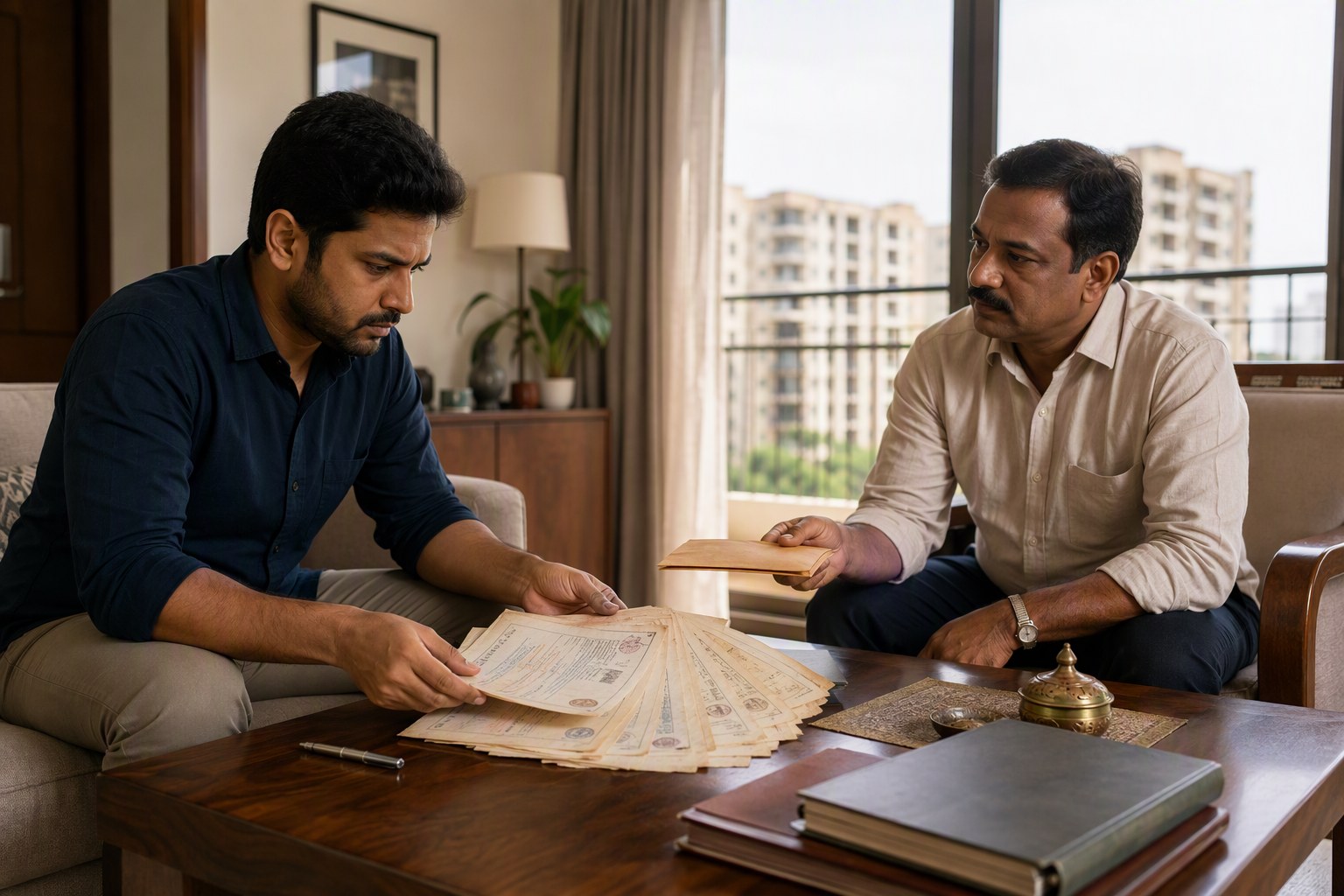
When One Co-Owner’s Signature Can Slow Your Home Sale, the problem rarely starts at the Sub-Registrar Office. It starts much earlier, usually when the seller accepts a good offer and assumes the paperwork will fall into place. We recently saw a typical Hyderabad situation: a family in Kondapur found a serious buyer, token amount was discussed, loan eligibility was clear, but one co-owner was working in Dubai and could not travel for registration. The buyer waited for a few days. Then his bank asked for clean consent documents. The sale suddenly became slow, awkward and risky.
This is more common than many sellers admit. In Hyderabad, Secunderabad, Rangareddy and Medchal-Malkajgiri, many homes are bought in joint names: husband and wife, parents and children, siblings, or inherited family members. Joint ownership is not a problem by itself. The problem comes when the seller lists the property without checking who must sign, who must give consent, whose identity proof has changed, and whether the ownership chain is clean.
Our view is simple: before you show the flat or plot to buyers, first show your ownership papers to yourself. If one co-owner is unavailable, unwilling, deceased, abroad, unwell, or legally represented by someone else, settle that file before entering serious price talks.
Co-Owner’s Signature: Why One Missing Consent Can Hold the Entire Sale
A buyer is not only buying walls, land area or undivided share. The buyer is buying your title. If the property has more than one owner, every person with a legal share normally has to join the sale, either by signing the sale deed personally or through a legally valid power of attorney, depending on the case.
In a simple resale flat in Gachibowli or Manikonda, this may look straightforward. Husband and wife are joint owners, both come to the SRO, sign and finish registration. But real transactions are rarely so neat. One co-owner may be in the US. One may be living separately. One may have changed surname after marriage. One may have lost PAN. One may be a senior citizen who cannot travel. In inherited houses at Himayatnagar, Malkajgiri or Kukatpally, the list can become longer: legal heirs, release deed holders, family settlement parties, and sometimes minors represented through guardians.
From a buyer’s point of view, a missing co-owner is a title risk. From a bank’s point of view, it is a documentation risk. From the SRO’s point of view, it is a registration compliance issue. So the buyer who was ready yesterday may pause today and ask, “Sir, can you first get everyone’s consent in writing?”
Co-Owner’s Signature Problems Start Before the Buyer’s Loan File
Many Hyderabad sellers think the buyer’s bank will only check the Encumbrance Certificate and sale deed. In practice, bank lawyers look at the entire ownership path. They check whether the person selling now has proper right to sell. If the current sale deed shows two names, they want both. If the seller got the property through succession, they ask for death certificate, legal heir proof, family settlement, release deed or court order, depending on facts. If there was a previous mortgage, they ask for closure proof and sometimes CERSAI details.
Before accepting a token, sellers should check the Encumbrance Certificate through Encumbrance Certificate Search and read it properly. If the EC shows past registered transactions, mortgages, releases or corrections, keep those documents ready. If you want help reading entries, use EC Analyzer. For bank charge-related checks, especially where a home loan was once taken, CERSAI Charge Check is also useful.
In our experience, deals slow down when sellers say “paper is there somewhere” or “my brother will sign later”. Buyers in areas like Nallagandla, Tellapur, Financial District, Miyapur and Sainikpuri are now more alert. Many have already lost time in previous transactions. They want documents before they push their loan file.
The Typical Story: Buyer Ready, Co-Owner Not Ready
Take a practical example. A family owns a flat near KPHB. The registered sale deed is in the names of the father and elder son. The father wants to sell. The elder son is in Bengaluru and agrees on WhatsApp. The buyer likes the flat, price discussion reaches a serious stage, and both sides plan agreement of sale.
Then the buyer’s lawyer asks for the elder son’s Aadhaar, PAN, passport-size photo, marital status declaration if needed, and confirmation that he will attend registration or issue a valid power of attorney. The son says he cannot travel for the next month. The buyer’s bank says the agreement must be signed by both owners or by a properly authorised attorney. Suddenly, what looked like a two-day step becomes a four-week delay.
Now imagine the same issue in an inherited plot at Maheshwaram mandal or Shankarpally mandal. The revenue records, pahani history, old link documents, legal heir details and family consent may all come into the picture. For agricultural land or converted land, sellers should also check survey number details using Survey Number Finder and screen the property through Property Verification Tool. Telangana’s Section 22-A prohibited property list is not a small corner issue either. As per latest IGRS data available in our database, prohibited properties under Section 22-A stand at 3,076,153. A seller should not wait for the buyer to discover such a concern.
For a direct Section 22-A screening, use Section 22-A Prohibited Property Check. It is far better to know the issue before listing than after accepting an advance.
Who Must Sign When a Jointly Owned Property Is Sold?
The short answer: every legal owner whose name or share appears in the ownership chain must be properly represented in the sale. The exact requirement depends on how the property is held.
| Ownership situation | Who usually needs to act | Seller preparation before listing |
|---|---|---|
| Flat in husband and wife’s joint names | Both owners sign sale agreement and sale deed, or one acts under valid authorisation | Keep both PAN, Aadhaar, photos, marriage/name proof if relevant |
| Plot bought by siblings jointly | All siblings sign or authorise one person properly | Confirm each person’s consent in writing before buyer visits |
| Inherited house after parent’s death | All legal heirs, or those holding title through release/settlement documents | Arrange death certificate, legal heir proof, release deeds, family settlement papers |
| NRI co-owner | NRI signs in India or gives legally acceptable power of attorney | Plan POA execution, attestation and adjudication well in advance |
| Minor has share | Guardian process may be required as per legal advice | Do not list casually; take legal advice before negotiation |
This table is only a practical seller checklist, not a substitute for legal advice. Still, it covers the situations we repeatedly see in Hyderabad resale deals.
Consent Is Not Just a Friendly Message
A common mistake is treating consent as a family understanding. “My sister has no objection” may be true at home, but buyers, banks and SRO processes need formal documents. If a co-owner is not signing personally, the authorisation must be clear, valid for sale, and accepted for registration use.
For example, a general power of attorney that only allows property management may not be enough for sale. A power of attorney for selling a specific flat or plot should identify the property properly: door number, flat number, undivided share if applicable, survey number, extent, boundaries and document references. If the property is in a gated community in Kokapet or Tellapur, mention the unit details correctly. If it is open land in Moinabad mandal or Ibrahimpatnam mandal, survey number and extent become even more sensitive.
Use Legal Document Generator only as a starting point for draft preparation. For signing, stamping, adjudication and registration effect, take advice from a property lawyer or licensed document writer familiar with Telangana registration practice.
Identity Mismatch: Small Error, Big Delay
One co-owner’s signature can slow your home sale even when everyone agrees, because identity records do not match. This is very common.
- Name in old sale deed: “K. Srinivas Rao”; name in PAN: “K Srinivas”; name in Aadhaar: “Srinivasa Rao K”.
- Married daughter’s surname changed after the purchase.
- Passport has expanded initials, while sale deed has initials only.
- Address proof belongs to a different city or old house.
- One co-owner is a senior citizen with thumb impression requirement or medical constraints.
These are not unsolvable issues. But they need time. If you are selling a flat in Ameerpet, Uppal, Chandanagar or Alwal, do not assume the SRO counter will casually ignore mismatches. The buyer’s bank may raise objections before the SRO stage itself.
Keep a simple identity folder for each co-owner: PAN, Aadhaar, passport if available, recent photo, mobile number linked to Aadhaar where required, address proof, and any affidavit or Gazette/name-change proof if applicable. If one co-owner is abroad, scan quality matters. Poor scans and half-visible IDs slow down bank legal review.
Check the Ownership Chain Before You Discuss Final Price
Price negotiation is exciting. Document checking is boring. But in property selling, boring work saves money.
Before listing, pull out the full chain: current sale deed, link documents, mother deed if available, EC, tax receipts, building permission papers if applicable, occupancy certificate for apartments where available, mutation or revenue entries for land, and loan closure documents. For plots and land parcels, check village and SRO mapping using SRO Village Directory or Find Your SRO Office.
For apartment resales, sellers should also understand valuation expectations. Buyers often cross-check government market value and registration cost. You can use Market Value / Guideline Value Search and Stamp Duty Calculator to anticipate what the buyer will see. If there is a building component valuation discussion, Building Value Calculator can help organise your numbers without guessing.
For land and development potential, tools like Land Use Zone Finder, Road Width Check and FSI/FAR Calculator can support early screening. These do not replace official approvals, but they help sellers answer buyer questions with better confidence.
Agreement of Sale: Do Not Sign Without All Owners Aligned
The agreement of sale is where many disputes begin. A seller may accept advance from the buyer and sign the agreement alone, assuming other co-owners will sign later. If the other co-owner delays, changes mind, asks for a different share of sale proceeds, or is unreachable, both buyer and seller get stuck.
My practical advice: do not take a serious advance unless every co-owner has agreed on these points:
- Sale price and payment schedule.
- Who will sign the agreement of sale.
- Who will attend registration.
- Whether any power of attorney is needed.
- How TDS, capital gains planning and loan closure will be handled.
- Who will receive the sale consideration and in what proportion.
- Timeline for handing over original documents and possession.
For tax planning, sellers may use Capital Gains Tax Calculator as an early estimate tool. The final advice should come from a chartered accountant, especially where multiple co-owners have different purchase costs, holding periods or exemptions.
NRI Co-Owner: Start Earlier Than You Think
NRI co-owner cases are a regular feature in Hyderabad real estate. Families bought homes in Madhapur, Kondapur, Narsingi, Bachupally, Kompally and LB Nagar during earlier job cycles. Years later, one owner is abroad and the family wants to sell quickly.
The usual route is either the NRI travels to India for signing or gives a power of attorney to a trusted person. The POA path needs careful drafting, execution before the proper authority abroad, attestation as required, courier time, local adjudication where applicable, and acceptance by the buyer’s bank and registration side. This cannot be planned after the buyer’s loan sanction is near expiry.
Also, banks may ask for KYC and tax documents of all sellers. If sale proceeds are going to NRO/NRE accounts, banking formalities may come in. Do not allow the buyer to discover these steps after paying token. Be upfront. Serious buyers respect clarity.
Inherited Property: Consent Can Be More Sensitive Than Price
Inherited homes and plots are emotionally loaded. A house in Narayanguda, a plot in Shamshabad mandal, or agricultural land near Chevella mandal may have family history attached to it. Sellers may agree in principle, but when money comes, old issues surface.
Before listing inherited property, confirm whether the title has already moved to legal heirs through proper documents. If some heirs have released their share, keep the registered release deed. If there is a family settlement, check whether it is registered where registration is required. If a will is involved, get legal advice on proof, probate requirements if any, and buyer comfort. If a legal heir is deceased, the next level of heirs may have to be considered.
Do not depend only on oral family approval. Buyers in Hyderabad have become cautious after seeing title disputes. If the title path is clean, say it clearly and show documents. If there is a gap, fix it before sale marketing.
Before Listing: A Seller’s Co-Owner Readiness Checklist
If you plan to sell in the next few months, sit with this checklist on a Sunday morning. It may save you from a failed transaction.
- Read the latest registered sale deed and list every owner name exactly as printed.
- Check whether each owner is alive, available, willing and legally competent to sign.
- Collect PAN, Aadhaar, photos and address proof for every co-owner.
- Check name mismatches and arrange supporting affidavit or proof where needed.
- If a co-owner is abroad, start POA planning before listing.
- If a co-owner is deceased, arrange death certificate, legal heir documents and registered releases where needed.
- Check EC, prior mortgage releases and bank NOC documents.
- For land, verify survey number, mandal, village, land use and Section 22-A status.
- Discuss sale proceeds split among co-owners before accepting advance.
- Identify the correct SRO and likely registration requirements early.
One useful habit is to maintain a property tracker. If your property details, ownership status or EC entries need monitoring, use Property Change Tracker. For Telugu terms appearing in old pahanis, link deeds or revenue papers, Telugu-English Property Terms Dictionary can help you understand basic document language before you meet a professional.
What Buyers Quietly Judge When They Meet a Seller
Buyers do not only judge the property. They judge the seller’s readiness. If you say, “All owners are available, here are the documents, EC is checked, SRO is identified, loan closure papers are ready,” you look reliable. If you say, “My brother is somewhere abroad, we will manage,” the buyer mentally discounts the deal.
This is especially true in competitive Hyderabad micro-markets. A buyer looking at flats in Nanakramguda, Nallagandla and Kondapur may have three options. If your property has co-owner uncertainty and another seller has clean documents, the buyer may choose the other one even if your flat is better.
We have seen good deals slip not because the title was bad, but because the seller looked unprepared. Real estate confidence is built through documents, not only through polite words.
Final Word: One Co-Owner’s Signature Is a Sale-Critical Document
When one co-owner’s signature can slow your home sale, the solution is not pressure. The solution is preparation. Get consent, identity proof, ownership documents, EC, SRO details and tax planning in order before the first serious buyer enters your living room.
In Telangana, where registrations, Dharani records, pahani references, SRO checks and Section 22-A screening all matter in different ways, a seller who prepares early has a clear advantage. Your buyer may love the property. But the buyer’s lawyer and bank will love only clean paperwork.
My honest opinion: do not market a jointly owned property as “ready for sale” unless every co-owner is truly ready to sign or properly authorise the sale. That one step can protect your price, your buyer’s confidence and your family peace.
Frequently Asked Questions
Can one co-owner sell a jointly owned flat in Telangana without the other owner?
Usually, no. A co-owner can sell only the right they legally hold, but a buyer purchasing the full flat will normally require all owners to sign the sale deed or be properly represented through valid authorisation. Take legal advice before accepting any advance.
What if one co-owner is abroad and cannot attend registration?
The co-owner may need to execute a properly drafted power of attorney in favour of a trusted person, subject to legal, attestation and registration-related requirements. Start this process before listing the property, because buyer banks may review the POA carefully.
Should all co-owners sign the agreement of sale?
Yes, that is the safer practice when the buyer is purchasing the entire property. If one person signs on behalf of others, the authority must be clear and valid. Otherwise, the buyer may hesitate or the bank may raise objections.
Which documents should joint owners keep ready before selling?
Keep the registered sale deed, link documents, EC, PAN, Aadhaar, photos, address proofs, loan closure papers, tax receipts, legal heir or release documents where applicable, and any POA or consent papers needed for absent co-owners.
How can I check if my Telangana property has a restriction before sale?
Check the Encumbrance Certificate, survey number details, SRO mapping and Section 22-A status before listing. Verified.RealEstate tools can help with early screening, but final legal opinion should come from a qualified property lawyer.