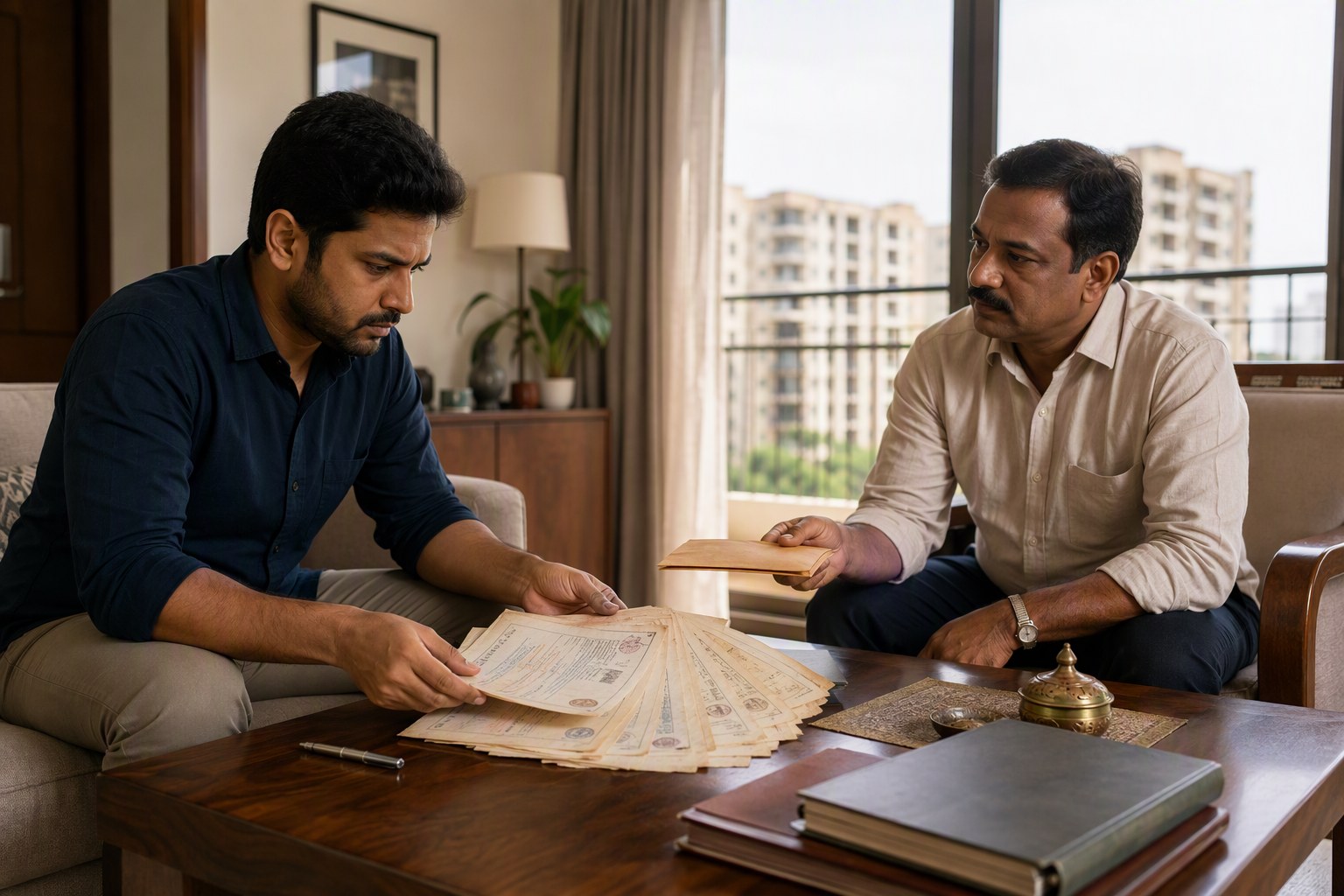
Pre-Listing Title Scan is becoming the new first step for serious property sellers in Telangana. Before a flat in Kondapur, an open plot in Mokila, or agricultural land near Shankarpally goes on the market, sellers are increasingly checking the Encumbrance Certificate, property tax dues, Dharani record trail and Section 22-A exposure. The reason is simple: buyers are no longer satisfied with a location pin and a good price. They want proof before they visit, negotiate or pay token advance.
The shift is sharper because Telangana’s prohibited property database is not small. As per latest IGRS data available in the Verified.RealEstate database, there are 30,76,153 prohibited property entries under Section 22-A. That does not mean every second property is risky. It means a seller who ignores title hygiene before listing may lose the best buyer at the document stage.
In our experience, the fastest deals now are not always the cheapest deals. They are the cleanest deals — where the seller can show EC, tax status, SRO details and 22-A check without drama.
Pre-Listing Title Scan is now a seller-side market practice
Until recently, title verification was mostly seen as the buyer’s job. The buyer’s advocate would ask for link documents, EC, tax receipts, approved plan, occupancy certificate where applicable, and the seller would start searching cupboards, WhatsApp groups and old bank files.
That habit is changing. Sellers in Hyderabad’s active resale pockets — Madhapur, Gachibowli, Nallagandla, Kondapur, Manikonda, Miyapur, Kukatpally, Bachupally, Kompally and Tellapur — are realising that document readiness directly affects negotiation power. If two similar flats are available in the same gated community, the seller who shares a clean document pack first usually gets more serious attention.
The same trend is visible in land transactions across Rangareddy, Medchal-Malkajgiri, Sangareddy and Yadadri-Bhuvanagiri districts. For land, the pre-listing check is even more sensitive because survey number, village, mandal, nature of land, Dharani status and Section 22-A references can make or break a deal.
A proper pre-listing scan is not a substitute for legal opinion. But it is a practical filter. It helps a seller know whether there is a visible issue before the buyer finds it. That difference matters.
What a Pre-Listing Title Scan should cover before advertising
A clean listing is not just about good photos. It should be backed by basic proof. I would not advise any seller to put a property on the market without checking the following items first.
1. Encumbrance Certificate trail
The EC shows registered transactions, mortgages, releases, gifts, sales and other registered encumbrances for the selected period. In Telangana resale transactions, buyers often ask for a long-period EC, not just a recent extract.
Before listing, sellers should run an EC check using the right document number, year, SRO and property details. A missing release deed, old mortgage entry or mismatch in schedule can delay the sale. You can start with the Encumbrance Certificate Search and, where the EC is long or confusing, review it through the EC Analyzer.
2. Section 22-A prohibited property exposure
Section 22-A is the area sellers should not take casually. Telangana’s prohibited property list includes entries connected to government lands, assigned lands, endowment lands, wakf lands, ceiling surplus lands and other restricted categories as reflected in government records. With 30,76,153 entries in the database, a survey number-level check is no longer optional for land sellers.
This matters in locations where village boundaries, old revenue records and urban expansion overlap. We’ve seen buyers become cautious in villages around Shankarpally mandal, Moinabad mandal, Maheshwaram mandal, Keesara mandal and Patancheru mandal because one wrong survey reference can put the transaction under doubt.
Sellers can do an early screening using the Section 22-A Prohibited Property Check. For land parcels, combine it with the Survey Number Finder so that the check is tied to the correct survey number, village and mandal.
3. Property tax, water and electricity dues
For apartments and houses, buyers now routinely ask whether municipal tax, water bills, electricity bills and maintenance charges are clear. In GHMC areas such as Jubilee Hills, Banjara Hills, Shaikpet, Serilingampally, Chanda Nagar and LB Nagar, unpaid tax dues may not destroy title, but they can disturb closing timelines.
A seller should collect the latest tax payment proof, electricity service number details, water connection status and society no-dues letter before listing. In gated communities, a no-dues letter from the association carries weight during final negotiation.
4. SRO and jurisdiction clarity
Many sellers casually say “Hyderabad registration” without knowing the correct Sub-Registrar Office. That creates confusion when buyers ask for EC or market value details. A property in Narsingi, Nanakramguda, Puppalaguda or Kokapet may fall under different registration references compared to an older city property in Himayatnagar or Secunderabad.
Use the Find Your SRO Office or the SRO Village Directory before sharing documents. A correct SRO reference helps the buyer’s lawyer pull records faster.
5. Guideline value and stamp duty readiness
Buyers also check whether the proposed transaction value is aligned with government market value, commonly called guideline value or ready reckoner value in everyday conversation. Sellers should not wait until the draft sale deed stage to check this.
The Market Value / Guideline Value Search gives a useful starting point. If the buyer asks about registration cost, point them to the Stamp Duty Calculator. This keeps the conversation factual and reduces last-minute bargaining based on wrong assumptions.
Pre-Listing Title Scan for flats in Hyderabad resale market
For a flat seller, the title scan is mostly about the chain of ownership, approvals and dues. In areas such as Kondapur, Gachibowli, Financial District, Nallagandla, Miyapur and Kukatpally, many resale flats have earlier bank loans. The seller must show that the loan is closed or explain the loan closure process clearly if the property is still under mortgage.
A practical flat seller document pack should include:
- Registered sale deed or conveyance deed in the seller’s name.
- Latest EC showing the ownership trail and any mortgage or release entries.
- Link documents, especially where the flat has changed hands earlier.
- Approved building plan and occupancy certificate, wherever available.
- Latest property tax receipt.
- Society maintenance no-dues status.
- Loan closure letter, release deed or current loan statement, as applicable.
- RERA details for under-construction or recently completed projects, checked through RERA Project Lookup.
For older apartments in Ameerpet, Begumpet, Mehdipatnam, Himayatnagar and Secunderabad, buyers may ask more questions on UDS, parking rights, builder handover papers and society formation. Sellers should not get irritated. These are normal buyer checks now.
Pre-Listing Title Scan for plots and agricultural land
Land is where the pre-listing scan becomes serious. A plot seller in Adibatla, Tukkuguda, Maheshwaram, Shadnagar, Shankarpally, Chevella, Moinabad, Ghatkesar, Bibinagar or Patancheru must be ready with revenue and registration clarity.
For open plots, the buyer will usually look at layout approval, land conversion status where relevant, chain documents, EC, survey number, village map reference, and whether the layout falls within HMDA, DTCP or local body jurisdiction. For agricultural land, Dharani passbook, pattedar details, pahani/adangal references and mutation trail become central.
A seller should not advertise land only as “clear title” unless the documents support that claim. The phrase has become overused in Hyderabad land marketing. A better approach is to say what has actually been checked: EC available, survey number verified, 22-A screening done, Dharani details available, link documents ready.
Where the land is close to a proposed road, lake buffer, forest boundary or government land pocket, a buyer may ask for extra checks. That is not a bad buyer. That is a careful buyer.
Why buyers are demanding proof before site visits
There are three practical reasons behind this change.
First, buyers are better informed. Many NRIs and salaried buyers in Hyderabad now do online checks before even speaking to the seller. They compare SRO, EC, guideline value, RERA status, 22-A exposure and map location early.
Second, token advance disputes have made people cautious. A buyer who pays advance and later finds an issue in EC or prohibited property records may face a painful refund discussion. So they prefer proof first.
Third, property prices in popular Hyderabad corridors are no longer small-ticket decisions. Whether it is a premium apartment in Kokapet or a land parcel near Pharma City-side growth corridors, buyers want legal comfort before emotional commitment.
Sellers who understand this behaviour are adjusting their sales process. They are not waiting for the buyer’s advocate to discover gaps. They are cleaning the file first.
Seller checklist: what to verify before listing
| Check | Why it matters | Useful tool |
|---|---|---|
| EC check | Shows registered ownership trail, loans, releases and other registered entries. | Encumbrance Certificate Search |
| 22-A check | Identifies whether the property appears in prohibited property records. | Section 22-A Prohibited Property Check |
| SRO identification | Helps buyer and lawyer search the correct registration records. | Find Your SRO Office |
| Survey number clarity | Critical for plots and agricultural lands in Telangana villages. | Survey Number Finder |
| Guideline value | Helps both sides understand registration value references. | Market Value / Guideline Value Search |
| Property verification summary | Gives a broader starting point before sharing documents with buyers. | Property Verification Tool |
How sellers should present a title-ready listing
A title-ready listing does not mean uploading every document publicly. That is risky and unnecessary. It means keeping a verified document pack ready and sharing it in a controlled manner with serious buyers.
For example, a seller can mention in the listing or buyer conversation:
- EC checked and available for review.
- Section 22-A screening completed for the relevant survey number, where applicable.
- Latest tax receipts available.
- SRO and document number details ready.
- Loan status clearly disclosed.
- RERA details available for applicable projects.
This style builds trust without oversharing sensitive papers. In our experience, serious buyers respond well when the seller is transparent but disciplined.
Common red flags sellers discover during pre-listing checks
A pre-listing scan sometimes brings uncomfortable surprises. That is still better than discovering the issue after accepting an advance.
Common issues include:
- Old mortgage entry visible in EC but release deed not reflected properly.
- Mismatch between door number in tax records and sale deed schedule.
- Wrong survey number quoted in an old agreement or marketing brochure.
- Land shown under a restricted category in 22-A records.
- Missing link document in the ownership chain.
- Society dues pending for several months.
- RERA details not matching the buyer’s understanding of the project.
- Extent mismatch between Dharani, sale deed and physical possession.
None of these should be hidden. Some can be corrected. Some need legal clarification. Some may affect value. The seller’s advantage is in knowing the issue before the buyer uses it as a negotiation weapon.
My view: clean documents now sell faster than loud marketing
Hyderabad property marketing has become noisy. Every second listing says “prime location”, “clear title”, “HMDA nearby”, “close to ORR” and “urgent sale”. Buyers have learnt to ignore these words unless documents support the claim.
A seller in Tellapur with a clean EC, tax receipts and proper sale deed is in a stronger position than a seller in the same location who only has glossy photos. A landowner in Shankarpally mandal who can show survey number clarity and 22-A screening will get better conversations than one who says “all papers are there” but cannot share even basic details.
That is why I see Pre-Listing Title Scan becoming standard practice in Telangana. Not because the law suddenly changed, but because buyer behaviour changed. Proof has moved to the front of the sale journey.
Practical steps for a seller this week
If you are planning to sell in the next few months, do not wait for the first buyer visit. Start with a simple title-readiness exercise.
- Pull the latest EC and read it line by line.
- Check Section 22-A exposure, especially for land and plots.
- Confirm the correct SRO, village and mandal.
- Keep latest tax, utility and society dues proof ready.
- Check guideline value before discussing registration cost.
- Organise link documents in chronological order.
- If there is a loan, prepare the closure process note.
- Speak to a property lawyer if any entry looks unclear.
A small effort before listing can save weeks during negotiation. It can also protect the seller from accepting an advance on terms that later become difficult to honour.
Frequently Asked Questions
Frequently Asked Questions
What is a Pre-Listing Title Scan?
A Pre-Listing Title Scan is a seller-side check done before advertising a property. It usually covers EC, ownership chain, tax dues, SRO details, survey number clarity and Section 22-A prohibited property exposure.
Is Section 22-A check needed for flats also?
It is most critical for land and plots, but flat buyers may still ask about land title behind the project, especially in smaller projects or older buildings. For a resale flat, EC, approvals, tax dues and loan status are usually the first checks.
Can I sell if my EC shows an old bank loan?
Yes, if the loan is properly closed or can be closed during the transaction. The seller should show release deed, loan closure letter or a clear loan closure process. If the EC still shows a mortgage after closure, get legal advice before listing.
Should I share property documents with every buyer?
No. Keep the documents ready, but share them only with serious buyers in a controlled manner. Basic details can be shown first, while full copies should be shared after buyer screening and sensible safeguards.
Does a clean pre-listing scan guarantee sale?
No scan can guarantee a sale. It improves buyer confidence and reduces document-stage surprises. Final purchase decisions still depend on price, location, legal opinion, bank eligibility and buyer preference.