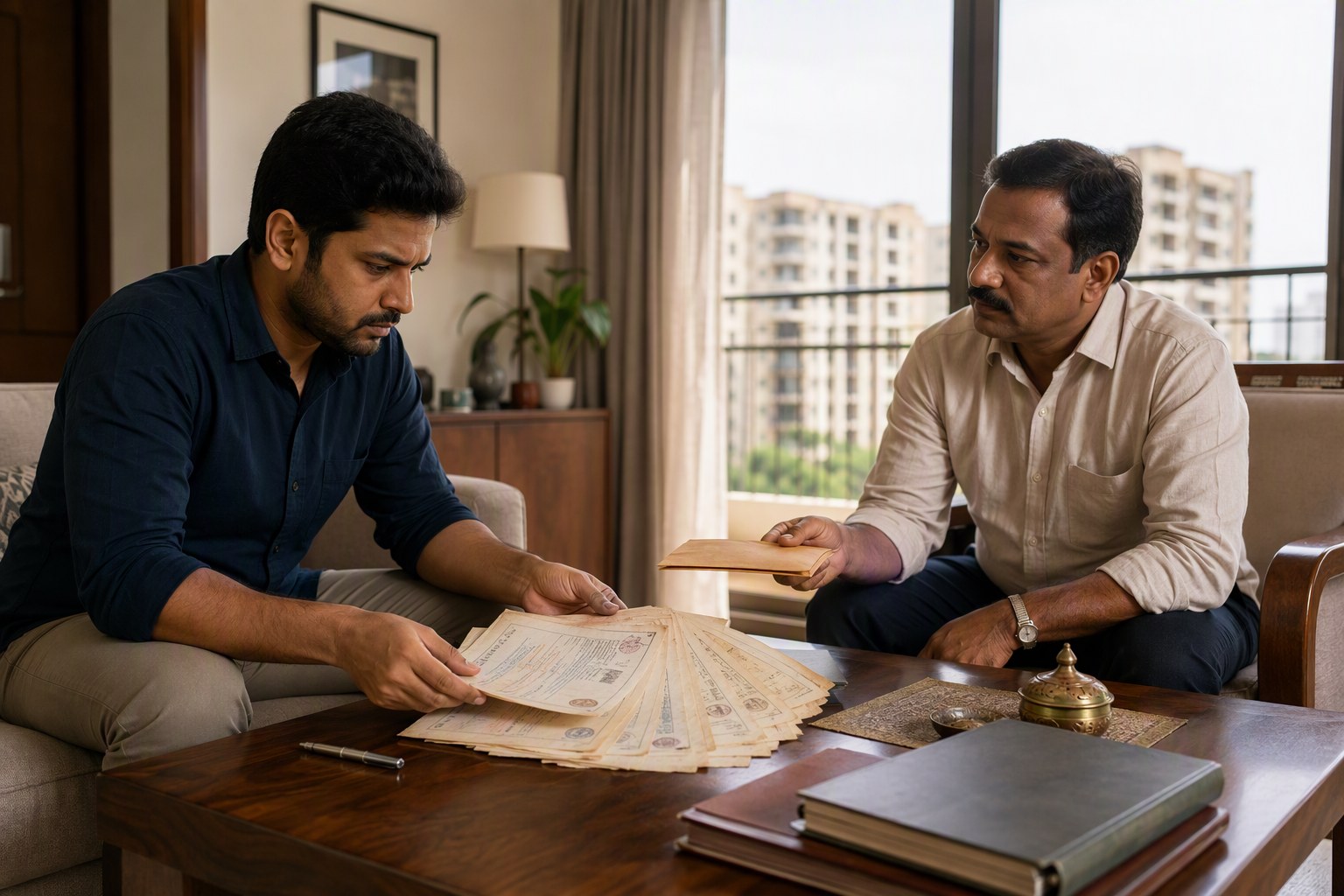



Undivided Share Errors are now becoming a quick rejection point in Hyderabad resale flat deals. A buyer may like the flat, negotiate the price, arrange a home loan and still walk away if the undivided share of land shown in the seller’s documents does not tally with the project records, link documents, RERA papers or the buyer advocate’s title check.
In our experience, this problem hurts genuine sellers the most. The flat may be physically clean. Maintenance dues may be paid. The apartment may be in a strong micro-market like Gachibowli, Kondapur, Narsingi, Miyapur, Kukatpally, Manikonda or Kompally. But if the UDS figure looks doubtful, serious buyers pause because they know one thing clearly: a flat is not only walls and carpet area. It is also a proportionate right in the land below the building.
For a resale flat seller, a wrong or unclear UDS entry is not a small paperwork issue. It can reduce the buyer pool to only those willing to take legal risk.
Undivided Share Errors in resale flats: what is happening on the ground
Buyer-side legal checks have become sharper in Hyderabad and surrounding Telangana markets. Earlier, many resale discussions were driven by location, floor, facing, parking and loan eligibility. Today, buyers and banks are asking for a tighter document trail.
The common question is simple: does the undivided share mentioned in the current sale deed match the project’s land records and earlier registered documents?
When there is a mismatch, the buyer’s lawyer usually asks for clarification before token advance. If the seller cannot explain it, the buyer either delays the deal or moves to another flat in the same locality. We have seen this in premium and mid-market pockets alike, including Serilingampally mandal locations such as Gachibowli, Kondapur and Chandanagar, and Gandipet mandal locations such as Kokapet, Narsingi and Manikonda.
The concern is not academic. UDS is linked to ownership in the project land. It affects title comfort, future redevelopment rights, compensation in rare land acquisition scenarios, and the buyer’s ability to resell the flat smoothly later.
Why Undivided Share Errors cut a seller’s buyer pool
A resale seller wants the widest possible buyer pool: end users, investors, bank-funded buyers and NRI buyers. UDS errors cut that pool because different buyers react differently to title risk.
- Bank-funded buyers may depend on the bank’s legal report. If the panel advocate raises a query, loan sanction can slow down.
- NRI buyers usually rely heavily on document review because they are not present for repeated local visits.
- End users may be willing to wait, but only if the seller produces a clear rectification path.
- Investors may ask for a price cut, arguing that future resale will carry the same doubt.
That is how a seller loses serious buyers without any defect in the flat itself. The apartment may have good ventilation, a proper car parking slot and strong rental demand. Still, a UDS mismatch can put it in the “need clarification” bucket.
What exactly is undivided share in a Telangana apartment?
Undivided share, commonly called UDS, is the flat owner’s proportionate ownership in the project land. In apartment documents, it is usually mentioned in the schedule of property. Depending on the deed drafting style, it may appear in square yards, square metres or as a fraction of the total land.
In simple terms, your flat has two parts from a legal angle:
- Constructed space: the apartment area, along with common area rights as per the project structure.
- Land share: the undivided share in the total land on which the apartment building stands.
UDS is normally calculated based on the flat’s proportionate share in the overall saleable or built-up area, depending on the project documentation. The exact method should come from the builder’s registered documents, development agreement, sanctioned plan, sharing agreement and sale deeds. Sellers should not rely only on old brochures or WhatsApp messages from the builder’s office.
Where UDS mismatch usually starts
Most UDS errors are not dramatic fraud stories. Many are boring paperwork mistakes that become expensive at resale time.
1. Typing error in the original sale deed
A digit may be typed incorrectly. A square yard figure may be rounded wrongly. Sometimes, the extent written in words and figures may not match. At the time of first purchase, the buyer may not notice it because the focus is on possession, interiors and loan disbursement.
2. Different UDS in agreement and registered sale deed
In some projects, the agreement of sale may mention one figure and the final registered sale deed may mention another. If there is no explanation, a resale buyer’s advocate will ask which one is correct and why the difference exists.
3. Project land extent changed after approvals
Road widening, open space reservation, setbacks, land pooling or revised approvals can affect how land extent is described in records. If the project documents are not aligned, the UDS schedule may look inconsistent.
4. Multiple blocks and phases
Large gated communities in areas like Narsingi, Tellapur, Kokapet, Miyapur and Bachupally often have multiple blocks and phases. The UDS of a flat must be read with the correct phase and land parcel. A buyer checking only the overall project name may get confused if the deed schedule is not precise.
5. Builder used a standard draft
Some older deeds were prepared using standard formats. Flat number, floor and area were changed, but land share details were not updated carefully. Such mistakes surface only when a resale transaction is scrutinised.
Buyer-side legal checks that expose UDS issues
Hyderabad buyers are increasingly using layered checks. A good buyer advocate will not stop with one sale deed. They may compare several records before giving a green signal.
- Seller’s registered sale deed and schedule of property
- Link documents and mother deed
- Development agreement-cum-GPA, if applicable
- Approved building plan and layout papers
- RERA project details, where applicable, using RERA Project Lookup
- Encumbrance Certificate using Encumbrance Certificate Search
- Market value and registration data using Market Value / Guideline Value Search
- SRO jurisdiction using Find Your SRO Office
- Section 22-A status using Section 22-A Prohibited Property Check
This is where a seller can get caught off guard. A buyer may ask for the UDS breakup, but the seller may only have a scanned sale deed and old possession letter. That is not enough when the buyer is spending life savings or arranging a high-value housing loan.
The Section 22-A angle sellers should not ignore
UDS errors and prohibited property checks are different issues, but in title review they often sit in the same file. If the land on which the apartment stands has any adverse government entry or classification issue, the buyer’s lawyer will examine it carefully.
As per latest IGRS data available in our database, Telangana has 3,076,153 prohibited property entries under Section 22-A. This number itself tells sellers why buyers are no longer casual about land schedules, survey numbers and SRO records.
For flats in peripheral growth corridors, such as parts of Gandipet, Rajendranagar, Quthbullapur, Bachupally and Medchal-side pockets, buyers often ask for survey number clarity. Even when the flat is in an established apartment, the underlying land identity matters. Sellers can cross-check survey references through Survey Number Finder and run broader title screening through Property Verification Tool.
How UDS errors affect price negotiation
Many sellers assume that a UDS doubt will only delay registration. Actually, it can change the negotiation tone.
A buyer may say, “I like the flat, but my advocate is not comfortable.” Once that sentence comes, the seller loses bargaining strength. The buyer may ask the seller to complete rectification first, keep a larger amount pending till registration, or reduce the price to compensate for legal risk.
In active resale localities like Kondapur, Gachibowli and Kukatpally, buyers usually have alternatives. If two similar flats are available in the same building or nearby project, the flat with cleaner documents gets preference. This is why I advise sellers to fix document gaps before listing, not after finding a buyer.
What sellers should check before listing a resale flat
Before putting the flat on the market, collect the document set and read the UDS schedule like a buyer’s lawyer would. Do not wait for the buyer to discover the issue.
Step 1: Read the schedule of your registered sale deed
Check the flat number, floor, block, built-up area, car parking reference and undivided share. See whether the UDS is written clearly in the same unit throughout the deed. If the deed uses both square yards and square metres, verify the conversion carefully through Area Unit Converter.
Step 2: Compare with other flats in the same project
If your neighbour has a similar flat size, the UDS should broadly follow the project’s allocation logic. It need not be identical in every case because flat sizes differ, but a strange difference deserves checking.
Step 3: Pull the Encumbrance Certificate
The EC may not directly validate UDS accuracy, but it shows the chain of registered transactions. Use EC Analyzer to read entries more systematically, especially if there are multiple loans, releases or transfers.
Step 4: Check RERA and approval records
For RERA-registered projects, compare the project details with your deed. If the project has phases, blocks or revised approvals, ensure your flat belongs to the correct record.
Step 5: Speak to the association
Apartment associations often maintain copies of project-level documents, land extent details, builder handover papers and common area information. They may know if other owners faced the same UDS issue during resale.
Step 6: Check SRO jurisdiction and ready reckoner value
For registration planning, sellers and buyers also check SRO jurisdiction and market value. Use Find Your SRO Office and Stamp Duty Calculator before finalising timelines and cost sharing. The ready reckoner or market value search is not a UDS cure, but it helps the transaction team work with the correct registration context.
Can a UDS error be corrected?
Many UDS errors can be corrected, but the route depends on the nature of the mistake. A simple clerical error may need a rectification deed. A deeper mismatch involving project land extent, multiple owners or builder-side drafting may require legal review and cooperation from relevant parties.
In Telangana practice, sellers should speak to a property lawyer and the concerned SRO before assuming the solution. The Sub-Registrar will look at the earlier registered document, parties involved, stamp duty implications if any, and whether the correction changes the substance of the transaction.
If the builder company is still active, getting clarification may be easier. If the builder has closed operations, changed management or the project is old, the seller may need to rely on registered records, association files and legal opinion.
Documents a seller should keep ready for a serious buyer
A clean document folder gives confidence. It also reduces repeated calls and last-minute confusion. For a resale flat in Hyderabad or nearby districts, I would keep these ready:
- Registered sale deed of the seller
- Link documents or previous sale deeds
- Mother deed or land title documents available from builder/association
- Development agreement-cum-GPA, where relevant
- Approved plan and occupancy certificate, if available
- RERA details, where applicable
- Latest EC
- Loan closure letter and release deed, if the flat was mortgaged
- CERSAI check using CERSAI Charge Check
- Maintenance no-dues certificate
- Property tax and utility payment records
- Parking allotment letter or deed reference
For sellers calculating post-sale tax, Capital Gains Tax Calculator is useful. For buyers checking total acquisition cost, Composite Value Calculator can help compare property components. These tools do not replace legal opinion, but they bring discipline to the deal discussion.
UDS mismatch warning signs in Hyderabad resale deals
Some warning signs should make a seller pause before taking token advance.
- The sale deed mentions UDS but the number looks unusually low or unusually high for the flat size.
- The agreement of sale and registered sale deed carry different land share figures.
- The flat area is changed in one document but UDS is not changed.
- The project has multiple land parcels, but the schedule does not identify the correct survey numbers.
- The builder’s allotment letter and registered deed describe different block or phase names.
- The buyer’s EC search shows entries that do not match the seller’s understanding of the property chain.
- The association says many owners have faced deed schedule corrections in the same project.
When any of these appear, do not dismiss the buyer as “too cautious”. In Hyderabad’s current resale market, cautious buyers are often the best buyers. They come with funds, bank pre-approval and a clear closing plan. They only want the paper trail to be clean.
How sellers can protect the transaction
My practical advice is straightforward: verify before marketing. A seller who identifies a UDS issue early can control the story. A seller who discovers it through the buyer’s advocate loses control.
Start with the registered deed. Then compare project documents. Run EC and prohibited property checks. Confirm SRO. If there is a mismatch, get a written legal opinion on whether it is clerical, curable or material. If a rectification deed is needed, start that process before accepting a large advance.
Also be transparent with buyers. If you already know there is a correction in progress, say it openly and share the lawyer’s note. Serious buyers respect clarity. What they do not like is surprise.
Verified.RealEstate view on Undivided Share Errors
Undivided Share Errors are not just paperwork irritants. They directly affect marketability. A resale flat with clean title records attracts more confident buyers, faster bank processing and fewer renegotiation attempts. A flat with UDS doubt may still sell, but usually after extra explanation, delay or discount pressure.
Hyderabad’s apartment market has matured. Buyers in areas like Gachibowli, Kondapur, Narsingi, Kokapet, Miyapur, Kukatpally, Manikonda and Kompally are not only comparing amenities. They are comparing document quality. Sellers who understand this will have an advantage.
Before listing, treat your UDS schedule like a headline item, not a footnote. In resale property, the best buyer is not always the one who gives the highest verbal offer. It is the one who can complete registration without legal drama.
Frequently Asked Questions
What is undivided share in a flat sale deed?
Undivided share is the flat owner’s proportionate ownership in the land on which the apartment project stands. It is usually mentioned in the property schedule of the registered sale deed.
Can I sell my Hyderabad flat if the UDS is wrong?
You may be able to sell, but serious buyers and bank advocates can raise objections. It is better to get the documents reviewed and, where required, complete rectification before finalising the resale.
Who can correct an undivided share error?
The correction route depends on the document and parties involved. A property lawyer and the concerned SRO can advise whether a rectification deed or other legal step is needed.
Does an Encumbrance Certificate show UDS mistakes?
An EC mainly shows registered transactions and encumbrances. It may not directly certify UDS accuracy, but it helps compare the document chain and identify inconsistencies.
Should sellers check Section 22-A before selling a flat?
Yes. Even for apartments, the underlying land record matters. A Section 22-A check is a sensible part of title verification, especially in peripheral growth areas and older projects.