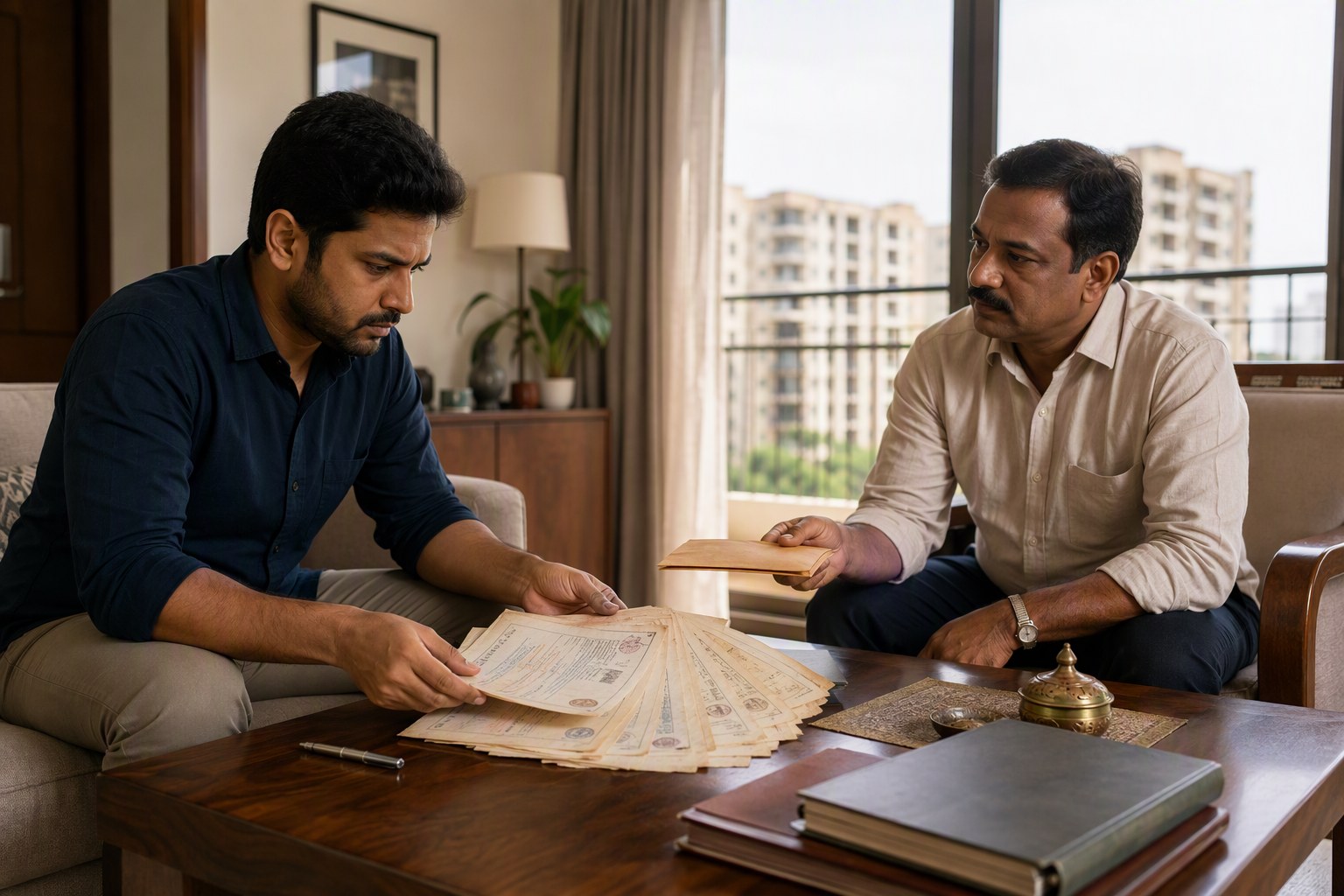
Telangana Sellers often think the hard part is finding a serious buyer. In our experience, the real test starts after the token amount, when the buyer’s lawyer asks for the full title chain and one old link deed is either missing, unreadable, or not matching the current survey number. I have seen this happen in Kondapur flats, Manikonda plots, Shankarpally land parcels, and even older houses in LB Nagar. The buyer is ready, the price is agreed, the family is planning the next move, and suddenly everyone is waiting for one dusty document from years ago.
The short answer: if you are planning to sell in Telangana, prepare your title-chain file before you list the property. Do not wait for the buyer’s advocate or bank panel lawyer to find gaps. A missing link deed may not always kill the sale, but it can delay bank loan approval, reduce buyer confidence, invite fresh negotiation, or force you to run around the SRO, Dharani, revenue office, society office, or old developer’s desk at the last minute.
My practical view is simple: sellers who keep the link deed file ready sell with more control. Sellers who search after receiving an advance usually sell under pressure.
Telangana Sellers: Why one old link deed creates so much drama
A link deed is not just an old paper. It is the bridge between your ownership and the previous owner’s ownership. In a clean title chain, every transfer should connect properly: who sold to whom, how the seller got title, whether the extent matches, whether the survey number or plot number is traceable, and whether the registration details are correct.
For a flat in Gachibowli or Kukatpally, the buyer’s lawyer may ask for the landowner’s link documents, development agreement, GPA, sanctioned plan, occupancy certificate, and sale deed chain. For an open plot in Mokila, Kollur, Tellapur, or Maheshwaram mandal, the lawyer may go deeper into old pattadar passbooks, pahanis, mutation entries, conversion orders, layout approvals, and the exact survey number history. For agricultural land near Shankarpally, Chevella, Moinabad, or Shamshabad, the Dharani and revenue trail becomes even more sensitive.
The problem is that many sellers only preserve their own sale deed. They assume that is enough. But a buyer taking a home loan will usually face a stricter legal check. The bank’s panel lawyer wants to see whether your seller had valid title. Then they check the seller before that. If one link is weak, the bank may ask for clarification, certified copies, legal heir documents, indemnity, paper publication, or sometimes a fresh legal opinion.
Telangana Sellers should prepare title-chain papers before buyer legal check
In Hyderabad’s active resale markets like Nallagandla, Narsingi, Kokapet, Miyapur, Chandanagar, Attapur, Uppal, and Kompally, buyers move fast when they like the property. But their lawyers do not skip title review just because the location is prime. If anything, high-value localities attract more caution because buyers are committing serious savings and loan obligations.
Before showing the property to serious buyers, keep a digital and physical file ready. It should be neat, indexed, and readable. A seller who shares documents professionally gives confidence. A seller who says “we will get it later” immediately creates doubt, even if the title is actually fine.
Minimum title-chain file for a resale flat
- Your registered sale deed.
- Previous link sale deed or builder’s sale deed chain.
- Landowner documents, where applicable.
- Development agreement-cum-GPA, if the project came through landowner-builder sharing.
- Approved building plan and occupancy certificate, if available.
- Property tax receipts and electricity bill.
- Society NOC or maintenance due statement, if the apartment association issues one.
- Latest EC. You can start with the Encumbrance Certificate Search.
- CERSAI check, especially when the seller has had a loan. Use the CERSAI Charge Check.
Minimum title-chain file for an open plot or land parcel
- Your registered sale deed or gift deed, partition deed, release deed, or other title document.
- All available previous link deeds.
- Survey number details and village/mandal mapping. The Survey Number Finder can help you organise this step.
- Latest EC and older EC where required.
- Dharani details, pattadar passbook information, pahani/adangal references where applicable.
- Mutation proceedings or revenue records showing title flow.
- Layout approval, LRS/BRS records, DTCP/HMDA/municipal approval documents, depending on the property.
- Non-agricultural conversion order, if the land was converted.
- Section 22-A check using the Section 22-A Prohibited Property Check.
Do not dump all documents into one WhatsApp folder and expect the buyer to understand. Name the files properly: “Current Sale Deed”, “Link Deed 2008”, “EC 2005-2024”, “Mutation”, “Layout Approval”, “Property Tax”. Small discipline reduces unnecessary back-and-forth.
Telangana Sellers and the Section 22-A background risk
There is another reason sellers should not be casual. Telangana has a large prohibited-property universe in the background. Verified database records show 3,076,153 entries under prohibited properties, commonly discussed under Section 22-A. This does not mean your property is automatically problematic. It means sellers should verify early rather than discover a restriction close to registration day.
Section 22-A issues may arise in different ways: government land, assigned land, endowment land, wakf-related records, ceiling land, disputed survey entries, and other categories notified to the registration department. In many cases, the seller genuinely may not know that the survey number or part of the survey number has an entry somewhere in the prohibited list.
In our experience, this is especially relevant for land and plot sales in expanding corridors like Maheshwaram, Ibrahimpatnam, Shamshabad, Shabad, Moinabad, Chevella, Shankarpally, and parts around ORR growth zones. It can also come up in older village layouts that later got absorbed into fast-growing urban markets.
Before you accept a large advance, run a basic check through the Property Verification Tool and the Section 22-A Prohibited Property Check. If there is a mismatch or alert, speak to a local document writer, property lawyer, or the concerned SRO before promising a fast registration date.
What exactly buyers and banks check in the old link deed
A buyer’s advocate is not just checking whether the document exists. They are checking whether the chain makes legal sense. A bank lawyer is usually even more structured because the property becomes security for the loan.
| Check point | Why it matters | Seller’s action |
|---|---|---|
| Name consistency | Spelling variations between deeds, EC, pattadar records, and tax records can trigger queries. | Keep ID proofs, affidavits, or clarification documents ready if names changed. |
| Survey number or plot number | Old documents may mention old survey numbers, sub-divisions, or village names. | Prepare a note showing how the current number connects to the old record. |
| Extent and boundaries | Extent mismatch or vague boundaries can create title doubt. | Compare all link deeds and keep layout/survey sketch copies where available. |
| Registration details | Document number, year, book, and SRO details must be traceable. | Use certified copies from the right SRO if originals are not available. |
| Encumbrances | Loans, mortgages, agreements, court attachments, or previous charges must be clear. | Check EC and CERSAI before buyer verification. |
| Nature of land | Agricultural, converted, layout-approved, assigned, or prohibited status affects saleability. | Verify Dharani, revenue records, approvals, and Section 22-A status. |
One common issue in Hyderabad resale apartments is the missing land link deed from the original landowner. The flat owner may have a perfect registered sale deed from the builder, but the buyer’s lawyer asks how the builder got rights over the land. If the project is old, the builder’s office may not respond quickly. If the society has a document archive, request copies early.
For plots, the trouble is often different. The old deed may mention a larger agricultural survey number, but your current plot number comes from a layout that is not properly attached in the file. In such cases, the buyer wants to know how Survey No. X became Plot No. Y, and whether the layout itself had valid approval. That is where revenue extracts, layout plans, and SRO records become useful.
Telangana Sellers: How to fix a missing or unclear old link deed
If one old link deed is missing, do not panic. Many gaps can be managed if you start early and stay transparent. The worst strategy is hiding the issue until the buyer’s lawyer finds it. That looks suspicious even when the issue is innocent.
1. Search the registration trail
Start with the document number, year, and SRO. If you do not know the SRO, identify it first through the Find Your SRO Office or check the location through the SRO Village Directory. Older Hyderabad records may be linked to SROs based on village jurisdiction, not just the current popular locality name. For example, a buyer may say “Manikonda”, but the document trail may refer to the village and mandal setup used at the time of registration.
2. Apply for certified copies
If the original link deed is lost but registration details are available, a certified copy from the registration department can usually satisfy many legal checks. Keep the certified copy properly scanned. If the document is old and unclear, ask whether a better copy or book extract is available.
3. Match the EC with the sale deed chain
An EC is not a substitute for title, but it is a strong supporting record. Run an EC for the period required by the buyer’s lawyer. If the property has changed hands multiple times, check whether every transfer appears correctly. The EC Analyzer can help you review the flow instead of reading it line by line under pressure.
4. Prepare a title-chain summary
This is a simple one-page note. Mention each owner, document number, year, SRO, extent, and transfer type. For a flat, include landowner to developer to first buyer to current seller. For land, include pattadar/revenue references where available. This summary does not replace legal opinion, but it makes your file easier for the buyer’s lawyer.
5. Use affidavits and indemnities only where suitable
Some sellers think an affidavit can solve every missing document. It cannot. An affidavit may help explain loss of original, name variation, or family circumstances. It cannot create title where the chain itself is weak. If the missing link involves inheritance, legal heirs, partition, minors, court disputes, or assigned land, take proper legal advice before drafting anything.
6. Do not ignore family documents
Many Telangana sales are delayed not by registration records, but by family history. A father purchased land decades ago, passed away, and children are now selling. If legal heir certificates, death certificates, release deeds, or partition documents are not ready, the buyer’s lawyer will stop. This is common in old houses in Secunderabad, Dilsukhnagar, Malkajgiri, Alwal, and village lands around Hyderabad’s outskirts.
Buyer confidence starts before the agreement of sale
The agreement of sale should not be signed casually when title documents are incomplete. Sellers sometimes accept a token, commit to a registration date, and then realise that the buyer’s bank wants documents they have never collected. This creates unnecessary tension. The buyer worries about refund. The seller worries about losing the deal. Brokers start pushing both sides. Nobody enjoys that week.
Before signing, share a document list and mention what is available. If one link deed is missing but you have applied for a certified copy, say so clearly. If the buyer is taking a loan, give enough time for legal and technical checks. A rushed sale may look attractive, but a failed loan approval can waste more time than a careful start.
For value-related preparation, sellers should also check the government market value before quoting and agreement drafting. The Market Value / Guideline Value Search helps you understand the ready reckoner side, while the Stamp Duty Calculator helps estimate registration cost for the buyer. These tools do not decide market price, but they reduce confusion during negotiation.
Red flags Telangana Sellers should not brush aside
Some title gaps are routine. Some need deeper work. If you see any of the following, slow down and get proper verification before collecting a large advance.
- The old link deed mentions a different survey number and there is no clear sub-division or layout record.
- The property is in a village or mandal where government land, assigned land, or Section 22-A entries are common.
- The seller before you purchased through an unregistered agreement or only GPA, without clear registered conveyance.
- The EC shows a mortgage, but loan closure and release deed are not available.
- The property came through inheritance, but all legal heirs have not joined or released their rights.
- The original deed is lost and there is no police complaint, paper notice, affidavit, or certified copy trail.
- The boundaries in the old deed do not match the current physical possession.
- The layout approval is unclear, especially for plots sold in older gram panchayat layouts.
We have seen sellers lose bargaining strength because they ignored these points until the buyer’s advocate raised them. Once a buyer feels legal risk, even a good property starts looking negotiable. Clean paperwork protects your price.
How sellers in Hyderabad can create a sale-ready document folder
Here is the folder structure I suggest to owners in Hyderabad and nearby districts. It works for flats, houses, plots, and land parcels with small changes.
- Folder 1: Current ownership — current sale deed, gift deed, partition deed, or release deed.
- Folder 2: Link documents — all previous deeds in chronological order.
- Folder 3: Revenue and municipal records — pahani, mutation, Dharani extracts, property tax, municipal records, as relevant.
- Folder 4: Approvals — layout plan, building plan, occupancy certificate, conversion order, RERA details if applicable. For new projects, check the RERA Project Lookup.
- Folder 5: Encumbrance and loan — EC, CERSAI report, loan closure letter, release deed, NOC.
- Folder 6: Identity and family — PAN, Aadhaar, death certificate, legal heir certificate, family tree, release deeds, if relevant.
- Folder 7: Drafting support — draft agreement, payment schedule, possession terms. You can use the Legal Document Generator for basic document preparation support.
Keep scanned copies in PDF format. Avoid sending cropped photos of old deeds where stamps, signatures, schedules, and SRO seals are missing. A badly scanned document creates fresh doubts.
Final view: a link deed delay is avoidable if Telangana Sellers act early
A missing old link deed is not always a title disaster. Sometimes it is only a documentation gap. But in a property sale, timing matters. If the gap appears after token payment, emotions rise. If it appears before listing, it becomes a task to solve.
For sellers in Telangana, especially in Hyderabad’s resale and plotted-development markets, title preparation is now part of pricing strategy. Clean documents can support your asking price. Weak or incomplete documents invite discounting, longer negotiation, and bank loan uncertainty.
My suggestion is direct: before you bring buyers, prepare the title chain, run the EC, check Section 22-A risk, identify your SRO, and keep certified copies ready for missing links. The buyer may still ask questions. That is normal. But you will answer from a position of control, not panic.
Frequently Asked Questions
Can I sell my Telangana property if one old link deed is missing?
Yes, in many cases you can still sell, but you may need a certified copy from the SRO, a clear EC, supporting revenue or approval records, and a proper explanation for the missing document. If the missing deed is central to title, get legal advice before accepting an advance.
Is an Encumbrance Certificate enough to prove ownership?
No. An EC shows registered transactions and encumbrances for the selected period, but it does not replace the full title chain. Buyers and banks usually check sale deeds, link deeds, revenue records, approvals, and loan-related documents along with the EC.
Why do banks ask for previous link deeds when I have my registered sale deed?
Banks want to confirm that the person who sold to you had valid title. Your sale deed proves your transaction, but the bank also checks the earlier ownership flow because the property will be used as loan security.
Should I check Section 22-A before selling land or a plot?
Yes. Telangana has a large prohibited-property record universe, and Verified database records show 3,076,153 entries. A quick check before negotiation can prevent last-minute registration issues, especially for land and plots in expanding mandals.
What should I do if the old deed has a different survey number?
Do not ignore it. Collect sub-division records, layout plans, revenue extracts, and any document showing how the old survey number connects to the present plot or property. A buyer’s lawyer will usually ask for this mapping.