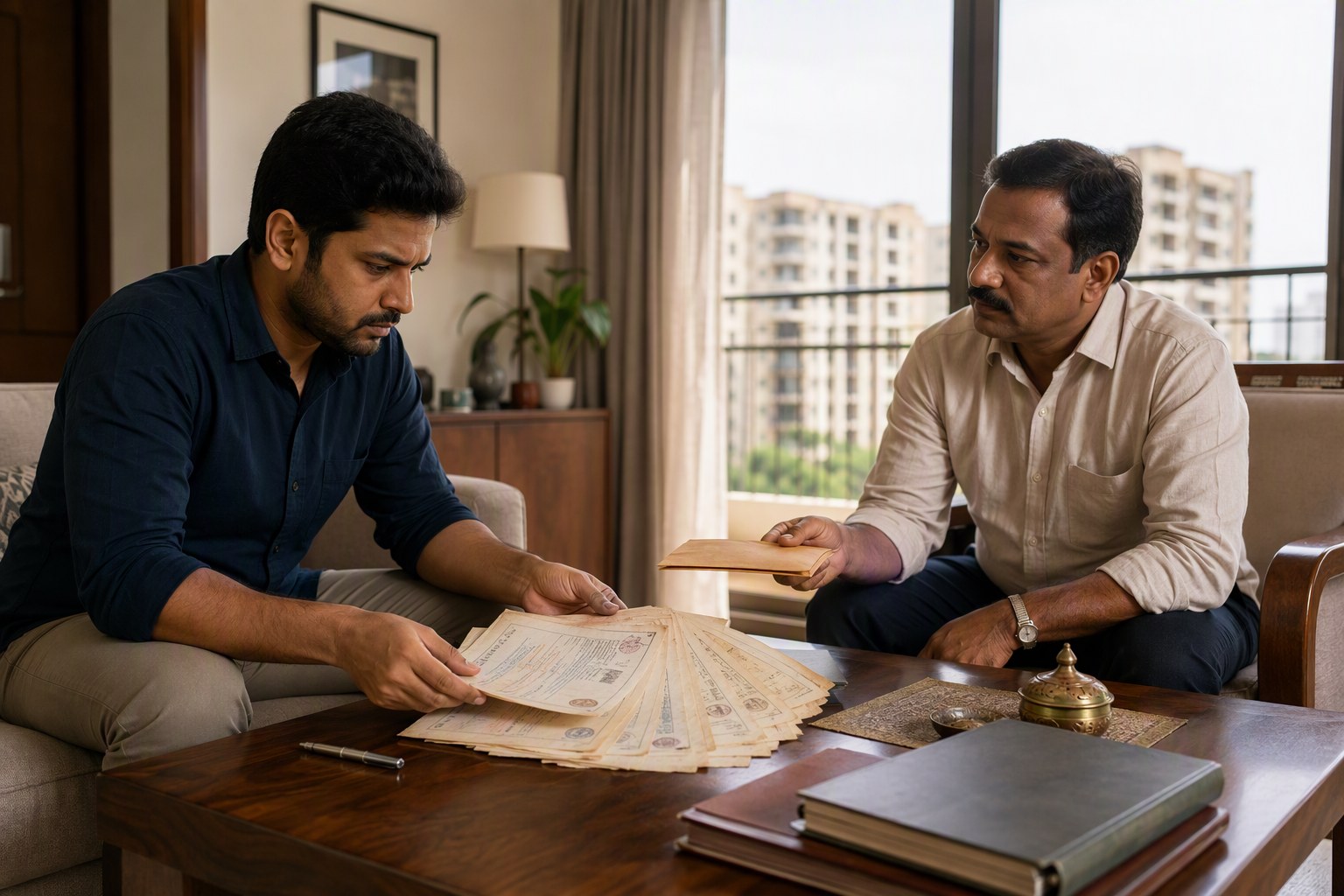
Telangana Sellers: Should You Disclose a Pending Case Early? Yes, in most sale situations, disclose it before price negotiation becomes serious. A pending civil suit, family partition dispute, injunction petition, boundary case, loan attachment or revenue appeal can kill a deal at the registration table if the buyer discovers it late. In Hyderabad and surrounding mandals, we have seen buyers walk out after token payment, banks pause loan files, and sellers accept sudden price cuts simply because the litigation came out through an Encumbrance Certificate, pahani, Dharani note, court search or neighbour enquiry at the last stage.
The sharper point is this: early disclosure does not always reduce your price. Late disclosure almost always reduces your negotiating power.
Our view at Verified.RealEstate is simple. If a case exists, control the story early with documents. If the buyer finds it first, you are no longer explaining; you are defending.
Telangana Sellers: Should You Disclose a Pending Case Early? The short answer from Hyderabad deals
For sellers in Telangana, pending litigation should be disclosed before the buyer spends money on legal verification, bank processing or sale agreement drafting. This is especially true in high-value localities like Kokapet, Gachibowli, Kondapur, Narsingi, Manikonda, Tellapur, Miyapur, Uppal, Shamshabad, Tukkuguda and Adibatla, where even a small doubt can become a large discount demand.
Residential flat deals in Kokapet and Financial District are often discussed in the ₹8,000 to ₹14,000 per sq ft range depending on project, tower, floor and possession status. Kondapur and Gachibowli resale flats commonly see ₹7,000 to ₹11,000 per sq ft conversations. In Uppal, Nagole and LB Nagar, many mid-market apartment discussions sit around ₹5,500 to ₹8,500 per sq ft. Open plot and independent house land values can move far faster. Jubilee Hills and Banjara Hills still see premium land discussions above ₹1 lakh per sq yd in many pockets, while Tukkuguda, Adibatla and Maheshwaram have become sensitive to HMDA layout status, road width, litigation and title clarity.
When values are this high, no buyer wants a court notice after registration. No banker wants to fund a property that may face an injunction. No SRO wants to accept a document that falls under a prohibitory list or carries a clear legal block.
Before quoting a final price, sellers should check the government market value using the Market Value / Guideline Value Search, pull an Encumbrance Certificate Search, identify the relevant office through Find Your SRO Office, and screen the asset through the Section 22-A Prohibited Property Check. These checks give both sides a cleaner starting point.
Why pending case disclosure is now a bigger issue in Telangana property sales
Telangana buyers have become more alert. Ten years back, many resale transactions in Hyderabad ran on local broker confidence, previous sale deed copies and a quick EC. Today, buyers cross-check Dharani, municipal records, building permissions, RERA status, court portals, Google searches, colony association inputs and sometimes even old village maps. In mandals like Serilingampally, Gandipet, Rajendranagar, Moinabad, Shamshabad, Maheshwaram, Medchal, Shankarpally, Hayathnagar and Uppal, title history can be layered with agricultural conversion, assignment land allegations, family partitions, GPA sales, layout approvals and boundary disputes.
The scale of restricted property records also explains buyer caution. Telangana has 147,934 properties listed under prohibited properties, commonly linked to Section 22-A restrictions. A pending court case is not the same as a Section 22-A prohibition, but buyers often club all risks together. If they hear “case” late in the process, they may assume the worst: government land issue, assigned land, wakf claim, temple land, ceiling issue, court attachment or family dispute.
That fear creates three immediate outcomes:
- Buyer exit: The buyer withdraws before agreement or before registration, especially if bank loan is involved.
- Price cut: The buyer asks for a litigation discount, sometimes 5% to 20%, depending on the nature of dispute.
- Registration delay: Lawyers ask for fresh affidavits, indemnities, court orders, revenue records and party confirmations.
In our experience, sellers who disclose early can still protect value if the case is minor, documented and not directly affecting title. Sellers who hide it usually lose trust, even if the case is technically harmless.
Telangana Sellers: Should You Disclose a Pending Case Early before negotiations?
Yes. The best time is before accepting a token advance or signing a sale agreement. Once money changes hands, emotions rise. If a buyer discovers litigation after paying ₹5 lakh or ₹10 lakh as advance, the conversation shifts from title clarity to refund, penalty and blame. That is where avoidable legal notices start.
Early disclosure should not be casual. Do not say only “small case is there” or “family matter, no problem.” Give the buyer a written note with facts. Mention the case number, court name, parties, subject matter, stage, next date if available, and whether any injunction or stay order exists. If the dispute affects only a portion of land, mention the survey number, sub-division, extent and boundaries. If it is an apartment, mention whether the case is against the builder, landowner, association, individual flat owner or government authority.
For land in villages around Hyderabad, the buyer will usually ask for survey number clarity. Use the Survey Number Finder and then compare it with pahani, Dharani passbook details, old sale deeds and layout plan. For apartments, check project registration through the RERA Project Lookup if the project falls under RERA requirements.
What kind of pending case must a Telangana seller reveal?
Some sellers wrongly think disclosure is needed only when there is a court stay. That is risky. The buyer is not only buying possession; the buyer is buying peace of title. Any dispute that may affect ownership, possession, marketability, construction legality or registration should be placed on the table.
| Type of pending issue | Common Telangana example | Likely buyer reaction |
|---|---|---|
| Family partition suit | Brothers or legal heirs disputing ancestral land in Serilingampally, Medchal or Hayathnagar | Buyer asks for all heirs to sign or exits |
| Injunction petition | Neighbour or claimant seeks restraint against sale or construction | Bank legal team may pause loan |
| Boundary dispute | Survey mismatch in Moinabad, Shankarpally, Gandipet or Maheshwaram lands | Buyer demands survey, demarcation and discount |
| Revenue appeal | Dharani mutation, pahani entry or pattadar passbook challenge | Buyer waits for revenue clarity |
| Builder litigation | Apartment project dispute over landowner share, approvals or association claims | Buyer asks for RERA, GHMC/HMDA and legal opinion |
| Loan attachment or recovery case | Bank, NBFC or private lender claim against owner | Buyer insists on closure letter and release deed |
| Section 22-A/prohibited concern | Government, assigned, endowment, wakf or other restricted category concern | Registration may be refused or delayed |
Not every case makes a property unsellable. A maintenance dispute in an apartment association is very different from a title suit over the land. A builder delay complaint is different from a government land claim. But the seller should not decide alone what is “minor.” Put the document before the buyer and let both legal teams classify the risk.
How non-disclosure damages the seller more than the buyer
Many sellers think hiding a case will help them secure a higher quote. In Hyderabad’s current resale market, that is usually a short-term win and a long-term loss. Buyers now run layered verification. They search ECs, court websites, SRO records, municipal files, RERA pages and sometimes even old newspaper notices. Once the issue appears, the buyer feels trapped or cheated.
At that point, three things happen. First, the buyer demands a bigger discount than the actual risk deserves. Second, the seller’s broker loses control of the conversation. Third, the buyer’s lawyer starts asking for more documents than usual. A simple sale that could have closed in 30 days stretches to 60 or 90 days.
For a seller who needs funds to buy another property, repay a loan, divide family assets or move abroad, delay itself is a cost. If the property is a high-ticket flat in Narsingi or Kokapet, even one failed transaction can push the unit back into the market with a stigma: “Something is there in that flat.” Brokers talk. Colony WhatsApp groups talk. Security guards talk. Do not underestimate local intelligence in Hyderabad real estate.
The right way to disclose a pending case without scaring the buyer
Disclosure is not the same as panic. A seller should present the issue like a file, not like a confession. The tone matters. The documents matter even more.
1. Prepare a litigation note
Make a one-page summary. Include case number, court or tribunal, names of parties, claim made, property details, current status and whether any interim order is operating. If the case has no stay against sale, say so only after checking the latest order copy.
2. Keep certified or downloaded copies ready
Buyers trust paper. Keep plaint/petition copy, counter if filed, latest order, docket status, compromise petition if any, and lawyer opinion. If the matter is closed, keep final order and certified copy if available.
3. Separate title risk from nuisance risk
A small association dispute over corpus or parking is not the same as a title challenge. Explain the difference with documents. If a buyer sees that the case does not affect ownership or transfer rights, negotiation can continue sensibly.
4. Offer protective clauses in agreement
Where suitable, the sale agreement can include disclosure acknowledgement, indemnity, refund terms, condition precedent, timeline for case closure, or escrow-style payment release. This must be drafted by lawyers, not copied from an old agreement.
5. Run your own verification before the buyer does
Sellers should not wait for the buyer to find defects. Use the Property Verification Tool, check EC, check market value, review survey number, and confirm whether any prohibited property issue exists. If the property is a plot or land parcel, also check land use through the Land Use Zone Finder and road access through the Road Width Check.
Pending case and price: how much discount is normal?
There is no fixed discount. Hyderabad buyers price risk based on three questions: Can I register? Can I get possession? Can I resell or mortgage later? If all three answers are clear, the discount may be small. If any answer is doubtful, the discount becomes steep.
For example, a flat in Kondapur with a pending association case about maintenance dues may still sell near market rate if dues are quantified and cleared. A villa plot in Moinabad with a boundary suit and no fresh survey may face a serious cut. A land parcel in Maheshwaram with a revenue appeal on pattadar rights may attract only investors who price aggressively. A Jubilee Hills house under family succession dispute may get buyer interest, but only if all legal heirs sign and the court position is clean.
The seller should also calculate tax and transaction cost before agreeing to a reduced price. Use the Capital Gains Tax Calculator to estimate tax impact and the Stamp Duty Calculator to explain registration costs to the buyer. In many negotiations, clarity on total landed cost helps both parties move from fear to numbers.
What buyers usually check after hearing about a pending case
Once a seller discloses litigation, the buyer’s lawyer will normally ask for a deeper file. Expect questions on title flow, link documents, mutation, EC, tax receipts, building permission, occupancy certificate, approved layout, RERA, bank NOC and possession. For agricultural or converted land, expect scrutiny of pahani, Dharani entries, old pattadar passbooks, land conversion order, HMDA/DTCP approval and survey sketch.
The SRO angle also matters. Registration offices in Hyderabad, Ranga Reddy, Medchal-Malkajgiri, Sangareddy and Yadadri-Bhuvanagiri may handle similar documents differently depending on property category, survey number, prohibitory lists and local record updates. Before fixing the registration date, identify the correct SRO and check if any document or survey number is likely to face objection.
One practical step: ask your document writer or lawyer to do a dry run of the registration file. Not an informal promise, but a checklist review. Sale deed, link deeds, EC, ID proofs, PAN, photographs, market value, stamp duty, court disclosure note, NOCs and bank release papers should be aligned before the buyer books payment.
When can a seller wait before disclosure?
There are very few situations where waiting is sensible. If a case is completely unrelated to the property, does not mention the property, does not affect title, and only involves a personal money claim against the seller with no attachment, it may not need to be highlighted in the same way. Even then, if there is any chance the buyer’s search will connect it to the property, disclose it with context.
For example, a personal cheque case against an owner may not be a property title issue. But if there is an attachment before judgment, recovery proceeding or bank lien affecting the property, it becomes relevant. Similarly, a builder’s general consumer complaint may not affect a completed flat resale, but a landowner-builder title suit can affect buyer comfort.
When in doubt, disclose. The cost of over-disclosure is a longer conversation. The cost of under-disclosure can be a failed transaction, refund dispute, legal notice or reputation damage.
Seller checklist before accepting advance in Telangana
- Pull latest EC for the required period, preferably from the date of parent document to present.
- Check government market value and compare with negotiated value.
- Verify SRO jurisdiction before drafting sale agreement.
- Check Section 22-A/prohibited property status, especially for land and old layouts.
- Collect all court case papers, latest orders and lawyer opinion.
- Confirm whether any injunction, stay, attachment or restraint order exists.
- For land, verify survey number, pahani, Dharani entry, extent and boundaries.
- For apartments, keep sale deed, mother deed, occupancy certificate, property tax, association NOC and RERA details where applicable.
- Put the disclosure in writing before token advance.
- Let the sale agreement record the buyer’s awareness and agreed risk allocation.
My practical opinion: a clean disclosure file can become a selling point. In Telangana, many properties have some history: family settlements, old GPAs, layout regularisation, builder disputes, revenue corrections. Buyers do not always expect perfection. They expect honesty backed by documents.
Final word for Telangana sellers dealing with pending litigation
If your property has a pending case, do not wait for the buyer’s lawyer to discover it. Disclose early, explain accurately, show documents and price the property based on the real risk. In Hyderabad’s active but cautious market, trust moves deals faster than clever silence.
A pending case does not automatically mean a bad property. But hidden litigation almost always creates a bad negotiation. Sellers who speak first usually retain control. Sellers who are caught later pay for it through discounts, delays or cancelled registrations.
Frequently Asked Questions
Should a Telangana seller disclose a pending civil case before taking token advance?
Yes. Disclosure before token advance is safer because the buyer can assess the risk before paying money. It also protects the seller from later allegations of suppression or cheating.
Can a property with a pending case be registered in Telangana?
It depends on the nature of the case. If there is no stay, injunction, attachment, prohibitory entry or Section 22-A restriction, registration may still be possible. The latest court order and SRO position must be checked.
Will disclosing litigation reduce my property price?
Not always. If the case is minor and well documented, the price impact may be limited. Late discovery usually causes a bigger discount demand than early disclosure.
What documents should I show the buyer for a pending case?
Share the case number, petition or plaint, latest order, current case status, lawyer opinion and any order showing there is no restraint on sale. For land, also share survey, pahani and Dharani-related records.
How do I check if my property is prohibited under Section 22-A?
You can use the Section 22-A prohibited property check and also verify with the concerned SRO. Telangana has 147,934 prohibited property records, so land sellers should not skip this step.